去內蒙古尋找心目中的草原,感受一家三代各不相同的游牧生活
2023-12-14 14:18:26TextandphotographybyRomanKierst
漢語世界(The World of Chinese) 2023年4期
關鍵詞:生活
Text and photography by Roman Kierst
Secrets of the Steppe
A journey through Inner Mongolias grassland reveals the enduring pulse of nomadic life
Leaning back on the bed inside his yurt, somewhere on the endless grasslands of Inner Mongolia, Bayar seems to be not just looking at me—a city boy hunkered down across from him—but into me. “Youre very quiet,” he says after a long while in his native Mongolian.
Its true. I was struck by the realization of just how disconnected my urban life was from the natural world—because I had just witnessed this 50-year-old man get as close to it as one possibly can.
Earlier, while his younger brother held one of his sheep on its back, Bayar had taken a knife and made a small incision in the animals chest, reaching inside to kill the sheep with his bare hand.
The animal didnt struggle. It lay with its eyes open, surrendered to its fate, almost as though in a tacit agreement between the herder and his animal chosen for slaughter: I have provided for you, and now you will provide for me and my guests. Thirty seconds later, the sheep was dead and the two men began taking it apart for dinner.
Under the harvest moon
A few days earlier, I had set out with three friends from Beijing to Qiqihar, Heilongjiang province, the starting point for our week-long road trip for the National Day holiday in October. We hoped to take in the vastness of the Inner Mongolian steppe and perhaps get a glimpse of Russia or Mongolia across the border.
Qiqihar, which sits at the convergence of Heilongjiang, Jilin, and Inner Mongolia, apparently comes from a Daur word for “frontier.” But with its bustling streets and modern malls, the city didnt seem to live up to its name.
The day of Mid-Autumn Festival, we load up our camping gear and hit the road, heading west and then north. We spend our first night camping on a wooded ridge a few kilometers off the highway in the Greater Hinggan Mountains, with the valley below under a silver veil of light from the giant harvest moon. The sky glistens with constellations and shooting stars that I had only known from love stories, framed against the Milky Way.
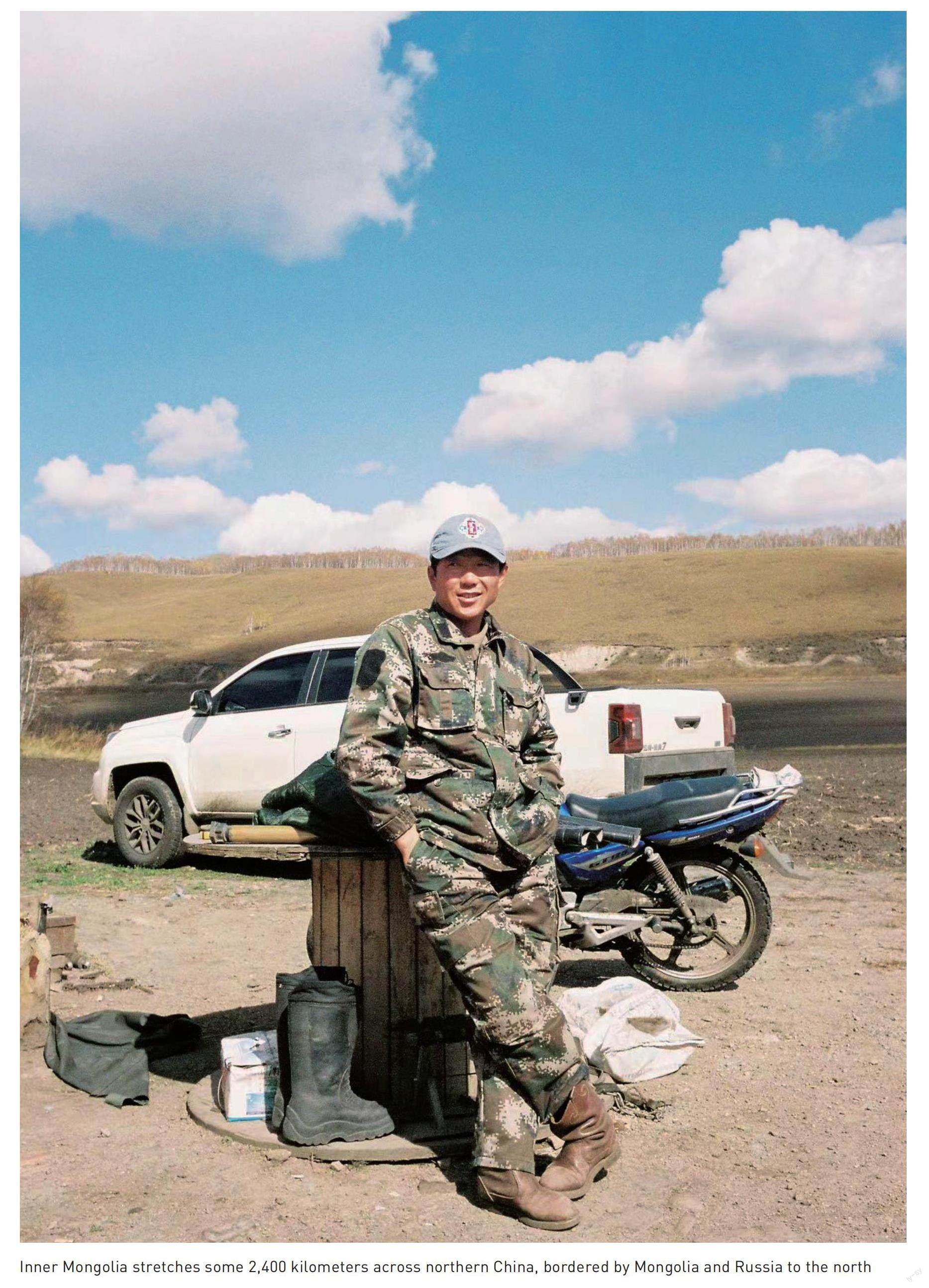
The chilly night of camping is still in my bones as the terrain surrounding us unfolds like an autumn tapestry under the morning sun. In the valley, we spot a single brick house surrounded by cows, with smoke rising from the chimney. We make our way down to investigate. A young man dressed in army fatigues leans on a wooden table outside, in front of a muddy motorbike he had been riding to herd his cattle. The cows cant stand the approaching winter and will be put into barns soon, he tells us.
The sky is bright blue, dotted with puffy clouds casting slow-moving shadows onto the rolling hills. We hike up the hills behind the farm. Were perhaps eight kilometers from Mongolia, but a thick forest at the top of these mountains obscures any view or path to the border.
Borderlands
We leave the man and his farm behind and drive along a valley—no sign of the steppe yet, though we are in Inner Mongolia by now. Along the way we see tourists, presumably city-dwellers like me, stopped by the side of the road to take photos with hay bales.
We drive along the border with the country of Mongolia—the most recent of a long list of changing demarcation lines in a region historically rife with geopolitical conflict. In the 13th century, the Mongol Empire, under Genghis Khan, united the tribes inhabiting the Mongolian grasslands, forging the largest contiguous land empire in history. In China, the Mongols founded the Yuan dynasty (1206 – 1368).
However, by the late 14th century, the Yuan had been overthrown by the Ming dynasty (1368 – 1644). The subsequent Manchu-led Qing dynasty (1616 – 1911), founded with support from Mongol armies, incorporated both todays Inner and Outer Mongolia. But as the Qing empire crumbled, Outer Mongolia, with Soviet support, declared independence in 1921. On street signs in this border region, we see both the Russian-influenced Cyrillic script of the Mongolian Republic and the traditional top-down Mongolian script used by Chinas ethnic Mongolians.
We arrive at Arxan, a county-level city not far from the Mongolian border, in the early afternoon. It looks like something outsiders are supposed to regard as local—an exotic backdrop for tourists to fill their social feeds with. The buildings resemble something in between an Alpine village and a rural Russian town. Other tourists drive around in electric tricycles, taking pictures of themselves in front of the motley architecture. “Id like to get out of here as soon as possible,” one of my friends says as we discuss whether to spend the night here.
Stocked up for another night of camping, we find ourselves back on the road, a little disappointed by the fakeness of the tourist town—but then I reflect that authenticity is an illusion, and my perception of it probably gives away more about me (my city roots, my desire for solace in nature, and my search for “real” Mongolian lifestyle) than the place itself. “There is no original moment,” anthropologist Robert Shepherd wrote in a 2002 paper on tourism and commodification, “There are no ethnic Others who have existed in a never-never land, segregated in both time and space.”
Walking in steppe
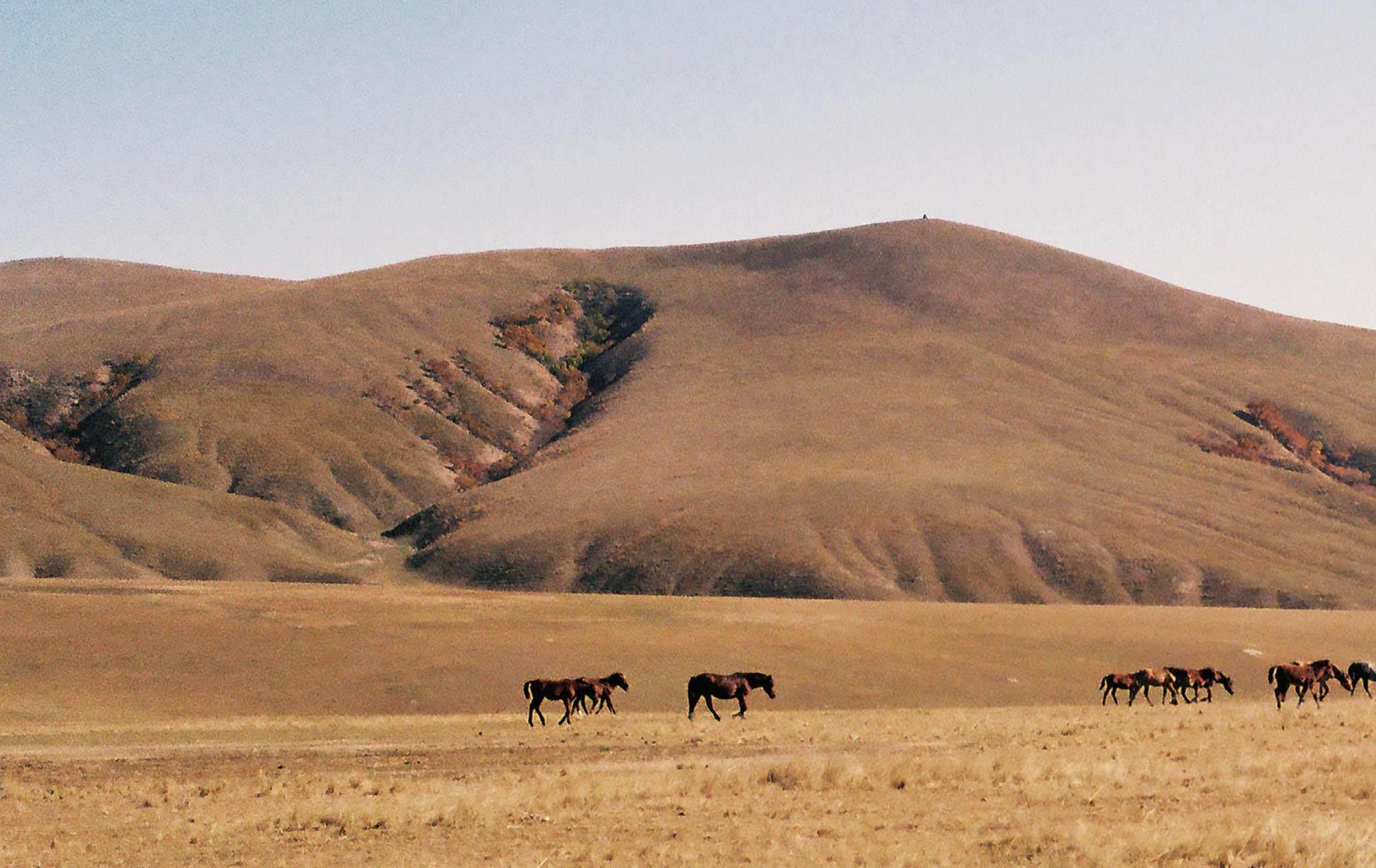
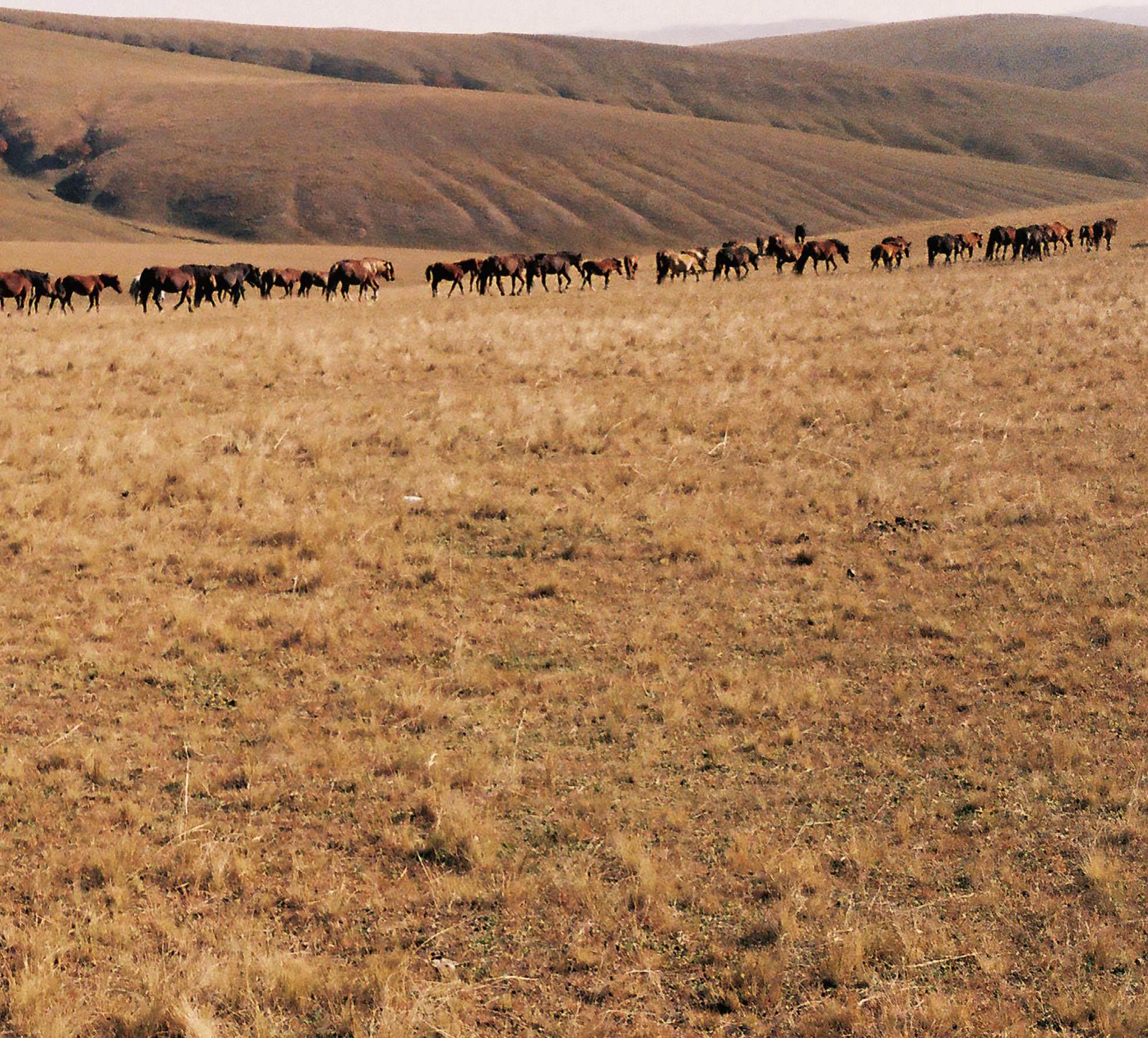
The vast steppe finally emerges before us as we leave Arxan. The horizon seems to stretch infinitely, interrupted only by yurts, livestock, and low-hanging clouds drifting over the prairie below. The region is Chinas largest grassland grazing area—88 million hectares, almost the same size as France and Germany combined.
Eventually, after what seems like an age on a straight road piercing through the flat earth, we arrive at Amugulang, a town of around 16,000 people. This is the “frontier town” I had been hoping for.
As we walk down the single main street at night, a man is taking pictures of a cow eating out of a trash can by the side of the road. I ask him if the cow is his. “My friend lost a cow. Im trying to find out if its this one,” he answers in Mandarin Chinese, before switching back to Mongolian to talk to his friend over the phone. The cow silently chews away at the garbage.
After a night in a local hotel, one of my friends arranges for us to meet Tuya, a friend who has been helping them learn Mongolian in Beijing, for breakfast. The 26-year-old was born in Amugulang, but left for Hohhot, the capital of the Inner Mongolia region, for high school in 2012. She hasnt lived in Amugulang permanently since then. Tuya recommends a place for an early filling of lamb and hot salty milk tea with cheese. “My mom cant go a day without drinking milk tea and chewing on some cheese slices,” Tuya says, referring to air-dried dairy products so hard they need to be soaked before eating.
Traditionally, there were no fences on Mongolian herding lands, says Tuya. The animals were individually owned, but the land was shared. That has changed recently. During the mid-20th century, large parts of the pastoral economy were managed through collectives, which were broken up in the 1980s with the introduction of market reforms.
In 1989, the regional government implemented a system that granted ownership, usage, and leasing rights of previously collective pastureland to individual households, leading to the construction of fences. Many herders now subdivide their plots and use rotational grazing.
Next to the restaurant where we had breakfast, we notice groups of elderly men and women playing cards. “They used to be nomads just like my family, but then the government provided them these apartments to live in,” Tuya explains, motioning to the concrete blocks behind them. They are part of official efforts to regenerate overgrazed grasslands by paying out herders and resettling them in urban areas. Some interest groups have argued that there are no suitable means of living for these herders after they move to settled homes—Tuya tells us that many of the former herders here spend their time drinking alcohol. Local governments in the region have promised to boost payouts and subsidies to herders affected by relocation and grazing restriction programs.
Life on horseback
Tuyas father Bayar, who has done stints in the Chinese military and now has a job with the local court, is a herder at heart—just like his father, who still oversees his 600 sheep every day.
“I cant remember the way,” frets Tuya, from the backseat of our rented car as we career over the endless, uniform steppe, looking for her grandfathers herding spot. We eventually come across the 74-year-old man in a traditional blue overcoat (adeelin Mongolian), with a bottle of milk tea stuffed into the front pocket and a battered radio hung from his shoulder by a loop of string. In the evening, he returns to his blue sheet-metal trailer a few hundred meters across the grassland.
His wife, Tuyas grandmother, lives a short drive across the steppe on another plot of land where the family keeps herds of cows and more sheep. Her yurt, orger—movable round tents traditionally used by nomadic peoples—sits next to government-built houses that the family uses exclusively for storage. They have an apartment in the town, but both Tuyas grandparents prefer the grassland.
Its only the beginning of October, but the nights are already close to freezing. In a month or so, it will be bitter, with snow blanketing the grass. “Sheep dont take days off,” Bayar says when we ask him about his work load. He, along with Tuyas grandparents, will be out every day herding on the steppe.
Bayar shows off his horse-riding skills. The rest of the family herds on motorbikes or on foot, but he rounds up livestock on horseback with a 10-foot wooden pole for catching stray animals. He swings rhythmically from side to side on the saddle as the horse accelerates into a gallop, wielding the stick as he goes, picking it off the ground without ever leaving the saddle.
Eating “red” and “white”
We dont know if that same pole was used to catch the sheep we later had for dinner. After the animal is slaughtered, its disassembled like a machine scrapped for its parts. The men kill the animal and take it apart, mostly using their bare hands and knives, while the women clean the meat and the intestines—still full of half-digested grass—in preparation for cooking. Tuyas grandmother fills the animals organs with its blood to make sausages.
Back in the yurt, the meat is boiled plain with salt and served with a paste made from fermented garlic chives. There is the ubiquitous milk tea, enriched with roasted grains, dried cheese, and more lamb. Tuya tells us Mongolian food comes in two varieties: red (meaning meat) and white (dairy). Its all well eat while were on the steppe.
“Do you like being out here more than the town?” we ask Bayar, who also has an apartment in Amugulang. He motions to the door, and the grassland beyond it—he prefers life on the farm.
Next to him, Tuyas 15-year-old cousin, also wearing herdeel, is busy on her phone. She goes to high school in the city of Hulunbuir, 170 kilometers away, and is home for the holiday. When shes not using her phone, she tucks it between the wooden frame and canvas roof of the yurt. The digital world of the Chinese internet is as much a reality to her as the vast steppe she is unlikely to return to after school.
This looming generational disconnect is more palpable the next day when we visit yet another plot of land belonging to Tuyas family. “My children both live and work in the city,” her uncle tells us over more milk tea and lamb, pointing at family pictures on the wall. Likewise, Tuya has never learned to care for livestock, and only knows the basics of horse riding. “No, I dont want her to return here,” Bayar had told us earlier when asked whether he wants Tuya, his only child, to move from Beijing to work on the family farm.
Were inside Tuyas uncles sheet-metal house that runs on wind and solar power. The hum of the wind propeller can be heard inside the room. A lot of families, it seems, while maintaining traditional yurts on their property, have moved into this kind of housing with more modern amenities—though water still comes from a nearby well.
The uncle and his wife are attending a traditional Mongolian wedding later that evening. There will be dozens of yurts set up around a main yurt, they explain to us, with the more distant relatives housed in the yurts farther away from the center.
As were getting ready to leave their house and hit the road again, I notice the uncle looking out the window. Perhaps he is pondering the sweeping landscape outside, the life it supports, the bond between people and nature that is threatened by changing lifestyles of future generations. Or perhaps hes just thinking about what to wear to the wedding as the sun is setting over the endless steppe.
猜你喜歡
風流一代·經典文摘(2018年1期)2018-02-22 09:00:43
黨的生活(黑龍江)(2017年12期)2017-12-23 17:01:20
求學·文科版(2017年10期)2017-12-21 11:55:48
求學·理科版(2017年10期)2017-12-19 13:42:05
民生周刊(2017年19期)2017-10-25 07:16:27
少年博覽·小學高年級(2016年12期)2017-01-16 12:48:35
特別文摘(2016年19期)2016-10-24 18:38:15
爆笑show(2016年3期)2016-06-17 18:33:39
37°女人(2016年5期)2016-05-06 19:44:06
爆笑show(2016年1期)2016-03-04 18:30:28