網(wǎng)漫時(shí)代,尋找原創(chuàng)力
2023-12-14 15:06:10劉玨
漢語(yǔ)世界(The World of Chinese) 2023年4期
關(guān)鍵詞:時(shí)代
劉玨

Over Drawn
Chinas booming online comics struggle to reproduce the magic of the 1990s
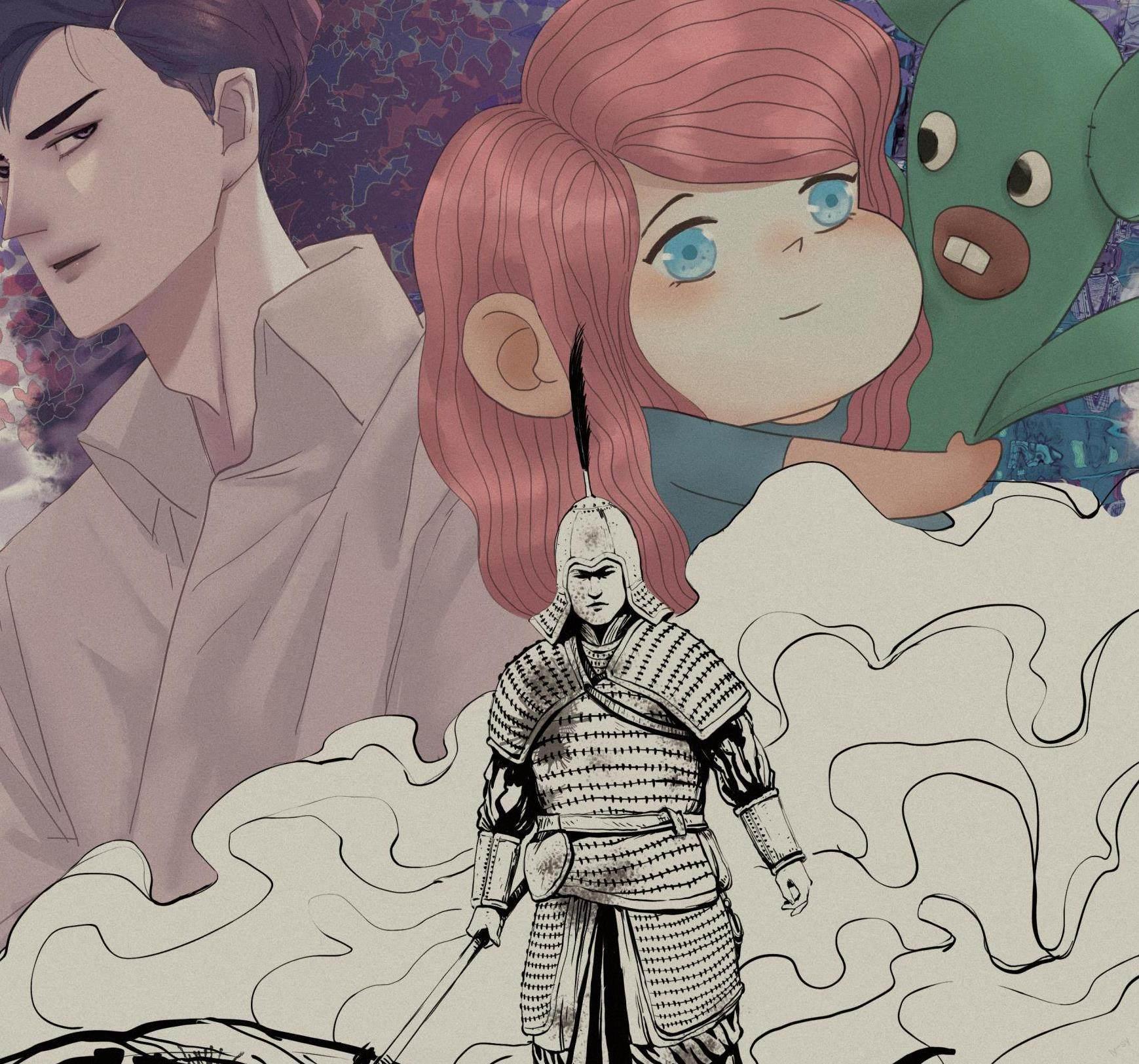
Illustration by Xi Dahe
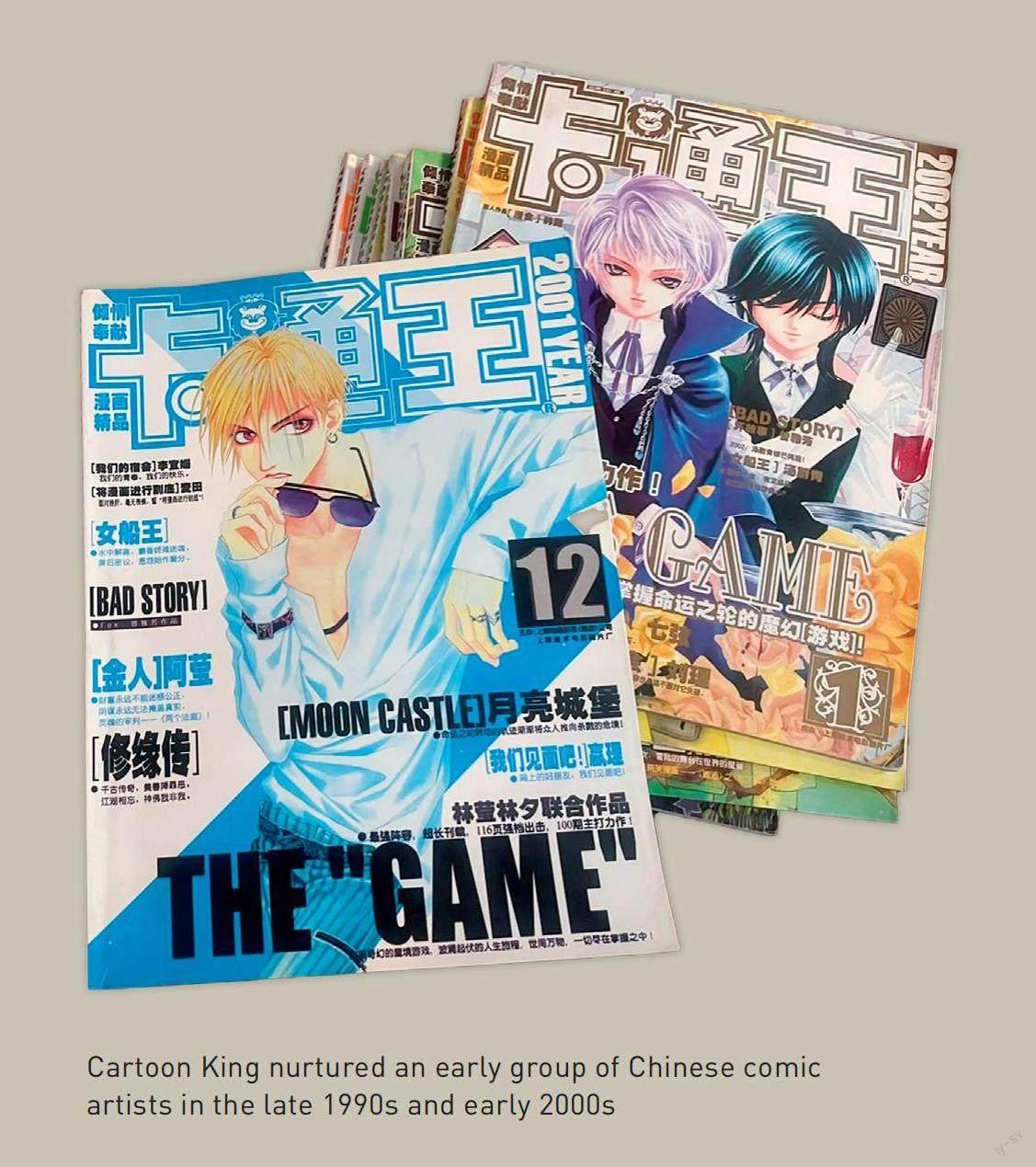
When I was in middle school 20-some years ago in a small town in Inner Mongolia, I was always excited for the beginning of each new month. Thats when Cartoon King would hit the shelves at my local post office in Ordos.
This comic magazine, with its technicolor cover and black-and-white stories inside, offered respite from the monotony of student life filled with homework and exams. My friends and I would eagerly dive into its fantasy stories based on Chinese history and legends, urban tales set in faraway Beijing or Shanghai, and sci-fi adventures from an imagined future. A few Japanese manga books, mostly pirated, also circulated on my school campus, but Cartoon Kings stories felt closer to my life.
Comics have a long history in China. Serial picture books emerged in the Qing dynasty (1616 – 1911) and comic strips became popular in the Republican Era (1912 – 1949). But these had mainly featured social commentary or targeted young children. “New comics”—graphical stories that featured three-dimensional drawings, animation-like multi-panel flow, and narratives for teenagers or adults—emerged in the 1990s. Cartoon King, published by the Shanghai Animation Film Studio, became one of the most popular comic magazines in the late 90s. It launched the careers of many of Chinas earliest comic artists and built a dedicated readership for this new art form.
But as my friends and I moved on to attend universities across the country in the early 2000s, our interest in comic magazines gave way to Korean TV dramas, travel, and the internet. By the end of 2008, Cartoon King announced that, after years of revenue losses, it was closing. Most of Chinas comic magazines met the same fate. From the 1990s to the 2010s, there were over 70 comic magazines in print, but only a handful survive today, mostly adapted for young children once again.
In their place, online comics have boomed through apps like Tencent Comic, Kuaikan, and Bilibili Comics. Kuaikan claimed in 2021 that it had more than 340 million registered users, with nearly 50 million monthly active users; 90 percent of them belong to Gen Z.
These platforms release hundreds of thousands of titles each year; some free, some available via subscription fees. Many of them are updated weekly or even bi-weekly. There is no more waiting for the next Cartoon King issue to arrive at the post office.
But most of todays content lacks the charm and originality of earlier comics.Only Love, one of the most popular romance comics on Kuaikan with over 2.6 million “l(fā)ikes,” features a young woman who dies in an accident but is reborn to deal with her enemies and love interests from her previous life. Another story,Sijin, has over 1 million “l(fā)ikes” and also features a female protagonist reborn to correct the wrongs of her past life, though this time set in ancient China. Countless stories follow the same tired patterns. Character-building is minimal, plots lack nuance, and the story proceeds to a predictable happy ending.
Many creators and independent publishers are suffering under the weight of the giant online platforms. By monopolizing comic publishing, these apps effectively control the content. They demand mass production at speed, with little space for imagination.
“The whole process became quite industrialized…over the past decade,” Wang Yang, editor-in-chief of Animation Babblers, a media outlet focused on Chinas animation and creative sectors, tells me. “Some [studios] were phased out, but what remained must be profitable.” Wang explains that these days a studio of several people generally churns out content rather than a single creator producing their own work, as with novels.
Many comic artists join such studios when they first enter the industry. “If you are willing to work on adaptions, and you work fast and are responsive to feedback…you can make a stable income,” says Wang. Platforms typically pay 200 to 300 yuan per published page, so a weekly series with 15 pages each issue would bring in 12,000 to 18,000 yuan per month for the creators.
To achieve this, artists dont only sacrifice creativity. Constantly updating and maintaining popularity can be demanding, even fatal. In 2019, Huishou Eryi, a 27-year-old female comic artist, died of sudden cardiac arrest after working 48 hours consecutively. She ran a top-ranking comic series which had over 200 million reads on Tencent Comic. One of Huishou Eryis friends later told news outlet The Paper that she had complained about the long hours, running out of inspiration, and frequent revisions to satisfy her fans.
Even established creators struggle. Uncle Booyoung, an artist who wishes to go by his pen name, has been creating original comics for over 20 years. His mystery seriesMisgivings of Bizarre Wateronce earned over 300 million online views in a single week and has become a TV animation series. But now, “I havent published original work with any online platforms for over two years,” he tells me. “There are just too many constraints with them.”
Editors asked him to change storylines and to take out violent or horror scenes, though he feels theyre essential to the visual impact of his stories. Nowadays, Uncle Booyoung posts updates to his series on microblogging platform Weibo for fans to enjoy for free. But he no longer makes enough money from his comics to commit to them full-time, and spends his days freelancing on various design projects.
Online comic platforms have faced issues with regulators for violent and obscene content. Starting in 2015, the Ministry of Culture (now the Ministry of Culture and Tourism) has been releasing blacklists of comic and animation works that they deem detrimental to minors and social morality. That year, the Ministry fined 29 online comic companies and shut down eight comic sites for publishing “harmful content” or operating without a publishing license.
Shantong, a scriptwriter and comic editor of over 10 years who asked to go by her pen name, has noticed a decline in online platforms that accept original work. Her studio used to run several comic series on online platforms, but now publishes none. Shantong worked as an editor with a print comic magazine until 2014, when she decided to start her own studio to produce works for digital platforms. “Certain kinds of content will always be more popular among general readers,” she tells me. “The internet expanded readership for comics and amplified this tendency [toward mediocrity].”
Like Shantongs studio, many of Chinas current leading comic apps were founded between 2012 and 2015 when venture capital flooded the industry. Stimulated by the success of animation films likeMonkey King: Hero Is Back (2015) andOne Hundred Thousand Bad Jokes(2014), investors saw potential in Chinese comics.Bad Jokeswas adapted from a comic series published on Youyaoqi, one of Chinas earliest online comic platforms, and made over 1 billion yuan at the box office.
Creators enjoyed a brief flourishing period: money poured into the industry, platforms competed to sign artists and original works, and experimentation attracted publishers. It nurtured a new group of original comic artists and their distinctive works.
Xu XianzhesBlades of the Guardians, an ongoing historical action comic series first published in 2015 online, remains revered by fans. Set in the Sui dynasty (581 – 618), the story follows the adventures of fictional martial artist Dao Ma and his child travel companion. Fans attribute its charm to the works intriguing narratives, well-rounded characters, and rugged yet detailed art style. It has been adapted into an award-winning animation series and published in Japan and Switzerland.
However, from the late 2010s, when investment declined and competition increased, several comic platforms disappeared. Youyaoqi, previously known for its thriving original content, was bought by Bilibili Comics in 2021 and merged its content with them in 2022. Surviving platforms quickly learned the formula for capturing the most readers with the least risky content.
Wang Yang suggests Chinas comic industry hinges on its fast-changing media landscape. “Our golden period for print media only lasted for about 25 years from the late 1980s to 2010,” he tells me. “Unlike Japan or the US, which have stronger traditional publishing industries, [paper] comics never had the chance to enter mainstream Chinese reading habits.”
Some comic artists, therefore, find more publishing opportunities abroad. Papayep, an independent comic magazine based in Paris and run by artists Shang Zhang and Chenghua Yang, collaborated with OWSpace, a Chinese bookstore chain, to createCountryside, a collection of comic stories by Chinese and French creators, in May 2023. The anthology, published in China, featured varied art styles and perspectives. Many artists told stories of their hometowns—often villages and small towns confronting modernization.
Notable Chinese comic artist Zuo Ma, who secured his first publishing deal in France in 2007, produced “The Bridge of Happiness” for the anthology, depicting a family trip back to his rural hometown. His workNight Bus, published in Italy in 2017, then France, the US, and finally China, follows a young womans fantastical trip to her hometown.
In the 90s, Zuos work would probably have gone straight into a paper comic magazine. Occasionally, I still read the Cartoon King issues stacked under my old bed in my parents apartment, and ponder the unfinished stories. Despite Chinas booming online comics, most of them struggle to recreate the magic of Cartoon King.
But in this era of fast-food entertainment, original stories are crucial for us to remember the past, reflect on the present, and envision the future. Just as Cartoon King helped me do when I was a child.
Cartoon King nurtured an early group of Chinese comic artists in the late 1990s and early 2000s
Young comic artists often work for studios like this one in Haikou, Hainan province (VCG)
猜你喜歡
小哥白尼(軍事科學(xué))(2022年7期)2022-09-20 03:51:30
嶺南音樂(2022年4期)2022-09-15 14:03:12
陽(yáng)光(2020年6期)2020-06-01 07:48:36
陽(yáng)光(2020年5期)2020-05-06 13:29:18
人大建設(shè)(2019年11期)2019-05-21 02:54:48
電影(2018年9期)2018-10-10 07:18:38
金橋(2018年4期)2018-09-26 02:24:44
足球周刊(2016年14期)2016-11-02 10:56:23
足球周刊(2016年15期)2016-11-02 10:55:36
足球周刊(2016年10期)2016-10-08 10:54:55