大興安嶺東坡中北段六九山斑巖銅成礦系統淺成巖成因與地球動力學背景
2024-01-01 00:00:00徐鑫劉陽張勇褚小磊徐智愷孫景貴劉晨
吉林大學學報(地球科學版) 2024年5期
關鍵詞:成礦

摘要:
六九山銅礦床產在大興安嶺地區東坡中北段,位于中亞造山帶東端。
為了探討該區淺成巖成因與地球動力學背景,
對六九山斑巖銅成礦系統內與成礦密切的閃長玢巖、二長斑巖兩類淺成巖進行了地質、巖相學、鋯石UPb同位素定年和元素地球化學等方面的研究。結果表明:閃長玢巖和二長斑巖內巖漿鋯石加權平均年齡分別為(132.6±2.6)Ma(n=5)和(132.4±1.3)Ma(n=22),巖漿就位發生在約132 Ma,結合輝鉬礦ReOs同位素年齡((134.1±0.8)Ma),限定成礦作用發生在早白堊世;閃長玢巖(w(SiO2)為52.98%~59.83%)和二長斑巖(w(SiO2)為66.90%~67.56%)為典型的中—酸性淺成斑巖,富集大離子親石元素,虧損高場強元素,分別為典型島弧鈣堿性巖和埃達克質巖石;巖漿起源于與大洋板塊俯沖有關的以流體交代為主的富集地幔部分熔融;成巖成礦作用適值中生代早白堊世庫拉板塊向歐亞板塊俯沖的大陸邊緣巖漿弧背景。
關鍵詞:
成巖時代;元素地球化學;斑巖銅成礦系統;巖石成因;地球動力學;六九山銅礦床;大興安嶺
doi:10.13278/j.cnki.jjuese.20230245
中圖分類號:P595;P581
文獻標志碼:A
徐鑫,劉陽,張勇,等.大興安嶺東坡中北段六九山斑巖銅成礦系統淺成巖成因與地球動力學背景.吉林大學學報(地球科學版),2024,54(5):15581574. doi:10.13278/j.cnki.jjuese.20230245.
Xu Xin, Liu Yang, Zhang Yong,et al. Genesis and Geodynamic Setting of Hypabyssal Intrusive Rocks in the" Liujiushan Porphyry Cu Ore System, Eastern Edge of the Northern Great Hinggan Range. Journal of Jilin University (Earth Science Edition), 2024,54(5):15581574. doi:10.13278/j.cnki.jjuese.20230245.
收稿日期:20231005
作者簡介:徐鑫(1989—),男,碩士研究生,主要從事礦床學方面的研究,E-mail:275046224@qq.com
通信作者:張勇 (1982—),男,研究員,主要從事礦床地球化學方面的研究,E-mail:yongzhangcc@163.com
基金項目:國家自然科學基金項目(42072085,41172072,40772052,40472050,41390444);中國地質調查局項目([2023]022306);國家重點研發計劃項目(2017YFC0601306)
Supported by the National Natural Science Foundation of China (42072085, 41172072, 40772052, 40472050, 41390444),the Project of China Geological Survey ([2023]022306) and the National Key Research and Development Program of China (2017YFC0601306)
Genesis and Geodynamic Setting of Hypabyssal Intrusive Rocks in the Liujiushan Porphyry Cu Ore System, Eastern Edge of the Northern Great Hinggan Range
Xu Xin1, Liu Yang1, Zhang Yong2, Chu Xiaolei1, Xu Zhikai1, Sun Jinggui1, Liu Chen3
1. College of Earth Sciences, Jilin University, Changchun 130061, China
2. Institute of Mineral Resources,Chinese Academy of Geological Sciences,Beijing 100037, China
3." Party Committee Organization Department, Changchun Institute of Technology, Changchun 130012, China
Abstract:
The Liujiushan Cu deposit is located in the eastern end of the northern Great Hinggan Range, part of the easternmost edge of Central Asian orogenic belt. This study presents detailed field geology, petrography, elemental geochemistry and geochronology of diorite porphyry and monzonite porphyry to reveal the petrogenesis and geodynamic setting of these intrusive rocks. Magmatic zircons from diorite porphyry and monzonite porphyry yielded a weighted average age of (132.6±2.6) Ma (n=5) and (132.4±1.3) Ma (n=22), respectively. The LAICPMS zircon UPb ages show these intrusive rocks were emplaced at ~132 Ma, consistenting with the molybdenite ReOs isotopic dating of (134.1±0.8) Ma, which constrains Cu mineralization to the Early Cretaceous. The diorite porphyry (52.98%59.83% w(SiO2)) and monzonite porphyry (66.90%67.56% w(SiO2)) are classified as intermediate to acidic hypabyssal intrusive rocks, enriched in the large ion lithophilic elements and deleted in high field strength elements, representing island arc alkaline and of adakitic rock types, respectively. Their parental magmas originated from an enriched mantle. All these studies show that the diagenesis and mineralization resulted from subduction of the Kula slab beneath Eurasian continent.
Key words:
diagenesis age; elemental geochemistry; porphyry Cu ore system;petrogenesis; geodynamic; Liujiushan Cu deposit; Great Hinggan Range
0" 引言
銅廣泛應用于建筑、電器、電子工業、機械制造、運輸設備和日用消費等領域,銅礦是有色金屬礦產資源的重要組成之一,是我國目前對外依存度較高的礦產[1]。六九山銅礦床是近年來在大興安嶺東坡中北段勘探出的中型銅礦床,其工業類型為爆破角礫巖型銅礦床[1]。礦床成因類型起初認為是斑巖型銅礦床[2],后期認為是淺成熱液高硫化型銅礦床[34];成礦時代初步認為發生在晚侏羅世—早白堊世[5]。對該銅礦床的礦床地質研究表明閃長玢巖巖脈和二長斑巖巖脈/巖株侵位于古生代花崗閃長巖巖基之內,銅礦化主要產于二長斑巖巖株之上的熱液角礫巖體內;鉆孔揭露表明二長斑巖巖株內發育明顯的鉀化蝕變,可見少量黃銅礦化和輝鉬礦化。以上侵位關系和礦化蝕變特征表明,斑巖侵入體與銅礦化具有明顯的時空和成因聯系。基于此,本文對礦區內閃長玢巖、二長斑巖進行了UPb同位素定年和元素地球化學分析,以期確定六九山銅礦床成礦作用發生的時限,為深入揭示大興安嶺地區深部巖漿動力學過程對區域大規模銅成礦作用的制約提供數據支撐。
1" 成礦地質背景與礦區地質
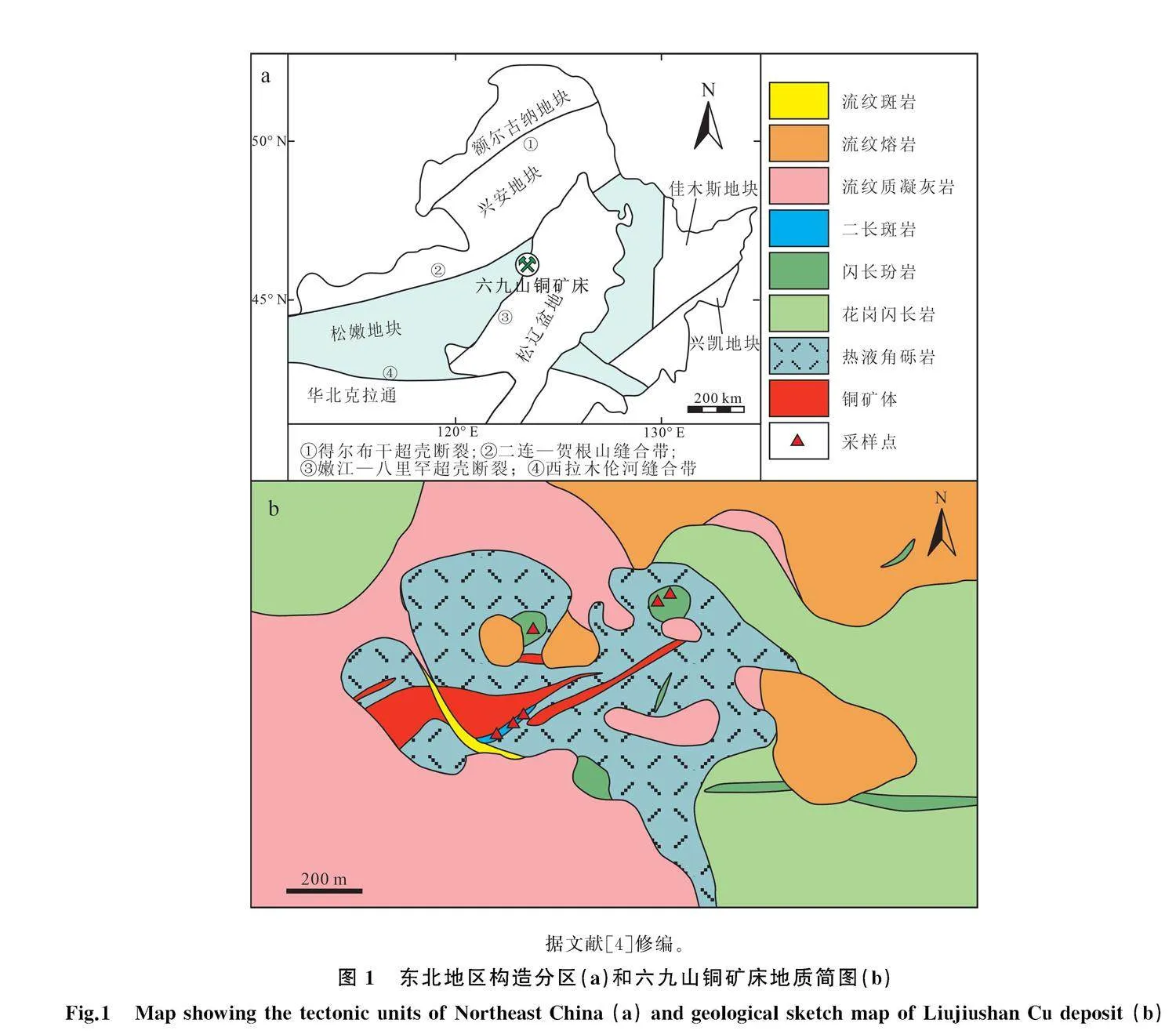
六九山銅礦床產在黑龍江省龍江縣六九村北,地處大興安嶺隆起帶與松遼盆地交界帶嫩江—八里罕深斷裂的西側(圖1a)。區域出露的地層主要有上古生界二疊系下統高家窩棚組、中生界龍江組和光華組,發育華力西晚期花崗閃長巖、黑云母花崗巖、堿性花崗巖和燕山晚期閃長玢巖、花崗閃長巖、花崗斑巖、二長斑巖、正長斑巖和石英斑巖等。區域構造主要是罕達罕河、寶泉子—西六九、樂業—茶壺嘴東山斷裂和二龍山褶皺等[24]。礦床地質研究表明,礦區內出露的地質體主要是中生界光華組流紋熔巖和華力西晚期花崗閃長巖、燕山期閃長玢巖和二長斑巖等;構造以北東向和北西向斷裂發育為特征,兩者聯合控制著該區火山機構分布,六九山礦床發育在東南側火山口的一側[4]。閃長玢巖和二長斑巖巖脈就位于同一構造體系,遭受了不同程度的熱液蝕變;前者普遍發生青磐巖化和絹云母化,而后者受鉀化和絹云母化蝕變影響,兩種蝕變類型均發育在頂部高級泥化帶之下;該礦區內銅成礦作用普遍發生在絹云母化帶中,表明與成礦密切相關的巖漿熱事件是閃長玢巖和二長斑巖。光華組流紋熔巖形成于成礦期后,不整合覆蓋于礦體之上(圖1b)。礦體為超淺成盲礦體,含銅硫化物沉淀在蝕變角礫巖裂隙和隱爆角礫之間[4]。
2" 樣品和實驗方法
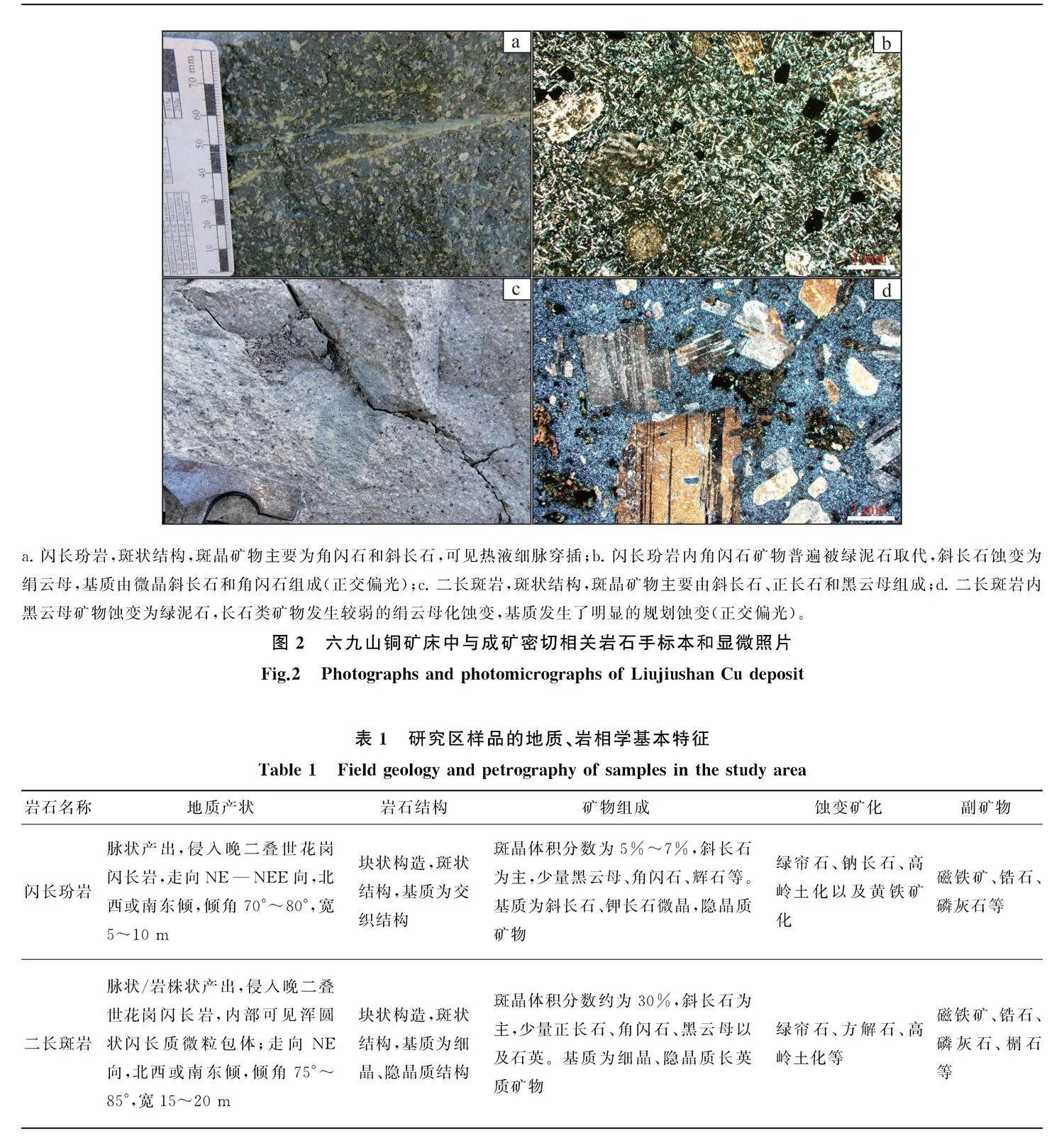
實驗樣品采自礦區露天采場的脈狀閃長玢巖和二長斑巖,采樣位置見圖1b;巖相學特征詳見圖2和表1。鋯石UPb定年和全巖元素分析實驗方法如下。
2.1" 鋯石UPb同位素定年
鋯石分離在河北省區域地質調查所實驗室完成,UPb同位素定年在吉林大學地球科學學院實驗中心完成。測試在顯微鏡和CL圖像觀察基礎上進行,儀器為美國Coherent公司的Com Pex 102 Excimer Laser,ICPMS為 Agilent 公司生產的Agilent 7500a激光剝蝕系統。測試采用國際標準鋯石91500作為外標標準物質;數據處理采用GLITTER程序,鋯石諧和圖譜和加權平均年齡計算采用Isoplot程序。LAICPMS分析的詳細方法和流程見文獻[5]。
2.2" 全巖元素分析
全巖地球化學數據(主量元素和微量元素)測試實驗在北京核工業分析測試中心完成。主量元素采用X熒光光譜(XRF)玻璃熔片法分析,這種方法能夠分析80多種元素,其檢測的質量分數范圍可以從10-2變化到10-6,分析精度優于±1%。微量和稀土元素分析采用電感耦合等離子體質譜法(ICPMS)進行,采用 BHVO1、AVG1和G2等國際標準物質進行質量監控,并作空白樣進行質量監控,分析精度優于±2%。具體測試方法和流程詳見文獻[6]。
3" 實驗結果
3.1" 鋯石UPb同位素定年結果
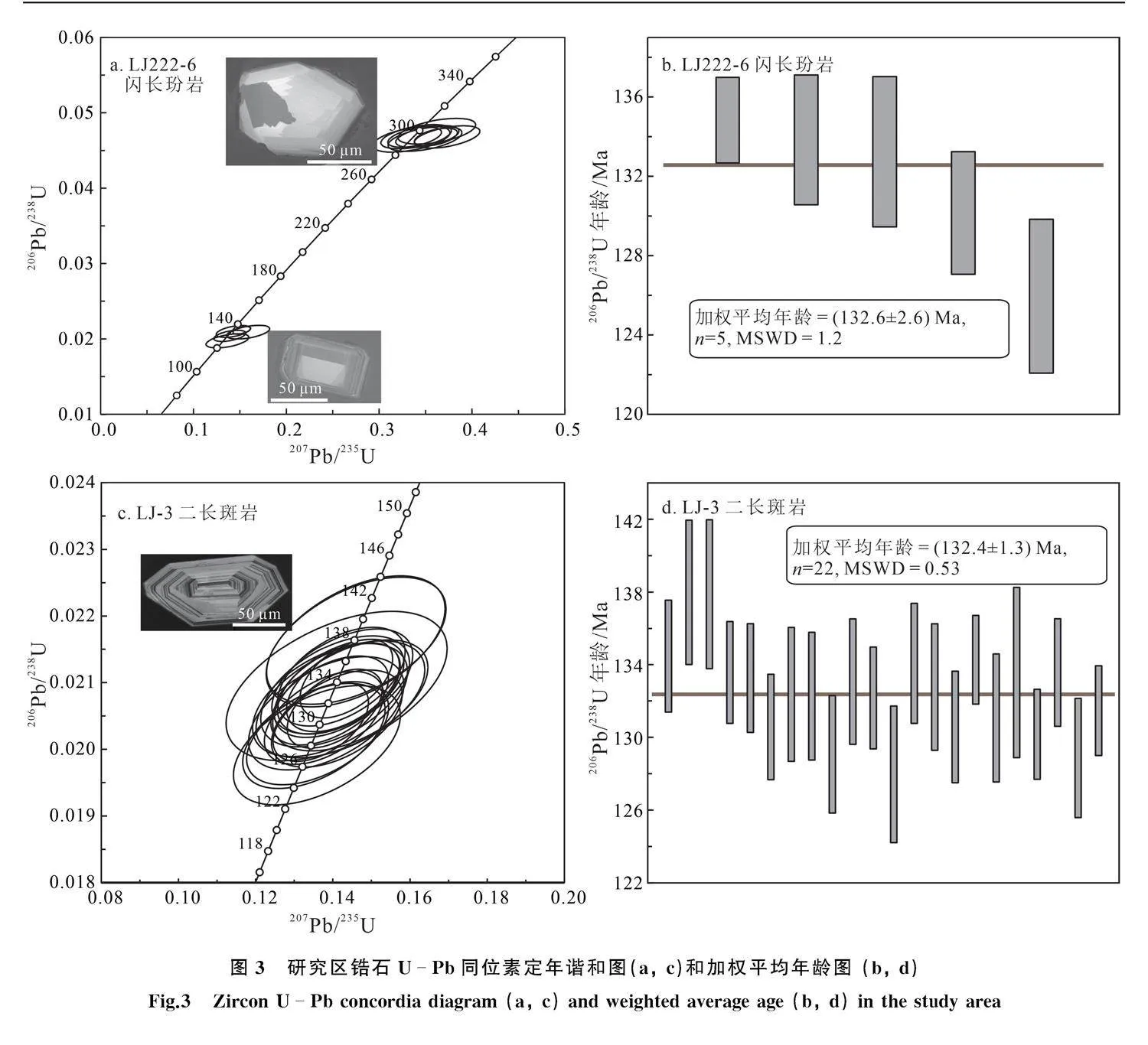
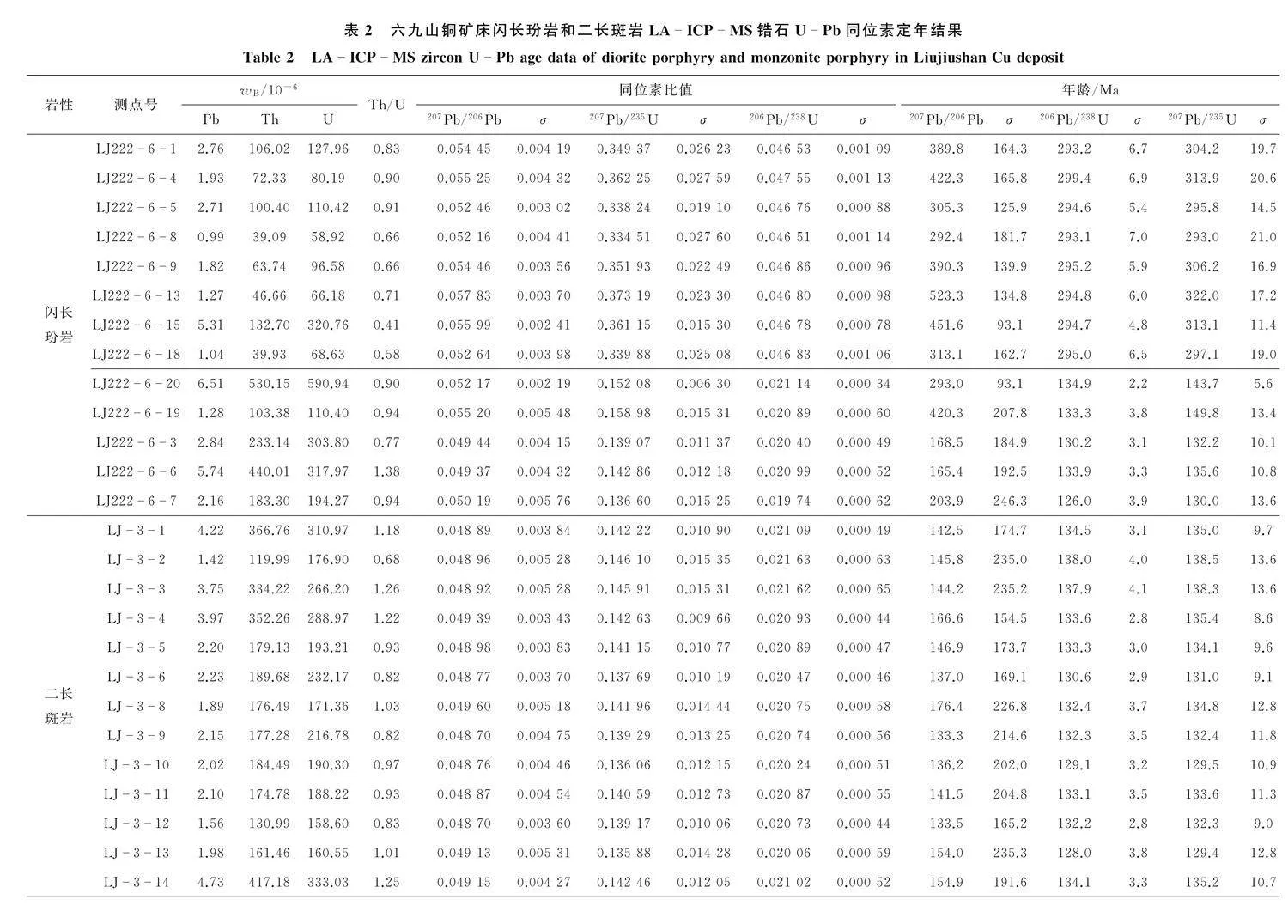
閃長玢巖(LJ2226)鋯石UPb同位素定年結果見表2。鋯石按年齡可分為2組:第1組鋯石呈短柱錐狀,內部寬帶結構為主,有環帶結構(圖3a),局部被熔化的特征顯示可能為捕獲鋯石;大小為50 μm×60 μm~80 μm×100 μm,長寬比為1∶1~1.5∶1,w(Th)為39.09×10⁻⁶~132.70×10⁻⁶,w(U)為58.92×10⁻⁶~320.76×10⁻⁶,Th/U值為0.41~0.91,整體呈現巖漿鋯石屬性[7];獲得加權平均年齡為(294.9±4.2)Ma(n=8,MSWD = 0.08,表2)。鑒于這組鋯石與前人所定絹英巖的鋯石UPb定年一致[7],其年齡應為賦礦圍巖晚古生代花崗閃長巖就位年齡,應為捕獲鋯石。第2組鋯石特征自形板狀,環帶結構發育(圖3a),大小為40 μm×50 μm~50 μm×100 μm,長寬比為1∶1~2∶1,w(Th)為103.38×10⁻⁶~530.15×10⁻⁶,w(U)為110.40×10⁻⁶~590.94×10⁻⁶,Th/U值為0.77~1.38;獲得鋯石的206Pb/238U同位素年齡為134.9~126.0 Ma(表2、圖3b),加權平均年齡為(132.6±2.6)Ma(n=5,MSWD = 1.2,圖3b),進而厘定閃長玢巖巖漿就位發生在中生代早白堊世。
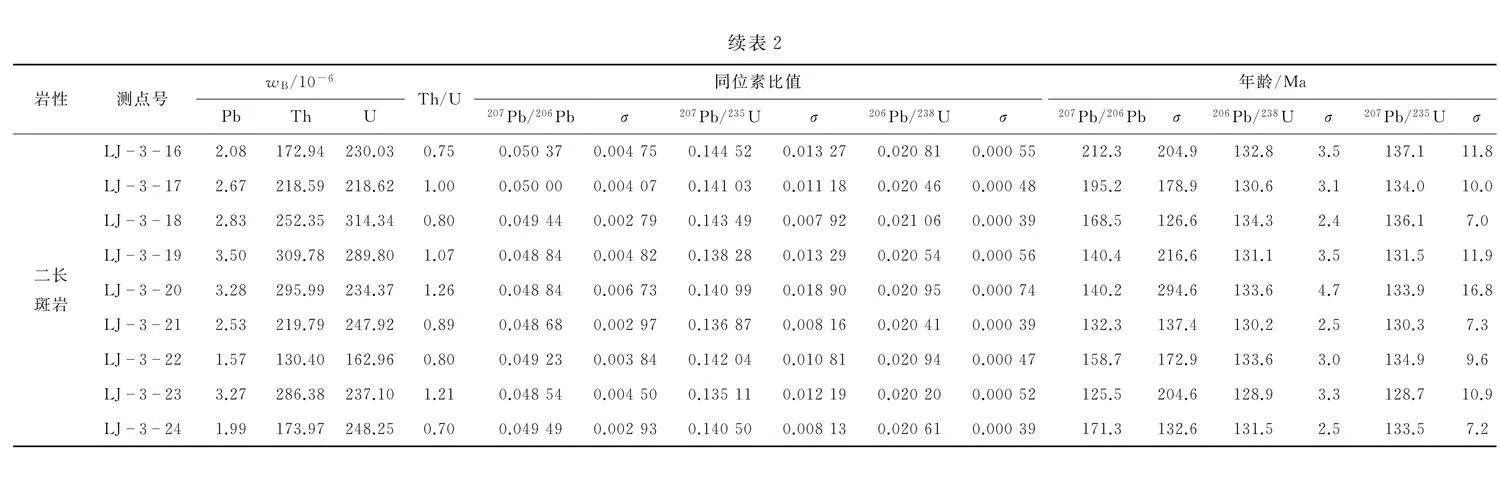
二長斑巖(LJ3)鋯石CL圖像顯示,其晶形多呈短柱錐狀,少數呈長柱錐狀,大小介于50 μm×50 μm~70 μm×120 μm之間,長寬比為1∶1~3∶1(圖3c),內部發育韻律環帶,w(Th)為119.99×10⁻⁶~417.18×10⁻⁶,w(U)為158.60×10⁻⁶~333.03×10⁻⁶,Th/U值為0.68~1.26,為淺成巖漿就位結晶的產物[8]。22粒鋯石UPb同位素定年
結果見表2,獲得206Pb/238U年齡在138.0~128.0 Ma之間(圖3c),加權平均年齡為(132.4 ± 1.3)Ma(n=22,MSWD = 0.53;圖3d),進而厘定二長斑巖巖漿就位發生在中生代早白堊世。
3.2" 元素地球化學特征
3.2.1" 閃長玢巖
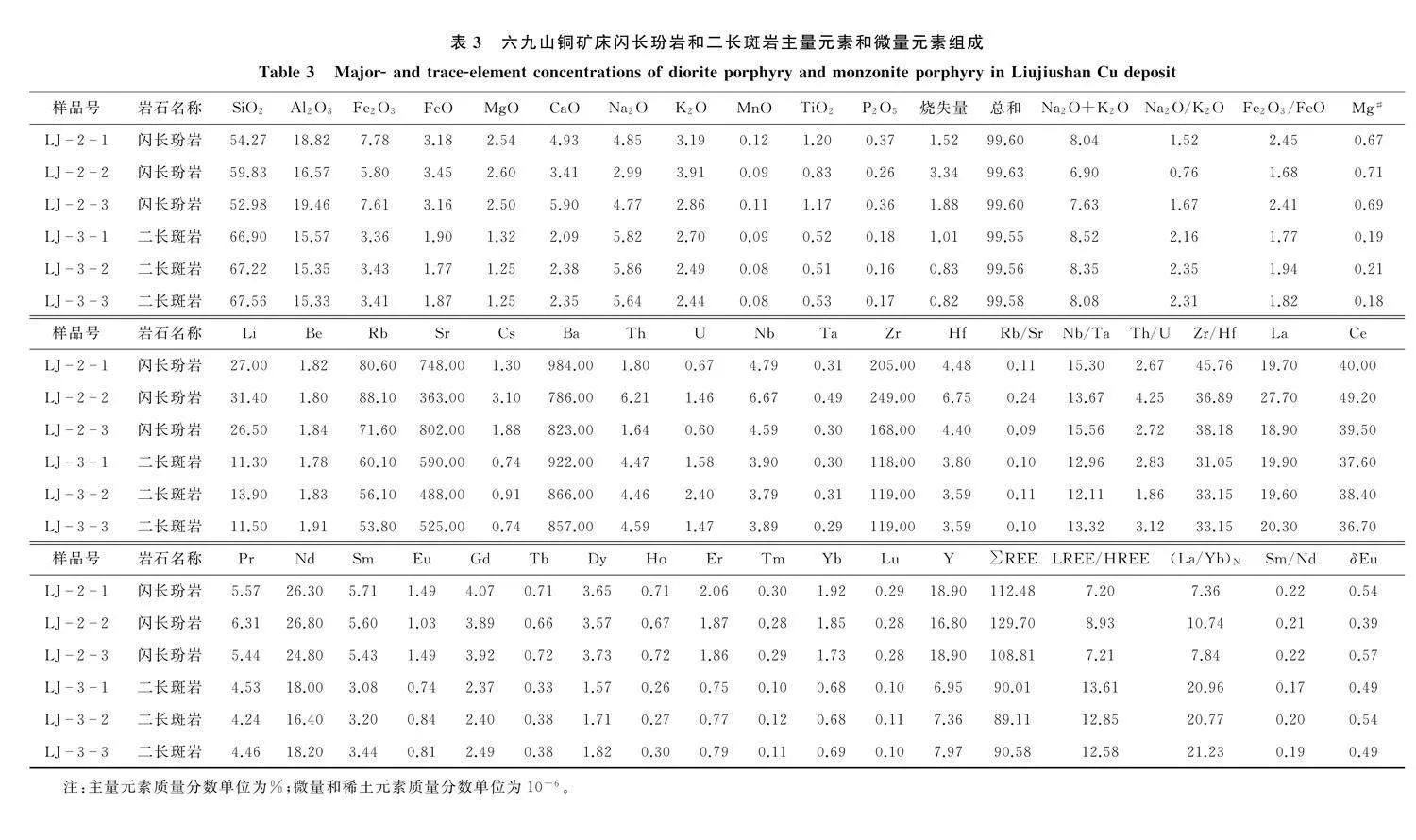
元素地球化學測試結果見表3。由表3可知,閃長玢巖的w(SiO2)為52.98%~59.83%,w(Al2O3)為16.57%~19.46%,w(Fe2O3)為5.80%~7.78%,w(FeO)為3.16%~3.45%,w(MgO)為2.50%~2.60%,w(CaO)為3.41%~5.90%,w(K2O)為2.86%~3.91%,w(Na2O)為2.99%~4.85%,w(TiO2)為0.83%~1.20%,w(P2O5)為0.26%~0.37%,w(Na2O+K2O)為6.90%~8.04%,Na2O/K2O值為0.76~1.67,鎂指數(Mg#=w(MgO)/40/(w(MgO)/40+0.8998w(TFe2O3)/72))為0.67~0.71;表明巖石整體屬于中基性巖漿巖特征。在TAS分類圖解(圖4a)上成分點落在二長閃長巖區域和二長巖區域,在w(K2O)w(SiO2)巖石系列分類圖解(圖4b)上樣品成分點落在鉀玄巖系列區域。這種特征表明其為堿質、中基性鉀玄巖系列巖漿。
在微量和稀土元素方面,閃長玢巖明顯富集大離子親石元素(LILE),w(Li)為26.50×10⁻⁶~31.40×10⁻⁶,w(Cs)為1.30×10⁻⁶~3.10×10⁻⁶,w(Ba)為786.00×10⁻⁶~984.00×10⁻⁶,w(Rb)為71.60×10⁻⁶~88.10×10⁻⁶;相對虧損高場強元素(HFSE),w(Th)為1.64×10⁻⁶~6.21×10⁻⁶,w(U)為0.60×10⁻⁶~1.46×10⁻⁶,w(Nb)為4.59×
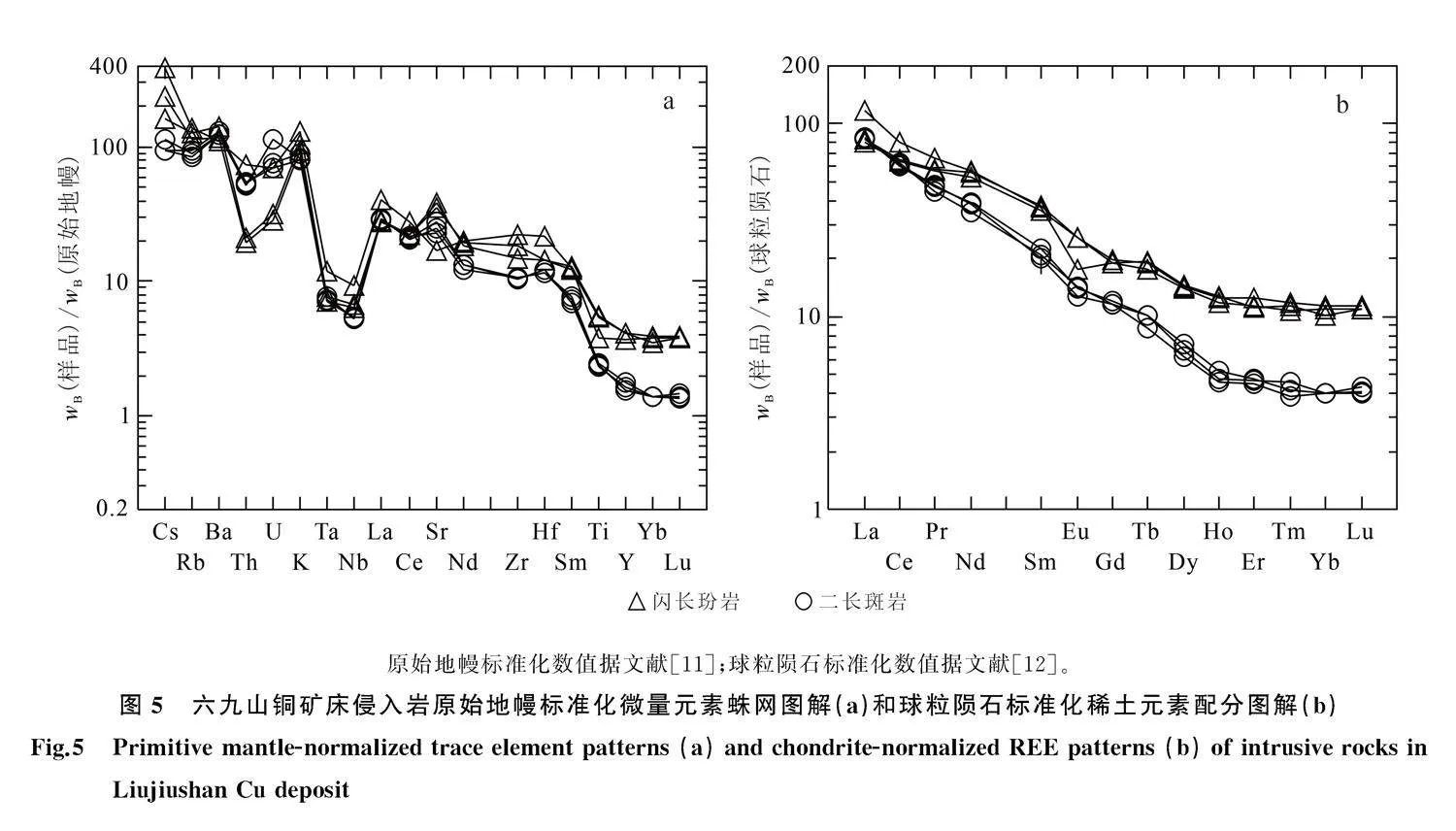
10-6~6.67×10⁻⁶,w(Ta)為0.30×10⁻⁶~0.49×10⁻⁶,w(Zr)為168.00×10⁻⁶~249.00×10⁻⁶,w(Hf)為4.40×10⁻⁶~6.75×10⁻⁶,w(Y)為16.80×10⁻⁶~18.90×10⁻⁶;w(∑REE)為108.81×10⁻⁶~129.70×10⁻⁶,LREE/HREE值為7.20~8.93,(La/Yb)N為7.36~10.74,Sm/Nd值為0.21~0.22,δEu為0.39~0.57。在原始地幔標準化圖譜(圖5a)上,
呈現明顯富集大離子親石元素(Cs、Rb、Ba、K等),相對虧損高場強元素Th、U、Nb、Ta等特征;在稀土元素的球粒隕石標準化圖解(圖5b)上,呈現中等分餾右傾斜、Eu異常不明顯或弱的負異常特征。以上特征表明該類巖石具有典型島弧巖漿的地球化學特征[1314]。Nb和Ta元素的虧損暗示巖漿來源于地殼或受到地殼物質的強烈混染,具有與板塊俯沖作用有關的島弧、大陸邊緣巖漿弧的巖漿屬性[1516];弱的Eu異常特征反映巖漿演化過程中斜長石分離結晶或源區殘留較少。
3.2.2" 二長斑巖
從表3可知,二長斑巖的w(SiO2)為66.90%~67.56%,w(Al2O3)為15.33%~15.57%,w(Fe2O3)為3.36%~3.43%,w(FeO)為1.77%~1.90%,w(MgO)為1.25%~1.32%,w(CaO)為2.09%~2.38%,w(K2O)為2.44%~2.70%,w(Na2O)為5.64%~5.86%,w(TiO2)為0.51%~0.53%,w(P2O5)為0.16%~0.18%,w(K2O+Na2O)為8.08%~8.52%, Na2O/K2O值為2.16~2.35,Mg#為0.18~0.21;表明其屬于中酸性巖漿巖范疇。在TAS圖解(圖4a)上,成分點均落在石英二長巖區域,在w(K2O)w(SiO2)巖石系列分類圖解(圖4b)上,成分點落在高鉀鈣堿性系列與鈣堿性巖系列分界線區域;較高的Na2O/K2O值指示其為堿性、鈉質中酸性、高鉀鈣堿性巖系與鈣堿性巖系過渡巖系。
在微量元素方面,其富集大離子親石元素(LILE),w(Li)為11.30×10⁻⁶~13.90×10⁻⁶,w(Cs)為0.74×10⁻⁶~0.91×10⁻⁶,w(Ba)為857.00×10⁻⁶~922.00×10⁻⁶,w(Rb)為53.80×10⁻⁶~60.10×10⁻⁶;相對虧損高場強元素(HFSE),w(Th)為4.46×10⁻⁶~4.59×10⁻⁶,w(U)為1.47×10⁻⁶~2.40×10⁻⁶,w(Nb)為3.79×10⁻⁶~3.90×10⁻⁶,w(Ta)為0.29×10⁻⁶~0.31×10⁻⁶,w(Zr)為118.00×10⁻⁶~119.00×10⁻⁶,w(Hf)為3.59×
10-6~3.80×10⁻⁶,w(Y)為6.95×10⁻⁶~7.97×10⁻⁶;稀土元素w(∑REE)為89.11×10⁻⁶~90.58×
原始地幔標準化數值據文獻[11];球粒隕石標準化數值據文獻[12]。
10-6,LREE/HREE值為12.58~13.61,(La/Yb)N為20.77~21.23,Sm/Nd值為0.17~0.20,δEu為0.49~0.54。在原始地幔標準化圖譜(圖5a)上,呈現明顯富集大離子親石元素(Cs、Rb、Ba、K等),明顯虧損高場強元素Nb、Ta和相對虧損Th、Ti、Y、Yb、Lu等高場強元素特征;在球粒隕石標準化圖解(圖5b)上,呈現中等分餾右傾、Eu異常不明顯特征;以上特征表明該類巖石具有典型島弧巖漿的地球化學特征[1314]。Nb和Ta元素的虧損暗示巖漿來源于地殼或是受到地殼物質的強烈混染,可能與板塊俯沖作用有關[1516];Eu異常不明顯的特征反映巖漿演化過程中斜長石分離結晶或源區殘留相對有限。
4" 討論
4.1" 成巖成礦時代和地質意義
如前所述,六九山銅礦床產在大興安嶺隆起帶與松遼盆地交界帶嫩江—八里罕深斷裂的西側或大興安嶺東坡中北段(圖1a),區域銅成礦系統與成礦密切的巖漿作用時代研究表明,富克山、小科勒河斑巖銅礦成礦系統的花崗閃長斑巖、花崗斑巖形成年齡分別為(152.5±1.7)Ma、(150.0±1.6)Ma [17],布敦花斑巖淺成熱液銅多金屬成礦系統的花崗閃長斑巖形成年齡為(151.7±1.3)Ma,鬧牛山淺成熱液高硫化型銅礦床的花崗閃長斑巖形成時代為(141.2±0.7)Ma[18]。本次獲得閃長玢巖巖漿結晶于(132.6±2.6)Ma,二長斑巖就位于(132.4 ± 1.3)Ma,二者應為深部巖漿房在不同演化階段的產物;鑒于閃長玢巖和二長斑巖結晶年齡與獲得的礦石礦物輝鉬礦ReOs同位素年齡相符((134.1±0.8)Ma,成果待發表),揭示六九山銅成礦作用與早白堊世巖漿就位有密切的時空聯系。這些精確的地質年代學數據結果限定六九山銅成礦作用過程持續時間小于1 Ma,與全球絕大多數的斑巖成礦系統一致[1920]。
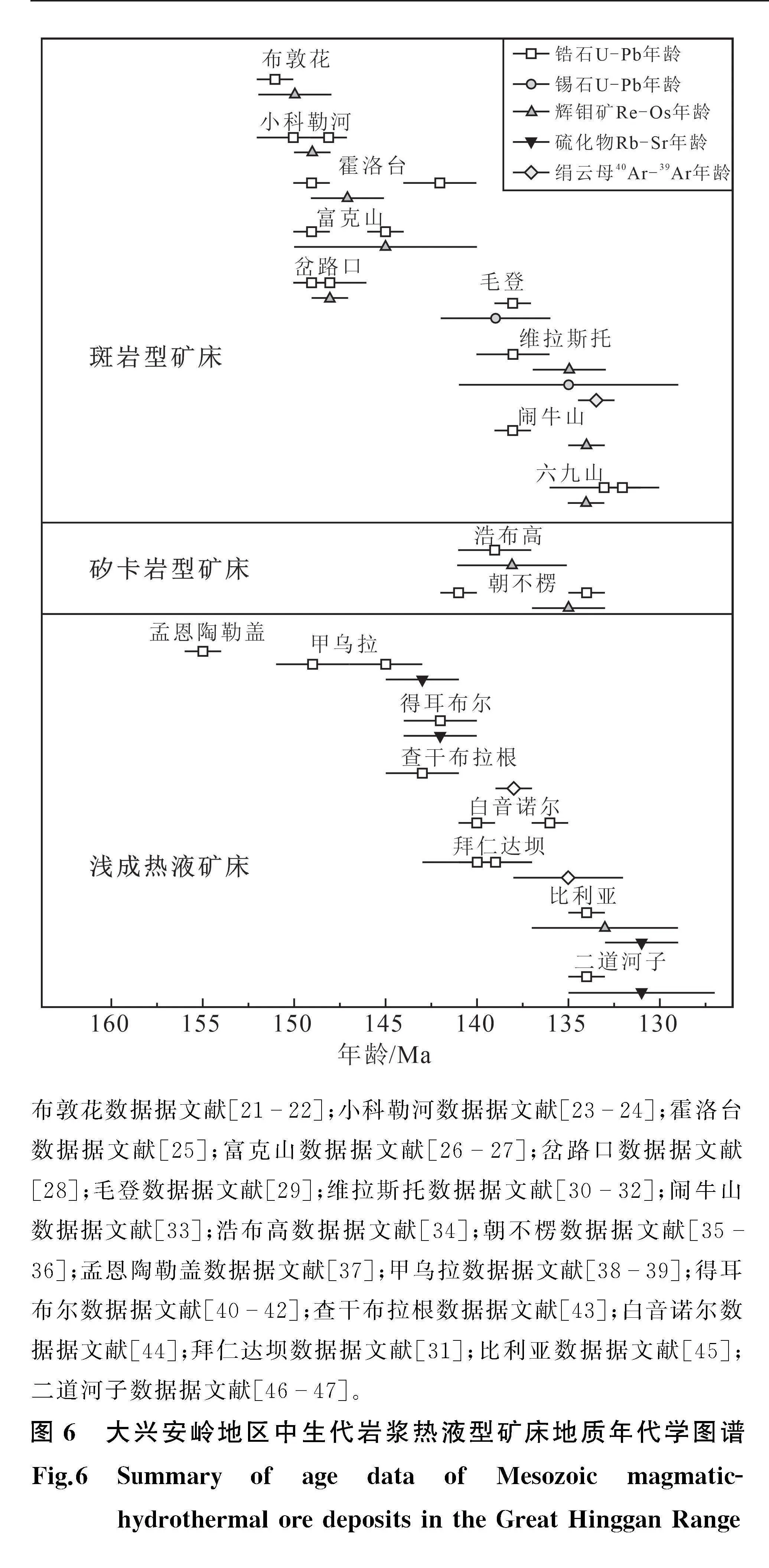
大興安嶺地區發育有大量的不同類型的熱液金屬礦床,產出了大量的銅、鉬、鉛、鋅和銀以及少量的鎢、錫和鐵等工業金屬。礦床成因類型主要包括淺成熱液型、斑巖型和矽卡巖型礦床,這些礦床主要形成于155~130 Ma(圖6)(數據來源于文獻[2147]),個別礦床形成較早,如多寶山斑巖銅鉬礦床(約480 Ma)[48]和八大關斑巖銅鉬礦床(約230 Ma)[49]。整體而言,六九山銅礦床是大興安嶺地區早白堊世期間大規模巖漿熱液活動的產物。在礦產勘查潛力方面,六九山銅礦床頂部發育有高級泥化帶,代表了典型的斑巖銅成礦系統的巖帽或頂部,表明該礦床保存程度較高,亦或遭受了較弱的成礦后剝蝕作用;結合區域上相鄰的鬧牛山淺成熱液
布敦花數據據文獻[2122];小科勒河數據據文獻[2324];霍洛臺數據據文獻[25];富克山數據據文獻[2627];岔路口數據據文獻[28];毛登數據據文獻[29];維拉斯托數據據文獻[3032];鬧牛山數據據文獻[33];浩布高數據據文獻[34];朝不楞數據據文獻[3536];孟恩陶勒蓋數據據文獻[37];甲烏拉數據據文獻[3839];得耳布爾數據據文獻[4042];查干布拉根數據據文獻[43];白音諾爾數據據文獻[44];拜仁達壩數據據文獻[31];比利亞數據據文獻[45];二道河子數據據文獻[4647]。
銅礦床[18],表明大興安嶺中部在早白堊世后期遭受了較弱的抬升剝蝕作用,該區域有著優越的找尋相似熱液金屬礦床的潛力。
4.2" 巖石成因類型與巖漿起源
目前,有關花崗巖的巖石成因已有多種論述,主流觀點是巖石成因分類,即M 型、I型、S 型和A型[5053]。上述與成礦密切相關的閃長玢巖和二長
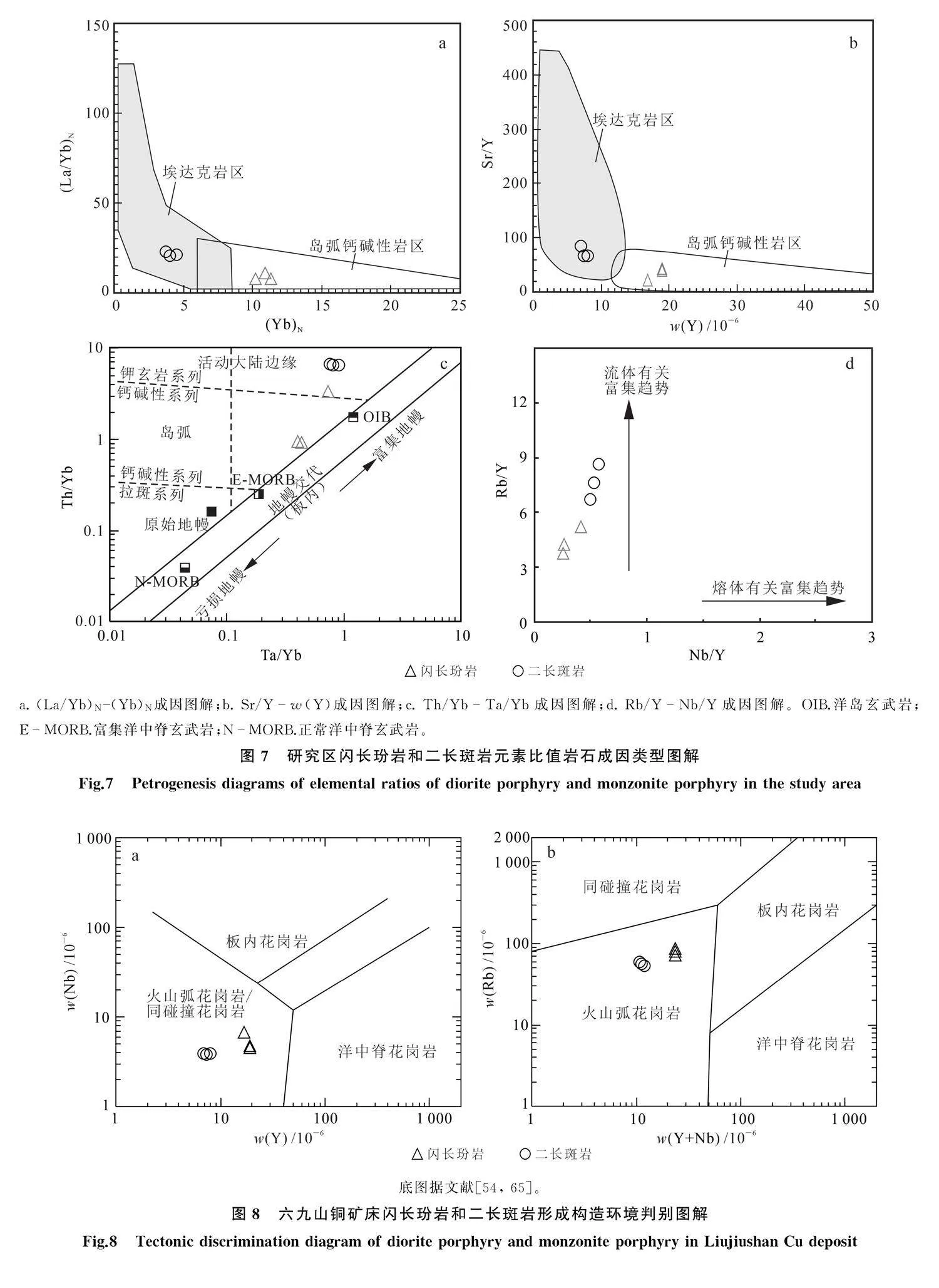
斑巖地質、巖相學和元素地球化學特征論述表明,它們均為淺成脈巖,其長英質礦物為斜長石/鈉長石+正長石+石英,暗色礦物黑云母、普通角閃石、普通輝石等,副礦物有磷灰石、鋯石、磁鐵礦等,表明其巖石成因類型應為I型花崗巖類。微量元素地球化學特征揭示其具有典型的島弧、大陸邊緣火山弧的巖漿特征,說明它們可能為典型島弧鈣堿性或埃達克質巖漿屬性(圖7a)[13];在(La/Yb)N (Yb)N和Sr/Yw(Y)劃分判別圖解(圖7a、b)上,閃長玢巖成分點落在島弧鈣堿性巖區,而二長斑巖成分點落在埃達克質巖區,前者具有島弧、大陸邊緣鈣堿性巖屬
性,而后者在SiO2、Al2O3、MgO、K2O/Na2O、Rb、Sr、Y、Yb、Sr/Y、(La/Yb)N和δEu等方面均滿足與大洋板塊俯沖有關的埃達克巖特征。在與板塊俯沖作用有關的Th/YbTa/Yb巖漿源區構造判別圖解(圖7c)上,閃長玢巖2件成分點明顯落在與大洋板塊俯沖有關的富集地幔源區,閃長玢巖1件和二長斑巖成分點落在活動陸緣區域;在Rb/YNb/Y圖解(圖7d)上,閃長玢巖、二長斑巖成分點均落在大洋俯沖提供流體交代下地殼而形成的富集地幔源區。
4.3" 形成環境與地球動力學背景
如前所述,六九山銅礦床產在興蒙造山帶東部、大興安嶺東坡中北段,區域先后經歷古亞洲洋構造體系和古太平洋構造體系演化。前人研究表明,古生代受古亞洲洋構造體系的控制[5458],古亞洲洋最終閉合于晚二疊世—早三疊世期間(約250 Ma),中三疊世期間進入鄂霍茨克洋和古太平洋俯沖體系[5960];目前,有關環太平洋構造體系開始的時間雖有爭論,但眾多學者認為古太平洋板塊在晚三疊世晚期—早侏羅世早期開始向歐亞大陸的俯沖作用[6164]。
六九山銅礦床成礦系統的閃長玢巖、二長斑巖鋯石UPb同位素定年結果表明巖漿作用發生在132 Ma,成礦與斑巖巖漿就位過程具有明顯的時空關系;這種特征表明成巖成礦作用發生在中生代早白堊世,其成巖成礦應形成于古太平洋板塊俯沖大陸邊緣巖漿弧環境。在w(Nb)w(Y)、w(Rb)w(Y+Nb)(圖8a、b)構造環境判別圖中,成分點均落在同碰撞火山弧區(圖8a)和火山弧區(圖8b),表明成巖成礦作用發生在碰撞與造山后火山弧階段;這一點與區域孔雀山、蓮花山和鬧牛山等淺成熱液銅礦床以及金雞嶺、富克山和小科勒河等斑巖型銅礦床,特別是蓮花山、鬧牛山等淺成熱液銅礦床處于相同的構造背景[17],成巖成礦適值中生代早白堊世庫拉板塊向歐亞板塊俯沖的大陸邊緣巖漿弧背景。
a. (La/Yb)N (Yb)N成因圖解;b. Sr/Yw(Y)成因圖解;c. Th/YbTa/Yb成因圖解;d. Rb/YNb/Y成因圖解。OIB.洋島玄武巖;EMORB.富集洋中脊玄武巖;NMORB.正常洋中脊玄武巖。
底圖據文獻[54, 65]。
5" 結論
本文通過大興安嶺東坡中北段六九山銅礦床成礦系統淺成巖地質、鋯石UPb同位素定年和元素地球化學特征研究,討論了成巖時代、成因類型與地球動力學背景,取得的主要認識如下:
1)將淺成巖地質與鋯石UPb同位素定年相結合,確定閃長玢巖和二長斑巖巖漿就位發生在132 Ma,結合輝鉬礦ReOs同位素年齡((134.1±0.8)Ma),限定成礦發生在早白堊世。
2)元素地球化學特征揭示,閃長玢巖為典型島弧鈣堿性巖,二長斑巖為典型埃達克質巖,二者與成礦作用密切相關;巖漿起源于與大洋板塊俯沖有關的以流體交代為主的富集地幔部分熔融。
3)從區域地球動力學角度出發,成巖成礦作用適值中生代早白堊世庫拉板塊向歐亞板塊俯沖的大陸邊緣巖漿弧背景。
參考文獻(References):
[1]" 翟明國,胡波. 礦產資源國家安全、國際爭奪與國家戰略之思考[J]. 地球科學與環境學報,2021,43(1):111.
Zhai Mingguo, Hu Bo. Thinking to State Security, International Competition and National Strategy of Mineral Resources[J]. Journal of Earth Sciencesand Environment, 2021, 43 (1): 111.
[2]" 李德勝.黑龍江省龍江縣后六九銅鉬礦床地質特征及成因初探[J]. 礦產與地質,2003,17(增刊):354357.
Li Desheng. Geological Character and Primary Study of Genesis About Houliujiu Copper-Molybdenum Deposit in Longjiang County of Heilongjiang Province[J]. Mineral Resources and Geology, 2003, 17 (Sup.): 354357.
[3]" 宮永吉,孫景貴,劉陽. 再論大興安嶺中東部六九山銅礦床成礦地質特征、成因與成礦地質背景[J].吉林地質,2020,39(4):110.
Gong Yongji, Sun Jinggui, Liu Yang. A Re-Evaluation on the Deposit Geological Features, Genesis and Metallogenic Geological Setting of Liujiushan Cu Deposit in the Central-Eastern Segment of the Greater Xing’an Range[J]. Jilin Geology, 2020,39 (4): 110.
[4]" 孫景貴,劉陽,徐智愷,等.試論中國東北部陸緣晚中生代淺成熱液大規模成礦與深部地質過程對成礦制約[J].吉林大學學報(地球科學版),2023,53(3):651692.
Sun Jinggui, Liu Yang, Xu Zhikai, et al. Large-Scale Epithermal Mineralization of Late Mesozoic and the Constraints of Deep Geological Processes on Mineralization in the Continental Margin of NE China[J]. Journal of Jilin University (Earth Science Edition), 2023, 53 (3): 651692.
[5]" Williams I S. UThPb Geochronology by Ion-Microprobe, Applications of Microanalytical Techniques to Understanding Mineralizing Processes[J]. Economic Geology, 1998, 7: 135.
[6]" Li X H. Geochemistry of the Longsheng Ophiolite from the Southern Margin of Yangtze Craton, SE China[J]. Geological Journal, 1997, 31: 323338.
[7]" 楊元江,呂長祿,李科,等. 黑龍江六九銅礦區巖漿巖年代學及成礦指示意義[J].礦物巖石,2021,41(3):118127.
Yang Yuanjiang, Lü Changlu, Li Ke, et al. Magmatic Geochronology and Metallogenic Geological Significance in Liujiu Cu Deposit of Heilongjiang Province[J]. Mineralogy and Petrology, 2021, 41 (3): 118127.
[8]" Corfu F, Hanchar J M, Hoskin P W O, et al. Atlas of Zircon Textures[J]. Reviews in Mineralogy and Geochemistry, 2003, 53: 469500.
[9]" Middlemost E A K. Naming Materials in the Magma/Igneous Rock System[J]. Earth Science Reviews, 1994, 37: 215224.
[10]" Peccerillo A, Taylor A R. Geochemistry of Eocene Calc-Alkaline Volcanic Rocks from the Kastamonu Area, Northern Turkey[J]. Contributions to Mineralogy and Petrology, 1976, 58: 6381.
[11]" Sun S S, Mcdonough W F. Chemical and Isotopic Systematics of Oceanic Basalts;Implications for Mantle Composition and Processes[J]. Geological Society London Special Publications, 1989, 42(1): 313345.
[12]" Boynton W V. Geochemistry of the Rare Earth Elements: Meteorite Studies[M]// Henderson P E. Rare Earth Element Geochemistry. Amsterdam:Elsevier,1984: 63114.
[13]" Pearce J A, Kempton P D, Nowell G M, et al. Hf-Nd Element and Isotope Perspective on the Nature and Provenance of Mantle and Subduction Components in Western Pacific Arc-Basin Systems[J]. Journal of Petrology, 1999, 40: 15791611.
[14]" 趙振華,王強,熊小林.俯沖帶復雜的殼幔相互作用[J].礦物巖石地球化學通報,2004,23(4):277284.
Zhao Zhenhua, Wang Qiang, Xiong Xiaolin. Complex Mantle-Crust Interaction in Subduction Zone[J]. Bulletin of Mineralogy, Petrology and Geochemistry, 2004, 23(4): 277284.
[15]nbsp; Foley S. Petrological Characterization of the Source Components of Potassic Magmas: Geochemical and Experimental Constraints[J]. Lithos, 1992, 28: 187204.
[16]" 趙振華,熊小林,王強,等. 鈮與鉭的某些地球化學問題[J].地球化學,2008,37(4):304320.
Zhao Zhenhua, Xiong Xiaolin, Wang Qiang, et al.Some Aspects on Geochemistry of Nb and Ta[J]. Geochimica, 2008,37(4): 304320.
[17]" 鄧昌州. 大興安嶺北部中生代斑巖銅礦: 成巖與成礦[D]. 長春:吉林大學,2019:1194.
Deng Changzhou. Petrology and Metallogenesis of the Porphyry Cu Deposits in the Northern Great Xing’an Range[D]. Changchun: Jilin University, 2019: 1194.
[18]" 古阿雷.大興安嶺中東部地區淺成熱液斑巖銅多金屬成礦系統成礦地質過程及成礦模式研究[D]. 長春:吉林大學,2016:1128.
Gu Alei. Study on the Mineralization Processes and Metallogenic Model of Epithermal-Porphyry Copper-Polymetallic Mineralization System in the Central and Eastern of Great Xing’an Range, China[D]. Changchun: Jilin University, 2016: 1128.
[19]" Chiaradia M, Schaltegger U, Spikings R, et al. How Accurately Can We Date the Duration of Magmatic–Hydrothermal Events in Porphyry Systems?:An Invited Paper[J]. Economic Geology, 2013, 108: 565584.
[20]" Chiaradia M, Schaltegger U, Spikings R. Time Scales of Mineral Systems:Advances in Understanding over the Past Decade[J]. Society of Economic Geologists, Special Publication, 2014, 18: 3758.
[21]" Ouyang H G, Wu X L, Mao J W, et al. The Nature and Timing of Ore Formation in the Budunhua Copper Deposit, Southern Great Xing’an Range: Evidence from Geology, Fluid Inclusions, and UPb and ReOs Geochronology[J]. Ore Geology Reviews, 2014, 63: 238251.
[22]" Shi K T, Wang K Y, Ma X L, et al. Fluid Inclusions, CHOSPb Isotope Systematics, Geochronology and Geochemistry of the Budunhua Cu Deposit, Northeast China: Implications for Ore Genesis[J]. Geoscience Frontiers, 2020, 11: 11451161.
[23]" Deng C Z, Sun D Y, Han J S, et al. Ages and Petrogenesis of the Late Mesozoic Igneous Rocks Associated with the Xiaokele Porphyry CuMo Deposit, NE China and Their Geodynamic Implications[J]. Ore Geology Reviews, 2019, 107: 417433.
[24]" Sun Y G, Li B L, Ding Q F, et al. Timing and Ore Formation of the Xiaokele Porphyry Cu (Mo) Deposit in the Northern Great Xing’an Range, NE China: Constraints from Geochronology, Fluid Inclusions, and HOSPb Isotopes[J]. Ore Geology Reviews, 2022, 143: 104806.
[25]" Sun Y G, Li B L, Zhao Z H, et al. Age and Petrogenesis of Late Mesozoic Intrusions in the Huoluotai Porphyry Cu(Mo) Deposit, Northeast China: Implications for Regional Tectonic Evolution[J]. Geoscience Frontiers, 2022, 13: 101344.
[26]" Deng C Z, Sun D Y, Han J S, et al. Late-Stage Southwards Subduction of the Mongol-Okhotsk Oceanic Slab and Implications for Porphyry CuMo Mineralization: Constraints from Igneous Rocks Associated with the Fukeshan Deposit, NE China[J]. Lithos, 2019, 326/327: 341357.
[27]" Sun Y G, Li B L, Ding Q F, et al. Mineralization Age and Hydrothermal Evolution of the Fukeshan Cu (Mo) Deposit in the Northern Great Xing’an Range, Northeast China: Evidence from Fluid Inclusions, HOSPb Isotopes, and ReOs Geochronology[J]. Minerals, 2020, 10: 591.
[28]" Zhao Q Q, Zhai D G, Mathur R, et al. The Giant Chalukou Porphyry Mo Deposit, Northeast China: The Product ofa Short-Lived, High Flux Mineralizing Event[J]. Economic Geology, 2021, 116: 12091225.
[29]" 季根源,江思宏,李高峰,等. 大興安嶺南段毛登 SnCu 礦床巖漿作用對成礦制約:年代學、地球化學及 SrNdPb 同位素證據[J]. 大地構造與成礦學,2021,45(4):681704.
Ji Genyuan, Jiang Sihong, Li Gaofeng, et al. Metallogenetic Control of Magmatism on the Maodeng SnCu Deposit in the Southern Great Xing’an Range: Evidence from Geochronology, Geochemistry, and SrNdPb Isotopes[J]. Geotectonica et Metallogenia, 2021, 45 (4): 681704.
[30]" 潘小菲,郭利軍,王碩,等. 內蒙古維拉斯托銅鋅礦床的白云母Ar/Ar年齡探討[J]. 巖石礦物學雜志,2009,28(5):473479.
Pan Xiaofei, Guo Lijun, Wang Shuo, et al. Laser Microprobe ArAr Dating of Biotite from the Weilasituo CuZn Polymetallic Deposit in Inner Mongolia[J]. Acta Mineralogica et Petrologica, 2009, 28 (5): 473479.
[31]" Liu Y F, Jiang S H, Bagas L. The Genesis of Metal Zonation in the Weilasituo and Bairendaba AgZnPbCu(SnW) Deposits in the Shallow Part of a Porphyry SnWRb System, Inner Mongolia, China[J]. Ore Geology Reviews, 2016, 78: 150173.
[32]" Wang F X, Bagas L, Jiang S H, et al. Geological, Geochemical, and Geochronological Characteristics of Weilasituo Sn–Polymetal Deposit, Inner Mongolia, China[J]. Ore Geology Reviews, 2017, 80: 12061229.
[33]" Gu A L, Sun J G, Bai L A, et al. Petrogenesis and Metallogenesis of the Early Cretaceous Naoniushan Cu-Dominated Polymetallic Deposit in the Central Great Xing’an Range, NE China[J]. Journal of Asian Earth Sciences, 2018, 165: 114131.
[34]" Wang X D, Xu D M, Lü X B, et al. Origin of the Haobugao Skarn FeZn Polymetallic Deposit, Southern Great Xing’an Range, NE China: Geochronological, Geochemical, and SrNdPb Isotopic Constraints[J]. Ore Geology Reviews, 2018, 94: 5872.
[35]" Sun Q F, Wang K Y, Wang Y C, et al. Fluid Evolution and Ore Genesis of the Chaobuleng Skarn FeZn Polymetallic Deposit, Northeast China: Evidence from Fluid Inclusions, COSPb Isotopes, and Geochronology[J]. Journal of Geochemical Exploration, 2021, 227: 106796.
[36]" Wu C, Wang B R, Zhou Z G, et al. The Relationship Between Magma and Mineralization in Chaobuleng Iron Polymetallic Deposit, Inner Mongolia[J]. Gondwana Research, 2017, 45: 228253.
[37]" 江思宏,聶鳳軍,劉翼飛,等. 內蒙古孟恩陶勒蓋銀多金屬礦床及其附近侵入巖的年代學[J]. 吉林大學學報(地球科學版),2011,41(6):17551769.
Jiang Sihong, Nie Fengjun, Liu Yifei, et al. Geochronology of Intrusive Rocks Occurring in and Around the Mengentaolegai Silver–Polymetallic Deposit, Inner Mongolia[J]. Journal of Jilin University (Earth Science Edition), 2011, 41(6): 17551769.
[38]" 李鐵剛,武廣,劉軍,等. 大興安嶺北部甲烏拉鉛鋅銀礦床RbSr同位素測年及其地質意義[J]. 巖石學報,2014,30(1):257270.
Li Tiegang, Wu Guang, Liu Jun, et al. Rb–Sr Isochron Age of the Jiawula AgPbZn Deposit in the Manzhouli Area and Its Geological Significance[J]. Acta Petrologica Sinica, 2014, 30 (1): 257270.
[39]" Niu S D, Li S R, Huizenga J M, et al. Zircon UPb Geochronology and Geochemistry of the Intrusions Associated with the Jiawula AgPbZn Deposit in the Great Xing’an Range, NE China and Their Implications for Mineralization[J]. Ore Geology Reviews, 2017, 86: 3554.
[40]" 明珠,孫景貴,閆佳,等. 內蒙古東部得耳布爾鉛鋅礦床安山巖的形成環境和巖漿熱液演化史:鋯石UPb定年[J]. 世界地質,2015,34(3):590598.
Ming Zhu, Sun Jinggui, Yan Jia, et al. Forming Environment and Magmatic-Hydrothermal Evolution History of Andesite in Derbur Lead-Zinc Deposit of Eastern Inner Mongolia: Zircon U–Pb Dating[J]. Global Geology, 2015, 34 (3): 590598.
[41]" 趙巖,呂駿超,張德寶,等. 內蒙古東北部得耳布爾鉛鋅銀礦床閃鋅礦RbSr年齡及地質意義[J]. 礦床地質,2017,36(4):893904.
Zhao Yan, Lü Junchao, Zhang Debao, et al. Rb–Sr Isochron Age of Derbur PbZnAg Deposit in Erguna Massif of Northeast Inner Mongolia and Its Geological Significance[J]. Mineral Deposits, 2017, 36 (4): 893904.
[42]" Xu Z T, Sun J G, Liang X L, et al. Genesis of Ore-Bearing Volcanic Rocks in the Derbur Lead-Zinc Mining Area of the Erguna Massif, Western Slope of the Great Xing’an Range, NE China: Geochemistry, SrNdPb Isotopes, and Zircon UPb Geochronology[J]. Geological Journal, 2019, 54: 38913908.
[43]" Li T G, Wu G, Liu J, et al. Geochronology, Fluid Inclusions and Isotopic Characteristics of the Chaganbulagen PbZnAg Deposit, Inner Mongolia, China[J]. Lithos, 2016, 261: 340355.
[44]" Jiang S H, Chen C L, Bagas L, et al. Two Mineralization Events in the Baiyinnuoer ZnPb Deposit in Inner Mongolia, China: Evidence from Field Observations, SPb Isotopic Compositions and UPb Zircon Ages[J]. Journal of Asian Earth Sciences, 2017, 144: 339367.
[45]" Xu Z K, Sun J G, Xu Z T, et al. Fluid Inclusion and Isotopic Constraints on the Origin of the AgPbZn Polymetallic Mineralization at Biliya, Great Xing’an Range, NE China[J]. Ore Geology Reviews, 2022, 143: 104793.
[46]" Xu Z T, Liu Y, Sun J G, et al. Nature and Ore Formation of the Erdaohezi PbZn Deposit in the Great Xing’an Range NE China[J]. Ore Geology Reviews, 2020, 119: 103385.
[47]" Xu Z T, Sun J G, Liang X L, et al. Geochronology, Geochemistry, and PbHf Isotopic Composition of Mineralization-Related Magmatic Rocks in the Erdaohezi PbZn Polymetallic Deposit, Great Xing’an Range, Northeast China[J]. Minerals, 2020, 10: 274.
[48]" Zeng Q D, Liu J M, Chu S X, et al. ReOs and UPb Geochronology of the Duobaoshan Porphyry CuMo(Au) Deposit, Northeast China, and Its Geological Significance[J]. Journal of Asian Earth Sciences, 2014, 79: 895909.
[49]" 康永建,王亞軍,黃光杰,等. 內蒙古八大關斑巖型銅鉬礦床成巖成礦年代學研究[J]. 礦床地質,2014,33(4):795806.
Kang Yongjian, Wang Yajun, Huang Guangjie, et al. Study of Rock-Forming and Ore-Forming Ages of Badaguan Porphyry CuMo Deposit in Inner Mongolia[J]. Mineral Deposits, 2014, 33 (4): 795806.
[50]" Pearce J A, Harris B W, Tindle A G. Trace Element Discrimination Diagrams for the Tectonic Interpretations of Granitic Rocks[J]. Journal of Petrology, 1984, 25: 956983.
[51]" King P L, White A J R, Chappell B W, et al. Characterization and Origin of Aluminous AType Granites from the Lachlan Fold Belt, Southeastern Australia[J]. Journal of Petrology, 1997, 38: 371391.
[52]" Chappell B W. Aluminium Saturation in I and SType Granites and the Characterization of Fractionated Haplogranites[J].Lithos, 1999, 46 (3): 53551.
[53]" Chappell B W, White A J R. Two Contrasting Granite Types: 25 Years Later[J]. Australian Journal of Earth Sciences, 2001, 48 (4): 489499.
[54]" Wu F Y, Sun D Y, Li H, et al. AType Granites in Northeastern China: Age and Geochemical Constraints on Their Petrogenesis[J]. Chemical Geology, 2002, 187 (1): 143173.
[55]" Sengr A M C, Natal’in B A, Burtman V S. Evolution of the Altaid Tectonic Collage and Paleozoic Crustal Growth in Eurasia[J]. Nature, 1993, 364: 299307.
[56]" Jahn B M. The Central Asian Orogenic Belt and Growth of the Continental Crust in the Phanerozoic [J]. Geological Society, London: Special Publications, 2004, 226: 73100.
[57]" 董清水,何春生,樓仁興,等. 大興安嶺南段阿魯科爾沁旗地區林西組沉積環境特征及其時限的地質意義[J]. 吉林大學學報(地球科學版),2020,50(2):425441.
Dong Qingshui, He Chunsheng, Lou Renxing, et al. Geological Significance of Sedimentary Environment Characteristics and Time Limit of Linxi Formation in Arhorchin Banner, Southern Great Xing’an Range[J]. Journal of Jilin University (Earth Science Edition), 2020, 50 (2): 425441.
[58]" Windley B F, Alexeiev D, Xiao" W J, et al. Tectonic Models for Accretion of the Central Asian Orogenic Belt[J]. Journal of the Geological Society, 2007, 164: 3147.
[59]" Wu F Y, Sun D Y, Ge W C, et al. Geochronology of the Phanerozoic Granitoids in Northeastern China[J]. Journal of Asian Earth Sciences, 2011, 41(1): 130.
[60]" 孫德有,吳福元,高山,等. 吉林中部晚三疊世和早侏羅世兩期鋁質A型花崗巖的厘定及對吉黑東部構造格局的制約[J]. 地學前緣,2005,12(2): 263275.
Sun Deyou, Wu Fuyuan, Gao Shan, et al. Confirmation of Two Episodes of AType Granite Emplacement During Late Triassic and Early Jurassic in the Central Jilin Province, and Their Constraints on the Structural Pattern of Eastern Jilin-Heilongjiang Area, China[J]. Earth Science Frontiers, 2005, 12 (2): 263275.
[61]" 尹志剛,龐學昌,王春生,等. 小興安嶺南部早侏羅世二長花崗巖形成時代、地球化學特征及地質意義[J].地質通報,2020,39(1):2739.
Yin Zhigang, Pang Xuechang, Wang Chunsheng, et al. Formation Age, Geochemical Characteristics and Geological Significance of the Early Jurassic Monzonitic Granites in Southern Xiao Hinggan Mountains[J]. Geological Bulletin of China, 2020, 39 (1): 2739.
[62]" 鄭全波,汪巖,張廣宇,等. 黑龍江東部晚三疊世A 型花崗巖的厘定及其構造環境的地球化學制約[J].世界地質,2019,31(3):471478.
Zheng Quanbo, Wang Yan, Zhang Guangyu, et al.Confirmation of Late Triassic AType Granite and Their Geochemical Constraints on Structural Setting in Eastern Heilongjiang[J]. Global Geology, 2019, 31 (3): 471478.
[63]" 徐智濤,李萌萌,孫景貴,等. 大興安嶺得耳布爾地區中侏羅世流紋巖成因及成巖地球動力學背景[J].吉林大學學報(地球科學版),2023,53(3):866886.
Xu Zhitao, Li Mengmeng, Sun Jinggui, et al. Genesis and Diagenetic Geodynamic Background of Middle Jurassic Rhyolites in Derbur Area, Great Xing’an Range[J]. Journal of Jilin University (Earth Science Edition), 2023, 53 (3): 866886.
[64]" Shu Q H, Chang Z S, Lai Y, et al. Regional Metallogeny of Mo-Bearing Deposits in Northeastern China, with New ReOs Dates of Porphyry Mo Deposits in the Northern Xilamulun District[J]. Economic Geology, 2016, 111: 17831798.
[65]" Pearce J A, Harris N B W, Tindle A G. Trace Element Discrimination Diagrams for the Tectonic Interpretation of Granitic Rocks[J]. Journal of Petrology, 1984, 25: 956983.
猜你喜歡
大地構造與成礦學(2021年5期)2021-10-27 11:15:36
大地構造與成礦學(2021年4期)2021-08-24 05:34:48
河北地質(2021年1期)2021-07-21 08:16:04
礦產勘查(2021年3期)2021-07-20 08:01:52
大地構造與成礦學(2021年3期)2021-06-29 11:16:24
大地構造與成礦學(2021年2期)2021-05-07 13:57:12
礦產勘查(2020年2期)2020-12-28 00:23:50
礦產勘查(2020年1期)2020-12-28 00:21:12
礦產勘查(2020年6期)2020-12-25 02:42:08
礦產勘查(2020年6期)2020-12-25 02:41:08