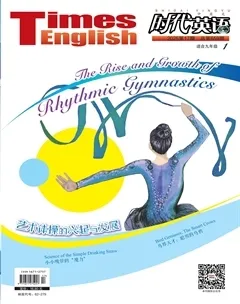
The Rise and Growth of Rhythmic Gymnastics藝術(shù)體操的興起與發(fā)展
2025-03-02 00:00:00
時(shí)代英語(yǔ)·初中 2025年3期


You might have seen athletes gracefully bending and leaping in rhythm with melodies. This is “rhythmic gymnastics”, a sport often mistaken for artistic gymnastics. However, the two are distinct in focus and presentation.
你可能見(jiàn)過(guò)運(yùn)動(dòng)員跟隨著旋律優(yōu)雅地彎曲、跳躍。這就是藝術(shù)體操,一項(xiàng)常被誤認(rèn)為是競(jìng)技體操的運(yùn)動(dòng)。然而,兩者在著重點(diǎn)和呈現(xiàn)形式上截然不同。
Artistic gymnastics focuses on strength, flexibility and balance, with athletes performing solo on various equipment. They are scored based on the difficulty of their movements, their execution of certain skills on each apparatus, and their ability to combine multiple skills into different movements. And rhythmic gymnastics emphasizes style and presentation, with athletes often performing in teams. Moving in harmony with music, they use different items like balls, hoops, ribbons and clubs. This creates a performance that looks like a dance but with athletic skills.
競(jìng)技體操注重力量、身體柔軟度以及平衡性,運(yùn)動(dòng)員在各種器械上單獨(dú)表演。他們的評(píng)分是根據(jù)動(dòng)作的難度、在每個(gè)器材上某些技巧的執(zhí)行度,以及將多種技巧組合成不同動(dòng)作的能力而來(lái)。而藝術(shù)體操?gòu)?qiáng)調(diào)風(fēng)格和呈現(xiàn),運(yùn)動(dòng)員經(jīng)常以團(tuán)隊(duì)形式表演。他們隨著音樂(lè)和諧一致地舞動(dòng)著,表演時(shí)會(huì)借助不同的物品,如球、環(huán)、彩帶和棒子。這創(chuàng)造了一種看起來(lái)像是舞蹈但具有運(yùn)動(dòng)技巧的表演。
Another significant difference between artistic and rhythmic gymnastics is that only women are allowed to compete in major international rhythmic gymnastics events. This has been the case since the sport’s beginning. Rhythmic gymnastics dates back to 19th-century Europe and started to gain international popularity during the mid-20th century. By the 1980s, it was formally included in the Olympic Games for women. Although the sport is largely associated with female athletes, there are also men who practice rhythmic gymnastics. However, male versions of the sport have yet to receive official recognition.
競(jìng)技體操和藝術(shù)體操之間的另一個(gè)顯著區(qū)別是,只有女性才可以參加主要的國(guó)際藝術(shù)體操賽事。自從這項(xiàng)運(yùn)動(dòng)誕生以來(lái),情況就一直是如此。藝術(shù)體操可追溯至19世紀(jì)的歐洲,并在20世紀(jì)中葉開(kāi)始在國(guó)際上流行。到了20世紀(jì)80年代,藝術(shù)體操正式列入女子奧運(yùn)比賽項(xiàng)目。盡管這項(xiàng)運(yùn)動(dòng)主要與女性運(yùn)動(dòng)員有關(guān),但也有男子在練習(xí)藝術(shù)體操。然而,這項(xiàng)運(yùn)動(dòng)的男性版本尚未獲得官方認(rèn)可。
Currently, two styles of male rhythmic gymnastics are on the rise. One of them, known as the Japanese School, is characterized by dynamic and powerful tumbling elements. While group routines don’t usually use equipment, individual routines use clubs, ropes, double rings and sticks. The Spanish School is more similar to traditional rhythmic gymnastics and has developed alongside it. Its rules mirror women’s international rhythmic gymnastics. Male rhythmic gymnastics might not be represented internationally yet, but its current growth speed suggest a promising future for the sport.
目前,兩種流派的男子藝術(shù)體操正興起。其中一種被稱為日本流派,其特色是動(dòng)感而有力的翻滾元素。雖然團(tuán)體整套的動(dòng)作不常使用器材,但個(gè)人整套的動(dòng)作會(huì)用到棒、繩、雙環(huán)和棍。西班牙流派與傳統(tǒng)的藝術(shù)體操更為相近,并與其一同發(fā)展。其規(guī)則跟女子國(guó)際藝術(shù)體操很像。男子藝術(shù)體操可能還無(wú)法列入國(guó)際賽事,但其目前的增長(zhǎng)速度顯示了這項(xiàng)運(yùn)動(dòng)的未來(lái)大有可為。
Word Bank
distinct" adj. 截然不同的;有區(qū)別的
execution" n. 實(shí)行;執(zhí)行;實(shí)施
apparatus" n. 儀器;器械;裝置
routine" n. (演出中的)一套動(dòng)作
猜你喜歡
今日農(nóng)業(yè)(2021年1期)2021-11-26 07:00:56
中老年保健(2021年4期)2021-08-22 07:10:02
動(dòng)漫界·幼教365(大班)(2021年4期)2021-05-23 21:33:16
甘肅教育(2020年12期)2020-04-13 06:24:46
作文周刊·小學(xué)一年級(jí)版(2018年17期)2018-09-10 02:39:46
小學(xué)生作文(低年級(jí)適用)(2018年3期)2018-04-17 00:58:35
攝影之友(影像視覺(jué))(2018年1期)2018-03-22 01:12:07
少年博覽·小學(xué)低年級(jí)(2017年4期)2017-06-09 16:22:28
作文周刊·小學(xué)一年級(jí)版(2016年28期)2017-06-03 00:28:49
小天使·一年級(jí)語(yǔ)數(shù)英綜合(2017年4期)2017-04-18 17:47:11