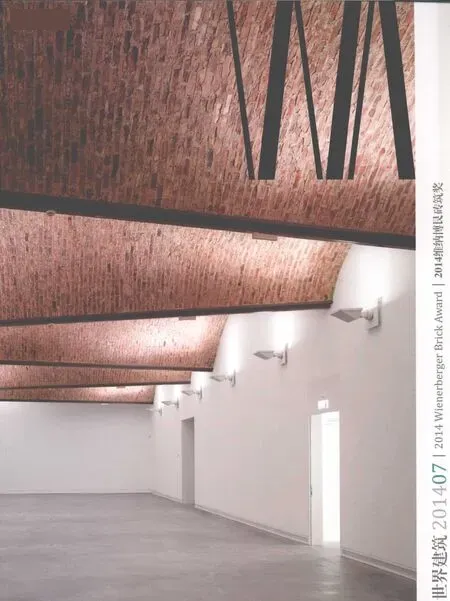
0505大樓改造翻修,慕尼黑工業大學,慕尼黑,德國
2014-02-20 05:41:47建筑設計希爾德與K建筑事務所
世界建筑 2014年7期
建筑設計:希爾德與K建筑事務所
0505大樓改造翻修,慕尼黑工業大學,慕尼黑,德國
建筑設計:希爾德與K建筑事務所

1 外景/Exterior view
弗朗茨·哈特是戰后慕尼黑推行技術化建造的建筑師之一。作為建造專業的教授,他將自己對現代主義冷凈和功能化的闡釋傳授給了學生。哈特的磚建筑就是這一理念的證明。想要深入了解他的手法,可以去讀他的教材《磚構造手冊》。他在慕尼黑工業大學校園里的研究所最近由希爾德與K建筑事務所進行了全面的現代化翻修。結果,這座以表現主義再現的建筑略帶諷刺意味地向這位傳奇大師致敬。
1963年,哈特與維爾納·艾希貝格在一處街角建造了一座工廠般方正的混凝土建筑。為了滿足建筑的功能,兩樓采用了不同的混凝土框架體系來連接,之間有一道明顯的分界。框架立柱間的凹槽給了希爾德與K建筑事務所靈感,他們把結構上的差異轉化為一種裝飾元素。分割新保溫磚立面的舊柱網上的扶壁被塑造成形式各異的豎直波浪,從而賦予了建筑一種懸垂的舞姿。波峰上的厚重磚垛由鋼支架托起——有些超長的連桿還要特批。這些永久的伸縮帶隱藏在縫隙中。扶壁上閃亮的灰色面磚采用順接。中間的護墻則通過對比突出了磚浪呼嘯的氣勢與詭秘,直到屋頂邊緣才終止。這是古代哥特還是現代“哥特”?不管怎樣,能讓人想起原始立面的只有與墻面平齊的各式鋁窗了。
研究所的室內在清空后進行了改造。除了涂有咖喱黃的墻面之外都是素混凝土。天花上噴涂著炫目的金色。雖然現在這座建筑是經濟系館,裸露的混凝土主梁卻顯露出這座工業大學的特征。兩層高的大廳中,新的樓梯為線性的功能空間帶來了華麗的間奏。兩樓間以前的分隔現在已經封上,并安裝了多位藝術家設計的窗戶。這種手法不但強化了室內高大空間的美觀效果,還可以營造一種宗教氣氛。不過對于世人而言,經濟不正是一種信仰么?(尚晉 譯)
項目信息/Credits and Data
客戶/Client: 巴伐利亞自治州/慕尼黑州第二建筑管理局/ Freistaat Bayern/Staatliches Hochbauamt München 2
建設周期/Construction Period: 2008 - 2013
使用面積/Usable Floor Area: 8300m2(主要使用面積/ Main usable area)
建筑用途/Building's Purpose: 教育(辦公室和教室)/ Education (offices and classrooms)
用磚類型/Brick Type: 面磚/Facing bricks
攝影/Photos: Wienerberger AG/Michael Heinrich

2 立面細部/Details on the facade
Franz Hart was one of the Munich architects who championed technically sound construction in the post-war years. As a professor of building construction, he passed his sober, functional interpretation of modernism on to his students. Hart's brick buildings stood as proof positive of his approach; whoever desired a more in-depth analysis could consult his textbook "Brick: a Technical Handbook". His institute building on the campus of the Technical University of Munich has recently been thoroughly renovated and modernised by Hild und K. The resulting, expressionistically reformulated architecture could be viewed as an ironic homage to the legendary master.
In 1963, Hart, together with Werner Eichberg, built an industrial-looking, angled concrete structure on a street corner. In accordance with the building's function, its wings were composed of two different adjoining concrete framework systems, with a marked break between them. This recess between the frame uprights inspired Hild und K to reinterpret the structural differential as a decorative element. The buttresses in the old column grid that divide the new insulated brick facade are shaped into varying vertical wave patterns, lending the building the dynamic look of a suspended dance motion. The considerable massing of the brick bulges formed at the wave crests is braced with steel brackets; in individual cases the unusually long tie-rods required special permits. Tucked into hollowed-out seams, the permanently elastic bands remain invisible. The shiny grey facing bricks of the buttresses are laid in a stretcher bond. The livelier parapets between provide a contrast and serve to enhance the eerily soaring momentum of the waves that appear to dissipate only at the roof's edge. Is this Gothic or "goth"? The only reminders of the original facade are the variously sectioned aluminium window frames set flush into the wall.
The interior of the institute building was gutted, modified and, aside from the wall surfaces painted a mustard-curry-pickle yellow, left to exhibit a raw concrete aesthetic. The gold-coloured spray-paint on the ceilings is a garish touch. Though the economics department now occupies this building, the exposed concrete girders proclaim in no uncertain terms that this is a technical university. A new staircase in a two-storey foyer interrupts the rectilinear functionality with a lascivious sweep. The old break at the juncture of the two building wings is now closed and outfitted with windows designed by various artists. Though this certainly enhances the aesthetics of the high space inside, it suggests an ecclesiastical purpose as well. For the layman, however, is economics not a matter of faith?

4 平面/Floor plan

3 內景/Interior view

5 立面/Elevation
評論
鮑威:舊建筑改造往往可以帶來出人意料的驚喜。此案門廳弧線的樓梯、連接處的玫瑰窗,都成為原有建筑平淡謙和背景上舞動的亮點。而此案給人帶來最大的驚喜還是在立面波浪柱體的營造上:每個柱體在不同高度的突起,這樣一個不大的動作一字排列下來,整體形成了微妙的光影效果。改造策略簡單干凈,實現效果典雅豐富。
楊志疆:這是一個對建于1960年代的現代主義建筑進行整體修繕和改造的項目。建筑師或許繼承了德國自門德爾松以來的表現主義傳統,試圖采用曲線和色彩來激發原有建筑的活力。灰磚砌筑的豎向不同弧度的墻垛在消解原有立面刻板形象的同時,整棟大樓也被其連續的曲線波動所軟化,令人想起達利的那幅“融化的時間”。某種意義上,這是用現代藝術的語言,來表達對建筑幾何性的一種“戲謔”。但建筑室內弧線形的大樓梯、金色的屋頂以及局部使用的彩色玻璃,只是一種碎片化的點綴,而缺乏整體的設計邏輯。
Comments
BAO Wei: Renovation projects can always bring surprises that we would never imagine with from buildings. In this project, the spirit of the old building is uplifted by flamboyant elements such as curvy staircases in the lobby and rose windows at the building connection.The most striking one is the wavy pillars on the building facade. Nothing is simpler than a gentle bulge of each column at a different height, yet a rich orchestration of light and shadow is achieved when they are arrayed in a linear fashion on the facade. A rich and elegant result is achieved with a simple and clean strategy.
YANG Zhijiang: This is an overall repair and renovation project for a modern building built in the 1960s. Architects have inherited expressionist traditions since Mendelssohn, and have used curves and colors to stimulate the vitality of the original building. Grey brick pilasters with various vertical curves not only resolve the original rigid facade, but also soften the whole building with waving curves, reminding people of Dali's classic painting "Melting Time". In a certain sense, the style used in this building is inspired by the language of modern art and a desire to add some "playfulness" to the building's geometry. However, the interior large-scale curving staircase, golden roof, and the topical use of stained glass, are examples of fragmented decoration and show a lack of holistic design logic.
Conversion and Refurbishment of Building 0505, Technical University of Munich, Munich, Germany, 2013
Architects: Hild und K Architekten BDA

6 內景/Interior view
猜你喜歡
現代裝飾(2022年5期)2022-10-13 08:48:04
建材發展導向(2022年10期)2022-07-28 03:04:00
北方建筑(2021年6期)2021-12-31 03:03:54
建材發展導向(2021年7期)2021-07-16 07:08:04
文苑(2020年10期)2020-11-07 03:15:36
現代裝飾(2020年6期)2020-06-22 08:43:12
水利規劃與設計(2020年1期)2020-05-25 08:01:30
現代裝飾(2020年4期)2020-05-20 08:55:08
小哥白尼(趣味科學)(2019年3期)2019-06-17 11:57:44
福建農業科技(2016年10期)2016-03-07 09:46:49