沉默信息調節因子1小干擾RNA抑制前列腺癌細胞DU145的遷移
2014-04-21 01:23:34王翠瑤王忠利
解放軍醫學院學報 2014年12期
王翠瑤,王忠利
遼寧醫學院,遼寧錦州 121001 1生物化學與分子生物學教研室;2附屬一院普外科
沉默信息調節因子1小干擾RNA抑制前列腺癌細胞DU145的遷移
王翠瑤1,王忠利2
遼寧醫學院,遼寧錦州 1210011生物化學與分子生物學教研室;2附屬一院普外科
目的觀察沉默信息調節因子1(silent information regulator 1,SIRT1)小干擾RNA(siRNA)對前列腺癌DU145細胞遷移和基質金屬蛋白酶中MMP2和MMP9表達變化的影響。方法體外培養DU145細胞,實驗分Scramble siRNA組和SIRT1 siRNA組;利用脂質體介導轉染技術轉染前列腺癌DU145細胞,Western blot方法檢測DU145細胞中SIRT1的干涉效能;劃痕實驗、平板克隆實驗和Transwell遷移實驗研究SIRT1對其體外遷移運動能力的影響;Western blot方法檢測DU145細胞中MMP2和MMP9的蛋白表達。結果與Scramble siRNA組比較,SIRT1 siRNA組SIRT1的蛋白表達水平降低,明顯抑制DU145細胞的遷移,降低MMP2和MMP9蛋白。結論下調SIRT1的表達可以抑制前列腺癌細胞DU145的遷移,其機制可能與改變基質金屬蛋白酶中MMP2和MMP9的表達相關。
沉默信息調節因子1;siRNA;前列腺癌;DU145
2 細胞培養 人前列腺癌細胞DU145購自上海生命科學院細胞和生物化學研究所,生長于含10%已滅活胎牛血清的DMEM培養基中(含100 U/ml青霉素和50 U/ml鏈霉素),37℃、5% CO2飽和濕度的溫箱中培養,每兩天換液1次,0.25%胰蛋白酶消化傳代。
3 SIRT1小干擾RNA(small interfering RNA,siRNA)的合成和轉染 針對人SIRT1(GenBank No.NM_012 238)的RNAi靶點序列:正義鏈5'-GAAGUUGACCU CCUCAUUGUdTdT-3',反義鏈5'-ACAAUGAGGAG GUCAACUUCdTdT-3',由上海吉瑪公司純化合成[6]。DU145細胞接種于6孔細胞培養板中,細胞轉染按照Invitrogen公司的Lipofectamine 2000轉染試劑說明書進行。實驗分Scramble siRNA組和SIRT1 siRNA組。20 μmol/L Scramble siRNA或 SIRT1 siRNA轉染細胞48 h后收集細胞進行后續實驗。
4 劃痕試驗 將生長至融合度達90%的DU145細胞,用黃色槍頭進行劃痕;PBS清洗3次;利用倒置顯微鏡標尺,測量劃痕寬度,攝像紀錄;細胞轉染后不同時間點監測劃痕寬度變化,并照相。
5 平板克隆形成實驗 取對數生長期的細胞,用0.25%胰蛋白酶消化并吹打成單個細胞,將細胞懸液作梯度倍數稀釋,以適當的細胞密度接種于培養皿中。靜置培養10 d左右,培養皿中出現肉眼可見的克隆時,終止培養。棄去上清液,用PBS小心浸洗2次。加純甲醇或1∶3醋酸/甲醇5 ml,固定15 min。然后去固定液,加適量Giemsa應用染色液染10 ~ 30 min,然后緩慢洗去染色液,空氣干燥。將平皿倒置并疊加一張帶網格的透明膠片,用肉眼直接計數克隆,或在顯微鏡(低倍鏡)計數>10個細胞的克隆數。最后計算克隆形成率。
6 Transwell實驗 對數生長期細胞撤血清饑餓12 ~24 h,細胞轉染后調整細胞濃度,收集消化后細胞,用無菌PBS洗2遍,無血清培養基懸浮后調整細胞密度至6×10⁵/ml。取細胞懸液100 μl加入Transwell小室(24孔板),下室一般加入500 μl含胎牛血清的DMEM培養基培養細胞,常規培養24 h后用0.1%結晶紫染色,PBS洗去浮色,攝像記錄。33%醋酸脫色,將結晶紫完全洗脫,在酶標儀上用波長595 nm測其OD值。
7 Western blot方法檢測SIRT1、MMP2和MMP9的蛋白表達 蛋白裂解液提取收集細胞的總蛋白,BCA法測定蛋白濃度,加入5×SDS樣品緩沖液煮沸5 min,離心后上樣,10% SDS-PAGE電泳分離,然后將蛋白轉至硝酸纖維素膜上,用含5%脫脂奶粉的TBS(pH 7.4)封閉濾膜,再分別與SIRT1、MMP2和MMP9抗體(稀釋比為1∶1 000)及β-actin抗體(稀釋比為1∶1 000) 4℃溫育過夜。TTBS洗膜3次,HRP偶聯的IgG作為二抗(稀釋比為1∶5 000)室溫溫育2 h,重復洗膜3次,ECL發光法顯色。
8 統計學分析 應用Graphpad prism 5統計軟件進行數據統計與分析,各組數據以±s表示,多樣本均數檢驗采用方差分析。P<0.01為差異有統計學意義。
結果
1 轉染SIRT1 siRNA能夠干涉SIRT1基因在DU145細胞中的表達 轉染SIRT1 siRNA或Scramble siRNA入DU145細胞后,與Scramble siRNA組比較,SIRT1 siRNA明顯抑制內源性SIRT1的蛋白表達。見圖1。
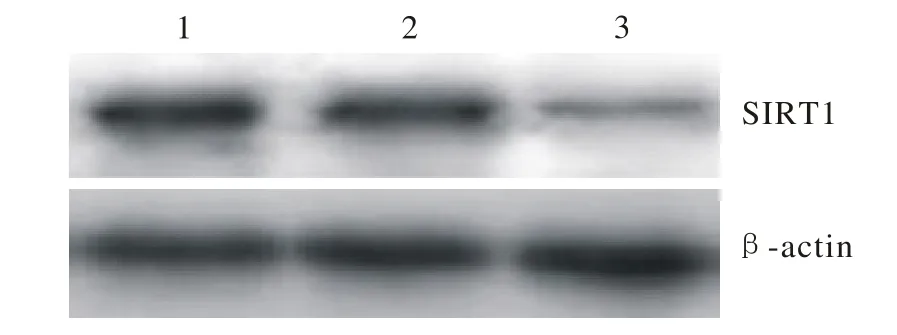
圖 1 Western blot檢測DU145細胞轉染SIRT1 siRNA后SIRT1蛋白表達水平Fig.1 Expression levels of SIRT1 protein in DU145 cells transfected with SIRT1 siRNA Lane 1: Mock group; Lane 2: scramble siRNA group; Lane 3: SIRT1 siRNA group
2 干涉SIRT1基因表達能夠抑制DU145細胞遷移轉染48 h后,轉染SIRT1 siRNA組細胞遷移的數量較Scramble siRNA組小,距離相對較遠。兩組細胞48 h愈合率分別為14.80%±1.9%和98.50%± 3.8%,差異有統計學意義(P<0.01,圖2)。說明轉染SIRT1 siRNA能夠顯著抑制DU145細胞遷移。
3 干涉SIRT1基因表達能夠抑制DU145細胞克隆形成 克隆平板實驗顯示,與轉染Scramble siRNA組相比,SIRT1 siRNA細胞轉染組克隆形成數目減少,兩組細胞克隆形成數分別為234%±4.9%和88%±3.8%,差異有統計學意義(P<0.01)。見圖3。
4 干涉SIRT1基因表達能夠抑制DU145細胞侵襲
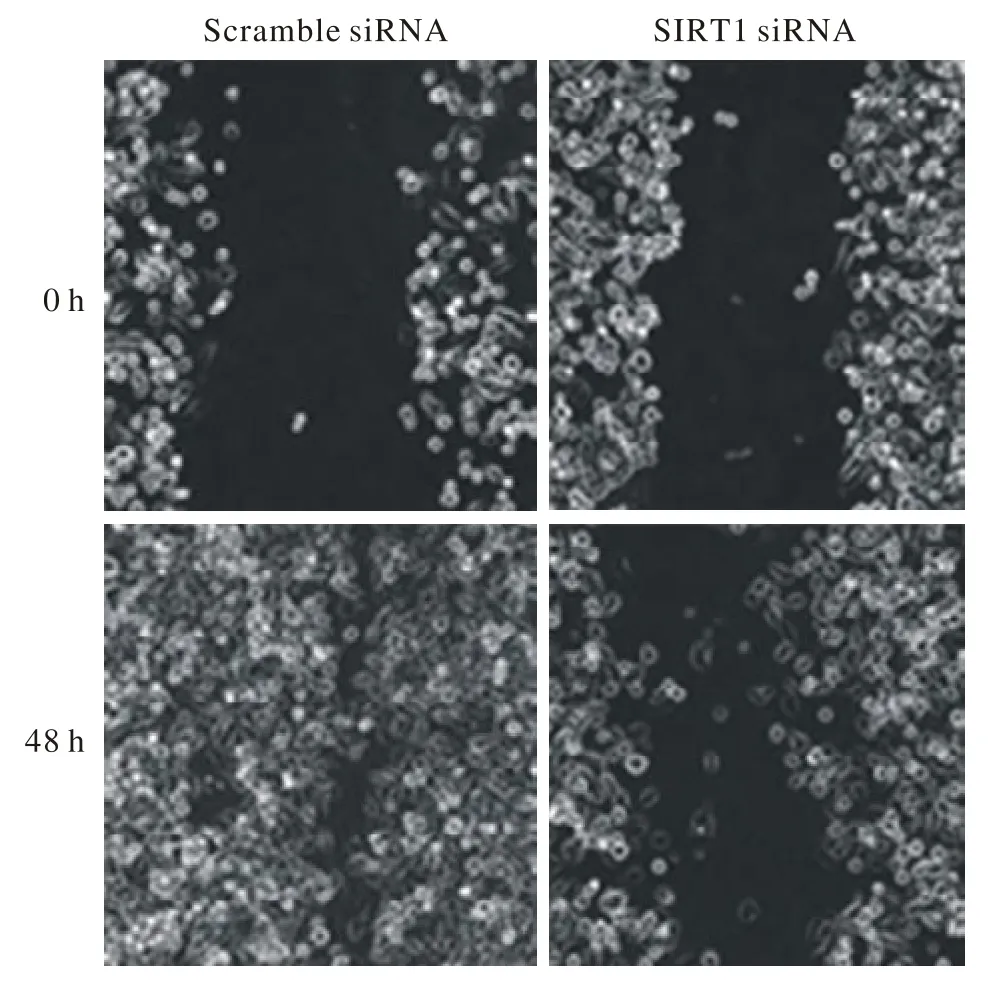
圖 2 劃痕實驗檢測轉染SIRT1 siRNA后DU145細胞的遷移情況Fig.2 Effect of SIRT1 siRNA on DU145 cell migration determined by wound healing assays
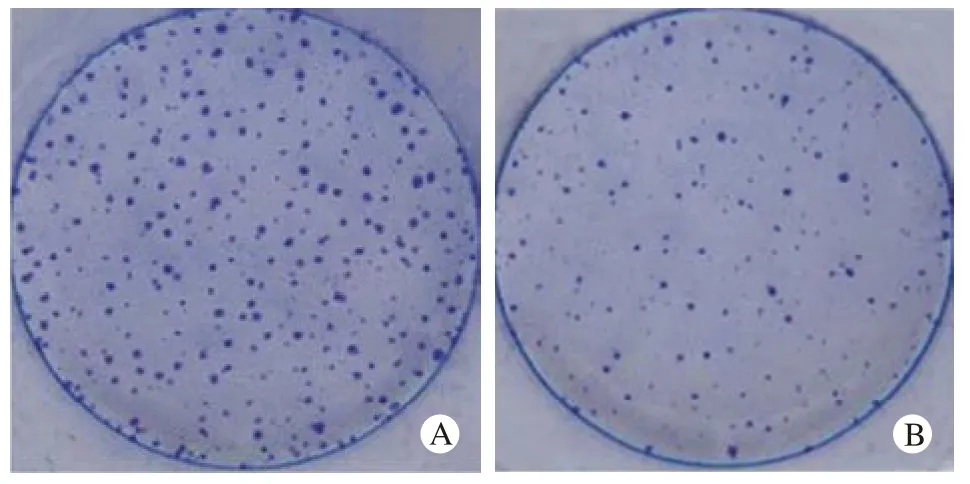
圖 3 平板克隆實驗檢測轉染SIRT1 siRNA DU145細胞的遷移情況Fig.3 Effect of SIRT1 siRNA on DU145 cell migration determined by colony formation assays A: scramble siRNA group; B: SIRT1 siRNA group
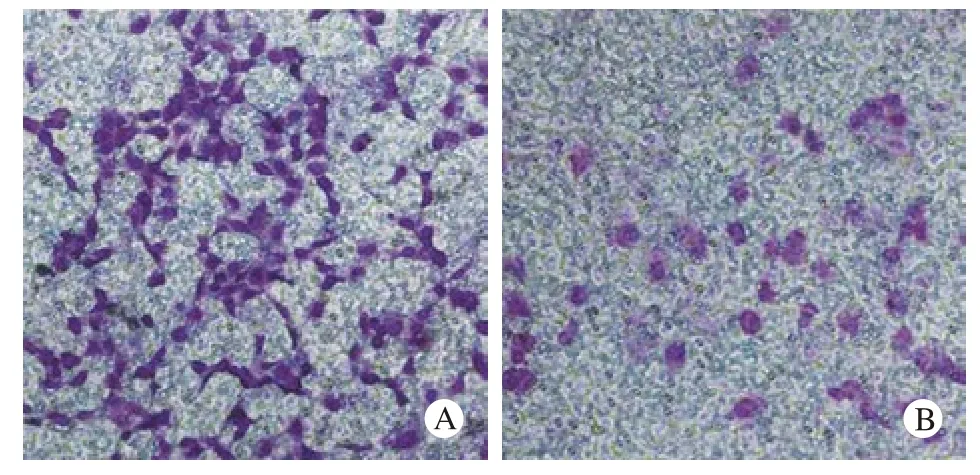
圖 4 Transwell實驗檢測轉染SIRT1 siRNA DU145細胞的遷移情況Fig.4 Effect of SIRT1 siRNA on DU145 cell migration determined by transwell assays A: scramble siRNA group; B: SIRT1 siRNA group
Transwell實驗顯示,SIRT1 siRNA轉染組細胞較Scramble siRNA轉染組細胞的轉移能力明顯下降,這兩組細胞48 h穿過微孔膜的細胞數分別為55.62±7.57、231.67±15.08,差異有統計學意義(P<0.01)。見圖4。
5 干涉SIRT1的表達能夠抑制DU145細胞中MMP2和MMP9基因的表達 Western blot檢測轉染SIRT1 siRNA對DU145細胞中細胞轉移相關蛋白MMP2和MMP9表達的影響。結果顯示,與Scramble siRNA組相比,SIRT1 siRNA組MMP2和MMP9蛋白的表達明顯降低。見圖5。
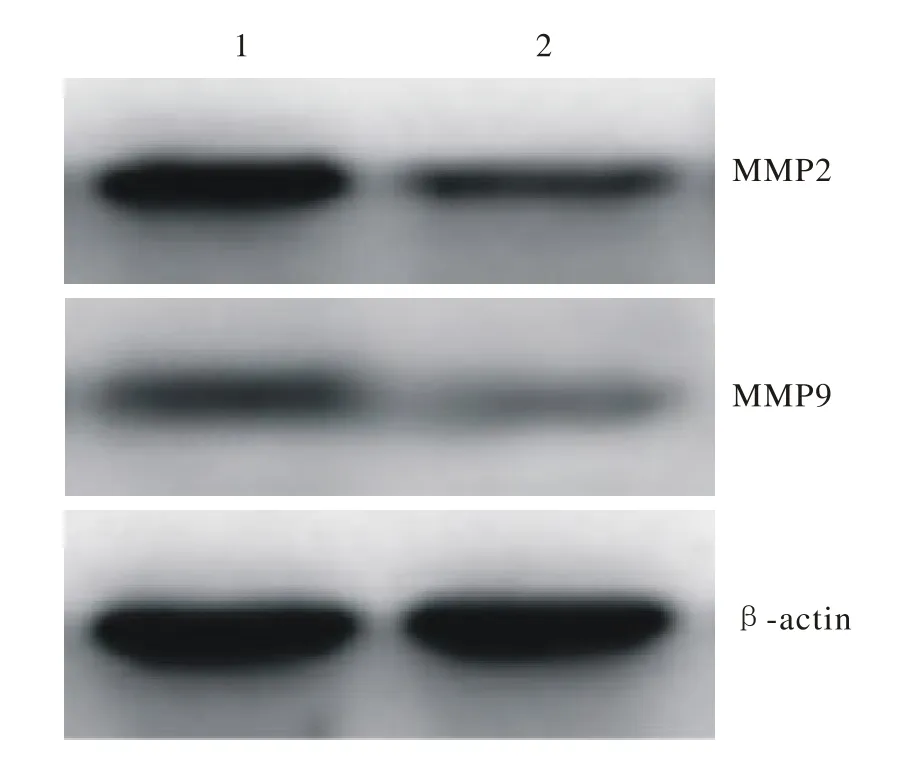
圖 5 Western blot檢測DU145細胞轉染SIRT1 siRNA后MMP2和 MMP9蛋白表達Fig.5 MMP2 and MMP9 protein expression levels in DU145 cells transfected with SIRT1 siRNA detected by Western blot 1: scramble siRNA group; 2: SIRT1 siRNA group
討論
研究已經表明,許多基因可以使腫瘤細胞的運動遷移能力發生改變,如MYC、RACK1等說明腫瘤細胞的運動遷移能力是影響腫瘤轉移的重要因素[10-12]。為了研究SIRT1在前列腺癌中的作用,我們使用RNA干涉的方法下調SIRT1的表達,觀察SIRT1對前列腺癌細胞DU145細胞遷移的影響。
劃痕實驗結果表明,SIRT1 siRNA組發生細胞運動愈合劃痕的比例明顯低于對照組,平板克隆形成實驗也證實,特異性抑制SIRT1表達能夠顯著阻礙DU145遷移。Transwell遷移試驗通過其小室內的微孔膜,檢測細胞變形后運動遷移的能力,是腫瘤細胞轉移能力的重要檢測手段。我們通過Transwell遷移試驗驗證了SIRT1 siRNA組細胞穿過微孔膜發生遷移的細胞數量明顯少于對照組,同劃痕愈合實驗結果相一致。通過腫瘤細胞細胞外基質遷移和入侵是腫瘤轉移發生的關鍵一步,各種癌癥已觀察到其細胞外基質成分的改變[13-15]。一些分子如基質金屬蛋白酶中的MMP2和MMP9可以降解細胞外基質的能力,促使上皮組織基底膜的破壞,使腫瘤細胞透過破損的基底膜發生轉移,參與調節腫瘤的侵襲過程[16-18]。基質金屬蛋白酶參與細胞表面受體的裂解和細胞凋亡配體的釋放(如FAS配體),進而調節腫瘤細胞的浸潤和轉移[13]。我們對兩組細胞中MMP2和MMP9蛋白表達的檢測發現,SIRT1 siRNA組細胞中MMP2和MMP9蛋白表達較Scramble siRNA組顯著下調。這提示SIRT1可能通過調節MMP2和MMP9蛋白的表達水平,影響前列腺癌DU145細胞的侵襲能力。
總之,本實驗表明特異性干涉SIRT1的表達能夠抑制前列腺癌細胞DU145的細胞遷移,可能與下調DU145細胞中MMP-2和MMP-9的蛋白表達有關,其具體機制還需進一步研究。我們后續的工作還會對SIRT1引起腫瘤侵襲、轉移的分子機制進行深入的研究,為SIRT1可能作為人類前列腺癌一個潛在的治療靶點提供實驗依據。
1 Chen J, Li HM, Zhang XN, et al. Dioscin-induced apoptosis of human LNCaP prostate carcinoma cells through activation of caspase-3 and modulation of Bcl-2 protein family[J]. J Huazhong Univ Sci Technolog Med Sci, 2014, 34(1):125-130.
2 Goyal J, Antonarakis ES. Clinical Evaluation of Abiraterone in the Treatment of Metastatic Prostate Cancer[J]. Clin Med Insights Urol, 2013, 2013, (7):1-14.
3 胡小龍,張春陽,于立春,等.抑癌PTEN基因聯合p53基因轉染對前列腺癌PC-3m細胞凋亡的影響[J].解放軍醫學院學報,2014,35(4):369-373.
4 Chen P, Huang Y, Zhang B, et al. EphA2 enhances the proliferation and invasion ability of LNCaP prostate cancer cells[J]. Oncol Lett,2014, 8(1): 41-46.
5 Ye L, Sanders AJ, Sun PH, et al. Capillary morphogenesis gene 2 regulates adhesion and invasiveness of prostate cancer cells[J]. Oncol Lett, 2014, 7(6): 2149-2153.
6 Yuan H, Su L, Chen WY. The emerging and diverse roles of sirtuins in cancer: a clinical perspective[J]. Onco Targets Ther, 2013, 6:1399-1416.
7 Li Y, Wong K, Giles A, et al. Hepatic SIRT1 attenuates hepatic steatosis and controls energy balance in mice by inducing fibroblast growth factor 21[J]. Gastroenterology, 2014, 146(2): 539-549.
8 Hwang BJ, Madabushi A, Jin J, et al. Histone/protein deacetylase SIRT1 is an anticancer therapeutic target[J]. Am J Cancer Res,2014, 4(3): 211-221.
9 Byles V, Zhu L, Lovaas JD, et al. SIRT1 induces EMT by cooperating with EMT transcription factors and enhances prostate cancer cell migration and metastasis[J]. Oncogene, 2012, 31(43):4619-4629.
10 Civenni G, Malek A, Albino D, et al. RNAi-mediated silencing of Myc transcription inhibits stem-like cell maintenance and tumorigenicity in prostate cancer[J]. Cancer Res, 2013, 73(22):6816-6827.
11 Li X, Liu X, Xu W, et al. c-MYC-regulated miR-23a/24-2/27a cluster promotes mammary carcinoma cell invasion and hepatic metastasis by targeting sprouty2[J]. J Biol Chem, 2013, 288(25):18121-18133.
12 Li J, Guo Y, Feng X, et al. Receptor for activated C kinase 1(RACK1): a regulator for migration and invasion in oral squamous cell carcinoma cells[J]. J Cancer Res Clin Oncol, 2012, 138(4):563-571.
13 Hadler-Olsen E, Winberg JO, Uhlin-Hansen L. Matrix metalloproteinases in cancer: their value as diagnostic and prognostic markers and therapeutic targets[J]. Tumour Biol, 2013, 34(4):2041-2051.
14 Li Y, Tan BB, Zhao Q, et al. ZNF139 promotes tumor metastasis by increasing migration and invasion in human gastric cancer cells[J]. Neoplasma, 2014, 61(3): 291-298.
15 Wang HL, Zhou PY, Zhang Y, et al. Relationships between abnormal MMP2 expression and prognosis in gastric cancer: a meta-analysis of cohort studies[J]. Cancer Biother Radiopharm, 2014, 29(4):166-172.
16 DI Carlo A. Matrix metalloproteinase-2 and -9 and tissue inhibitor of metalloproteinase-1 and -2 in sera and urine of patients with renal carcinoma[J]. Oncol Lett, 2014, 7(3):621-626.
17 Stetler-Stevenson WG, Gavil NV. Normalization of the tumor microenvironment: evidence for tissue inhibitor of metalloproteinase-2 as a cancer therapeutic[J]. Connect Tissue Res, 2014, 55(1): 13-19.
18 Wang F, Chang Z, Fan Q, et al. Epigallocatechin-3-gallate inhibits the proliferation and migration of human ovarian carcinoma cells by modulating p38 kinase and matrix metalloproteinase-2[J]. Mol Med Rep, 2014, 9(3): 1085-1089.
Effects of small interfering RNA of SIRT1 on cell migration in prostate cancer DU145 cells
WANG Cui-yao1, WANG Zhong-li2
1Department of Biochemistry and Molecular Biology;2Department of Surgery, the First Affiliated Hospital Liaoning Medical University, Jinzhou 121001, Liaoning Province, China
WANG Zhong-li. Email: wzlaily@126.com
ObjectiveTo observe the effects of double-stranded small interfering RNA (siRNA) of silent information regulator 1 (SIRT1) on the cell migration and the expression levels of MMP2 and MMP9 of matrix metalloproteinases in prostate cancer DU145 cells.MethodsDU145 cells were cultured in vitro and divided into scramble siRNA group and SIRT1 siRNA group randomly. The eff i ciency of SIRT1 siRNA was examined by Western blot, and the cell migration of DU145 cells was assayed by wound healing, colony formation and transwell migration experiment. The protein expression of MMP2 and MMP9 were determined by Western blot.ResultsCompared with scramble siRNA group, the protein expression of SIRT1 in SIRT1 siRNA group decreased, and the colony formation and cell migration of DU145 cells were restrained significantly and the expression of MMP2 and MMP9 also decreased.ConclusionThe cell migration of DU145 cells can be inhibited by down-regulating the expression of SIRT1, and its mechanism may relate to the changes of the expression of MMP2 and MMP9 in matrix metalloproteinases.
silent information regulator 1; siRNA; prostate cancer; DU145
R 581.3
A
2095-5227(2014)12-1253-04
10.3969/j.issn.2095-5227.2014.12.021
時間:2014-08-12 08:45
http://www.cnki.net/kcms/detail/11.3275.R.20140812.0845.002.html
前列腺在體內位置較表淺,基因治療藥物可通過安全的腔內方式直接注射到病灶,加強治療效果,因此,人們開始嘗試一些包括基因治療在內的新方法治療前列腺癌[1-3]。惡性細胞的特性是由許多調節重要的細胞功能包括細胞增殖、遷移運動和侵襲轉移等信號通路來決定的,細胞的增殖和遷移運動是侵襲和轉移的重要步驟[4-5]。沉默信息調節因子1(silent mating type information regulator 1,SIRT1)隸屬于Sirtuin家族,是Ⅲ類去乙酰化酶中的重要一員,通過去乙酰化眾多組蛋白和非組蛋白,參與調控體內眾多病理生理過程[6-7]。其大多數的功能是通過對基因表達過程中起關鍵作用的調節蛋白的特定去乙酰化而實現的,SIRT1的作用靶點包括轉錄因子以及代謝調節中的輔酶因子[7-8]。SIRT1通過和上皮-間質轉換(epithelialto-mesenchymal transition,EMT)相關的轉錄因子作用誘導EMT,進而增加前列腺癌細胞的侵襲和轉移,但具體的機制還不是十分清楚[9]。本研究通過在前列腺癌DU145細胞株中特異性干涉SIRT1,探討下調SIRT1的表達對人前列腺癌DU145細胞株轉移的影響,為使SIRT1作為人類前列腺癌一個潛在的基因治療靶點提供實驗依據。
材料和方法
1 主要試劑與儀器 DMEM培養液(Corning公司);SIRT1 siRNA和Scrambled siRNA(上海吉瑪公司合成);Lipofectamine 2000(Invitrogen);SIRT1 (鼠單克隆抗體,Merck Millipore公司)、MMP2和MMP9(兔多克隆抗體,Cell Signaling Technology公司);HRP標記的山羊抗兔,抗鼠IgG(北京中杉金橋生物技術有限公司);BCA蛋白濃度測定試劑盒(北京碧云天生物技術公司)。BB16UV CO2培養箱(Heraeus);凝膠自動成像儀GDS8000、水浴式電轉印槽、電泳儀(Bio-Rad,美國)。
2014-06-03
王翠瑤,女,學士,高級實驗師。研究方向:腫瘤分子生物學。Email: 1140379451@qq.com
王忠利,男,碩士,主治醫生。Email: wzlaily@126.com
猜你喜歡
小獼猴智力畫刊(2022年9期)2022-11-04 02:31:42
中學生數理化·七年級數學人教版(2021年6期)2021-11-22 07:50:58
中學生數理化·七年級數學人教版(2021年6期)2021-11-22 07:50:58
中學生數理化·七年級數學人教版(2021年6期)2021-11-22 07:50:58
家庭醫學(下半月)(2020年3期)2020-05-30 12:42:02
家庭醫學(下半月)(2020年3期)2020-05-30 12:42:00
家庭醫學(下半月)(2020年3期)2020-05-30 12:42:00
小哥白尼(趣味科學)(2019年6期)2019-10-10 01:01:50
中國生殖健康(2019年7期)2019-01-06 09:27:34
發明與創新(2016年38期)2016-08-22 03:02:52