國外臨床數據挖掘研究熱點的文獻計量學分析
2015-03-13 10:54:57鐘秀梅
醫學信息學雜志 2015年5期
鐘秀梅 崔 雷
(中國醫科大學醫學信息學系 沈陽 110013)
?
國外臨床數據挖掘研究熱點的文獻計量學分析
鐘秀梅 崔 雷
(中國醫科大學醫學信息學系 沈陽 110013)
為了解近年國外臨床數據挖掘領域的研究熱點,以Web of Science收錄的文獻為研究對象,采用文獻計量學方法對“最新高被引文獻-施引文獻”引文網絡進行聚類和分析,總結出國外臨床數據挖掘的研究熱點,以期對我國相關領域研究有所借鑒。
臨床數據挖掘;研究熱點;文獻計量學
1 引言
數據挖掘是在大型數據存儲庫中智能地發現有用信息的技術,經過近些年的快速發展,如今已在商務領域和互聯網領域得到了很好的應用,逐步擴展向更多領域。緊跟大數據時代的步伐,醫療領域數據的數量和質量不斷攀升(尤其是電子病歷數據),這些數據蘊涵著豐富的信息,發掘潛藏于海量數據之中的知識和規律,將會極大地推動醫學創新的開展,因此越來越多的學者對臨床數據的挖掘研究產生了濃厚的興趣。臨床數據挖掘是將數據挖掘的理念和方法運用于臨床數據,包括對臨床數據的概念化、信息提取、數據分析及結果解讀等,以期獲取和補充醫藥學領域知識,支持知識庫構建、臨床決策和臨床實踐[1]。為了解近年國外臨床數據挖掘領域的研究熱點,本文對國外研究學者在該領域發表的文獻進行分析,以認識和把握該領域的科研狀況。
2 資料與方法
2.1 樣本數據獲取
在Web of Science數據庫中進行檢索,“臨床數據挖掘”相關檢索詞,見表1。檢索策略:主題字段=“臨床數據”相關檢索詞 AND “數據挖掘”相關檢索詞,限定文獻類型為“Article”,限定時間為2000-2014年,檢索數據庫SCI-Expanded、CCR-Expanded、IC。數據截止至2014年7月15日。共檢索到3 405條記錄,下載其全記錄與參考引文格式數據作為樣本集A。
按系統抽樣法,將3 405條記錄順序分為7份(前6份每份500條,后1份405條),各抽取50條記錄作為樣本集Bi,i∈{1,2,3,4,5,6,7}。對各樣本集Bi進行人工評判,手工檢驗查準率(查準率即檢出的相關文獻占總檢出數的百分比),總結誤匹配的原因。除數據庫檢索系統原因外,根據其他誤匹配原因,手工篩除樣本集A的文獻記錄。最后,剩余3 356條記錄,形成研究樣本集C。
2.2 引文網絡構建
運用BICOMB2.1[2],對研究樣本集C進行數據處理和特征提取。步驟:(1)導入數據并提取和統計引文。(2)截取被引頻次≥11次的引文作為高被引文獻,獲得131×883“高被引文獻-施引文獻”矩陣a。(3)以2008年后發表的引文作為最新引文,刪除矩陣a中2008年以前的高被引文獻數據,隨后刪除原矩陣中施引總次數為0的施引文獻數據,獲得49×315“最新高被引文獻-施引文獻”矩陣b。
2.3 引文網絡聚類
運用gCLUTO1.0[3],對矩陣b進行聚類分析。步驟:(1)導入數據并聚類:重復二分法、余弦相似函數、I2標準函數。(2)調整聚類類群數,選擇類內相似度(Isim)較高而類間相似度(Esim)較低的聚類結果。(3)文獻內容較基礎或較綜合時,往往會引用多方面內容,在聚類結果中的表現是:以高描述度文獻和高區分度文獻出現在多個類群中,進而降低類內相似性,提高類間相似性,即削弱各類的特異性。為此本研究提出,若同一施引文獻在一半以上類群的高描述度文獻或高區分度文獻中出現,則視為基礎性或綜合性施引文獻;以此為矩陣精簡條件,將這類文獻從矩陣b中刪除。(4)對矩陣c循環執行步驟(1)~(3),至無基礎性或綜合性施引文獻為止。(5)最終為49×312矩陣c聚類。其中,高描述度文獻是指使各個類群類內相似性較高的特征性施引文獻;高區分度文獻是指使各個類群類間差異度較高的特征性施引文獻。
2.4 引文網絡分析
根據聚類結果,以最新高被引論文為臨床數據挖掘領域的知識基礎,將高描述度及高區分度的施引文獻作為該領域的研究前沿,總結其研究主旨,進而獲得領域內研究熱點。
3 結果與分析
3.1 數據有效性檢驗
檢驗各樣本集Bi的查準率,結果分別為98%(49/50)、92%(46/50)、96%(48/50)、100%(50/50)、98%(49/50)、100%(50/50)、98%(49/50),均值為97.42%(341/350)。因此,檢索結果具有較高查準率。分析影響查準率的原因包括:(1)數據庫檢索系統錯誤,在所有錯誤中占比為37.5%(3/8)。(2)醫學意義上的“PACS”與其他縮寫意義的誤匹配,在所有錯誤中占比為62.5%(5/8)。故剔除“PACS”誤匹配文獻條目,形成新樣本集C用于研究是較為有效的。此外,在各樣本集Bi中發現縮寫詞均會同全稱一并出現在摘要中,故以全稱檢索醫院信息系統(HIS)等的相關文獻是可行的。
3.2 矩陣精簡條件合理性探查
本研究以“同一施引文獻在一半以上類群的高描述度文獻或高區分度文獻中出現,視為基礎性或綜合性施引文獻,將這類文獻從矩陣b中刪除”為矩陣精簡條件。結果顯示滿足此條件的有3篇。了解具體內容后發現,其主題或基礎、或宏觀、或綜合,廣泛涉及臨床數據挖掘的各方面。此結果說明,本研究采取的矩陣精簡條件是合理的。
3.3 引文網絡聚類
以“2008年后發表且樣本集C中被引頻次>11次”為篩選條件,共獲得49篇最新高被引文獻。以這49篇最新高被引文獻為基礎,構建出矩陣c并進行聚類,最終聚為6類,其結果見表2、圖1。

表2 49×312矩陣c聚類情況
注:RPHC為最新高被引文獻;D&D為高描述度文獻和高區分度文獻。

圖1 49×312矩陣c聚類結果 注:a圖中,山丘的高度越高代表類內相似性越高,體積越大代表類群包含對象越多。
3.4 引文網絡分析
3.4.1 概述 引文網絡聚類分析結果顯示近年該領域研究分為6個方向,見表3。
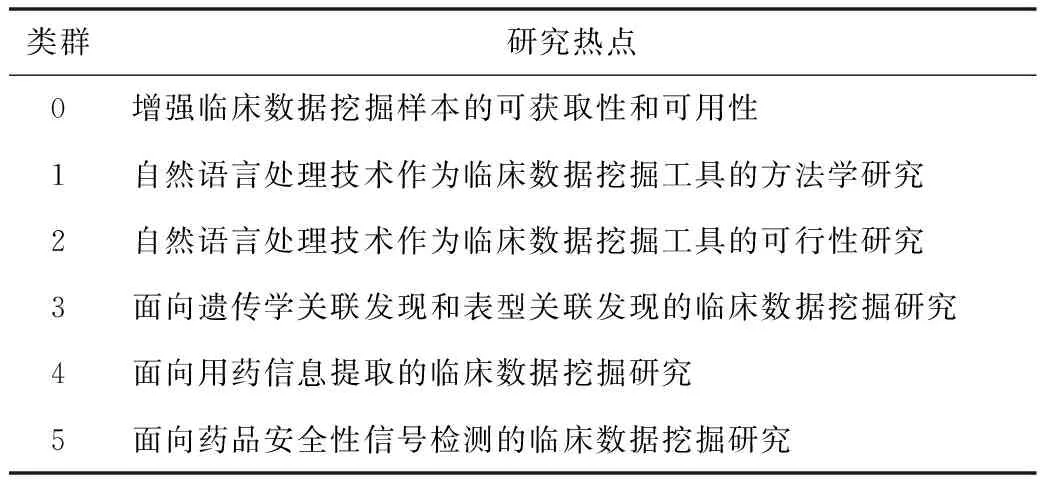
表3 近年國外臨床數據挖掘領域6大研究熱點
3.4.2 增強臨床數據挖掘樣本的可獲取性和可用性 美國是衛生信息技術(Health Information Technology,HIT)發展的前沿陣地,代表著電子病歷(Electronic Medical Records, EMR)推廣與使用的先進水平。DesRoches等[4]和Jha等[5]分別在醫師個體水平和醫院水平調查了美國EMR系統的應用現狀,其結果表明功能不齊全、互操作性不好及技術支持人員不夠是阻礙其應用的基本原因,直接影響用戶接受度和滿意度,也影響EMR使用的利弊比較和書寫質量,進而造成臨床數據挖掘樣本獲取不易、質量不高。2010年美國提出《衛生信息技術促進經濟和臨床健康法案》(Health Informatiom Technology for Economic and Clinical Health,HITECH)并施行,以期促進HIT的全面推廣以及EMR的格式規范化[6-7]。隨著HITECH的實施與推進,美國公眾逐漸認可EMR系統的使用,認為其使用益處大于隱私風險,這更加激勵研究者對HIT的完善,進而提高臨床數據挖掘樣本的可獲取性和可用性[8-12]。
3.4.3 自然語言處理技術作為臨床數據挖掘工具的方法學研究 臨床數據包含大量自由文本,如臨床醫囑、出院小結等,因此自然語言處理(Natural Language Processing, NLP)技術成為臨床數據挖掘的必要工具。對臨床文本這一特定領域信息載體進行分析,需將NLP一般方法進行領域具象化,即要具體適應特定領域,如MetaMap、生物學信息與臨床信息整合(i2b2)工作臺、cTAKES、ConText算法及特定用于結腸鏡檢查信息提取的算法等都是用于臨床文本處理的NLP工具[13-20]。這些NLP工具大多采用基于規則的機器學習型算法[16-20]。此外這些工具在命名體識別上表現較好,但在否定識別、詞義消歧以及時序判定上仍有待提高[13,16,18,21]。
3.4.4 自然語言處理技術作為臨床數據挖掘工具的可行性研究 基于臨床自由文本的NLP工具日漸成熟,將NLP用于臨床數據挖掘的應用研究也日益增多。從i2b2工作臺的應用中可窺其一二:2008-2013年,有多位學者致力于從臨床文本中自動識別和分析患者吸煙狀況[22-23]、肥胖癥及其并發癥[24]、手術后并發癥[25]等信息,也有學者致力于研究受保護健康信息的自動識別和自動去標識化(即去除患者身份信息,以防患者信息泄露)[26-28]。由此看出NLP技術作為臨床數據挖掘工具的可行性研究主要處在識別階段,而在關系提取上的研究相對較少。此外,Chapman等[29]總結NLP處理臨床文本的障礙,Fan等[30]提出臨床文本句法解析不適當時的指導思想。
3.4.5 面向遺傳學關聯發現和表型關聯發現的臨床數據挖掘研究 遺傳學數據不屬于臨床數據,將患者的臨床數據和遺傳學數據結合起來進行挖掘是當前轉化醫學研究的一個突破口。2007年美國啟動電子病歷與基因組學網絡項目[31],旨在“結合生物資料庫與EMR系統進行大規模、高通量的遺傳學研究”。自此一大批研究[32-39]致力于結合EMR數據和大型生物資料庫進行遺傳學關聯的分析與發現。早前重在找尋或建立合適的可與EMR相鏈接的生物資料庫[31-32]。近年主要轉向以下3方面研究:(1)結合EMR與生物資料庫進行全基因組關聯研究(GWAS)[31,33-37,39-40]。(2)結合EMR與生物資料庫,進行全表型組關聯研究(PheWAS),也稱“反GWAS”[41-43]。(3)結合EMR與藥學及藥物基因組學,構建用藥適應癥資源庫[44-45]。這些研究在時間上是相互交叉的,在理念上也存在相互繼承和借鑒。
3.4.6 面向用藥信息提取的臨床數據挖掘研究 藥物治療是醫療活動的重要組成部分,在疾病診療過程中具有重要作用。早前,多位學者分別運用BioMedLEE和MedLEE系統、商業化NLP工具、MedEx系統、SecTag算法等工具從臨床文本中自動提取用藥信息,以期探索疾病的用藥知識,進而構建疾病用藥知識庫[46-49]。近年i2b2項目組織了20個團隊開展臨床文本的用藥信息提取工具方面的研究,取得一定成果。研發出的這些工具在識別和提取藥品名稱、用藥劑量、用藥途徑和用藥頻率上均具有較好表現,在識別和提取用藥持續時間和用藥原因上卻表現不佳[50-52]。但EMR在用藥信息提取上仍具有巨大潛力,如Wilke等[44]指出EMR在藥物基因組學中扮演著新的重要角色。
3.4.7 面向藥品安全性信號檢測的臨床數據挖掘研究 2004年后i2b2項目[53]、歐盟藥品不良反應監測(EU-ADR)項目[54]、觀察醫療結果合作組織項目[55]等相繼啟動。隨后歐美各國組織大量研究者參與,其中應用電子健康檔案(Electronic Health Records,EHR)或EMR挖掘藥品安全性信號便是其研究方向之一。已有研究證明,將其作為除藥品不良事件自發報告外的另一補充數據源,用于藥物警戒是可行的[56-57]。近年許多研究人員采用不同的信息平臺、自然語言處理工具、藥物領域本體和知識庫、挖掘模式,將其用于“藥品-不良事件”間關聯和“藥物間相互作用-不良事件”間關聯的挖掘[58-59];也有研究人員將自發報告與EHR聯合使用進行藥品安全信號挖掘[60]。但EHR或EMR信息的錯綜復雜性,使這類研究不可避免受混雜因素影響,最近(2014年)的研究開始尋找應對辦法,以控制混雜因素對利用EHR檢測藥品不良反應的影響[61]。
4 結語
本研究特色與創新在于:(1)抽取樣本進行誤匹配調查和修正。(2)以最新高被引論文構建引文網絡。(3)將出現在多個類群中的特征性施引文獻作為基礎性或綜合性文獻并刪除。本研究結果顯示,2008年以來臨床數據挖掘的發展總體呈現如下特點:(1)挖掘樣本以文本為主。主要包括EMR、EHR、生物醫學文獻數據庫中的文本信息,但同時也注重與其他類型信息的結合,如基因組數據以及藥品不良事件自發申報系統中信息。(2)挖掘工具以NLP工具為主。由于樣本主要是文本,因此首要工具是NLP工具。(3)面向領域以藥物為主。主要包括用藥信息提取以及藥品不良事件和藥物間相互信號發現等。
在對臨床數據挖掘研究熱點的分析中,筆者發現以領域本體、詞表或特征詞匯為基礎,借助NLP等工具,識別和提取臨床信息,以發現潛在信息或關聯,是臨床數據挖掘的常規方法。研究和深入理解臨床各領域的表達特點對臨床數據挖掘是非常重要的。為此希望能就此展開相關研究,運用已有本體和詞表或構建新的相關本體或詞表,進行臨床信息識別和提取。
1 Epstein I.Clinical Data Mining:integrating practice and research[M].USA:Oxford University Press,2009.
2 崔雷,劉偉,閆雷,等.文獻數據庫中書目信息共現挖掘系統的開發[J].現代圖書情報技術,2008,(8):70-75.
3 Rasmussen M,Karypis G.gCLUTO-an interactive clustering, visualization, and analysis system[EB/OL].[2014-07-28].http://glaros.dtc.umn.edu/gkhome/node/174.
4 DesRoches CM,Campbell EG,Rao SR,et al.Electronic Health Records in Ambulatory Care——a national survey of physicians[J].N Engl J Med,2008,359(1):50-60.
5 Jha AK,DesRoches CM,Campbell EG,et al.Use of Electronic Health Records in U.S. Hospitals[J].N Engl J Med,2009,360(16):1628-1638.
6 Blumenthal D,Tavenner M.The “Meaningful Use” Regulation for Electronic Health Records[J].N Engl J Med,2010,363(6):501-504.
7 Blumenthal D.Launching HITECH[J].N Engl J Med,2010,362(5):382-385.
8 Kho AN,Pacheco JA,Peissig PL,et al.Electronic Medical Records for Genetic Research: results of the eMERGE consortium[J].Sci Transl Med,2011,3(79):79re1.
9 Gaylin DS,Moiduddin A,Mohamoud S,et al.Public Attitudes about Health Information Technology, and Its Relationship to Health Care Quality, Costs, and Privacy[J].Health Serv Res,2011,46(3):920-938.
10 Zhang M,Shubina M,Morrison F,et al.Following the Money: copy-paste of lifestyle counseling documentation and provider billing[J].BMC Health Serv Res,2013,(13):377.
11 Blavin FE,Buntin MJ,Friedman CP.Alternative Measures of Electronic Health Record Adoption Among Hospitals[J].Am J Manag Care,2010,16(12S HIT):293-301.
12 Frimpong JA,Jackson BE,Stewart LM,et al.Health Information Technology Capacity at Federally Qualified Health Centers: a mechanism for improving quality of care[J].BMC Health Serv Res,2013,(13):35.
13 Aronson AR,Lang FM.An Overview of MetaMap: historical perspective and recent advances[J].J Am Med Inform Assoc,2010,17(3):229-236.
14 Uzuner O,Solti I,Cadag E.Extracting Medication Information from Clinical Text[J].J Am Med Inform Assoc,2010,17(5):514-518.
15 Patrick J,Li M.High Accuracy Information Extraction of Medication Information from Clinical Notes: 2009 i2b2 medication extraction challenge[J].J Am Med Inform Assoc,2010,17(5):524-527.
16 de Bruijn B,Cherry C,Kiritchenko S,et al.Machine-learned Solutions for Three Stages of Clinical Information Extraction: the state of the art at i2b2 2010[J].J Am Med Inform Assoc,2011,18(5):557-562.
17 Savova GK,Masanz JJ,Ogren PV,et al.Mayo Clinical Text Analysis and Knowledge Extraction System (cTAKES): architecture, component evaluation and applications[J].J Am Med Inform Assoc, 2010,17(5):507-513.
18 Harkema H,Dowling JN,Thornblade T,et al.ConText: an algorithm for determining negation, experiencer, and temporal status from clinical reports[J].J Biomed Inform,2009,42(5):839-851.
19 Denny JC,Peterson JF,Choma NN,et al.Extracting Timing and Status Descriptors for Colonoscopy Testing from Electronic Medical Records[J].J Am Med Inform Assoc,2010,17(4):383-388.
20 Harkema H,Chapman WW,Saul M,et al.Developing a Natural Language Processing Application for Measuring the Quality of Colonoscopy Procedures[J].J Am Med Inform Assoc,2011,18(S1):150-156.
21 Garla VN,Brandt C.Knowledge-based Biomedical Word Sense Disambiguation: an evaluation and application to clinical document classification[J].J Am Med Inform Assoc,2013,20(5):882-886.
22 Uzuner O,Goldstein I,Luo Y,et al.Identifying Patient Smoking Status from Medical Discharge Records[J].J Am Med Inform Assoc,2008,15(1):14-24.
23 Savova GK,Ogren PV,Duffy PH,et al.Mayo Clinic NLP System for Patient Smoking Status Identification[J].J Am Med Inform Assoc,2008,15(1):25-28.
24 Uzuner O.Recognizing Obesity and Comorbidities in Sparse Data[J].J Am Med Inform Assoc,2009,16(4):561-570.
25 Murff HJ,FitzHenry F,Matheny ME,et al.Automated Identification of Postoperative Complications within an Electronic Medical Record Using Natural Language Processing[J].J Am Med Assoc,2011,306(8):848-855.
26 Ferrández O,South BR,Shen S,et al.Evaluating Current Automatic De-identification Methods with Veteran's Health Administration Clinical Documents[J].BMC Med Res Methodol,2012,(12):109.
27 Neamatullah I,Douglass MM,Lehman LW,et al.Automated De-identification of Free-text Medical Records[J].BMC Med Inform Decis Mak,2008,(8):32.
28 McMurry AJ,Fitch B,Savova G,et al.Improved De-identification of Physician Notes Through Integrative Modeling of Both Public and Private Medical Text[J].BMC Med Inform Decis Mak,2013,(13):112.
29 Chapman WW,Nadkarni PM,Hirschman L,et al.Overcoming Barriers to NLP for Clinical Text: the role of shared tasks and the need for additional creative solutions[J].J Am Med Inform Assoc,2011,18(5):540-543.
30 Fan JW,Yang EW,Jiang M,et al.Syntactic Parsing of Clinical Text: guideline and corpus development with handling ill-formed sentences[J].J Am Med Inform Assoc,2013,20(6):1168-1177.
31 McCarty CA,Chisholm RL,Chute CG,et al.The eMERGE Network: a consortium of biorepositories linked to electronic medical records data for conducting genomic studies[J].BMC Med Genomics,2011,26:4-13.
32 Roden DM,Pulley JM,Basford MA,et al.Development of a Large-scale De-identified DNA Biobank to Enable Personalized Medicine[J].Clin Pharmacol Ther,2008,84(3):362-369.
33 Ritchie MD,Denny JC,Crawford DC,et al.Robust Replication of Genotype-phenotype Associations Across Multiple Diseases in an Electronic Medical Record[J].Am J Hum Genet,2010,86(4):560-572.
34 Kullo IJ, Fan J,Pathak J,et al.Leveraging Informatics for Genetic Studies: use of the electronic medical record to enable a genome-wide association study of peripheral arterial disease[J]. J Am Med Inform Assoc,2010,17(5):568-574.
35 Kohane IS.Using Electronic Health Records to Drive Discovery in Disease Genomics[J].Nat Rev Genet,2011,12(6):417-428.
36 Denny JC, Ritchie MD, Crawford DC,et al.Identification of Genomic Predictors of Atrioventricular Conduction: using electronic medical records as a tool for genome science[J].Circulation,2010,122(20):2016-2021.
37 Kho AN,Hayes MG,Rasmussen-Torvik L,et al.Use of Diverse Electronic Medical Record Systems to Identify Genetic Risk for Type 2 Diabetes within a Genome-wide Association Study[J].J Am Med Inform Assoc,2012,19(2):212-218.
38 Carroll RJ,Thompson WK,Eyler AE,et al.Portability of an Algorithm to Identify Rheumatoid Arthritis in Electronic Health Records[J].J Am Med Inform Assoc,2012,19(e1):162-169.
39 Kullo IJ,Ding K,Jouni H,A Genome-wide Association Study of Red Blood Cell Traits Using he Electronic Medical Record[J].PLoS One,2010,5(9):13011.
40 Denny JC,Crawford DC,Ritchie MD,et al.Variants Near FOXE1 are Associated with Hypothyroidism and Other Thyroid Conditions: using electronic medical records for genome- and phenome-wide studies[J].Am J Hum Genet,2011,89(4):529-542.
41 Denny JC,Ritchie MD,Basford MA,et al.PheWAS: demonstrating the feasibility of a phenome-wide scan to discover gene-disease associations[J].Bioinformatics,2010,26(9):1205-1210.
42 Heatherly RD,Loukides G,Denny JC,et al.Enabling Genomic-phenomic Association Discovery Without Sacrificing Anonymity[J].PLoS One,2013,8(2):53875.
43 Denny JC,Bastarache L,Ritchie MD,et al.Systematic Comparison of Phenome-wide Association Study of Electronic Medical Record Data and Genome-wide Association Study Data[J].Nat Biotechnol,2013,31(12):1102-1110.
44 Wilke RA,Xu H,Denny JC,et al.The Emerging Role of Electronic Medical Records in Pharmacogenomics[J].Clin Pharmacol Ther,2011,89(3):379-386.
45 Wei WQ,Cronin RM,Xu H,et al.Development and Evaluation of an Ensemble Resource Linking Medications to Their Indications[J].J Am Med Inform Assoc, 2013,20(5):954-961.
46 Chen ES,Hripcsak G,Xu H,et al.Automated Acquisition of Disease Drug Knowledge from Biomedical and Clinical Documents: an initial study[J].J Am Med Inform Assoc,2008,15(1):87-98.
47 Jagannathan V,Mullett CJ,Arbogast JG,et al.Assessment of Commercial NLP Engines for Medication Information Extraction from Dictated Clinical Notes[J].Int J Med Inform,2009,78(4):284-291.
48 Xu H,Stenner SP,Doan S,et al.MedEx: a medication information extraction system for clinical narratives[J].J Am Med Inform Assoc,2010,17(1):19-24.
49 Denny JC,Spickard A,Johnson KB,et al.Evaluation of a method to identify and categorize section headers in clinical documents[J].J Am Med Inform Assoc,2009,16(6):806-815.
50 Doan S,Bastarache L,Klimkowski S,et al.Integrating Existing Natural Language Processing Tools for Medication Extraction from Discharge Summaries[J].J Am Med Inform Assoc,2010,17(5):528-531.
51 Hamon T,Grabar N.Linguistic Approach for Identification of Medication Names and Related Information in Clinical Narratives[J].J Am Med Inform Assoc,2010,17(5):549-554.
52 Deléger L,Grouin C,Zweigenbaum P.Extracting Medical Information from Narrative Patient Records: the case of medication-related information[J].J Am Med Inform Assoc,2010,17(5):555-558.
53 Murphy SN,Weber G,Mendis M,et al.Serving the Enterprise and Beyond with Informatics for Integrating Biology and the Bedside (i2b2)[J].J Am Med Inform Assoc,2010,17(2):124-130.
54 Trifirò G,Pariente A,Coloma PM,et al.Data Mining on Electronic Health Record Databases for Signal Detection in Pharmacovigilance: which events to monitor?[J]Pharmacoepidemiol Drug Saf,2009,18(12):1176-1184.
55 Stang PE,Ryan PB,Racoosin JA,et al.Advancing the Science for Active Surveillance: rationale and design for the observational medical outcomes partnership[J].Ann Intern Med,2010,153(9):600-606.
56 Wang X,Hripcsak G,Markatou M,et al.Active Computerized Pharmacovigilance Using Natural Language Processing, Statistics, and Electronic Health Records: a feasibility study[J].J Am Med Inform Assoc,2009,16(3):328-337.
57 Tatonetti NP,Denny JC,Murphy SN,et al.Detecting Drug Interactions from Adverse-event Reports: interaction between paroxetine and pravastatin increases blood glucose levels[J].Clin Pharmacol Ther,2011,90(1):133-142.
58 Sittig DF,Hazlehurst BL,Brown J,et al.A Survey of Informatics Platforms that Enable Distributed Comparative Effectiveness Research Using Multi-institutional Heterogenous clinical Data[J].Med Care,2012,(50S):S49-59.
59 Haerian K,Varn D,Vaidya S,et al.Detection of Pharmacovigilance-related Adverse Events Using Electronic Health Records and Automated Methods[J].Clin Pharmacol Ther,2012,92(2):228-234.
60 Harpaz R,Vilar S,Dumouchel W,et al.Combing signals from Spontaneous Reports and Electronic Health Records for Detection of Adverse drug Reactions[J].J Am Med Inform Assoc,2013,20(3):413-419.
61 Li Y,Salmasian H,Vilar S,et al.A Method for Controlling Complex Confounding Effects in the Detection of Adverse Drug Reactions Vsing Electronic Health Records[J].J Am Med Inform Assoc,2014,21(2):308-314.
Bibliometrics Analysis on the Hot Spots of Foreign Clinical Data Mining Research
ZHONGXiu-mei,CUILei,
DepartmentofMedicalInformatics,ChinaMedicalUniversity,Shenyang110013,China
In order to find out the hot spots of foreign clinical data mining research in recent years, the paper carries out bibliometric analysis on the literatures included in Web of Science, “the latest high cited literatures-citing literature” citation network is clustered and analyzed, the research hot spots of foreign clinical data mining are summarized, so as to provide references for related research in China.
Clinical data mining; Research hot spots; Bibliometrics
2014-12-31
鐘秀梅,在讀碩士研究生,發表論文2篇;通訊作者:崔雷,教授,博士生導師。
R-058
A 〔DOI〕10.3969/j.issn.1673-6036.2015.05.012
猜你喜歡
體育科技文獻通報(2022年3期)2022-05-23 13:46:54
天津外國語大學學報(2021年3期)2021-08-13 08:32:18
遼金歷史與考古(2021年0期)2021-07-29 01:06:54
大眾投資指南(2021年35期)2021-02-16 01:06:26
科技傳播(2019年22期)2020-01-14 03:06:54
民用飛機設計與研究(2019年4期)2019-05-21 07:21:24
汽車工程學報(2017年2期)2017-07-05 08:13:02
電力與能源(2017年6期)2017-05-14 06:19:37
中國中醫藥信息雜志(2016年7期)2016-12-01 06:07:55
信息通信技術(2015年6期)2015-12-26 01:16:46