Abstracts and Key Words
2016-02-01 10:36:17Contents
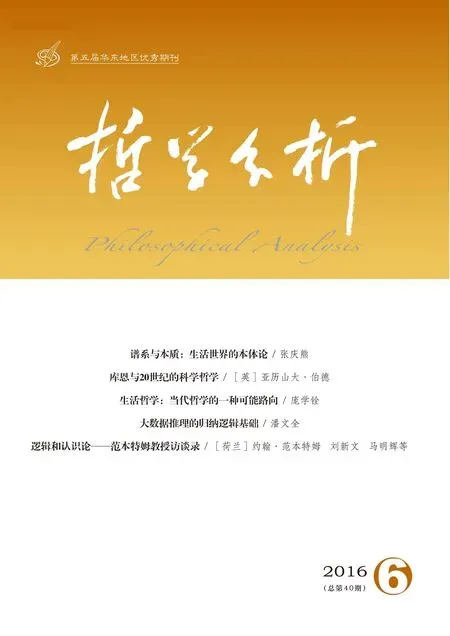
哲學分析 2016年6期
Contents
s and Key Words
● Spectrum and Essence: The Ontology of Life World
ZHANGQingxiong
Abstract: Husserl tried to establish the ontology of life world in his later years. He regarded the life world as the hometown that all meanings came from and went back. He also associated the life world with science and philosophy in order to clarify the clues and rules of how knowledge takes place and develops. According to Husserl’s view, relations of the basis and the based exist in the constitution of knowledge, and the degree sequence of evidence exists in various forms of knowledge. Husserl set up the ontology of life world for the purpose of finding the universal connections and essential unity in all kinds of life forms and various knowledge spectrums. Husserl insisted on fighting against the relativism in his time. We are able to gain some inspirations and theoretical reasons from Husserl’s ontology of life world to reject the postmodern relativism in our current era.
spectrum; essence; the life world; postmodernism; relativism
● Phenomenology and Life: Husserl’s Project
YOUCongqi
Abstract: What is the relationship between life and phenomenology? Husserl has provided us with two alternatives. The one holds that phenomenology is distanced from life, whereas the other considers phenomenology close to life. I contend that by reading Husserl, neither aspect should be neglected. They do not contradict each other. In order to unfold this point, my paper suggests that the transcendental phenomenology is not sufficient. Granted that transcendental phenomenology can be viewed as the ultimate goal in the phenomenological thinking of Husserl, as long as only it provides us with the way to reach the radical reflection. Yet it is not the way to deal with the seemingly contradictory relationship between life and phenomenology. Instead of that, only phenomenological psychology can pave the way to it.
Key words: Husserl; phenomenological psychology; life; transcendental phenomenology
● Moments, Differential Spaces and Rhythm Analysis of the Critique of Everyday Life: A Case Study of Henri Lefebvre
LIUHuaiyu
Abstract: Critique of everyday life has been one of the general philosophical problems since 20th century. Henri Lefebvre was one of the most important promoters in this tendency and one of its typical epitomes. Different from many other contemporary philosophers who took existential viewpoints instead of a dialectically epistemological view of history, he was a philosopher of dialectic who highlighted the trinity of Hegel, Marx and Nietzsche. He provided us with several perspectives concerning dialectical critique of everyday life during the different phases of his long lifetime. In his early academic life, he proposed an imagination of momentary revolution of life, based on a totalizing dialectical stand; while during his later life, devoting himself to the dissolution of this totalization, he put forward respectively differential urban space dialectics and a philosophical method of embodied rhythm analysis. The above transitions in his philosophical vision not only showed the dilemma that Western leftists were facing at his time, but also embodied the persistence of dialectic in the post modern context.
Key words: critique of everyday life; Henri Lefebvre; dialectics; space; rhythm
● Kuhn and Philosophy of Science in the Twentieth Century
AlexanderBird
Abstract: In the 1960s, the relationship between philosophy of science and “core” philosophy, earlier so close, changed radically, Kuhn and his contemporaries raised other problems that were original to the philosophy of science, only to find the development of more or less relativistic and constructivistic history and sociology of science. Traditional philosophical explanations of theory choice are excluded, and sociological explanations take precedence. Philosophy of science further begins to distance from central concerns in epistemology and metaphysics. Incommensurability thesis can be seen as a far more radical departure from positivism, and for all the apparently dramatic implications of incommensurability, it can be seen as decidedly conservative and old-fashioned in its commitments, but Kuhn came close to breaking the mould. Ironically, just as philosophy of science was beginning to open itself up to naturalism, a priori approach occurred in Kuhn’s thought, and when Kuhn’s philosophy of science shifted its focus away from paradigms and onto incommensurability, again philosophical currents have been in the opposite direction. With increasing interest in cognitive science and artificial intelligence, paradigm-like notions, such as case-based reasoning, have become familiar to the relevant philosophers; when Kuhn rejected aspects of contemporary philosophy of science, he was unintentionally aligning himself more loosely to positivism. Precisely because philosophy of science has become more naturalized and more open to cognitive science and artificial intelligence, the time has come to reappraise those naturalistic elements of Kuhn’s thought that he himself abandoned.
Key words: Kuhn; philosophy of science; naturalism; positivism
● The Shadow of Kant and Transcendence of Fichte: The Highest Principle ofWissenschaftslehreRevisited
NIYicai
Abstract: In the “transcendental deduction” ofCritiqueofPureReason, 2nd edition, published in the year of 1787, Kant’s attempts in interpreting the conditions for the use of categories of understanding generated the thesis of self-consciousness, which would be crucial for the later-called idealist philosophy. As the direct philosophical successor of Kant, Fichte attempted to centralize the thesis of self-consciousness within his own system ofWissenschaftslehre, although the very thesis still remained as a meta-problem for Kant. Fichte’s philosophical project aimed at getting rid of Kant’s shadow and bringing out the thesis of self-consciousness in a bright new way. The interpretation here focused on the discussion concerning the fundamental principle before and in Fichte’s Jena systems ofWissenschaftslehre, is intended to reveal that how Fichte resolves the antinomies left by Kant and transcends the old problem domain of philosophy successfully.
Key words: self-consciousness;Wissenschaftslehre; original insight; internal constitution of consciousness
● Life Philosophy: A Possible Trend of Development of Contemporary Philosophy
PANGXuequan
Abstract: Pessimism in philosophy theory of crisis and finality pervaded in the late 20th century western philosophy since Wittgenstein and Heidegger expressed disappointment towards traditional western speculative philosophy and worked through traditional philosophy problems. Therefore, it was of reality and urgency to find a way out for contemporary philosophy. And the efforts on saving crisis of philosophy made contemporary philosophy head for diverse scenarios. The scene in this article briefly showed a kind of conversion of philosophy, which indicated that as a special way of thinking, philosophy had no finality nor wouldn’t come to an end. Besides, it was exploited and developed in the search for new way out. The research field and content was more rich and colorful, while the study space was more open and liberal as well. The sign lay in the transformation of practical reason and the prosperity of practical philosophy. Meanwhile, the revival of life philosophy marked the return to practice and life, which is an important trend of contemporary philosophy development. The article discussed three prerequisite and basic questions on carrying out the research of life philosophy further: the relationship between life philosophy and philosophy of life, the relationship between life and living world, and the meaning and characteristics of life philosophy. It indicated that life philosophy must face to the living world itself, return to the living practice, and pay attention to the development of this age.
Key words: contemporary philosophy; trends of development; life philosophy
● The Normativity of Human: Creation and Change of Norms
ClaudeDebru
Abstract: Georges Canguilhem considers the “biological normativity” as the organism creates the new functional norms in the pathological state. Pr. Claude Debru analyses how Piaget studies the origin of the children’s conscience of moral normativity in terms of cognitive psychology, and how Piaget elaborates the evolution of this conscience in different ages. Meanwhile, he analyses how Tomasello compares the different effects of the cultural factor in the ontogenesis between non-humain primates and children, and Tomasello points out the fundamental signification of the “constructive function of language” for the development of human’s normative conscience. Debru tries to connect Canguilhem with Piaget, whose studies concern how children create and change the norms, and he tries to analyze the theoretical signification of the normativity on the basis of these psychological studies.
Key words: normativity; rule; moral conscience; children
● On the Way of Perfect Happiness and Keeping Alive From Temporality and Corporality: An Interpretation of Chuang Tzu
YANGWanyi
Abstract: Different from the idea of displaying its own perfectness in an established form, the body, the spatiality of transformation, appears as the source of various forms of occurrence. For instance, in dance, various forms of free transformation of the body appear as a spatial transformation field. Therefore, the body can be regarded not only as space, but also as the spatiality carrying out different spatial patterns, and at the same time as the extension of the temporality (la temporalité) in the movement of self-shaping. If we call this flow of corporality (la corporéité) as life, which is time and space at the same time, then what is the meaning of the traces left by the life? If we extend this implication of corporality to the nature, how would we imagine this nature, which shapes itself through motion and also becomes the nature of temporality? Furthermore, what is the relationship between existence and being in this sense? Is it possible to develop a corporality-based view of life from the thought of Chuang Tzu, which is different from the physical and mental dichotomy of traditional western philosophy?
Key words: corporality; temporality; Chuang Tzu; life; nature
● The Logic Foundation for Big Data’s Inference
PANWenquan
Abstract: Big data is the new trend of the development for computer at present. Its principle is to use collected big data to infer totality, and for this reason many logical inferences have been used in the analysis of big data. However, this topic has not been studied adequately. Big data’s inference is different from classical logic inference. It is a statistical reasoning and a composite reasoning model based on classical logic. Therefore, using inference to study big data can develop a new inference, which would benefit the analysis of big data.
Key words: big data; inference; logic;
● The Rise and Possible Development of Contemporary Expertise Philosophy
ZHANGFan
Abstract: There have been three waves for judging experts: the first wave trusts expert absolutely; the second wave reveals the irrational mechanism of expert’s opinion, and makes public realize that social factors are the internal epistemological features of expertise. The Third wave returns to the technical analysis of expertise itself. There are two mature approaches to expertise study of third wave, including individualism developed by H. Dreyfus and collectivism developed by H. Collins. Both focus on the clues of “body”. However, Dreyfus’ study is based on normal life experience, while Collins’ is based on scientific experience. The divergence of approach causes debates between them on the problem of tacit knowledge and embodiment. In fact, these two approaches hold two extremes in the expertise study. How to bridge them and find the middle way is the future possible direction of expertise study.
Key words: third wave; expertise; individualism; collectivism
Contents
·Philosophical Issues
4 Spectrum and Essence: The Ontology of Life World
ZHANGQingxiong
16 Phenomenology and Life: Husserl’s Project
YOUCongqi
27 Moments, Differential Spaces and Rhythm Analysis of the Critique of Everyday Life: A Case Study of Henri Lefebvre
LIUHuaiyu
·Philosophical Traditions
44 Kuhn and Philosophy of Science in the Twentieth Century
AlexanderBird
56 The Shadow of Kant and Transcendence of Fichte: The Highest Principle ofWissenschaftslehreRevisited
NIYicai
·Philosophical Reflection on Modern Life
74 Life Philosophy: A Possible Trend of Development of Contemporary Philosophy
PANGXuequan
85 The Normativity of Human: Creation and Change of Norms
ClaudeDebru
94 On the Way of Perfect Happiness and Keeping Alive From Temporality and Corporality: An Interpretation of Chuang Tzu
YANGWanyi
·Philosophical Understanding of Science and Technology
104 The Logic Foundation for Big Data’s Inference
PANWenquan
113 The Rise and Possible Development of Contemporary Expertise Philosophy
ZHANGFan
·Essays and Interviews
128 A Wise and Benevolent Confucian: Remembering Mr. Liu Shuxian
LUOYijun
137 In Memory of Mr. Liu Shuxian
YANGGuorong
140 Logic and Epistemology: An Interview with Johan van Benthem
JohanvanBenthem,LIUXinwen,MAMinghui
·Philosophical Events and Book Reviews
155 The 15th “Hongmen Dialogue” at Peking University: A Summary of the Forum on “Philosophy in Chinese”
XUEDanni
172 Philosophy of Life and Contemporary Human Existence: A Summary of 13th Forum ofPhilosophicalAnalysis
WANGZhaolu
182 Exploring New Area and Big Problem in Normative Study: A Review of General Theory on Norms
WANGXiaosheng