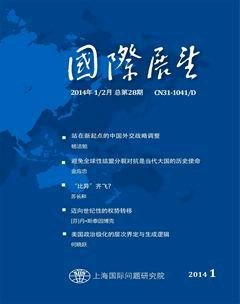
英文摘要
2014-01-27 18:29:37
國際展望 2014年1期
關鍵詞:英文
Strategic Adjustment of Chinas Diplomacy at a New Starting Point
YANG Jiemian
For more than one year after taking office, Chinas new leadership has largely inherited and continued the diplomatic strategy of its predecessor. On the other hand, given Chinas growing comprehensive national strength, increasing international challenges, and change of governments in the world including China, it has adjusted and enriched the substance of the strategy in a distinctive way. For example, the new leadership has specified strategic self-identification, updated strategic thinking, kept strategic composure, strengthened strategic initiative and planning, and developed strategic theories. Chinas diplomatic strategy requires further adjustment for the next decade to enhance theoretical innovation and execution, Chinas diplomacy will be conducted in a more active, pragmatic, and effective way and will thrive in meeting challenges and overcoming difficulties. Chinas strategic diplomacy needs to reflect the vision and logic of a rising global power, strengthen strategic construction based on practice and experience by further adjusting strategic objectives, building strategic cooperation networks, and deepening strategic theoretic studies. Chinas diplomatic strategy requires perspectives that are all-dimensional, diversified, and transcends space and time. It needs to take into account the changing and interacting internal and external environments to further consolidate and deepen domestic support. Finally, academic circles of IR and diplomatic studies should be driven by an acute and urgent sense of calling to construct and develop Chinas strategies within the diplomatic theoretical system with Chinese characteristics to enrich the variety of public goods provided by China to the international community.
The Historic Mission of the Contemporary Major Powers to Avoid Splitting and Confrontation of Global Alliances
——With Discussion on Theories and Practices of the New Type of Major-power Relationship
JIN Yingzhong
Traditional major-power relations feature alliance, splitting, and confrontation that compete for world hegemony with each other. Not only the political relations are splitting, but also economic relations are confrontational, both without an overarching arrangement of coordination mechanisms. With the historic inertia left thereof, the post-war bipolar configuration formed between the two superpowers, the U.S. and the USSR, remains the same with the above-mentioned feature. The Cold War was the name of the day between the two superpowers though a general hot war avoided. Today the global system, symbiotic by nature, has added a modern sense to “either win-win games or lose-lose games”, the feature of now the fate-commonwealth of humankind, which has lessened the raison d'être of the basic nature of the traditional major-power relationship, and weakened the historic inertia of the major-power relationship, hence leaving a historic requirement and opportunity to build a new type of major-power relationship. Chinas timely call for building a new type of major-power relationship is not only due to its adherence to the road of peaceful development, but also a hope to offer a direction to the common effort of the world to get rid of the historic inertia of the traditional major-power relationship, which not only contains theoretical and practical grounds, but also scientifically masters historic trends of the post-war international relations.
Basing Common Grounds upon Reserving Differences?
——Studying and Pondering the Construction of Sino-U.S. New Type of Major-power Relationship
SU Changhe
Although the new type of major-power relationship is a concept put forward by the new leadership of China, China and the United States have been exploring for a new type of major-power relationship since the establishment of their formal diplomatic relations. The Chinese academic community tends to approach the construction of the new type of major-power relationship between China and U.S. with a view more on seeking common ground than on comparing differences, i.e., exploring common factors and convergences in the bilateral relations to expand the potential and space for cooperation, a helpful approach per se. On the other hand though, the differences between the two countries should not be underestimated. Some differences are even fundamental. Highlighting differences is not to ignore the possibility of cooperation, but rather to deepen the cooperation through facing up and carefully defining the differences. Therefore, we should not only seek common ground in the bilateral relations, but also compare the differences. Seeking common ground is to search for the foundation of cooperation while comparing differences is to perceive both sides more prudently. In fact, it is exactly this approach of seeking common ground on the basis of comparing differences where the wisdom of having the Shanghai Communique signed 40 years ago dwells. Comparing differences appropriately can help to identify the upsides and downsides of the two countries, hence lay down the foundation for learning from each other, drawing up experiences with each other, and respecting each other.
Toward the Once-in-a-century Transition
——New Policy Approaches in the Sino-U.S. Relations
Dan Steinbock
As Washington and Beijing are moving toward the once-in-a-century transition of economic power, each is also engaged in rebalancing in Asia, as evidenced by changing alliances and the scramble for the trade blocs in the region. Due to historical legacies, different growth trajectories and strategic objectives, the way these two great nations are pivoting in Asia is very different, as evidenced by U.S. cooperation with Japan and Australia, and Chinas reforms and rebalancing in Southeast and South Asia. However, concerns over new “Eurasian challengers” are dated. While both are scrambling to trade and investment blocs in Asia, there are vital internal and external incentives toward the building of “major country relationship”. Currently, the U.S. policy approach is largely inductive; in contrast, the Chinese approach seeks to be deductive. At the surface, the two approaches seem mutually exclusive; in practice, the two do converge in certain areas. For all practical purposes, the most fundamental challenge will be the ability to work well in some areas, despite competition or even strong differences in other areas. New models of “major country relationships” require new, pragmatic and dynamic policy approaches in bilateral relations.
The Cultural Logic of New Model of Major Power Relationship and Its Implication for the Chinese Dream
CAI Liang
With its development, China is becoming a global power, but scholars from the West get used to use the theory of power transition to explain the power redistribution among major powers. Chinas new leadership proposed constructing a new model of major power relationship on the basis of mutual respect, cooperation and win-win results for the benefit of the people. China put forward “No confrontation and no conflict, mutual respect and cooperation and win-win relationship as the rule of peaceful development. To realize the Chinese Dream is Chinas national strategy and international responsibility.
Theory, Tactics, and Mechanism
——Triple-Reflections on Constructing a New Type of Sino-U.S. Military Relationship
ZHANG Fang
New military relationship is one of the new relationships of major powers, and it is also an inevitable part of the Sino-U.S. relations. Upon the analysis of the asymmetric-interdependent Sino-U.S. military relations, the author assumes that the Sino-U.S. military relations feature coexistence and interdependence between sensitivity and importance, between vulnerability and adaptation, and between cooperation and competition. The author raises the thinking, such as, gradually eliminating obstacles, controlling the action-reaction cycles of the external environment, eliminating ambiguity of military images, seeking identities of major power military status to match the construction of the new Sino-U.S. military relations. The author also proposes to incrementally establish a "Sino-U.S.+X or NX" trilateral or multilateral defense ministerial meeting mechanisms, public diplomatic mechanisms of the Sino-U.S. military diplomacy, and new mechanisms for the think-tanks of the Sino-U.S. military relations.
The Relativity of Chinas Rise and U.S. Decline in Global Public Opinion
ZHAI Shilei
“Chinas rise” and “U.S. decline” are two relative judgments about global power shift from the U.S. to China at the turn of the century. The traditional criterion, assessing global power by comparing comprehensive items relating to the hard and soft power, has hardly been widely accepted. The global opinions about “Chinas rise” and “U.S. decline” are considered to be another feasible approach for evaluating that tendency. Public opinions in the past ten years show that “Chinas rise” and “U.S. decline” are rather a relative change, and a kind of forecast. The global public still sees the U.S. as a dominant power in global affairs, except for the economic sphere. And China is expected to promote its global reputation and prestige by taking public diplomacy and finally wins global support.
The Stratification and Generation Approaches on U.S. Political Polarization
HE Xiaoyue
Political polarization is continuously enhanced in today's American politics and has a profound impact on the American electoral politics, congress functioning and public policy making. On the study of American political polarization, there also exists considerable controversy. U.S. political polarization can be divided into two levels: the political elite and the ordinary voters, the logic linkage of the two levels is the division of political geography that American electoral system rests on, with the performance of the state as the basic unit of electoral college system in the presidential election and the constituency as the basic unit of seats competitive system in the congressional election. On this basis, the political parties and voters as bi-doer together construct the three basic generation mechanisms and two reverse generation mechanisms. Although demographic changes and legislative limitation of political contributions might make the U.S. political ecology return to normal in the future, the intensification of economic inequality, the selective public media information taken by technological advances, the impact of the social movement and the increase of Republican safe constituency make it difficult to eliminate the U.S. political polarization in a short time. The lasting existence of American political polarization gives hints to China that it is necessary to consider U.S. domestic political characteristics while handling U.S.-China relations, enhance the communication with U.S. private sectors, and be prepared for the return of neo-conservative forces.
A Tentative Analysis on the Evolution of Copts Political Status in Postwar Egypt
PAN Weijuan
Copts in Egypt, the largest Christian community in the Middle East, did not seized international attention until conflicts between Muslims and Christians became incessant in the 1970s. From three aspects, namely, Egyptian presidents attitude toward religion and Copts, the influence of laws and regulations enacted by the Egyptian government on Copts, and the attitudes of Coptic Christianity and Copts toward the Egyptian government, the article starts with combing the evolution of Copts political status in postwar Egypt. As to why Copts political status has changed, the various ways in which Egyptian presidents handled religions functions, the Egyptian government having yet established a common political identity, and Copts lacking enthusiasm for politics are main reasons. Looking to the future, when the situation remains complicated, post-revolutionary Egypt will become increasingly Islamized while the secularization of Egypts constitution will have a direct influence on the problem of Copts political status. Consequently, the article predicts that it is unlikely for Copts political status to be improved in the near future.
猜你喜歡
國際展望(2017年2期)2017-03-21 18:34:18
鄱陽湖學刊(2016年6期)2017-01-16 13:05:41
中國遠程教育(2016年6期)2016-12-07 10:07:02
財經(2016年19期)2016-08-11 08:17:03
中國遠程教育(2016年5期)2016-06-29 10:13:42
中國遠程教育(2016年2期)2016-03-21 10:31:21
中國遠程教育(2016年1期)2016-02-26 10:37:15
國際展望(2015年5期)2015-09-15 05:41:45
國際展望(2015年4期)2015-07-13 05:30:56
能源(2014年9期)2014-09-15 13:18:12