英文摘要
2015-09-15 05:41:45
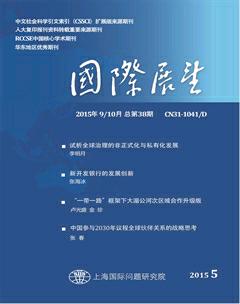
國際展望 2015年5期
關鍵詞:英文
A Tentative Analysis of Informal and Privatized Patterns of Global Governance
LI Mingyue
The traditional pattern of global governance is built on a combination of hegemony and multilateralism, dominated by Western-led international organizations. Since the end of the Cold War, especially after the 2008 financial crisis, the traditional pattern of governance has suffered “governance deficit,” inadequate to address the complex and multiple pressing global issue, due to subtle as well as dramatic changes in the international power structure. Two new patterns of global governance, the “informal” and the “privatized,” have emerged, attracting global attention. The informal pattern refers to the diverse informal institutional arrangements for equal consultations among major countries on global issues, such as the Group of Twenty and the Asia-Pacific Economic Cooperation. The privatized pattern of global governance is established by non-state, market-driven authorities, which plays a role in such global issues as environmental protection and climate change. These two patterns of global governance are flexible and highly practical making up for the deficiency of the traditional pattern of governance and play a positive role in global governance. Although they also have their own defects, their future functions in global governance will be further enhanced. This has brought new opportunities and challenges for Chinas participation in global governance. China needs to take advantage of these opportunities to respond to the challenges and promote the development of global governance in the direction of greater equity and democracy.
The New Development Banks Development and Innovation
ZHANG Haibing
The BRICS establishes the New Development Bank (NDB), but whats new in the NDB? This paper thinks there are four new features distinguishing this financial institution. Firstly, the new identity. The BRICS countries are on the way of graduating from the World Bank and becoming shareholders of the NDB, which will add more new concepts and resources to international development cooperation. Secondly, the new governance principles. The NDB adopts an equal and sharing governance structure, and abandons the traditional unequal governance pattern based on disparate voting power. Thirdly, the new development role. The NDB is not only a coordinator but also a competitor and reformer. Fourthly, the new cooperation axis. BRICS cooperation is based on common development mission instead of common values, and emphasizes the effectiveness of development. For the NDB, its potential future innovation largely depends on its capabilities of addressing challenges and preparing for uncertainties, for example, financing for development and financial sustainability, expanding its social influence and building BRICS character, and better serving the BRICS interests and benefiting more developing countries.
International Institutional Interplay and G20 Transition:
The Case of Global Tax Governance
ZHU Jiejin
The G20 is in institutional transition from a crisis institution to a steering institution, adopting the “G20+” governance architecture. In this new architecture, the role of the G20 is to set the agenda and build political consensus, while other international institutions are playing the role of technical support and implementation. For emerging economies, the G20 is the first global economic governance institution to participate on an equal footing with the advanced countries, so equal participation on the “G20+” is the prerequisite to complete the G20 institutional transition. In the case of global tax governance, “G20+OECD” reflects the needs and interests of both advanced and emerging countries. The G20 built the political consensus that taxation should be in jurisdictions where economic activity takes place and agreed on automatic exchange of tax information, and the OECD proposed the Action Plan of Base Erosion and Profit Shifting Action Plan and global Common Standard for the automatic exchange of tax information. In this way, the OECDs technical advantage is in complementing G20s political advantage, pushing the process of global tax governance.
The Development of International Sector-based Mitigation Rules and the Potential Impact on China
HUANG Yitian
The United Nations Climate Conference is the major platform for global climate negotiations. However, major developed countries attempt to circumscribe this widely-representative mechanism, and develop international sector-based mitigation rules. Specifically, developed countries actions can be approached from two aspects. One is the “market-driven, sector-based, rule-developing activities,” which rely on the advantageous positions of developed countries in transnational supply chains. The other is the “government-led, sector-based, rule-developing activities,” which have been implemented via the International Maritime Organization and the International Civil Aviation Organization, focusing on international shipping and civil aviation. This article begins by analyzing the constraints that the UN Climate Conference, which is based on the United Nations Framework Convention on Climate Change and its protocols, has imposed on developed countries. Then it traces in detail the activities of multinational corporations, non-governmental organizations, and governmental agencies in developed countries. The potential impact that developed countries actions might have on China are analyzed from two angles: mitigation path setting and barriers to trade. It concludes by briefly discussing the interactions between the development of international sector-based mitigation rules and the current global climate regime, and the measures that China could take to address the challenges.
Upgrading GMS Cooperation within the Framework of the “Belt and Road Initiative”: Concept, Challenges, and Approaches
LU Guangsheng and JIN Zhen
GMS cooperation is the first regional cooperation that China participated in. Its not only the most effective regional initiative that China is involved but also the one with least barriers. However, GMS cooperation has its own development bottlenecks. Meanwhile, it is an issue of strategic importance and urgency for China to upgrade GMS cooperation, further consolidate Chinas strategic reliance in the neighborhood, and make breakthrough in implementing the “Belt and Road” strategy in Southeast Asia. In addition, upgrading GMS cooperation is also meaningful for Chinas neighborhood diplomacy for the present and in the future. From the perspective of the advanced integration theory, this paper analyzes the theoretical basis and relevant practices of upgrading sub-regional cooperation, discusses the strategic connections between GMS cooperation and the “Belt and Road” initiative, identifies major difficulties and challenges for GMS cooperations further enhancement, and explores approaches for building an upgraded GMS cooperation.
The Twenty-first-century Maritime Silk Road and Chinas Energy Diplomacy
SHU Xianlin
Ensuring energy security and enhancing energy cooperation are the key elements of Chinas 21st Century Maritime Silk Road initiative. The joint building of the Road not only contributes to energy co-exploration and regional marine energy cooperation, but also helps maintain the stability and security of maritime energy routes, promoting international energy cooperation. As a responsible developing country and the largest economy along this Maritime Road, China must respond to the rising expectations and demands in its greater neighborhood about energy cooperation and energy security. To do so, China has to more actively conduct its energy policy in the neighborhood by improving the Chinese-style energy diplomacy and providing more public goods for regional energy security and economic development. It should also, together with the nations along the Road, share and co-explore marine oil and gas and other new sources of energy, promote inter-connectivity of regional energy infrastructure and energy trade facilitation, with a view to ensuring its own energy security while building a community of shared destiny in the international energy sector on the basis of common, cooperative, and sustainable security.
High-Level International Trade Rules of the TPP: Challenges and Strategies for China
PAN Xiaoming
The TPP negotiations pushed by the United States will become a latest update for international trade rules after the Uruguay Round Negotiations. These new rules have profound impacts on the international economic regime. From full market access to well protection of investors, from regulations on state-owned enterprises to the introduction of new issues, such as environment and labor, TPP initiates changes to international trade rule system. China keeps itself open to free trade agreements, including the TPP. Chinas government expresses its “understanding” and “welcome” to high-level trade rules and would be open to TPP negotiations. However, the TPP, which stands for high-level international trade rules, is well beyond Chinas capability. Joining the TPP negotiations will pose significant challenges to China. This paper starts from analyzing the high-level trade rules of the TPP by discussing a few important issues on the TPP negotiation agenda. It also looks into the challenges that Chinas economy and industries may face should it join the negotiations. In the end, in line with its development agenda, the paper discusses Chinas strategies for meeting the challenges. If the accession to the WTO presented a precious opportunity for Chinas rapid growth in the past decade, TPP might be another opportunity to drive China to innovate and to continue its growth in the next decade.
On Chinas Role in Global Partnership Building for the 2030 Agenda
ZHANG Chun
Given the fact that its basic goal framework has been created, the discussion about UN 2030 Agenda for Sustainable development now is moving to global partnership, means of implementation, and follow-up implementation. As a global course, global partnership is key to the means of implementation and follow-up implementation of the 2030 agenda, to which China is expected to contribute greatly. For China, to participate in global partnership generates potential benefits and incurs costs. On one hand, with the rise of China, the physical gains will shrink in the future while non-physical gains have the potential to grow significantly. On the other hand, China is called on to contribute more global public goods in physical terms but not necessarily intellectual ones. In sum, Chinas cost-benefit balance in participating this global partnership is that physical costs is higher than physical benefits, while non-physical gains are full of uncertainty. Given its developing country identity and the uncertainty in its future development, Chinas strategy for participating in the global partnership for the 2030 agenda should be: making clear strategic commitments at multilateral platforms, promising concrete physical assistance at bilateral (collective) forums, and promoting domestic comprehensive reform through advocating global partnership.
Trust and Power: On the Asymmetric, Strategic Sino-India-U.S. Triangle
CAO Dejun
The current “strategic triangle” of China, the United States, and India was born under the U.S. unipolar hegemonic shadow, which is a typical asymmetric triangle. Why the three asymmetric great powers make a three-way relationship instead of forming an alliance? This paper puts forward the trust-power analysis framework, advocating that objective power gap should be placed in a subjective trust framework to interpreted the trilateral relations. Generally speaking, the current Sino-U.S. relationship is a “coercion-response” dynamic, i.e., a relationship characterized by rational trust under predominant power; the relationship between America and India is “wooing-prevention” relationship, which means “domination with strong emotional trust”; and the Sino-Indian interaction is a “co-option-bandwagon” dynamic, namely a relationship of “rational trust under relational power.” With the change of “power” and “trust,” the Sino-India-U.S. “asymmetric triangle” will face three scenarios: “Two vs. One” pattern, “Hub” pattern, and “Group-3” pattern. However, the three players are most likely to maintain a delicate balance between friend and foe, and the asymmetric triangle game will also be the new normal for the Sino-India-U.S. strategic relationship.
猜你喜歡
國際展望(2017年2期)2017-03-21 18:34:18
鄱陽湖學刊(2016年6期)2017-01-16 13:05:41
中國遠程教育(2016年6期)2016-12-07 10:07:02
財經(2016年19期)2016-08-11 08:17:03
中國遠程教育(2016年5期)2016-06-29 10:13:42
中國遠程教育(2016年2期)2016-03-21 10:31:21
中國遠程教育(2016年1期)2016-02-26 10:37:15
國際展望(2015年4期)2015-07-13 05:30:56
能源(2014年9期)2014-09-15 13:18:12
能源(2014年6期)2014-07-25 13:18:23