轉(zhuǎn)化生長(zhǎng)因子—β3與纖維連接蛋白在子宮肌瘤及子宮肌層內(nèi)的表達(dá)水平與生物學(xué)意義
2016-11-09 03:19:04潘偉汪海霞劉霞
中國(guó)性科學(xué)
2016年4期
關(guān)鍵詞:差異
潘偉 汪海霞 劉霞
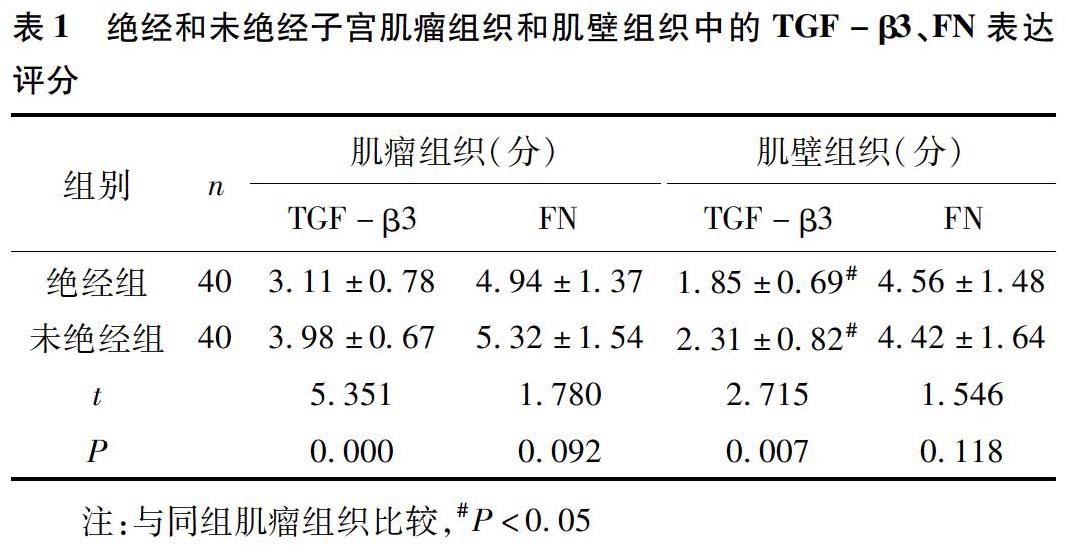
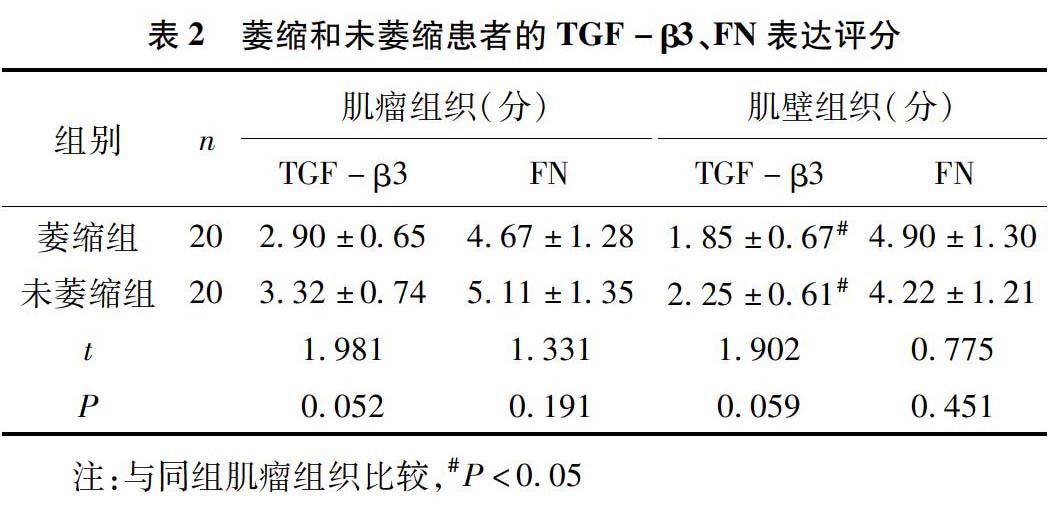
【摘要】目的:探討轉(zhuǎn)化生長(zhǎng)因子(TGF)-β3與纖維連接蛋白(FN)在絕經(jīng)或未絕經(jīng)婦女子宮肌瘤及子宮肌層中表達(dá)的水平變化及其意義。方法:采用免疫組化法(SP)檢測(cè)40例絕經(jīng)后子宮肌瘤婦女(絕經(jīng)組)、40例未絕經(jīng)子宮肌瘤婦女(未絕經(jīng)組)肌瘤組織及肌壁組織中的TGF-β3、FN的表達(dá)差異,同時(shí)將絕經(jīng)組婦女根據(jù)肌瘤是否發(fā)生萎縮分為萎縮組(17例)、未萎縮組(23例)并進(jìn)行上述指標(biāo)的比較。結(jié)果:絕經(jīng)組的肌瘤組織、肌壁組織中的TGF-β3表達(dá)評(píng)分分別為(3.11±0.78)分、(1.85±0.69)分均顯著的低于未絕經(jīng)婦女的(3.98±0.67)分、(2.31±0.82)分(P<0.05);兩組婦女肌瘤組織和肌壁組織中的FN表達(dá)評(píng)分差異不顯著(P>0.05)。子宮肌瘤萎縮和未萎縮患者的子宮肌瘤組織、肌壁組織中TGF-β3、FN表達(dá)在兩組間差異均不顯著(P>0.05),萎縮組和未萎縮組的肌瘤組織TGF-β3表達(dá)分別為(2.90±0.65)分、(3.32±0.74)分均顯著的高于本組肌壁組織中的(1.85±0.67)分、(2.25±0.61)分(P<0.05);兩組肌瘤和肌壁組織中的FN表達(dá)差異不顯著(P>0.05)。結(jié)論:TGF-β3表達(dá)可能與患者絕經(jīng)前后的激素水平改變有關(guān)。
【關(guān)鍵詞】轉(zhuǎn)化生長(zhǎng)因子-β3;纖維連接蛋白;絕經(jīng);子宮肌瘤;子宮肌層
Expression and biological significance oftransforming growth factor-β3 and fibronectin in uterine myoma and uterine muscle layerPAN Wei1, WANG Haixia2, LIU Xia2. 1. Department of Gynecology, Huangshi Central Hospital, Huangshi 435000, Hubei, China; 2. Department of Obstetrics, Huangshi AiKang Hospital, Huangshi 435000, Hubei, China
【Abstract】Objectives: To discuss the expression and biological significance of transforming growth factor-β3 and fibronectin in uterine myoma and uterine muscle layer. Methods: Using immunohistochemical method (SP), 40 cases of postmenopausal uterine leiomyoma (postmenopausal group) and 40 cases of premenopausal uterine leiomyoma (premenopausal group) were selected. Different expression of TGF- beta-3 and NF on leiomyoma tissue and muscle tissues were detected. At the same time, postmenopausal group was divided into atrophy group (17 cases) and non-atrophy group (23 cases). The above indexes of the two groups were compared. Results: The TGF- beta-3 expression scores of premenopausal group in muscle tissue and leiomyoma wall were (3.11±0.78) and (1.85± 0.69) points, which were significantly lower than these of premenopausal group (3.98 ± 0.67, 2.31 ± 0.82) (P<0.05); FN expression score of two groups in leiomyoma tissue and muscle tissues had no significant difference (P>0.05). TGF- beta-3 and FN expression of atrophy group and non-atrophy group in uterine fibroids and uterine tissues had no significant difference (P>0.05). TGF- beta-3 expression of atrophy group and non-atrophy group in uterine fibroids were (2.90±0.65) and (3.32±0.74), which were both significantly higher than these in uterine tissues of (1.85± 0.67) and (2.25± 0.61) (P<0.05); FN expression of the two group in fibroids and muscle tissues did not show significant difference (P>0.05). Conclusion: TGF- beta-3 expression of premenopausal patients is significantly higher than that of postmenopausal patients; TGF- beta-3 expression of atrophic group and non-atrophy patients in leiomyoma is higher than that in muscle wall tissue, without significant difference. TGF- beta-3 expression may be associated with hormone level changes in postmenopausal patients.
【Key words】Transforming growth factor beta-3; Fibronectin; Menopause; Uterine myoma; Uterine muscular layer
【中圖分類號(hào)】R737.33【文獻(xiàn)標(biāo)志碼】A
子宮肌瘤作為女性生殖系統(tǒng)常見(jiàn)的良性腫瘤,其發(fā)病率約占全部女性生殖系統(tǒng)疾病的25%~30%,是導(dǎo)致女性子宮全切的重要原因。其發(fā)病機(jī)制與卵巢分泌的雌、孕激素對(duì)局部生長(zhǎng)因子的自分泌和旁分泌調(diào)節(jié),從而影響肌瘤細(xì)胞的生長(zhǎng)和分化有關(guān)[1]。轉(zhuǎn)化生長(zhǎng)因子-β3(transforming growth factor-β3, TGF-β3)與纖維連接蛋白(fibronectin ,F(xiàn)N)等多種生產(chǎn)因子均會(huì)對(duì)子宮肌瘤的生長(zhǎng)、發(fā)展產(chǎn)生重要作用,從而出現(xiàn)肌細(xì)胞異常增殖以及細(xì)胞外基質(zhì)聚集等[2,3]。為此,本研究針對(duì)TGF-β3以及FN在絕經(jīng)或未絕經(jīng)婦女子宮肌瘤及子宮肌層中表達(dá)的水平變化及其意義進(jìn)行探討。現(xiàn)將……
登錄APP查看全文
猜你喜歡
英語(yǔ)世界(2023年10期)2023-11-17 09:19:16
汽車實(shí)用技術(shù)(2022年10期)2022-06-09 11:16:58
音樂(lè)探索(2022年2期)2022-05-30 21:01:37
收藏界(2019年3期)2019-10-10 03:16:40
小天使·一年級(jí)語(yǔ)數(shù)英綜合(2019年8期)2019-08-27 02:23:00
中國(guó)特種設(shè)備安全(2018年11期)2019-01-08 02:08:32
小學(xué)科學(xué)(學(xué)生版)(2018年7期)2018-08-13 09:33:04
中國(guó)非營(yíng)利評(píng)論(2017年1期)2017-11-09 03:09:10
海外華文教育(2017年8期)2017-11-07 04:42:02
現(xiàn)代語(yǔ)文(2016年21期)2016-05-25 13:13:50