棕色脂肪組織產熱功能與肥胖
2017-04-27 09:16:50顏光濤
臨床醫藥文獻雜志(電子版) 2017年7期
關鍵詞:小鼠
張 永,顏光濤
(解放軍總醫院,北京 100853)
棕色脂肪組織產熱功能與肥胖
張 永,顏光濤
(解放軍總醫院,北京 100853)
棕色脂肪是哺乳動物體內重要的非戰栗產熱器官,解偶聯蛋白是棕色脂肪產熱的關鍵蛋白,棕色脂肪缺失會導致肥胖,棕色脂肪的活化可以減少脂肪蓄積。近年來研究發現成人體內也存在棕色脂肪,激活成人體內的棕色脂肪可能成為治療肥胖的新途徑。
棕色脂肪;肥胖;解偶聯蛋白
棕色脂肪組織(BAT),由瑞士自然學家Conrad Gessner于1551年首次發現。它最初被稱為“冬眠腺”,在接下來的400年,又發現了棕色脂肪的其他功能,比如具有內分泌功能,是調節體溫的非戰栗產熱的重要器官,后來還發現其產熱是由線粒體上的解偶聯蛋白決定的[1]。肥胖本質上是能量消耗與能量攝入的不平衡,棕色脂肪的產熱在能量平衡的調節中扮演著重要角色。本文將對棕色脂肪的產熱與能量平衡和肥胖做一綜述。
1 肥胖與能量平衡
肥胖的發生是因為能量的攝入超過了能量的消耗。能量的攝入當然是從可產能的食物中攝取,除了糞便和尿中會損失一部分未利用的能量外,其他能量消耗通常包括基礎代謝,身體活動和生熱。20世紀70年代對肥胖的認識是過度飲食和運動不足的結果。人群和動物實驗也都證實了這一觀點[2-3]。動物實驗發現肥胖小鼠和非肥胖小鼠喂飼同樣的飼料,肥胖小鼠的食物功效比是非肥胖小鼠的兩倍多,這種結果只能是因為能量消耗的減少造成的,在隨后的研究中發現這與非戰栗產熱的減少有關[4]。
2 評價棕色脂肪組織產熱功能的指標
測量動脈和靜脈血液中氧含量的差值是評估BAT的產熱活性的最直接的方法。然而,這一方法要求在體內進行監測并不適合作為常規指標。因此,在相關研究中,多使用分離的組織、線粒體及蛋白分子等離體指標來評價BAT的活性[5]。見表1。
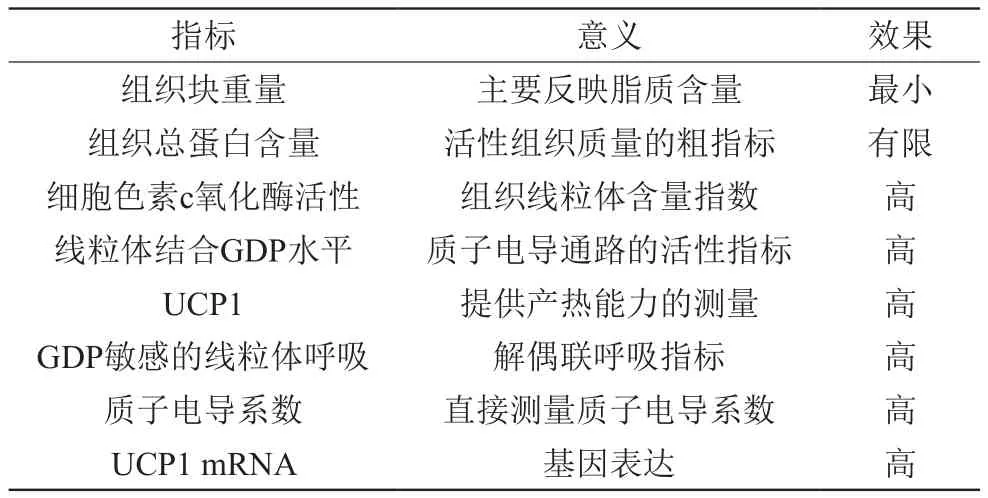
表1 體外評估棕色脂肪組織的產熱功能的指標
棕色脂肪組織塊的重量是最直觀的指標,但在肥胖的情況下,其重量容易受周圍白色脂肪蓄積的影響。在早期研究中還經常采用棕色脂肪組織中總蛋白質含量來粗略評價其功能。與棕色脂肪產熱密切相關的是線粒體含量,線粒體的募集導致氧化和產熱能力的增強。一般通過測量組織中細胞色素c氧化酶活性來廣泛評估線粒體含量[5]。評價棕色脂肪產熱活性的最有效指標是線粒體與GDP結合能力測定。結合的水平越高,產熱活性越強。另一個最常用的關鍵指標是線粒體中UCP1的含量的測量,UCP1的量決定了組織的產熱能力[6]。
3 BAT與肥胖
瘦素缺乏的肥胖小鼠以及其它幾種肥胖動物模型,其BAT的產熱活性都降低。去甲腎上腺素通過刺激非肥胖小鼠BAT增加非戰栗產熱,這與冷適應的大鼠的觀察結果一致[7]。這也表明肥胖小鼠響應去甲腎上腺素的產熱能力的降低幾乎完全是由于BAT的減少。切除腎上腺也可以減弱產熱能力[8]。相對于非肥胖小鼠,肥胖小鼠的線粒體中UCP1的濃度降低[9]。最初肥胖癥動物模型是通過腹內側下丘腦(VMH)的手術損傷來實現。在VMH損傷的大鼠中觀察到棕色脂肪線粒體含量下降[10]。通過抑制轉基因小鼠UCP1的表達克導致肥胖[11]。
4 成人體內BAT的發現
在20世紀60年代,最早在新生兒發現棕色脂肪[12],而且普遍認為BAT在出生后的最初幾年就消失了,雖然也有一些證據表明成人體內的棕色脂肪組織會持續存在[13],但當時由于技術條件的限制只是在解剖學和組織學上觀察到多腔脂肪細胞,缺少棕色脂肪關鍵產熱蛋白UCP1的檢測。后來通過檢測人體脂肪組織中的UCP1,確定BAT存在于成人體內[14],盡管其含量低于兒童[15]。
氟脫氧葡萄糖正電子發射斷層掃描(FDG-PET),本來是應用于癌癥研究,但是卻發現在脂肪組織部位有高水平的葡萄糖攝取,且其分布具有類似于基于早期解剖學觀察的成年人BAT的分布模式[13]。后來通過檢測UCP1確定具有高葡萄糖攝取的脂肪組織確實是BAT[16]。通過FDG-PET技術發現,寒冷和胰島素會激活成人BAT[17],但是在老年受試者中其活性較低 ,并且重要的是,肥胖者的活性比瘦人低,與BMI(體重指數)成反比[18]。因此,棕色脂肪組織再次成為研究肥胖癥的焦點。相應地,對BAT的激活和/或募集有可能作為治療肥胖的治療途徑[19]
最近還發現了BAT的重要代謝作用,特別是在甘油三酯清除,胰島素敏感性和葡萄糖體內平衡中,BAT已被作為代謝的主要器官[20-22]。因此,BAT活性的降低與代謝綜合征的發展相關[23]。
5 結 語
BAT自發現以來,其生理功能一直受眾多研究者的關注,尤其BAT在能量平衡中的重要作用,對肥胖有十分重要的意義,而且近年來成人體內活性BAT的發現使得激活成人體內的BAT可能成為治療肥胖的新途徑。
參考文獻
[1] Cannon B,Nedergaard J.Brown adipose tissue: function and physiological significance.Physiol Rev 2004;84:277-359.
[2] Djazayery A,Miller DS,Stock MJ.Energy balances in obese mice. Nutr Metab 1979; 23:357-367.
[3] Miller DS,Mumford P,Stock MJ. Gluttony.2.Thermogenesis in overeating man.Am J Clin Nutr 1967; 20:1223-1229.
[4] Thurlby PL,Trayhurn P.The role of thermoregulatory thermogenesis in the development of obesity in genetically-obese(ob/ob) mice pair-fed with lean siblings. Br J Nutr 1979;42:377-385.
[5] Trayhurn P,Milner RE.A commentary on the interpretation of in vitro biochemical measures of brown adipose tissue thermogenesis. Can J Physiol Pharmacol 1989;67:811-819.
[6] Klaus S,Casteilla L,Bouillaud F,Ricquier D.The uncoupling protein UCP:a membraneous mitochondrial ion carrier exclusively expressed in brown adipose tissue. Int J Biochem 1991;23:791-801.
[7] Thurlby PL,Trayhurn P.Regional blood flow in genetically obese(ob/ob) mice.The importance of brown adipose tissue to the reduced energy expenditure on non-shivering thermogenesis. Pflugers Arch 1980; 385:193-201.
[8] Wickler SJ,Horwitz BA,Stern JS.Blood flow to brown fat in lean and obese adrenalectomized Zucker rats.Am J Physiol 1986;251:R851-858.
[9] Ashwell M,Holt S,Jennings G,Stirling DM,Trayhurn P,York DA.Measurement by radioimmunoassay of the mitochondrial uncoupling protein from brown adipose tissue of obese(ob/ob)mice and Zucker (fa/fa) rats at different ages.FEBS Lett 1985; 179:233-237.
[10] Seydoux J,Rohner-Jeanrenaud F,Assimacopoulos-Jeannet F,Jeanrenaud B,Girardier L.Functional disconnection of brown adipose tissue in hypothalamic obesity in rats. Pflugers Arch 1981; 390:1-4.
[11] Lowell BB,V SS,Hamann A,Lawitts JA,Himms-Hagen J,Boyer BB,et al.Development of obesity in transgenic mice after genetic ablation of brown adipose tissue. Nature 1993; 366:740-742.
[12] Aherne W,Hull D.Brown adipose tissue and heat production in the newborn infant. J Pathol Bacteriol 1966;91:223-234.
[13] Heaton JM.The distribution of brown adipose tissue in the human.J Anat 1972; 112:35-39.
[14] Bouillaud F,Combes-George M,Ricquier D.Mitochondria of adult human brown adipose tissue contain a 32 000-Mr uncoupling protein. Biosci Rep 1983;3:775-780.
[15] Lean ME,James WP,Jennings G,Trayhurn P.Brown adipose tissue uncoupling protein content in human infants, children and adults. Clin Sci (Lond) 1986;71:291-297.
[16] Cypess AM,Lehman S,Williams G,Tal I,Rodman D Goldfine AB,et al.Identification and importance of brown adipose tissue in adult humans.N Engl J Med 2009; 360:1509-1517.
[17] Ouellet V,Labbe SM,Blondin DP,Phoenix S,Guerin B,Haman F,et al.Brown adipose tissue oxidative metabolism contributes to energy expenditure during acute cold exposure in humans.J Clin Invest 2012;122:545-552.
[18] Yoneshiro T,Aita S,Matsushita M,Kameya T,Nakada K,Kawai Y,et al.Brown adipose tissue,whole-body energy expenditure,and thermogenesis in healthy adult men.Obesity (Silver Spring) 2011; 19:13-16.
[19] Trayhurn P,Arch JR.New Physiological Aspects of Brown Adipose Tissue. Curr Obes Rep 2014;3:414-421.
[20] Bartelt A,Bruns OT, Reimer R,Hohenberg H,Ittrich H,Peldschus K,et al.Brown adipose tissue activity controls triglyceride clearance. Nat Med 2011; 17:200-205.
[21] Stanford KI,Middelbeek RJ,Townsend KL, An D,Nygaard EB,Hitchcox KM,et al.Brown adipose tissue regulates glucose homeostasis and insulin sensitivity. J Clin Invest 2013; 123:215-223.
[22] Bartelt A,Heeren J.The holy grail of metabolic disease: brown adipose tissue.Curr Opin Lipidol 2012;23:190-195.
[23] Nedergaard J,Bengtsson T,Cannon B.New powers of brown fat: fighting the metabolic syndrome.Cell Metab 2011;13:238-240.
本文編輯:李 豆
R333.6
B
ISSN.2095-8242.2017.07.1379.02
猜你喜歡
興趣閱讀·興趣作文與閱讀(低年級)(2025年8期)2025-08-18 00:00:00
東方少年·布老虎畫刊(2023年8期)2023-08-01 15:45:12
科學大眾(2021年6期)2021-07-20 07:42:44
科學(2020年3期)2020-11-26 08:18:30
學苑創造·A版(2020年9期)2020-10-13 09:41:02
娃娃樂園·綜合智能(2019年3期)2019-04-03 09:17:36
中成藥(2018年2期)2018-05-09 07:19:34
小學生學習指導(低年級)(2017年10期)2017-10-10 01:00:05
湖北師范大學學報(自然科學版)(2015年2期)2016-01-10 08:41:55
云南中醫學院學報(2014年3期)2014-07-31 18:57:34