不同尺度下停歇點濕地對遷徙水鳥的影響研究綜述
2017-06-26 11:28:36馬克明李金亞張育新
生態學報 2017年8期
張 強,馬克明,李金亞,張育新
中國科學院生態環境研究中心,城市與區域生態國家重點實驗室,北京 100085
?
不同尺度下停歇點濕地對遷徙水鳥的影響研究綜述
張 強,馬克明*,李金亞,張育新
中國科學院生態環境研究中心,城市與區域生態國家重點實驗室,北京 100085
停歇點濕地是遷徙水鳥重要的能量補給地,在水鳥每年的往返遷徙過程中具有十分重要的生態意義。近年來隨著全球變化和人類活動增加,遷飛路線上的停歇點濕地正發生劇烈變化。各個停歇點濕地的生境變化及周圍環境不僅是影響水鳥棲息地適宜性的重要因素,還改變了各路線上遷徙水鳥的種群大小和群落多樣性。分析不同尺度下停歇點濕地影響遷徙水鳥種群變化的主要生態因子和環境因素,不僅有助于理解各停歇點景觀變化的生態效應,也可為遷徙水鳥種群保護提供理論支持。首先分析了在棲息地斑塊尺度上停歇點濕地內的水、食物、棲息地格局和人類干擾等生態要素對水鳥覓食和棲息活動的影響;其次,分析了景觀尺度上濕地周圍的氣候變化、土地利用和外來生物等環境條件在各停歇點對水鳥棲息地質量的改變;最后,基于多尺度條件下濕地影響因素的耦合效應,分析了當前濕地生境與水鳥種群關系研究中存在的主要問題,并總結了對濕地和水鳥保護的啟示。
停歇點;濕地;水鳥;棲息地;遷飛路線
濕地生境對水鳥遷徙具有重要的生態意義,尤其是遷飛路線上分布的各類濕地是水鳥遷徙過程中重要的能量補給來源,為不同種群提供食物和棲息地[1]。全球依賴濕地生存的水鳥有870多種,多數濕地水鳥是季節性遷徙鳥類[2]。沿遷徙路線分布的一系列可用停歇點濕地是保證水鳥遷徙成功的基礎,在整個遷飛網絡中起到中繼站和食物補給地的作用,但往往也是眾多水鳥種群遷徙過程中的瓶頸[3]。濕地棲息地的變化尤其是具有國際意義的重要中途停歇點濕地的生境變化,對遷徙過程中水鳥種群的數量產生強烈影響[4]。
近幾十年來隨著氣候變化和人類活動的加劇,自然濕地發生大規模喪失,尤其是位于東亞-澳大利西亞遷徙路線上的沿海濕地發生了巨大變化[5]。截至20世紀末,全球已有超過50%的濕地消失,而中國則在1978—2008年間喪失了約33%的濕地,剩余部分在人類活動干擾下也發生了不同程度的退化[6]。位于遷飛路線上的眾多水鳥棲息地喪失或生境質量下降,已對遷徙種群造成了嚴重威脅[7]。如果現存濕地生態系統進一步遭到破壞,水鳥種群將在遷徙過程中失去合適的濕地作為停歇地或越冬地,無法完成遷飛循環而最終滅絕。
濕地對遷徙水鳥影響的研究很早就引起了人們的重視[8]。近年來相關研究逐漸從現象描述發展為機制分析,研究內容多關注濕地景觀變化的模擬預測和水鳥種群對棲息地變化的響應等方面,且更加重視大尺度環境變化對整個水鳥遷徙過程的影響[9- 11]。隨著越來越多新技術的應用和國際合作的逐步展開,人們開始研究不同尺度效應下濕地對水鳥的影響[12-13]。針對濕地生境變化與水鳥種群波動間的關系,研究范圍開始面向探討影響水鳥群落多樣性和遷徙策略的主要因素等內容,而且研究方向也逐步從現象和數量的描述向濕地生態功能和遷徙水鳥的種群反饋機制的分析等方向深入[14-15]。
雖然當前有關繁殖地和越冬地生境變化對候鳥的影響研究較多,但在中途停歇點濕地對遷徙水鳥的影響方面還較為缺乏[16-17],已有研究也主要是關注單個濕地生態系統的變化或單一水鳥物種的遷徙[18]。對于整個遷飛路線上的水鳥種群來說,各遷徙種群的需求各異,不同停歇點濕地內的生境要素對水鳥的生態意義也不相同[19-20]。研究發現,棲息地適宜性是決定各中途停歇點水鳥數量的主要因素,也是影響濕地內種群分布和多樣性變化的重要原因[21-22]。因此在研究停歇點濕地的影響機制時,需要根據水鳥種群在遷徙過程中對主要生態因子的需求,找出影響水鳥種群棲息地適宜性的共同因素。
1 棲息地斑塊尺度濕地生境要素的影響
沿遷徙路線分布的濕地作為水鳥遷徙過程中的重要節點,濕地面積的多少和棲息地質量的高低決定了其生態承載能力的大小。各停歇點濕地內的適宜生境面積是影響棲息水鳥種群大小的決定性因素,生境要素的配置變化則對水鳥的物種多樣性有顯著影響[23-24]。水鳥對停歇點生境的利用程度受濕地內景觀結構和多生境要素綜合作用的影響,濕地內的水位變化、水質、食物資源、棲息地結構以及人類干擾等生境特征的變化都強烈影響水鳥的覓食和棲息,是水鳥遷徙過程中選擇棲息地的主要依據。
1.1 水位變化的影響
停歇點濕地水量影響水鳥棲息地的適宜性主要體現在水位高低、水位變化和水面面積3個方面[25]。首先,水位是決定濕地水鳥選擇適宜生境的重要因素。不同水鳥對水位要求不同,濕地鳥類的分布與水位高低關系密切,低水位濕地是鸻鷸類水鳥重要的覓食地和棲息地,而高水位則對雁鴨類有利[26-27]。水位還影響水鳥棲息地面積的大小,如You等[28]的研究表明,鄱陽湖濕地水位在10.22 m至19 m之間時,可以提供的水鳥棲息地面積最大。其次,濕地水位的變化規律影響水鳥對棲息地的選擇[29]。水位的波動能夠營造多樣化生境,對于提高水鳥多樣性具有重要意義;能夠調節濕地動植物種類和生物量,引起水鳥多度的變化;濕地水位的季節性升降還會影響水鳥棲息地的面積和質量等[30]。最后,濕地水面面積的比例也是決定水鳥分布的重要因素。一般大的水面可以包含更多的生境類型,使水鳥可利用的覓食與棲息空間擴大,水鳥的種類和數量也隨水面面積的擴大而增加[31-32]。
1.2 水質的影響
濕地水質與水鳥的多度相關,對其影響多是間接和隱性的。水質變化一般直接影響水生生態系統,然后反映在水鳥適宜棲息地數量的波動上。如在不同的pH值、鹽度和水體富營養化狀態下,濕地水生生物的數量也將發生變化,最終引起水鳥食物和棲息地面積的改變[33]。此外,水鳥對污染引起的水質變化也十分敏感,如排入濕地內的工農業污染物可能導致水鳥抵抗力減弱[34],對其飛行和健康造成影響;濕地內的重金屬和持久性污染物還會隨著食物鏈進入鳥類體內累積,損害其羽毛和器官機能[35];濕地水體因石油泄漏被嚴重污染,導致水鳥大量死亡等[36]。
1.3 食物資源的影響
水鳥對停歇點食物資源需求不同于繁殖地和越冬地,其豐富度不僅決定了棲息地的適宜程度,也是影響水鳥遷徙過程的最重要因素[37]。無論是遷飛時間的選擇還是停歇點的確定,均受食物資源的限制[38-39]。食物資源的數量、質量和獲取難易是水鳥是否能夠獲取足夠能量的決定性因素,也是影響水鳥對停歇地的選擇的直接原因[40]。如由于停歇點濕地與越冬地在食物類型和質量上的不同,黑腹濱鷸(Calidrisalpine)在遷徙過程中將采取不同的覓食策略,以保證能量的攝入[41]。遷徙路線上食物資源豐富的濕地能夠提供更多食物,也吸引更多水鳥棲息,因而維持濕地棲息地較高的生產力對于水鳥種群保護具有重要意義[42]。
食物資源的可利用性和覓食對策共同決定了在湖泊灘涂和淺水區域覓食的水鳥群落的結構,而食物的獲取難易是評價食物資源數量和質量時的主要依據,也是影響水鳥豐富度的重要因素[43]。如底棲動物的分布是決定鸻鷸類覓食地選擇的重要因子,當一定范圍內易于獲取的底棲動物密度增加時,鳥類的密度和取食效率都會隨之增加[44]。取食難易程度決定了水鳥遷徙過程中的覓食效率,不僅影響水鳥對棲息地的選擇偏好,而且能夠實現具有不同取食方式的種群共存,降低種間競爭壓力[45]。增加食物資源是水鳥生境恢復的重要目標之一,某些情況下可獲取的食物資源的比例將直接影響濕地水鳥保護的效果[46]。
1.4 棲息地結構的影響
各停歇點濕地內不同生境需求的水鳥多度與濕地的類型有關,種群在濕地內的分布不僅有微生境質量的要求,還會對棲息地斑塊特征的變化做出響應[47]。適宜棲息地斑塊的面積和分布是決定水鳥種群遷徙策略的主要因素,濕地斑塊的多樣性和完整性能在不同的時空尺度上影響水鳥種群的大小,所以多種類型棲息地的喪失和斑塊破碎化是導致水鳥種群下降的重要原因[48]。
水鳥對棲息地的利用受到多重景觀格局因素的影響,其中棲息地的斑塊多樣性是影響濕地鳥類群落結構的重要因素[49]。在景觀尺度上,多樣化的濕地生境更有利于不同需求的鳥類棲息,水鳥多樣性與斑塊多樣性顯著相關[50]。有研究在分析水鳥群落與濕地棲息地特征間的關系時發現,在較大和異質性較高的濕地中,物種豐富度、鳥類的多度和多樣性均更高[51]。此外,對有些海岸帶鹽沼水鳥物種來說,斑塊異質性甚至比其大小更重要[52]。與之對應,盡管濕地內的人類活動也能夠增加斑塊多樣性,并使部分邊緣生境鳥類的多樣性增加,但濕地開墾所造成的天然濕地減少和生境均質化,將導致濕地內水鳥的種類和數量總體呈現下降趨勢[53]。
1.5 人類干擾的影響
除了食物、水深等因素外,干擾來源及分布對濕地水鳥的分布、密度和多樣性均有不同程度的影響。濕地內的各種人類活動是水鳥遷徙和棲息過程中面臨的主要干擾,食物的豐富程度和應對干擾風險的成本共同決定了水鳥對覓食區域的選擇[54]。水鳥種群對不同類型的干擾的響應不一樣,而且不同水鳥對干擾的敏感程度也有差別[55]。干擾除影響水鳥在停歇過程中對棲息地的選擇和濕地內的活動范圍外,還會降低棲息地質量和改變水鳥遷徙策略。
不同強度的干擾對水鳥的影響主要體現在對棲息地生境和鳥類活動的改變上。首先,干擾的存在影響水鳥對濕地棲息地的選擇。如河口濕地中的涉禽即使在同等食物條件下,相比鹽田,也更傾向于選擇干擾較少潮間帶泥灘棲息[56]。在不同干擾強度下的生境類型中,則分別對應不同的水鳥生態類群,干擾越強,種類越少[57]。其次,干擾還影響水鳥在棲息地內的能量補給和種群行為,其影響程度也與水鳥的覓食策略、生境需求以及干擾類型有關。如Burger[58]的研究發現,笛鸻在人類活動較少的區域將90%的活動時間用于覓食,而在人類活動較多區域,用于覓食的時間則不足50%。最后,各種類型的干擾還影響水鳥在濕地停歇點間的飛行狀態。近年來在遷飛過程中針對水鳥的捕殺、投毒及偷獵等現象不僅干擾其遷徙,更是直接威脅種群的生存;遷徙路徑上越來越多的風電場、高壓線等人工設施引發碰撞,影響種群的順利通過[59];濕地內日益增加的建設開發還使得噪音、煙霧等強烈干擾頻繁,導致水鳥個體離群或迷路等現象增多[60]。
2 景觀尺度濕地環境背景的影響
除了棲息地斑塊尺度的濕地生境因素,景觀尺度的環境背景也是導致水鳥遷徙過程中種群變化的重要因素[61]。盡管在不同尺度上環境因素影響停歇點濕地內水鳥種群的主導因子不同,但都將直接或間接改變棲息地的各類生境要素[62]。在棲息地斑塊尺度,濕地對水鳥的影響主要體現在各生境要素對停歇點覓食和棲息條件的改變上,而景觀尺度對水鳥的影響則主要表現為對水鳥遷徙過程中不同停歇點棲息地適宜性的改變上。在引起水鳥停歇點濕地生境變化的眾多環境因素中,氣候變化、土地利用和外來生物入侵等對遷徙水鳥種群的影響最為顯著。
2.1 氣候變化的影響
氣候變化對濕地水鳥的影響包括氣候變暖導致遷徙時間和遷徙距離發生變化,以及改變停歇點濕地食物和棲息資源的提供等[63]。氣候變化不僅需要遷徙水鳥在權衡能量消耗和飛行時間時做出改變,而且需要中途棲息地的食物、植被等因素變化與遷徙時機相一致。此外,氣候對棲息地分布的改變和極端天氣的增加也會影響水鳥棲息地的選擇和食物補給。
2.1.1 棲息地分布的變化
近年來隨著氣溫升高和棲息環境變化,海平面上升,沿海和高緯度濕地區域的極端天氣頻繁發生,停歇點濕地的變化對水鳥地理分布和遷徙策略的影響也越來越重。在過去30年間,當初冬氣溫上升后,沿西北歐遷飛的3種水鳥停歇點的分布重心向東北方向發生明顯偏移[64]。氣候變化還直接影響水鳥的停歇和飛行,遷徙距離增加迫使水鳥的停歇點選擇和飛行路徑發生改變,一些小型鳥類每年在飛行途中將面臨更大的生存風險,而且停歇點棲息地分布的變化也將使得對生境要求較高的水鳥種群數量急劇下降[65]。氣候變暖還使得單位面積濕地上的水鳥數量減少,相同數量的種群將需要更大面積的濕地棲息地,將迫使那些競爭力較弱的物種尋找其它替代生境[66]。
2.1.2 物候的變化
氣候變暖、降水減少、水位異常波動,不僅影響會各停歇點濕地的棲息地適宜性,也影響水鳥的多樣性[67]。首先,氣候變暖加速了濕地景觀格局演變的進程,間接增加了水鳥種群的環境壓力。研究表明,洞庭湖濕地水鳥的遷徙規律與洪枯水位季節性交替變化的環境相適應,若氣候異常導致低水位提前或推后,都會對鳥類的適宜棲息地面積產生影響[68]。其次,氣候變化在改變濕地棲息地適宜性同時,也影響了水鳥的種群結構和數量。如Steen等[69]發現美國大草原的小型濕地在氣溫和降水變化影響下面臨干涸,近1/2的水鳥適宜棲息地將消失,但不同物種之間的響應差異顯著,因而水鳥群落結構也將隨之變化。
2.2 土地利用的影響
隨著社會經濟發展和人類活動范圍的不斷擴大,各類生產建設活動的對濕地生境的影響日益顯著。與具體干擾因素作用于濕地內的水鳥種群不同,土地利用對遷徙水鳥種群的影響主要作用于景觀尺度上,包括對中途停歇點適宜生境斑塊的類型和數量的改變,因而對依賴濕地遷徙的水鳥種群的影響常是整體性和破壞性的[70]。土地利用對土地類型和微地形的改變,影響了棲息地周邊的水文、水質、生物多樣性和地表生態過程等,引起植被的退化和動物的遷移,導致濕地內停歇的水鳥種群多度和多樣性下降[71]。
2.2.1 棲息地的類型
土地利用往往改變濕地生境要素的分布,破壞濕地生態系統完整性,造成水鳥棲息地類型的變化和分布的不均[72]。土地利用對濕地棲息地類型的影響具體體現在以下兩個方面:1)造成生境單一,如濱海養殖塘的修建不僅導致生境同質化嚴重,而且引起濕地富營養化以及食物和棲息資源的分布集中,加劇不同覓食種群間的競爭[73];2)改變水文格局。如流域內各類開發建設活動影響了濕地的水文過程,不僅造成污染,還將改變濕地植被結構,間接影響水鳥的群落組成和多度[74]。
2.2.2 棲息地的面積
停歇點濕地的景觀變化直接決定了水鳥棲息地的多少,而周邊開墾活動的增加和土地類型的轉換在不斷改變濕地內適宜棲息地的面積,并影響水鳥種群的大小。研究發現,人為活動驅動下的濕地土地利用變化是造成遷徙水鳥棲息地喪失和種群變化的重要原因,近80%的水鳥物種所受威脅來自于農業生產引起的棲息地數量變化[75]。濕地周邊越來越多的道路、堤壩等人工設施不僅改變了水文條件和棲息地數量,而且影響鳥類的覓食和活動范圍。如作為水鳥重要停歇點和越冬地的東洞庭湖濕地,近年來由于周圍水田和低洼坑塘逐漸被開墾為旱地,在濕地暖干化趨勢下,水鳥適宜棲息地大幅減少[76]。
2.2.3 棲息地景觀格局
棲息地格局的變化也會影響鳥類群落變化[77],破碎化是引起不同鳥類棲息地適宜性變化的主要原因[78]。由于殘存生境斑塊之間的距離增加,使得水鳥賴以生存的水文條件、覓食區域、棲息環境等均發生變化[79]。在此過程中,那些對斑塊面積、景觀連通性要求較高的鳥類種群數量迅速降低,而那些生境要求較低、適應能力較強的鳥類種群波動則較小。如海岸帶濕地破碎化可能為蝦蟹等小型動物提供適宜環境,對以之為食的鳥類種群也更為有利,但其對于生境連續性有較高要求的多數鳥類則不利[80]。因此,棲息地破碎化既會導致水鳥物種數量的下降,也會使得群落組成的時空格局發生變化。
2.3 外來生物入侵的影響
外來生物入侵不僅影響本地動植物群落的生存,而且改變了水鳥棲息和種群覓食生境。外來生物入侵對濕地生態系統造成的破壞使得大多數鳥類的適宜棲息地發生變化和生態承載力下降[81]。入侵生物的定居對棲息植被和水鳥食物的影響,導致多數水鳥在遷徙過程中因無法適應入侵生境而不得不尋找其它停歇點濕地[82]。
2.3.1 本土植被群落
外來物種尤其是植物還改變了水鳥棲息地的群落類型,影響其活動和停歇空間[83]。以互花米草群落為例,因其植株較密,阻礙鳥類視線和在斑塊內的活動,無法提供有效的棲息空間,所以互花米草群落內鳥類的物種數和密度都顯著低于本地植物群落。在崇明東灘河口鹽沼濕地,由于互花米草的入侵,造成土著植被面積銳減,鳥類適宜棲息地大面積喪失,原生境斑塊內的各類水鳥也逐漸消失[84]。
2.3.2 底棲生物群落
外來物種的大量繁殖取代本地濕地物種,影響水鳥遷徙中的能量補充。首先,外來生物在濕地內的擴散定居將造成底棲生物多樣性降低,原有物種的快速減少將使部分水鳥無法在停歇點濕地內獲得足夠的食物[85]。其次,盡管目前對于外來動植物的定居過程對不同濕地生態系統和遷徙水鳥種群的影響大小缺少定量數據,但已有研究表明外來植物的擴散影響濕地分解速率和養分循環,造成生態系統生產力降低,食物質量下降,使得水鳥無法在短期內補充飛行所需能量[86]。
雖然外來生物對水鳥的影響多是負面的,但濕地外來物種并非必然使濕地鳥類的棲息地質量降低。如千屈菜作為濕地外來物種有利于某些鳥類棲息,并增加物種多樣性[87];水葫蘆等對水生動植物群落的影響隨群落組成和食物網結構而不同,若加以適當控制則可能對水鳥群落有利[88]。目前有關外來動植物對水鳥的影響因物種的不同而存在不確定性,其影響還有待進一步深入分析。因此,對外來入侵物種的控制還需要根據保護目標制定相應策略。
3 對停歇點濕地和水鳥保護的啟示
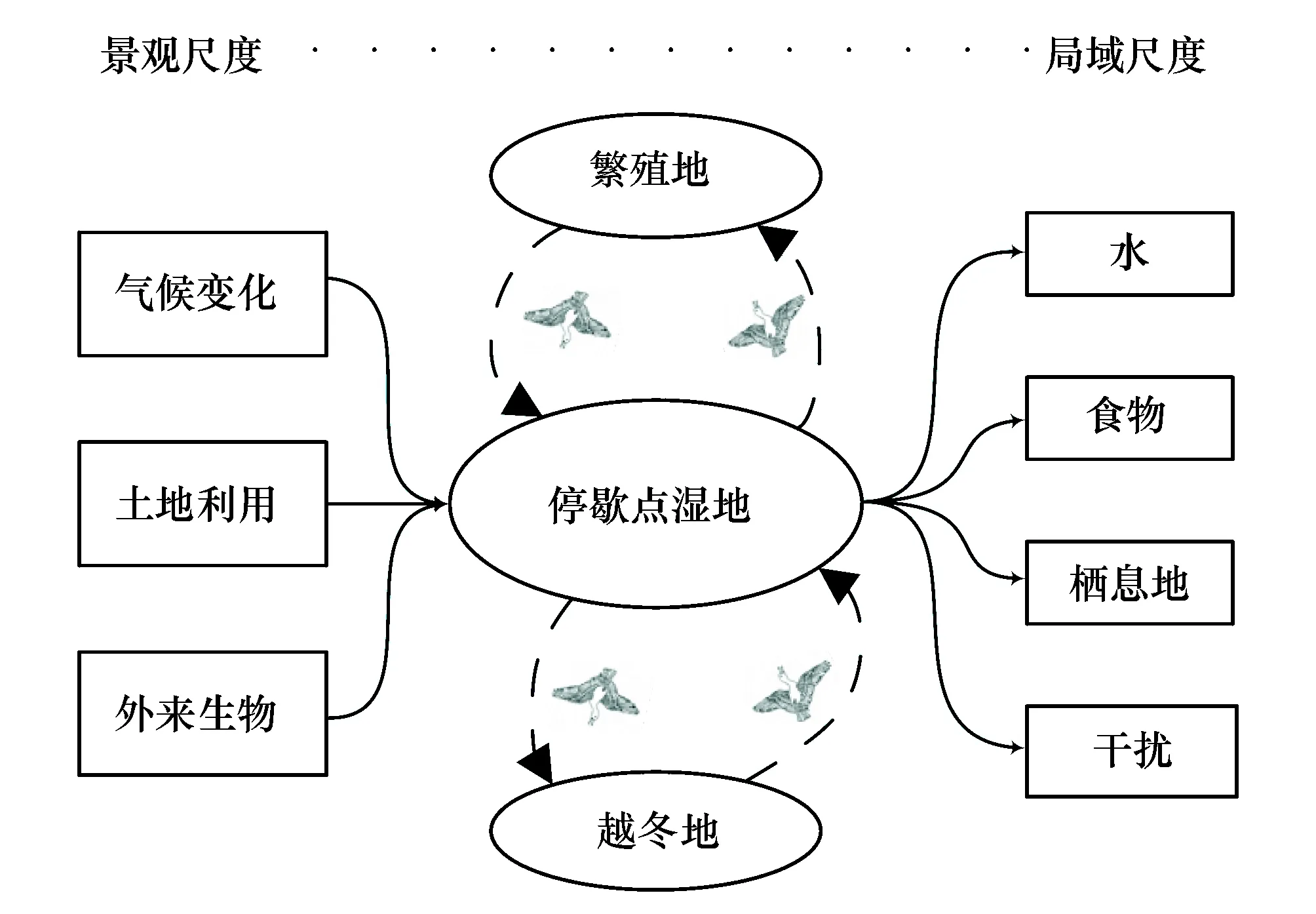
圖1 停歇點濕地影響遷徙水鳥種群的主要因素示意圖 Fig.1 Main factors impact on waterbird populations in their annual cycle
遷徙水鳥種群多度和多樣性的變化是局域和區域環境因子以及氣候變化共同作用的結果(圖 1),對棲息地影響因素的研究方法也需要遵循由各點調查到沿線跟蹤,再到過程模擬和生態效應分析的過程。當前濕地對遷徙水鳥的影響機制研究還在以下幾個方面存在不足:(1)水鳥對生境要素的需求會隨著不同的生長階段、氣候條件、競爭強弱和適應能力而變化,在進行濕地棲息地適宜性評價時未與水鳥遷徙途中的具體需求相結合;(2)傳統的濕地保護管理措施多側重于面向固定的濕地單元,未從景觀尺度或區域尺度上來充分考慮濕地自身的生態過程、功能和生產力特征對遷徙水鳥的影響;(3)在不同尺度下影響水鳥棲息地選擇的主要因素也不同,而當前濕地景觀格局變化的量化指標對水鳥棲息地適宜性的生態意義還不清楚;(4)沿水鳥遷飛路線上多個停歇點棲息地之間的生境分析尚未建立聯系,缺乏多時空尺度上濕地累積效應方面的研究。
基于不同尺度條件下停歇點濕地的主要生態功能及作用機制,建議在濕地單元水平上,加強濕地水文與土壤環境對濕地生物群落和水鳥的協同響應機制研究;在景觀層面上,重點開展濕地格局變化對遷徙水鳥棲息地適應性與連通性的影響機制研究,進而從景觀配置角度提出不同水鳥棲息地及其種群的保護管理對策。
3.1 不同水鳥生境限制因子的識別及其響應機制研究
濕地生境對遷徙水鳥的影響不僅包括多個尺度上的生境要素,其影響程度還與地形和季節等條件密切相關。鳥類數量和生境條件等統計指標雖能夠反映棲息地質量,但濕地對多種水鳥可能存在不同的限制因子,所以在未來的研究中,需要我們全面評估整個濕地內鳥類群落結構的多年變化情況,建立水鳥種群突變與濕地生境間的耦合關系。通過對主要保護對象的生境需求分析,將濕地生境要素、環境基質等因子根據影響權重納入衡量生態承載能力的指標體系中,建立種群響應模型,來分析預測水鳥群落的變化,為將來監測水鳥遷徙策略的變化和遷飛路線上重要停歇點濕地的保護提供支持。
3.2 景觀尺度的濕地生態過程與功能分析
盡管目前在斑塊尺度上針對固定濕地生態系統恢復或生物多樣性保護的措施能夠對遷徙水鳥的覓食和棲息起到積極作用,但在景觀尺度上,棲息地斑塊與周邊景觀類型存在密切的物質和能量交換關系,濕地區域景觀格局對水鳥棲息地的選擇具有重要影響。因此,濕地生態功能的發揮也與周圍環境背景密切相關。在較大時空尺度上分析濕地景觀格局變化的驅動因子及其生態過程,不僅有利于對濕地水鳥棲息地的分布和適宜性變化趨勢進行預測,還有助于區域發展與濕地保護策略的制訂。此外,隨濕地周邊城鎮化進程加快,霧霾天氣、熱島效應等大概率事件對遷徙水鳥的影響也需要在景觀尺度上展開研究。
3.3 濕地斑塊破碎化的量化分析及景觀變化的生態效應研究
濕地景觀格局變化在不同尺度上影響因素和作用范圍不同,所以在探討影響遷徙水鳥棲息地選擇的主要因素時,還需要探究引起濕地景觀變化的多尺度因素。盡管棲息地斑塊結構特征和濕地景觀格局特征分別在各個尺度上影響水鳥棲息地的類型和面積,但目前相應格局指數變化所代表的生態學意義還不清楚,而且濕地景觀變化及其驅動因素引起的生態效應也有待進一步分析。未來通過對不同鳥類物種景觀破碎化的敏感性分析,建立濕地景觀連通性等指數與水鳥適宜棲息地之間的對應關系,識別引起棲息地適宜性變化的景觀指數閾值,將有助于指導濕地生態系統的恢復和景觀格局的構建。
3.4 停歇點濕地間的對比分析與遷飛保護網絡的建立
水鳥種群的波動是遷徙路徑上一系列濕地景觀變化共同作用的后果,需要在多個時空尺度分析各停歇點濕地景觀變化與水鳥種群的相關關系,以確定每年引起遷徙水鳥種群變化的決定性因素是位于濕地內還是飛行途中。未來不僅需要加強對位于水鳥遷飛路線上的一系列停歇點濕地的生態承載能力的對比分析,確定不同水鳥種群的瓶頸棲息地和生境變化驅動因素,還需要分析遷徙過程中水鳥對不同停歇點的選擇機制和策略變化,以便通過連接國際重點鳥區(Important Bird Areas, IBA)建設遷飛保護網絡。
[1] Junk W J, Brown M, Campbell I C, Finlayson M, Gopal B, Ramberg L, Warner B G. The comparative biodiversity of seven globally important wetlands: a synthesis. Aquatic Sciences, 2006, 68(3): 400- 414.
[2] Delany S, Scott D. Waterbird Population Estimates. 4th ed. Wageningen: Wetlands International, 2006.
[3] Bamford M, Watkins D, Bancroft W, Tischler G, Wahl J. Migratory Shorebirds of the East Asian-Australasian Flyway: Population Estimates And Internationally Important Sites. Oceania, Canberra: Wetlands International, 2008.
[4] Hansen B D, Menkhorst P, Moloney P, Loyn R H. Long-term declines in multiple waterbird species in a tidal embayment, south-east Australia. Austral Ecology, 2015, 40(5): 515- 527.
[5] MacKinnon J, Verkuil Y I, Murray N. IUCN Situation Analysis on East and Southeast Asian Intertidal Habitats, with Particular Reference to the Yellow Sea (including the Bohai Sea). Occasional paper of the IUCN species survival commission No.47, 2012.
[6] Niu Z G, Zhang H Y, Wang X W, Yao W B, Zhou D M, Zhao K Y, Zhao H, Li N N, Huang H B, Li C C, Yang J, Liu C X, Liu S, Wang L, Li Z, Yang Z Z, Qiao F, Zheng Y M, Chen Y L, Sheng Y W, Gao X H, Zhu W H, Wang W Q, Wang H, Weng Y L, Zhuang D F, Liu J Y, Luo Z C, Cheng X, Guo Z Q, Gong P. Mapping wetland changes in China between 1978 and 2008. Chinese Science Bulletin, 2012, 57(22): 2813- 2823.
[7] Somveille M, Manica A, Butchart S H M, Rodrigues A S L. Mapping global diversity patterns for migratory birds. PLoS One, 2013, 8(8): e70907.
[8] Erwin R M, Dawson D K, Stotts D B, McAllister L S, Geissler P H. Open marsh water management in the Mid-Atlantic region: aerial surveys of waterbird use. Wetlands, 1991, 11(2): 209- 228.
[9] Flather C H, Sauer J R. Using landscape ecology to test hypotheses about large-scale abundance patterns in migratory birds. Ecology, 1996, 77(1): 28- 35.
[10] Lemoine N, Bauer H G, Peintinger M, B?hning-Gaese K. Effects of climate and land-use change on species abundance in a central European bird community. Conservation Biology, 2007, 21(2): 495- 503.
[11] Van Eerden M R, Drent R H, Stahl J, Bakker J P. Connecting seas: western Palaearctic continental flyway for water birds in the perspective of changing land use and climate. Global Change Biology, 2005, 11(6): 894- 908.
[12] Beatty W S, Webb E B, Kesler D C, Raedeke A H, Naylor L W, Humburg D D. Landscape effects on mallard habitat selection at multiple spatial scales during the non-breeding period. Landscape Ecology, 2014, 29(6): 989- 1000.
[13] Platteeuw M, Foppen R P B, van Eerden M R. The need for future wetland bird studies: scales of habitat use as input for ecological restoration and spatial water management. Ardea, 2010, 98(3): 403- 416.
[14] Valiela I, Martinetto P. Changes in bird abundance in eastern North America: urban sprawl and global footprint?. Bioscience, 2007, 57(4): 360- 370.
[15] Merken R, Deboelpaep E, Teunen J, Saura S, Koedam N. Wetland suitability and connectivity for trans-Saharan migratory waterbirds. PLoS One, 2015, 10(8): e0135445.
[16] Leu M, Thompson C W. The potential importance of migratory stopover sites as flight feather molt staging areas: a review for neotropical migrants. Biological Conservation, 2002, 106(1): 45- 56.
[17] Albanese G, Davis C A. Characteristics within and around stopover wetlands used by migratory shorebirds: Is the neighborhood important?. The Condor, 2015, 117(3): 328- 340.
[18] Ma Z J, Cai Y T, Li B, Chen J K. Managing wetland habitats for waterbirds: an international perspective. Wetlands, 2010, 30(1): 15- 27.
[19] Harms T M, Dinsmore S J. Habitat associations of secretive marsh birds in Iowa. Wetlands, 2013, 33(3): 561- 571.
[20] Tavares D C, Guadagnin D L, de Moura J F, Siciliano S, Merico A. Environmental and anthropogenic factors structuring waterbird habitats of tropical coastal lagoons: implications for management. Biological Conservation, 2015, 186: 12- 21.
[21] Holm T E, Clausen P. Effects of water level management on autumn staging waterbird and macrophyte diversity in three Danish coastal lagoons. Biodiversity and Conservation, 2006, 15(14): 4399- 4423.
[22] Tian B, Zhou Y X, Zhang L Q, Yuan L. Analyzing the habitat suitability for migratory birds at the Chongming Dongtan Nature Reserve in Shanghai, China. Estuarine, Coastal and Shelf Science, 2008, 80(2): 296- 302.
[23] Sebastián-González E, Green A J. Habitat use by waterbirds in relation to pond size, water depth, and isolation: lessons from a restoration in Southern Spain. Restoration Ecology, 2014, 22(3): 311- 318.
[24] Paracuellos M. How can habitat selection affect the use of a wetland complex by waterbirds?. Biodiversity and Conservation, 2006, 15(14): 4569- 4582.
[25] Gyurácz J, Bánhidi P, Csuka A. Successful restoration of water level and surface area restored migrant bird populations in a Hungarian wetland. Biologia, 2011, 66(6): 1177- 1182.
[26] Colwell M A, Taft O W. Waterbird communities in managed wetlands of varying water depth. Waterbirds, 2000, 23(1): 45- 55.
[27] Isola C R, Colwell M A, Taft O W, Safran R J. Interspecific differences in habitat use of shorebirds and waterfowl foraging in managed wetlands of California′s San Joaquin Valley. Waterbirds, 2000, 23(2): 196- 203.
[28] You H L, Xu L G, Jiang J H, Wang X L, Huang Q, Liu G L. The effects of water level fluctuations on the wetland landscape and waterfowl habitat of Poyang Lake. Fresenius Environmental Bulletin, 2014, 23(7A): 1650- 1661.
[29] Kingsford R T, Jenkins K M, Porter J L. Imposed hydrological stability on lakes in arid Australia and effects on waterbirds. Ecology, 2004, 85(9): 2478- 2492.
[30] Taft O W, Colwell M A, Isola C R, Safran R J. Waterbird responses to experimental drawdown: implications for the multispecies management of wetland mosaics. Journal of Applied Ecology, 2002, 39(6): 987- 1001.
[31] Pescador M, Peris S. Seasonal and water mass size effects on the abundance and diversity of waterbirds in a Patagonian National Park. Waterbirds, 2009, 32(1): 25- 35.
[32] Paracuellos M, Tellería J L. Factors affecting the distribution of a waterbird community: the role of habitat configuration and bird abundance. Waterbirds, 2004, 27(4): 446- 453.
[33] Takekawa J Y, Miles A K, Schoellhamer D H, Athearn N D, Saiki M K, Duffy W D, Kleinschmidt S, Shellenbarger G G, Jannusch C A. Trophic structure and avian communities across a salinity gradient in evaporation ponds of the San Francisco Bay estuary. Hydrobiologia, 2006, 567(1): 307- 327.
[35] Sakellarides T M, Konstantinou I K, Hela D G, Lambropoulou D, Dimou A, Albanis T A. Accumulation profiles of persistent organochlorines in liver and fat tissues of various waterbird species from Greece. Chemosphere, 2006, 63(8): 1392- 1409.
[36] Larsen J L, Durinck J, Skov H. Trends in chronic marine oil pollution in Danish waters assessed using 22 years of beached bird surveys. Marine Pollution Bulletin, 2007, 54(9): 1333- 1340.
[37] Tidwell P R, Webb E B, Vrtiska M P, Bishop A A. Diets and food selection of female Mallards and Blue-Winged Teal during spring migration. Journal of Fish and Wildlife Management, 2013, 4(1): 63- 74.
[38] Danner R M, Greenberg R S, Danner J E, Kirkpatrick L T, Walters J R. Experimental support for food limitation of a short-distance migratory bird wintering in the temperate zone. Ecology, 2013, 94(12): 2803- 2816.
[39] Taylor C M, Lank D B, Pomeroy A C, Ydenberg R C. Relationship between stopover site choice of migrating sandpipers, their population status, and environmental stressors. Israel Journal of Ecology & Evolution, 2007, 53(3/4): 245- 261.
[40] Lunardi V O, Macedo R H, Granadeiro J P, Palmeirim J M. Migratory flows and foraging habitat selection by shorebirds along the northeastern coast of Brazil: the case of Baía de Todos os Santos. Estuarine, Coastal and Shelf Science, 2012, 96: 179- 187.
[41] Martins R C, Catry T, Santos C D, Palmeirim J M, Granadeiro J P. Seasonal variations in the diet and foraging behaviour of dunlinsCalidrisalpinain a South European estuary: improved feeding conditions for northward migrants. PLoS One, 2013, 8(12): e81174.
[42] Butler R W, Davidson N C, Morrison R I G. Global-scale shorebird distribution in relation to productivity of near-shore ocean waters. Waterbirds, 2001, 24(2): 224- 232.
[43] Gawlik D E. The effects of prey availability on the numerical response of wading birds. Ecological Monographs, 2002, 72(3): 329- 346.
[44] Horváth Z, Vad C F, V?r?s L, Boros E. The keystone role of anostracans and copepods in European soda pans during the spring migration of waterbirds. Freshwater Biology, 2013, 58(2): 430- 440.
[45] Beerens J M, Gawlik D E, Herring G, Cook M I. Dynamic habitat selection by two wading bird species with divergent foraging strategies in a seasonally fluctuating wetland. The Auk, 2011, 128(4): 651- 662.
[46] Trexler J C, Goss C W. Aquatic fauna as indicators for Everglades restoration: applying dynamic targets in assessments. Ecological Indicators, 2009, 9(6): S108-S119.
[47] Quesnelle P E, Fahrig L, Lindsay K E. Effects of habitat loss, habitat configuration and matrix composition on declining wetland species. Biological Conservation, 2013, 160: 200- 208.
[48] Fahrig L. Effect of habitat fragmentation on the extinction threshold: a synthesis. Ecological Applications, 2002, 12(2): 346- 353.
[49] Zárate-Ovando B, Palacios E, Reyes-Bonilla H. Community structure and association of waterbirds with spatial heterogeneity in the Bahia Magdalena-Almejas wetland complex, Baja California Sur, Mexico. Revista De Biologia Tropical, 2008, 56(1): 371- 389.
[50] VanDusen B M, Fegley S R, Peterson C H. Prey distribution, physical habitat features, and guild traits interact to produce contrasting shorebird assemblages among foraging patches. PLoS One, 2012, 7(12): e52694.
[51] González-Gajardo A, Sepúlveda P V, Schlatter R. Waterbird assemblages and habitat characteristics in wetlands: influence of temporal variability on species-habitat relationships. Waterbirds, 2009, 32(2): 225- 233.
[52] Shriver W G, Hodgman T P, Gibbs J P, Vickery P D. Landscape context influences salt marsh bird diversity and area requirements in New England. Biological Conservation, 2004, 119(4): 545- 553.
[53] Maclean I M D, Hassall M, Boar R, Nasirwa O. Effects of habitat degradation on avian guilds in East African papyrusCyperuspapyrusswamps. Bird Conservation International, 2003, 13(4): 283- 297.
[54] Navedo J G, Masero J A. Measuring potential negative effects of traditional harvesting practices on waterbirds: a case study with migrating curlews. Animal Conservation, 2007, 10(1): 88- 94.
[55] McLeod E M, Guay P J, Taysom A J, Robinson R W, Weston M A. Buses, cars, bicycles and walkers: the influence of the type of human transport on the flight responses of waterbirds. PLoS One, 2013, 8(12): e82008.
[56] Rosa S, Encarna??o A L, Granadeiro J P, Palmeirim J M. High water roost selection by waders: maximizing feeding opportunities or avoiding predation?. Ibis, 2006, 148(1): 88- 97.
[57] Cardoni D A, Favero M, Isacch J P. Recreational activities affecting the habitat use by birds in Pampa′s wetlands, Argentina: implications for waterbird conservation. Biological Conservation, 2008, 141(3): 797- 806.
[58] Burger J. The effect of human disturbance on foraging behavior and habitat use in piping plover (Charadriusmelodus). Estuaries, 1994, 17(3): 695- 701.
[59] Pocewicz A, Estes-Zumpf W A, Andersen M D, Copeland H E, Keinath D A, Griscom H R. Modeling the distribution of migratory bird stopovers to inform landscape-scale siting of wind development. PLoS One, 2013, 8(10): e75363.
[60] Ronconi R A, Allard K A, Taylor P D. Bird interactions with offshore oil and gas platforms: review of impacts and monitoring techniques. Journal of Environmental Management, 2015, 147: 34- 45.
[61] Kampichler C, Van Turnhout C A M, Devictor V, Van Der Jeugd H P. Large-scale changes in community composition: determining land use and climate change signals. PLoS One, 2012, 7(4): e35272.
[62] Brazner J C, Danz N P, Niemi G J, Regal R R, Trebitz A S, Howe R W, Hanowski J M, Johnson L B, Ciborowski J J H, Johnston C A, Reavie E D, Brady V J, Sgro G V. Evaluation of geographic, geomorphic and human influences on Great Lakes wetland indicators: a multi-assemblage approach. Ecological Indicators, 2007, 7(3): 610- 635.
[63] Traill L W, Bradshaw C J A, Brook B W. Satellite telemetry and seasonal movements of Magpie Geese (Anseranassemipalmata) in tropical northern Australia. EMU, 2010, 110(2): 160- 164.
[64] Lehikoinen A, Jaatinen K, V?h?talo A V, Clausen P, Crowe O, Deceuninck B, Hearn R, Holt C A, Hornman M, Keller V, Nilsson L, Langendoen T, Tománková I, Wahl J, Fox A D. Rapid climate driven shifts in wintering distributions of three common waterbird species. Global Change Biology, 2013, 19(7): 2071- 2081.
[65] Goodenough A E, Hart A G. Correlates of vulnerability to climate-induced distribution changes in European avifauna: habitat, migration and endemism. Climatic Change, 2013, 118(3/4): 659- 669.
[66] Huntley B, Collingham Y C, Willis S G, Green R E. Potential impacts of climatic change on European breeding birds. PLoS One, 2008, 3(1): e1439.
[67] Dalby L, McGill B J, Fox A D, Svenning J C. Seasonality drives global-scale diversity patterns in waterfowl (Anseriformes) via temporal niche exploitation. Global Ecology and Biogeography, 2014, 23(5): 550- 562.
[68] Guan L, Wen L, Feng D D, Zhang H, Lei G C. Delayed flood recession in central Yangtze floodplains can cause significant food shortages for wintering geese: results of inundation experiment. Environmental Management, 2014, 54(6): 1331- 1341.
[69] Steen V, Skagen S K, Noon B R. Vulnerability of breeding waterbirds to climate change in the prairie pothole region, U.S.A. PLoS One, 2014, 9(6): e96747.
[70] Eglington S M, Pearce-Higgins J W. Disentangling the relative importance of changes in climate and land-use intensity in driving recent bird population trends. PLoS One, 2012, 7(3): e30407.
[71] Forcey G M, Thogmartin W E, Linz G M, Bleier W J, McKann P C. Land use and climate influences on waterbirds in the Prairie Potholes. Journal of Biogeography, 2011, 38(9): 1694- 1707.
[72] Bolca M, ?zen F, GüneA. Land use changes in Gediz Delta (Turkey) and their negative impacts on wetland habitats. Journal of Coastal Research, 2014, 30(4): 756- 764.
[73] Cardoni D A, Isacch J P, Fanjul M E, Escapa M, Iribarne O O. Relationship between anthropogenic sewage discharge, marsh structure and bird assemblages in an SW Atlantic saltmarsh. Marine Environmental Research, 2011, 71(2): 122- 130.
[74] Figarski T, Kajtoch. Alterations of riverine ecosystems adversely affect bird assemblages. Hydrobiologia, 2015, 744(1): 287- 296.
[75] Kirby J S, Stattersfield A J, Butchart S H M, Evans M I, Grimmett R F A, Jones V R, O′Sullivan J, Tucker G M, Newton I. Key conservation issues for migratory land-and waterbird species on the world′s major flyways. Bird Conservation International, 2008, 18(S1): S49-S73.
[76] Yuan Y J, Zeng G M, Liang J, Li X D, Li Z W, Zhang C, Huang L, Lai X, Lu L H, Wu H P, Yu X. Effects of landscape structure, habitat and human disturbance on birds: a case study in East Dongting Lake wetland. Ecological Engineering, 2014, 67: 67- 75.
[77] Froneman A, Mangnall M J, Little R M, Crowe T M. Waterbird assemblages and associated habitat characteristics of farm ponds in the Western Cape, South Africa. Biodiversity and Conservation, 2001, 10(2): 251- 270.
[78] Andrén H. Effects of habitat fragmentation on birds and mammals in landscapes with different proportions of suitable habitat: a review. Oikos, 1994, 71(3): 355- 366.
[79] Euliss N H, Mushet D M. Influence of agriculture on aquatic invertebrate communities of temporary wetlands in the prairie pothole region of North Dakota, USA. Wetlands, 1999, 19(3): 578- 583.
[80] Guadagnin D L, PeterS, Perello L F C, Maltchik L. Spatial and temporal patterns of waterbird assemblages in fragmented wetlands of Southern Brazil. Waterbirds, 2005, 28(3): 261- 272.
[81] Ge Z M, Zhou X, Wang T H, Wang K Y, Pei E L, Yuan X. Effects of vegetative cover changes on the carrying capacity of migratory shorebirds in a newly formed wetland, Yangtze River Estuary, China. Zoological Studies, 2009, 48(6): 769- 779.
[82] Villamagna A M, Murphy B R, Karpanty S M. Community-level waterbird responses to water hyacinth (Eichhorniacrassipes). Invasive Plant Science and Management, 2012, 5(3): 353- 362.
[83] Lupien N G, Gauthier G, Lavoie C. Effect of the invasive common reed on the abundance, richness and diversity of birds in freshwater marshes. Animal Conservation, 2015, 18(1): 32- 43.
[84] Gan X J, Cai Y T, Choi C, Ma Z J, Chen J K, Li B. Potential impacts of invasiveSpartinaalternifloraon spring bird communities at Chongming Dongtan, a Chinese wetland of international importance. Estuarine, Coastal and Shelf Science, 2009, 83(2): 211- 218.
[85] Markert A, Esser W, Frank D, Wehrmann A, Exo K M. Habitat change by the formation of alienCrassostrea-reefs in the Wadden Sea and its role as feeding sites for waterbirds. Estuarine, Coastal and Shelf Science, 2013, 131: 41- 51.
[86] Levin L A, Neira C, Grosholz E D. Invasive cordgrass modifies wetland trophic function. Ecology, 2006, 87(2): 419- 432.
[87] Tavernia B G, Reed J M. The impact of exotic purple loosestrife (Lythrum salicaria) on wetland bird abundances. The American Midland Naturalist, 2012, 168(2): 352- 363.
[88] Villamagna A M, Murphy B R. Ecological and socio-economic impacts of invasive water hyacinth (Eichhorniacrassipes): a review. Freshwater Biology, 2010, 55(2): 282- 298.
The effect of stopover wetlands on migratory waterbirds at different scales: a review
ZHANG Qiang, MA Keming*, LI Jinya, ZHANG Yuxin
StateKeyLaboratoryofUrbanandRegionalEcology,ResearchCenterforEco-EnvironmentalSciences,ChineseAcademyofSciences,Beijing100085,China
Abstract: Stopover wetlands are important refueling stations for numerous migratory waterbird species, and are ecologically significant in the annual cycle of birds. Recently, stopover wetlands located on flyways were faced with dramatic changes owing to global warming and increasing human activities. Previous studies have suggested that both habitat and environmental factors of these wetlands contributed to the habitat suitability of various species, and the key factors affecting the abundance and diversity of waterbird communities. Therefore, it would be helpful to understand the ecological effects of landscape changes at each stopover by analyzing the diverse habitats and environmental factors that affect various waterbird populations during migration. Furthermore, it would provide theoretical support necessary to formulate effective conservation strategies. In this review, we systematically analyzed how habitat factors such as water body, food resources, habitat configuration, and human disturbance affect the foraging and resting of waterbirds at a local scale. Then, we discussed various environmental contexts, including global warming, land use, and exotic species, that indirectly affect habitat suitability and bird migration at the landscape scale. Finally, on the basis of the coupling effects of various influencing factors that were related to stopover wetlands at different scales, we summarized some shortages based on the research of the present relationships between wetlands and waterbirds, and suggested some priorities for future studies and environmental conservation.
stopover; wetland; waterbird; habitat; flyway
國家“十二五”科技支撐計劃項目課題(2012BAC07B04)
2015- 10- 26;
2016- 07- 11
10.5846/stxb201510262158
*通訊作者Corresponding author.E-mail: mkm@rcees.ac.cn
張強,馬克明,李金亞,張育新.不同尺度下停歇點濕地對遷徙水鳥的影響研究綜述.生態學報,2017,37(8):2520- 2529.
Zhang Q, Ma K M Li J Y, Zhang Y X.The effect of stopover wetlands on migratory waterbirds at different scales: a review.Acta Ecologica Sinica,2017,37(8):2520- 2529.
猜你喜歡
中學生數理化·八年級物理人教版(2022年3期)2022-03-16 05:55:08
現代裝飾(2021年6期)2021-12-31 05:27:54
當代陜西(2021年2期)2021-03-29 07:41:24
小學科學(學生版)(2020年12期)2021-01-08 09:28:10
小學科學(學生版)(2020年7期)2020-07-28 08:00:52
少年漫畫(藝術創想)(2020年12期)2020-06-09 05:50:08
媽媽寶寶(2017年3期)2017-02-21 01:22:28
中國塑料(2016年3期)2016-06-15 20:30:00
照明工程學報(2016年3期)2016-06-01 12:17:56
通信電源技術(2016年3期)2016-03-26 07:13:38