徽州傳統(tǒng)民居室內(nèi)水體蒸發(fā)實測研究
2017-06-27 11:51:52黃志甲程建張恒
土木建筑與環(huán)境工程
2017年4期
關(guān)鍵詞:模型
黃志甲++程建++張恒

摘要:
徽州傳統(tǒng)民居室內(nèi)水體蒸發(fā)對室內(nèi)環(huán)境的營造起到了積極作用。根據(jù)水體蒸發(fā)熱平衡,建立民居室內(nèi)水體蒸發(fā)模型,用實地連續(xù)測試的蒸發(fā)數(shù)據(jù)對該模型進(jìn)行驗證。結(jié)果表明,該模型能有效的計算徽州傳統(tǒng)民居室內(nèi)水體蒸發(fā)過程,計算和測試的水體蒸發(fā)量之間的均方根誤差和平均相對誤差分別為41.5 g/(m2·h)和4.2%。環(huán)境參數(shù)中地面溫度、太陽輻射、風(fēng)速、相對濕度和氣溫對水體蒸發(fā)的影響程度逐漸降低,蒸發(fā)量和環(huán)境參數(shù)之間的相關(guān)系數(shù)分別為0.909、0.779、0736、-0.654和0.622。
關(guān)鍵詞:
傳統(tǒng)民居;蒸發(fā)模型;實測;環(huán)境參數(shù)
Abstract:
Water evaporation in Huizhou traditional dwellings has played a positive role in environment formation. Evaporation model was built by analyzing heat balance of water evaporation. The model was calibrated against evaporation data which were obtained from field measurement in traditional dwellings. The results show that the model could effectively predict the water evaporation process in Huizhou traditional dwellings. In addition, the error of standard deviations and the average relative error between calculate values and experimental values are 41.5 g/(m2·h) and 4.2%, respectively. Correlation analysis results show that the water evaporation is most correlated to the ground temperature, followed by solar radiation, wind speed, relative humidity and air temperature, and the correlation coefficients are 0.909, 0.779, 0.736, -0.654 and 0.622, respectively.
Keywords:
traditional dwelling; evaporation model; field measurement; environment parameters
被動蒸發(fā)冷卻是古人在夏季最常使用的一種降溫技術(shù),對夏季室內(nèi)環(huán)境的營造起著重要的作用。長期以來人們從大尺度范圍出發(fā),利用各種方法對室外江、河、湖、海等大面積水體的蒸發(fā)量進(jìn)行預(yù)測[12]。
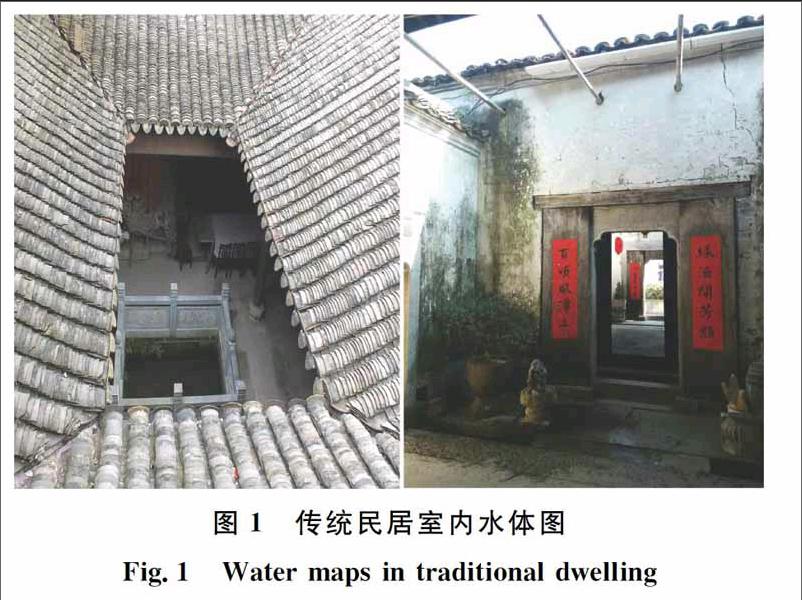
徽州傳統(tǒng)民居作為極具特色的地域性建筑,蘊含著大量的生態(tài)設(shè)計經(jīng)驗。天井作為最活躍的元素,和室內(nèi)環(huán)境的營造有著密不可分的關(guān)系[34]。天井底部通常蓄有薄水層,夏季水體蒸發(fā)帶走熱量,降低室內(nèi)溫度,這一蒸發(fā)過程屬于微氣候、微尺度的范圍,在現(xiàn)有的文獻(xiàn)中還少有涉及。在大尺度空間的研究范圍內(nèi),水體的蒸發(fā)量主要與環(huán)境參數(shù)有關(guān)[57],但徽州傳統(tǒng)民居的室內(nèi)水體蒸發(fā)卻更為復(fù)雜,需要通過測試和分析進(jìn)行更加深入的探究。水體蒸發(fā)的研究方法主要包括利用氣象因子的經(jīng)驗公式法[89]和利用傳熱傳質(zhì)的熱質(zhì)平衡法[1011]。……
登錄APP查看全文
猜你喜歡
童話王國·奇妙邏輯推理(2024年5期)2024-06-19 16:03:38
網(wǎng)絡(luò)安全與數(shù)據(jù)管理(2022年1期)2022-08-29 03:15:20
導(dǎo)航定位學(xué)報(2022年4期)2022-08-15 08:27:00
新世紀(jì)智能(數(shù)學(xué)備考)(2021年9期)2021-11-24 01:14:36
成都醫(yī)學(xué)院學(xué)報(2021年2期)2021-07-19 08:35:14
新世紀(jì)智能(數(shù)學(xué)備考)(2020年9期)2021-01-04 00:25:14
數(shù)學(xué)物理學(xué)報(2020年2期)2020-06-02 11:29:24
光學(xué)精密工程(2016年6期)2016-11-07 09:07:19
核科學(xué)與工程(2015年4期)2015-09-26 11:59:03
中學(xué)數(shù)學(xué)雜志(初中版)(2006年1期)2006-12-29 00:00:00