英文摘要
2017-09-01 04:36:48
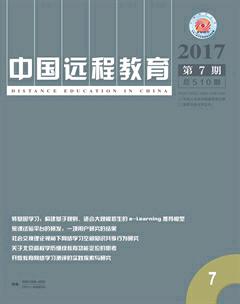
中國遠(yuǎn)程教育 2017年7期
關(guān)鍵詞:英文
Transgenic learning: towards a rule-based eLearning recommendation model for massive enrollment
Daniel Burgos and Alberto Corbí
Current models and methodologies in the field of educational technology do not involve engagement between formal and informal learning. Usually, only activities within a formal environment (i.e., assignments, grades, etc.) are stored, tracked and retrieved as an input parameter in recommendation systems. There is normally no useful combination with the informal activity of every user (e.g., social networks and continuous evaluation). In addition, tutoring systems in academic domains are usually based only on content filtering and collaboration from other students, which contributes to dissolving the crucial role of the tutor. Last, MOOCs and SPOCs have become a crucial part of educational models combining formal and informal settings, playing a key role in the learning path of every user. Education requires a disruptive approach to boost the learning-teaching process. We call it transgenic learning and by making use of information about the users behavior and interactions as well as efficient monitoring and personalized counselling by a tutor, we can improve the learning performance of every user. This paper presents LIME, a personalized eLearning recommendation model for public and private social networks and learning management systems, which supports this approach, specifically for massive courses and large data sets. It then elaborates on a framework and software prototype (iLIME) which has been developed to demonstrate how the LIME model could operate independently of the learning management infrastructure in use. Finally, it reports on a case study developed around the Apereo Sakai CLE 2.10-svn, in the context of a MOOC strategy to be implemented at university level. Technical issues and challenges are also discussed and solutions are proposed in order to run iLIME and deliver LIME-based recommendations to learners in a real academic scenario.
Keywords: transgenic learning; informal learning; massive open online courses; rule-based recommendation system; learning tool interoperability (LTI)
Developing a MOOC experimentation platform: Insights from a user study
Vitomir Kovanovi?, Sre?ko Joksimovi?, Philip Katerinopoulos, Charalampos Michail,
George Siemens, and Dragan Ga?evi?
In 2011, the phenomenon of MOOCs swept the world of education and put online education in the focus of the public discourse around the world. Although researchers were excited with the vast amounts of MOOC data being collected, the benefits of this data did not stand to the expectations due to several challenges. The analyses of MOOC data are very time-consuming and labor-intensive, and require a highly advanced set of technical skills, often not available to the education researchers. Because of this MOOC data analyses are rarely done before the courses end, limiting the potential of data to impact student learning outcomes and experience. In this paper, we introduce MOOCito (MOOC intervention tool), a user-friendly software platform for the analysis of MOOC data, which focuses on conducting data-informed instructional interventions and course experimentations. We cover important design principles behind MOOCito and provide an overview of the trends in MOOC research leading to its development. Although a work-in-progress, we outline the prototype of MOOCito and the results of a user evaluation study that focused on the system's perceived usability and ease-of-use. The results of the study are discussed, as well as their practical implications.
Keywords: MOOCs; A/B testing; controlled experiments; analysis platform; user study; technology acceptance model; Coursera
Knowledge sharing behavior in online learning spaces: a social exchange theory perspective
Si Zhang
The purpose of online learning spaces is to form learning networks and facilitate personalized learning. Knowledge sharing behavior in online learning spaces is in its essence a social exchange process whereby learners help each other and progress together. This study first put forward a research model and research hypotheses of knowledge sharing behavior in online learning spaces from a social exchange theory perspective. It then tested the research model and research hypothesis via questionnaire survey. Analysis of reliability and validity of the questionnaire demonstrates high degree of goodness of fit of the measuring model. The results show that sense of self-worth, respect from others and social support have positive impact on knowledge sharing behavior, while being noticed has no significant impact. It is also found that perceived executional costs and cognitive costs hinder knowledge sharing behavior in online learning spaces. Suggestions for improving knowledge sharing behavior in online learning spaces are discussed and limitations of the study identified.
Keywords: social exchange theory; online learning space; knowledge sharing; adult learner; primary and middle school teacher; influencing factors
Rethinking the roles and functions of degree programs in the continuing education provision of colleges and universities in Beijing
Faxin Wang, Huaying Bao, Yuanxia Liu, Wenfeng Huang and Meihui Gao
Abstract: This study focuses on the roles and functions of degree programs of continuing education in colleges and universities in Beijing, analyzing the gradual weakening degree-upgrading function of these programs as well as the existing problems in the following aspects: target students, quality of the programs, social credibility, etc. The authors suggest that a more sustainable part-time degree continuing education needs to be developed with a long term development oriented perspective, achieving gradually the same educational quality as the full-time degree programs and providing multi-level diversified talents to suit the needs of social and economic development of Beijing, Tianjin and Hebei Province.
Keywords: degree programs of continuing education; roles and functions of continuing education; part-time education; adult education
(英文目錄、摘要譯者:劉占榮)
猜你喜歡
國際展望(2017年2期)2017-03-21 18:34:18
鄱陽湖學(xué)刊(2016年6期)2017-01-16 13:05:41
中國遠(yuǎn)程教育(2016年6期)2016-12-07 10:07:02
財(cái)經(jīng)(2016年19期)2016-08-11 08:17:03
中國遠(yuǎn)程教育(2016年5期)2016-06-29 10:13:42
中國遠(yuǎn)程教育(2016年2期)2016-03-21 10:31:21
中國遠(yuǎn)程教育(2016年1期)2016-02-26 10:37:15
國際展望(2015年5期)2015-09-15 05:41:45
國際展望(2015年4期)2015-07-13 05:30:56
能源(2014年9期)2014-09-15 13:18:12