
城市草坪不同管理方式下土壤動物群落結構特征與差異
2017-12-06 07:40:31羅熳麗黃婷婷肖玖金黃進平彭彩云
浙江農業學報 2017年11期
關鍵詞:差異
羅熳麗,黃婷婷,肖玖金,*,黃進平,張 健,彭彩云
(1.四川農業大學 林學院, 四川 溫江611130; 2.四川農業大學 生態林業研究所, 四川 溫江611130; 3.四川農業大學 旅游學院, 四川 都江堰 611830)
城市草坪不同管理方式下土壤動物群落結構特征與差異
羅熳麗1,2,黃婷婷3,肖玖金1,2,*,黃進平3,張 健1,2,彭彩云1,2
(1.四川農業大學 林學院, 四川 溫江611130; 2.四川農業大學 生態林業研究所, 四川 溫江611130; 3.四川農業大學 旅游學院, 四川 都江堰 611830)
為了解城市草坪不同管理方式下土壤動物的群落結構,于2015年7月,大型動物采用手撿法,中小型土壤動物采用干、濕漏斗法進行分離,對未除草、人工除草和人為踐踏3種管理方式下草坪土壤動物的群落結構進行調查。試驗共捕獲土壤動物1 009只,隸屬于2門11綱20科;3種草坪管理方式下土壤動物平均密度排序為未除草(3.84×10⁴只·m-2)>人工除草(3.63×10⁴只·m-2)>人為踐踏(2.79×10⁴只·m-2),土壤動物類群數為未除草(33)>人工除草(27)>人為踐踏(20)。未除草與人工除草管理方式的土壤動物密度-類群指數(DG)有顯著性差異(P<0.05),各管理方式間土壤動物群落多樣性指數(H′)差異不顯著(P>0.05),大型土壤動物類群數差異性顯著(P<0.05)。表明城市草坪土壤動物的豐富度、多樣性和均勻度與人為干擾強度呈緊密的負相關關系。
城市草坪;土壤動物;群落結構;類群指數
隨著經濟和城市人口的快速增長,人們對城市居住環境質量的要求越來越高。城市草坪為居民提供休閑娛樂場所的同時,也在調節城市小氣候、提高城市生態承載力等方面起著重要的作用,是城市的綠色基礎設施和城市重要的生命保障系統[1],對凈化空氣、吸收粉塵、保持水土等發揮著重要的作用[2-4],城市綠地生態系統的好壞對綠地系統生態功能具有重要影響[5]。目前,對城市草地生態系統的干擾主要有人工除草和人為踐踏等,本研究以未進行人工除草的草地為對照,探討這些干擾對城市草地生態系統的影響。
土壤動物是在土壤中占有一定存在時間、空間,并對土壤產生一定影響的動物,目前國內外對其調查主要集中在森林、草原、田園等[6],而對城市草坪不同管理方式下的土壤動物研究甚少[7]。作為土壤生態系統中不可缺少的部分[8],土壤動物對土壤環境變化十分敏感,在污染物降解、物質分解、能量流動、環境污染指示等方面有著重要的作用[9-18]。草坪區域的土壤動物是城市綠地生態系統的重要組成部分[19],其組成與分布在很大程度上會影響草域生態系統的穩定程度和發展方向,而且不同生態系統演替階段的土壤動物群落具有較大差異[20-24]。本研究通過研究草坪不同管理方式下的土壤動物群落結構,了解人為活動強度與土壤動物群落結構的關系,進而了解城市綠地質量,為城市草坪管理提供參考。
1 材料與方法
1.1 試驗地概況
試驗地位于四川省都江堰市觀鳳路(30°57′56.0″N,103°39′02.8″E),屬亞熱帶濕潤氣候,四季分明,雨量充沛,年均降雨量1 243.80 mm,年平均最大相對濕度80%,最小相對濕度75%,平均日照時數1 017 h。未除草樣地綠化用草為結縷草(ZoysiajaponicaSteud)和一定量的白車軸草(TrifoliumrepensL)、小蓬草(Conyzacanadensis(L.) Cronq.)、喜旱蓮子草(Alternantheraphiloxeroides(Mart.) Griseb.);除草樣地綠化用草為結縷草(ZoysiajaponicaSteud);人為踐踏樣地以綠化用草為主,選址在未除草樣地和除草樣地之間。樣地總蓋度90%,土壤為黃壤,樣地基本信息見表1。
1.2 研究方法
于2015年7月,分別在未除草、人工除草和人為踐踏共3種管理方式的草坪中設置3個面積為10 m×10 m的樣地,各樣地內按“品”字型設置3個50 cm×50 cm小樣方。
分層收集樣點內的土壤動物,0~5、5~10、10~15 cm共3個土壤層次。對土壤中的大型動物進行手撿,將所得的土壤動物分層放入75%乙醇中殺死,對其編號,帶回實驗室,在解剖鏡下鑒定并分類計數;在各樣點土壤中,分0~5、5~10、10~15 cm層用環刀(R=5 cm,V=100 cm3)自上而下依次取土樣,每層各取2個,用尼龍網包好,編號后放入黑布袋,帶回實驗室分別用Tullgren干漏斗(干生)和Baermann濕漏斗(濕生)對土樣中的中小型土壤動物進行分離。土壤動物的分離均在烘蟲箱中進行,烘蟲箱的溫度控制在35~40 ℃。干生和濕生的烘蟲時間均為48 h,其中濕生4 h觀察1次。干生分離出的土壤動物均用盛有75%乙醇的器皿收集,濕生土壤動物用清水收集,最后在解剖鏡下進行分類鑒定和數量統計。
土壤動物的分類鑒定:手撿和干濕分離所得的土壤動物用雙目解剖鏡(Leica,EZ4HD)進行觀觀察,主要采用《中國土壤動物檢索圖鑒》[25]《中國亞熱帶土壤動物》[26]《昆蟲分類檢索》[27]和《幼蟲分類學》[28]進行分類鑒定,一般鑒定到科,同時統計個體數量。
表1樣地基本信息
Table1Basic condition of plots
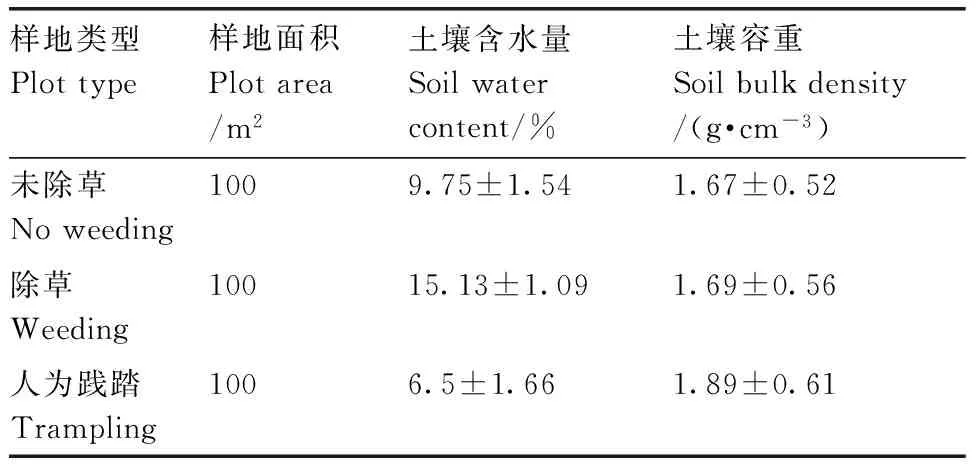
樣地類型Plottype樣地面積Plotarea/m2土壤含水量Soilwatercontent/%土壤容重Soilbulkdensity/(g·cm-3)未除草Noweeding1009.75±1.541.67±0.52除草Weeding10015.13±1.091.69±0.56人為踐踏Trampling1006.5±1.661.89±0.61
1.3 數據的處理
采用多樣性指數H′、豐富度指數M、均勻度指數J、優勢度指數C和密度-類群指數DG[29]等對土壤動物群落多樣性進行分析。
Shannon-Wiener多樣性指數
H′=-∑PilnPi。
式中:Pi=ni/N,ni為第i個類群的密度數;N為所有類群的密度數。
Margalef豐富度指數M=(S-1)/lnN。
式中:S為類群數;N為所有類群的密度數。
Pieluo均勻度指數J=H′/lns。
式中:H′為Shannon-Wiener多樣性指數;s為類群數。
Simpson優勢度指數C=Σ(ni/N)2。
式中:ni為第i個類群的密度數;N為所有類群的密度數。
密度-類群指數
式中:Di為第i類群密度數;Dimax是各群落中第i類群的最大密度數;g為群落中的類群數;G為各群落包含的總類群數;Ci是在C個群落中第i個類群出現的比率。
群落相似性分析:采用Sorensen相似性指數(Q),即Q=2C/(A+B)。其中:C為2個群落或樣地生境共有類群數,A和B分別為生境a和b的類群數。
差異顯著性分析:采用單因素方差分析(One-way ANOVA)對不同樣地間土壤動物群落組成進行檢驗,顯著性水平設定為P=0.05。
2 結果與分析
2.1 土壤動物類群組成和數量
本試驗共捕獲土壤動物1 009只,隸屬于2門11綱20科,共46個類群。其中,優勢類群為線蟲綱和線蚓科,分別占總捕獲量的77%和11%(表2)。常見類群有蟻科、小蚓科、等節科等,其他種類構成稀有類群。人工除草樣地捕獲土壤動物共431只27類,平均密度3.63×10⁴只·m-2。未除草樣地捕獲298只33類,平均密度3.84×10⁴只·m-2。人為踐踏樣地捕獲280只20類,平均密度2.79×10⁴只·m-2。
2.2 不同體型土壤動物群落結構特征
參照尹文英[25]對土壤動物的劃分,體長大于2 mm為大型土壤動物,體長小于2 mm為中小型土壤動物。不同體型土壤動物群落結構特征見圖1,由圖1-A可以看出,各種草地管理方式下,大型土壤動物平均密度以除草樣地最高,踐踏樣地次之,未除草樣地最低;中小型土壤動物則以未除草樣地最高,除草樣地次之,踐踏樣地最低。進一步對其做差異顯著性檢驗,結果表明,草地不同管理方式對大型土壤動物(F=2.07,P=0.16)和中小型土壤動物(F=1.84,P=0.89)平均密度的影響均無顯著差異。
草地不同管理方式對大型和中小型土壤動物類群數產生了一定的影響,由圖1-B可以看出,大型土壤動物和中小型土壤動物類群數均以未除草最高,除草樣地次之,踐踏樣地最低;進一步對其做差異顯著性檢驗,結果表明,除草和未除草樣地大型土壤動物類群數顯著高于踐踏樣地(F=5.32,P=0.018),樣地間差異不顯著(P>0.05);草地不同管理方式對中小型土壤動物類群數的影響差異不顯著(F=2.02,P=0.16)。
2.3土壤動物群落結構的垂直分布特征
草地不同管理方式下,不同土壤深度的含水量、土壤容重、緊密程度等存在一定差異,導致不同深度的土壤動物平均密度和類群數皆有所差別[30-31]。土壤動物群落結構的垂直分布特征見圖2。由圖2-A可以看出,除踐踏樣地外,除草和未除草樣地土壤動物平均密度均隨著土層的加深而減少;草地不同管理方式下,0~5 cm土層土壤動物平均密度以除草樣地最高,踐踏樣地最低;5~10 cm土層土壤動物平均密度以未除草樣地最高,踐踏樣地最低;10~15 cm土層土壤動物平均密度以踐踏樣地最高,除草樣地最低。差異顯著性檢驗結果表明,草地不同管理方式下,0~5、5~10、10~15 cm土層的土壤動物平均密度差異均不顯著(P>0.05);同種管理方式下,除草樣地和未除草樣地0~5 cm土層土壤動物平均密度均顯著高于5~10、10~15 cm土層(P<0.05),5~10和10~15 cm土層間土壤動物平均密度差異不顯著(P>0.05);踐踏樣地0~5和10~15 cm土層土壤動物平均密度顯著高于5~10 cm土層(P<0.05),0~5和10~15 cm土層間差異不顯著(P>0.05)。
表2土壤動物群落組成統計
Table2Composition of soil animal community statistics
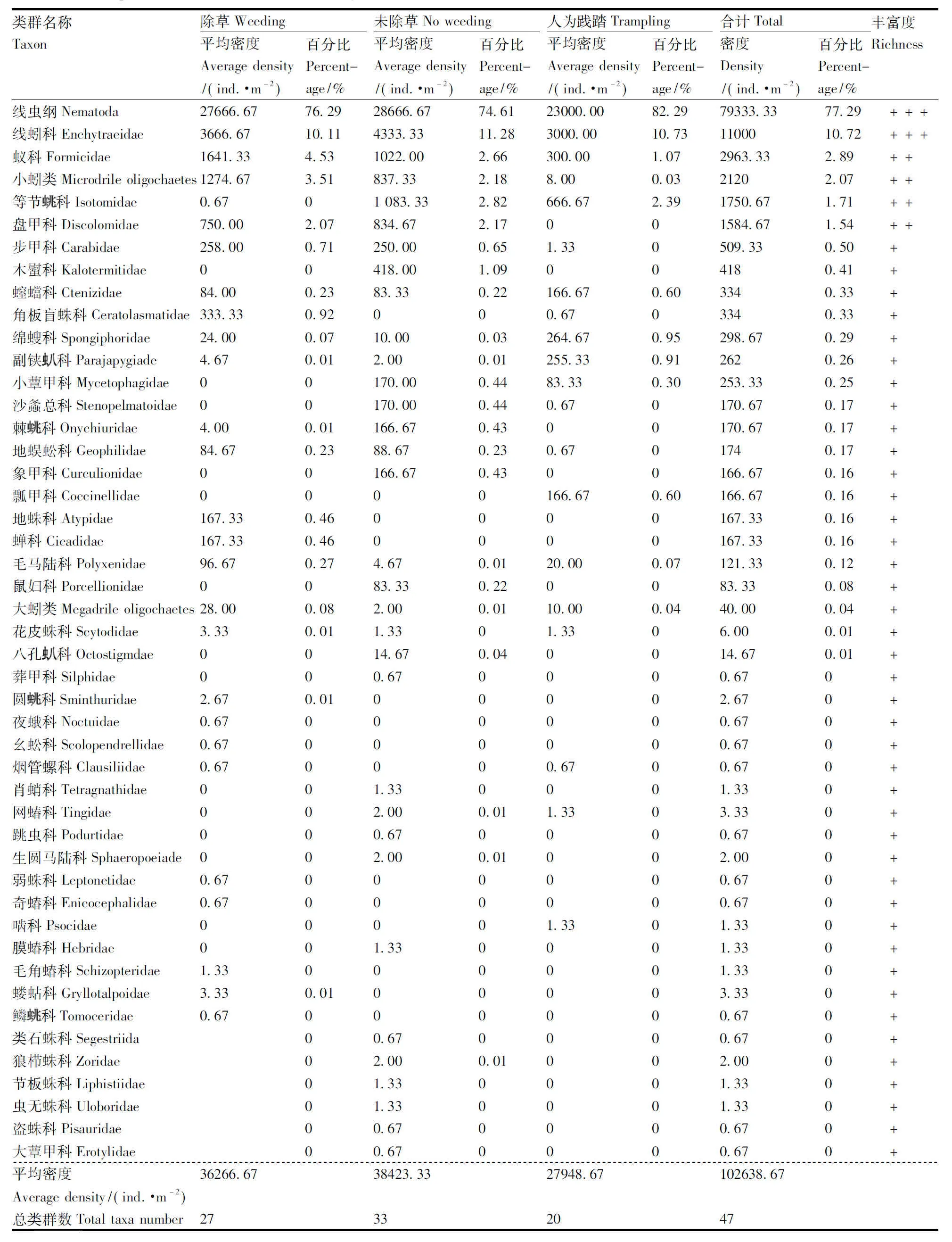
類群名稱Taxon除草Weeding平均密度Averagedensity/(ind.·m-2)百分比Percent-age/%未除草Noweeding平均密度Averagedensity/(ind.·m-2)百分比Percent-age/%人為踐踏Trampling平均密度Averagedensity/(ind.·m-2)百分比Percent-age/%合計Total密度Density/(ind.·m-2)百分比Per-centage/%豐富度Richness線蟲綱Nematoda27666.6776.2928666.6774.6123000.0082.2979333.3377.29+++線蚓科Enchytraeidae3666.6710.114333.3311.283000.0010.731100010.72+++蟻科Formicidae1641.334.531022.002.66300.001.072963.332.89++小蚓類Microdrileoligo-chaetes1274.673.51837.332.188.000.0321202.07++等節科Isotomidae0.6701083.332.82666.672.391750.671.71++盤甲科Discolomidae750.002.07834.672.17001584.671.54++步甲科Carabidae258.000.71250.000.651.330509.330.50+木螱科Kalotermitidae00418.001.09004180.41+螲蟷科Ctenizidae84.000.2383.330.22166.670.603340.33+角板盲蛛科Ceratolasmatidae333.330.92000.6703340.33+綿螋科Spongiphoridae24.000.0710.000.03264.670.95298.670.29+副鋏科Parajapygiade4.670.012.000.01255.330.912620.26+小蕈甲科Mycetophagidae00170.000.4483.330.30253.330.25+沙螽總科Stenopelmatoidae00170.000.440.670170.670.17+棘科Onychiuridae4.000.01166.670.4300170.670.17+地蜈蚣科Geophilidae84.670.2388.670.230.6701740.17+象甲科Curculionidae00166.670.4300166.670.16+瓢甲科Coccinellidae0000166.670.60166.670.16+地蛛科Atypidae167.330.460000167.330.16+蟬科Cicadidae167.330.460000167.330.16+毛馬陸科Polyxenidae96.670.274.670.0120.000.07121.330.12+鼠婦科Porcellionidae0083.330.220083.330.08+大蚓類Megadrileoligo-chaetes28.000.082.000.0110.000.0440.000.04+花皮蛛科Scytodidae3.330.011.3301.3306.000.01+八孔科Octostigmdae0014.670.040014.670.01+葬甲科Silphidae000.670000.670+圓科Sminthuridae2.670.0100002.670+夜蛾科Noctuidae0.67000000.670+幺蚣科Scolopendrellidae0.67000000.670+煙管螺科Clausiliidae0.670000.6700.670+肖蛸科Tetragnathidae001.330001.330+網蝽科Tingidae002.000.011.3303.330+跳蟲科Podurtidae000.670000.670+生圓馬陸科Sphaeropoeiade002.000.01002.000+弱蛛科Leptonetidae0.67000000.670+奇蝽科Enicocephalidae0.67000000.670+嚙科Psocidae00001.3301.330+膜蝽科Hebridae001.330001.330+毛角蝽科Schizopteridae1.33000001.330+螻蛄科Gryllotalpoidae3.330.0100003.330+鱗科Tomoceridae0.67000000.670+類石蛛科Segestriida00.670000.670+狼櫛蛛科Zoridae02.000.01002.000+節板蛛科Liphistiidae01.330001.330+蟲無蛛科Uloboridae01.330001.330+盜蛛科Pisauridae00.670000.670+大蕈甲科Erotylidae00.670000.670+平均密度Averagedensity/(ind.·m-2)36266.6738423.3327948.67102638.67總類群數Totaltaxanumber27332047
+++為優勢類群,++為常見類群,+為稀有類群。
+++, Predominant group;++, Frequent groups;+, Rare groups.
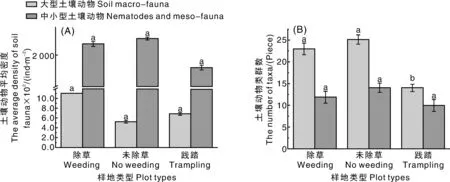
相同顏色柱子上無相同小字母表示差異顯著(P<0.05)Data on the same colour bars marked without the same lowercase letter indicated significant differences at P<0.05圖1 不同體型土壤動物群落特征Fig.1 Distribution characteristics of different size types of soil fauna
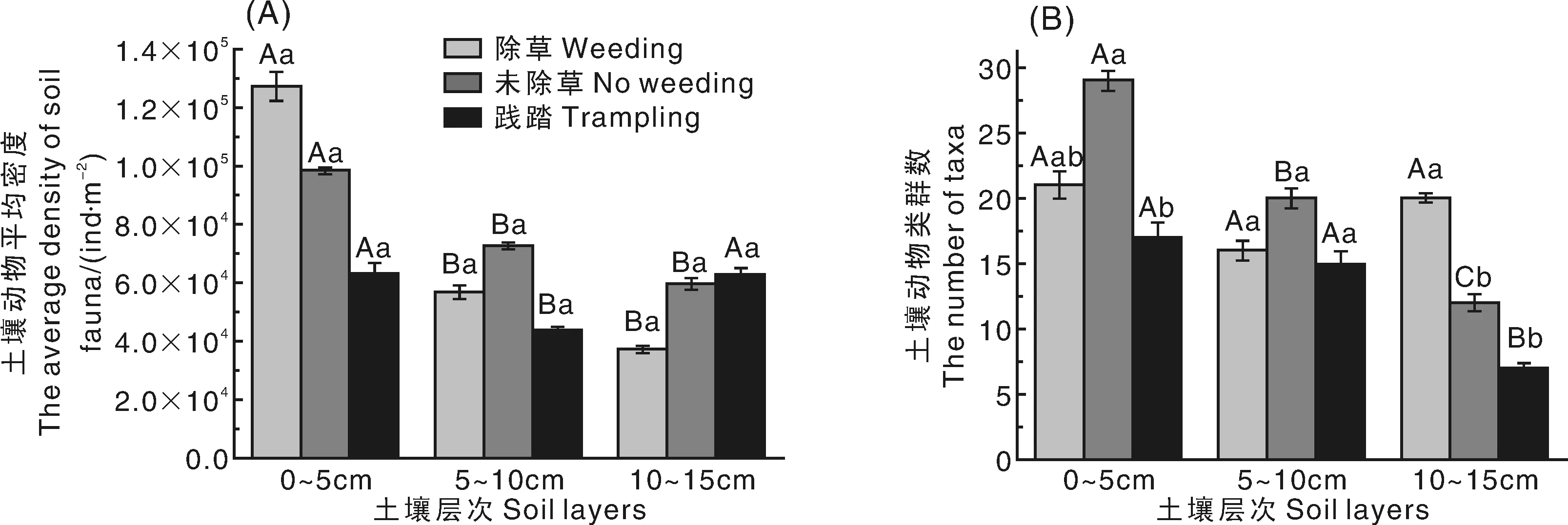
不同管理方式、相同土壤分層的柱子上無相同小寫字母表示差異顯著(P< 0.05);同一管理方式、不同土壤分層的柱子上無相同大寫字母表示差異顯著(P< 0.05)Data on the bars in the different management ways and the same soil layers marked without the same lowercase letter indicated significant differences at P<0.05; Data on the bars in the same management ways and the different soil layers marked without the same uppercase letter indicated significant differences at P<0.05圖2 土壤動物垂直分布特征Fig.2 Vertical distribution characteristics of soil fauna
從圖2-B可以看出,未除草和踐踏樣地土壤動物類群數均隨著土層的加深而減少;同一土層中,0~5和5~10 cm土層土壤動物類群數均以未除草樣地最高,除草樣地次之,踐踏樣地最低;10~15 cm土層土壤動物類群數以除草樣地最高,未除草樣地次之,踐踏樣地最低。差異顯著性檢驗結果表明,草地不同管理方式下,0~5 cm土層土壤動物類群數以未除草樣地顯著高于踐踏樣地(P<0.05),除草和踐踏樣地間土壤動物類群數差異不顯著(P>0.05);各樣地5~10 cm土層土壤動物類群數差異不顯著(P>0.05);10~15 cm土層土壤動物類群數以除草樣地顯著高于未除草和踐踏樣地(P<0.05),未除草和踐踏樣地間差異不顯著(P>0.05)。同種管理方式下,除草樣地各土層間土壤動物類群數差異不顯著(P>0.05),未除草樣地各土層間土壤動物類群數差異顯著(P<0.05),踐踏樣地0~5和5~10 cm土層土壤動物類群數顯著高于10~15 cm土層(P<0.05)。
2.4土壤動物的多樣性指數特征
草地不同管理方式中,未除草樣地的多樣性指數、均勻度指數、豐富度指數最高,優勢度指數以人為踐踏樣地最高,人工除草樣地的密度-類群指數最高,未除草和人工除草樣地的密度-類群指數存在顯著性差異(P<0.05),其他各個指數差異均不顯著(P>0.05)。
2.5土壤動物類群相似性指數特征
為了解草地不同管理方式間土壤動物群落的相似性特征,本文采用Sorensen相似性指數進行研究,其中,土壤動物類群相似性指數在0.75~1.00為極相似,0.50~0.74為相似,0.25~0.49為中等不相似,0~0.24為極不相似[32]。草地不同管理方式間土壤動物群落的相似性指數見表4,從表中可以看出,未除草樣地、除草樣地與人為踐踏樣地相似性指數分別為0.59和0.58,均為相似水平;除草樣地和未除草樣地間相似性指數為0.46,為中等不相似水平。
表3草地不同管理方式土壤動物群落的多樣性指數特征(平均值±標準差)


樣地類型PlottypeH'JCMDG除草Weeding0.87±0.14a0.34±0.05a0.6±0.07a1.25±0.14a0.88±0.19a未除草Noweeding0.91±0.20a0.35±0.07a0.59±0.09a1.25±0.11a0.17±0.01b人為踐踏Trampling0.63±0.17a0.29±0.07a0.7±0.09a0.9±0.19a0.57±0.17ab
H′,Shannon-Wiener多樣性指數;J,Pieluo均勻度指數;C,Simpson優勢度指數;M,Margalef豐富度指數;DG,密度-類群數指數。同列數據后不同小寫字母表示差異顯著(P<0.05)。
H′, the Shannon-Wiener diversity index;J, Pieluo evenness index;C, Simpson dominance index;M, Margalef richness index; DG, density-groups index. Data marked without the same lowercase letter in each column indicated significant differences at 0.05 level (P<0.05).
表4草地不同管理方式土壤動物類群相似性指數
Table4Similarity coefficient of soil fauna in different management ways of urban lawn
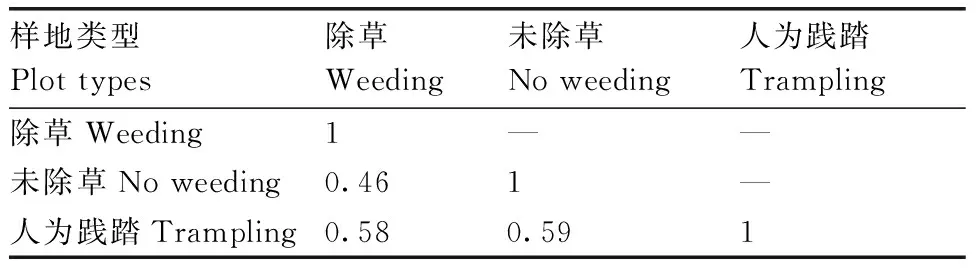
樣地類型Plottypes除草Weeding未除草Noweeding人為踐踏Trampling除草Weeding1——未除草Noweeding0.461—人為踐踏Trampling0.580.591
3 討論
3種不同管理方式的城市草坪中,土壤動物的平均密度和類群數表現為未除草>人工除草>人為踐踏,表明踐踏行為在草坪磨損和土壤容重等方面影響草坪理化性質[33],導致土壤動物的平均密度和群落數量明顯偏低且類群較單一。而未除草樣地各方面基本未受到干擾,適宜土壤動物生存,因而樣地中土壤動物的平均密度和類群數最高。人工除草樣地的土壤減少了植被覆蓋率、有機質降解和養分積累,使土壤容重增加[34],一定程度上影響了土壤動物的活動,土壤動物平均密度和類群數比未除草樣地低,但高于人為踐踏樣地,表明人為干擾對城市綠地土壤動物的影響較大[35]。各樣地土壤動物平均密度差異性不顯著,但踐踏樣地與其他兩類樣地大型土壤動物類群數存在顯著差異,可能是不同管理水平下樣地的土壤物理性結構和養分不同所致[29]。就本研究來看,3種樣地在土壤類群數上存在顯著差異,未除草樣地適合更多類型的土壤動物生存。
不同管理方式下各樣地的各個指數中,只有未除草和人工除草樣地的密度-類群指數DG存在顯著性差異(P<0.05)。DG指數可以反映土壤動物物種數量和總體個數的豐富度,是類群數和類群密度的綜合[36]。未除草樣地無人為干擾,自然狀態為土壤動物提供了更多食物來源[37],其豐富度和多樣性也較高[38]。未除草樣地與人工除草樣地的DG指數存在顯著性差異,是由于人工管理模式下的植物較單一,且長期打藥除草、人工割草等;而人為踐踏樣地是在未除草樣地周圍的踐踏土樣上進行調查的,理化性質不同,但周圍保持了一定的植物且無人為破壞,具有一定相似性。各樣地相似性分析表明,未除草樣地、除草樣地分別與人為踐踏樣地具有相似性,而除草樣地和未除草樣地屬于中等不相似。不同的立地類型因其生境條件不同,導致土壤動物的多樣性等不同[39],但人為踐踏樣地是在其他2個樣地范圍內建立的,故與2個樣地均表現一定的相似性。
以上結果顯示,城市綠化草坪不同管理方式的土壤動物群落結構存在一定差異。土壤動物的類群組成和數量是評價生態環境的重要指標,通過本研究對土壤動物密度及類群數的分析結果來看,未除草的管理方式對土壤動物群落結構影響最小,而除草和踐踏管理模式對土壤動物群落結構有一定的影響。
[1] 孔繁花, 尹海偉. 城市綠地功能的研究現狀、問題及發展方向[J]. 南京林業大學學報(自然科學版), 2010, 34(2): 119-124.
KONG F H, YIN H W. Urban green space functions: present, problems and future[J].JournalofNamingForestryUniversity(NaturalScienceEdition), 2010, 34(2): 119-124. (in Chinese with English abstract)
[2] 蔣炳伸. 鄭州市不同綠地類型土壤理化性狀與土壤微生物特征研究[D]. 鄭州: 河南農業大學, 2005.
JIANG B S. Studying on the properties of physics chemistry and microbial characteristic of soil in Zhengzhou city [D]. Zhengzhou: Henan Agricultural University, 2005. (in Chinese with English abstract)
[3] 趙勇, 李樹人, 閻志平. 城市綠地的滯塵效應及評價方法[J]. 華中農業大學學報, 2002, 21(6): 582-586.
ZHAO Y, LI S R, YAN Z P. The effect of greenland on absorbed dust and its assessment method[J].JournalofHuazhongAgriculturalUniversity, 2002, 21(6): 582-586. (in Chinese with English abstract)
[4] 何薇, 黃尤優, 嚴賢春, 等. 我國城市綠地景觀緩解城市熱環境效應的研究進展[J]. 四川環境, 2016, 35(2): 153-156.
HE W, HUANG Y Y, YAN X C, et al. Review on China’s urban green landscape reducing urban thermal effect[J].SichuanEnvironment, 2016, 35(2): 153-156. (in Chinese with English abstract)
[5] 張浩, 王祥榮. 城市綠地的三維生態特征及其生態功能[J]. 中國環境科學, 2001, 21(2): 6-9.
ZHANG H, WANG X R. Three-dimensional ecological characters of urban green space and its ecological function[J].ChinaEnvironmentalScience, 2001, 21(2): 6-9. (in Chinese with English abstract)
[6] 朱永恒, 趙春雨, 王宗英, 等. 我國土壤動物群落生態學研究綜述[J]. 生態學雜志, 2005,24(12):1477-1481.
ZHU Y H, ZHAO C Y, WANG Z Y, et al. Research on soil animal community ecology in China[J].ChineseJournalofEcology, 2005, 24(12): 1477-1481. (in Chinese with English abstract)
[7] 王海霞, 殷秀琴, 周道瑋. 松嫩草原區農牧林復合系統中小型土壤動物群落生態研究[J]. 應用生態學報, 2003, 14(10): 1715-1718.
WANG H X, YIN X Q, ZHOU D W. Ecological study on small-middle size soil animals in a compound ecosystem of farmland, grassland and woodland in the grassland region of Songnen Plain[J].ChineseJournalofAppliedEcology, 2003, 14(10): 1715-1718. (in Chinese with English abstract)
[8] 梁文舉, 聞大中. 土壤生物及其對土壤生態學發展的影響[J]. 應用生態學報, 2001, 12(1): 137-140.
LIANG W J, WEN D Z. Soil biota and its role in soil ecology[J].ChineseJournalofAppliedEcology, 2001, 12(1): 137-140. (in Chinese with English abstract)
[9] 蘇越, 鄔天媛, 張雪萍. 我國土壤動物環境指示功能研究進展[J]. 國土與自然資源研究, 2011 (6): 64-67.
SU Y, WU T Y, ZHANG X P. Research advances in the indicative function soil fauna to environment in China[J].Territory&NaturalResourcesStudy, 2011 (6): 64-67. (in Chinese with English abstract)
[10] 朱新玉, 胡云川. 土壤動物對土壤質量變化的響應述評[J]. 中國農學通報, 2011, 27(11): 236-240.
ZHU X Y, HU Y C. Review on the response of soil fauna to soil quality change[J].ChineseAgriculturalScienceBulletin, 2011, 27(11): 236-240. (in Chinese with English abstract)
[11] 史玉菲, 蘇越, 張雪萍. 我國土壤動物功能作用的研究進展[J]. 哈爾濱師范大學自然科學學報, 2011, 27(3): 84-88.
SHI Y F, SU Y, ZHANG X P. Research advance in the functional role of soil fauna in China[J].NaturalScienceJournalofHarbinNormalUniversity, 2011, 27(3): 84-88. (in Chinese with English abstract)
[12] 馬文明, 陳智華, 吳鵬飛. 我國土壤動物生態學研究進展[J]. 安徽農業科學, 2008, 36(22): 9644-9645.
MA W M, CHEN Z H, WU P F. Research progress on soil animal ecology in China[J].JournalofAnhuiAgriculturalSciences, 2008, 36(22): 9644-9645. (in Chinese with English abstract)
[13] 向昌國, 楊世俊, 聶琴. 土壤動物對土壤環境的生物指示作用[J]. 中國農學通報, 2003, 23(4): 364-368.
XIANG C G, YANG S J, NIE Q. The biological indication of soil animals to soil environment[J].ChineseAgriculturalScienceBulletin, 2003, 23(4): 364-368. (in Chinese with English abstract)
[14] 殷秀琴, 馬祝陽. Tullgren法對土壤動物的分離效率[J]. 東北師大學報(自然科學版). 2002, 34(2): 84-91.
YING X Q, MA Z Y. Segregate efficiency of Tullgren method to middle-small-sized soil animal[J].JournalofNortheastNormalUniversity(NaturalScienceEdition). 2002, 34(2): 84-91. (in Chinese with English abstract)
[15] DONG W, YIN X. Transformation of carbon and nitrogen by earthworms in the decomposition processes of broad-leaved litters[J].ChineseGeographicalScience, 2007, 17(2): 166-172.
[16] YIN X, SONG B, DONG W, et al. A review on the eco-geography of soil fauna in China[J].JournalofGeographicalSciences, 2010, 20(3): 333-346.
[17] HUHTA V. The role of soil fauna in ecosystems: A historical review[J].Pedobiologia, 2007, 50(6): 489-495.
[18] BARDGETT R D, CHAN K F. Experimental evidence that soil fauna enhance nutrient mineralization and plant nutrient uptake in montane grassland ecosystems[J].SoilBiology&Biochemistry, 1999, 31(7): 1007-1014.
[19] 席嘉賓. 草坪綠地在城市園林綠化中的現狀與發展對策[J]. 草業科學, 2000,17(3):58-61.
XI J B. The role and developing strategies of turf in urban landscape development[J].PrataculturalScience, 2000, 17(3): 58-61. (in Chinese with English abstract)
[20] 鄭艷苗. 松嫩草地植被不同演替階段中小型土壤動物的群落動態變化[D]. 長春: 東北師范大學, 2007.
ZHENG Y M. Dynamic of soil mesofauna communities in different vegetation succession stages in Songnen Grassland [D]. Changchun: Northeast Normal University, 2007. (in Chinese with English abstract)
[21] 吳東輝, 胡克, 殷秀琴. 松嫩草原中南部退化羊草草地生態恢復與重建中大型土壤動物群落生態特征[J]. 草業學報, 2004, 13(5): 121-126.
WU D H, HU K, YIN X Q. Ecological characteristics of soil macro-animal community in mid-south Songnen degraded Leymus chinensis grasslands under restoration succession[J].ActaPrataculturaeSinica, 2004, 13(5): 121-126. (in Chinese with English abstract)
[22] 易蘭, 由文輝, 宋永昌. 天童常綠闊葉林五個演替階段凋落物中的土壤動物群落[J]. 生態學報. 2005, 25(3): 466-473.
YI L, YOU W H, SONG Y C. Soil animal communities in the litter of the evergreen broad-leaved forest at five succession stages in Tiantong[J].ActaEcologicaSinica, 2005, 25(3): 466-473. (in Chinese with English abstract)
[23] YIN W Y. Studies on soil animals in subtropical China[J].AgricultureEcosystems&Environment, 1997, 62(2): 119-126.
[24] RUSEK J. Microhabitats ofCollembola(Insecta: Entognatha) in beech and spruce forests and their influence on biodiversity[J].EuropeanJournalofSoilBiology, 2001, 37(1): 237-244.
[25] 尹文英, 胡圣豪, 寧應之, 等. 中國土壤動物檢索圖鑒[M]. 北京: 科學出版社, 1998.
[26] 尹文英, 楊逢春, 王振中, 等. 中國亞熱帶土壤動物[M]. 北京: 科學出版社, 1992.
[27] 李鴻興, 隋敬之,周士秀, 等. 昆蟲分類檢索[M]. 北京: 農業出版社, 1987.
[28] 鐘覺民. 幼蟲分類學[M]. 北京: 農業出版社, 1990.
[29] 廖崇惠, 李健雄. 再論DG指數的性質與應用[J]. 生物多樣性, 2009,17(2): 127-134.
LIAO C H, LI J X. Re-evaluating the character and application of density-group index (DG)[J].BiodiversityScience, 2009, 17(2):127-134. (in Chinese with English abstract)
[30] 王移, 衛偉, 楊興中, 等. 我國土壤動物與土壤環境要素相互關系研究進展[J]. 應用生態學報, 2010, 21(9): 2441-2448.
WANG Y, WEI W, YANG X Z, et al. Interrelationships between soil fauna and soil environmental factors in China: Research advance[J].ChineseJournalofAppliedEcology, 2010, 21(9): 2441-2448. (in Chinese with English abstract)
[31] 葛寶明, 張代臻, 張華彬, 等. 鹽城市春季幾種城市綠地大型土壤動物群落結構與功能群[J]. 生態學雜志, 2012, 31(1): 87-92.
GE B M, ZHANG D Z, ZHANG H B, et al. Community structure and functional groups of soil macrofauna in urban green spaces of Yancheng City, Jiangsu Province in spring[J].ChineseJournalofEcology, 2012, 31(1): 87-92. (in Chinese with English abstract)
[32] 肖玖金, 黃曉麗, 朱萬強, 等. 獼猴桃園春季土壤動物群落結構特征[J]. 應用與環境生物學報, 2013, 19(3): 454-458.
XIAO J J, HUANG X L, ZHU W Q, et al. Community structure of soil fauna in kiwifruit orchards in spring[J].ChineseJournalofAppliedandEnvironmentalBiology, 2013, 19(3): 454-458. (in Chinese with English abstract)
[33] 董潔, 王康, 董寬虎. 不同踐踏程度對觀賞草坪的影響[J]. 中國草地學報, 2008, 30(2): 93-97.
DONG J, WANG K, DONG K H. Effects of trample on decorative turfgrass[J].ChineseJournalofGrassland, 2008, 30(2): 93-97. (in Chinese with English abstract)
[34] 周蘭勝, 戴其根, 張洪程, 等. 不同踐踏強度對草坪坪床理化性狀的影響[J]. 江蘇農業科學, 2005,33(5):64-68.
ZHOU L S, DAI Q G, ZHANG H C, et al. Effects of trampling stress on the characters of turf-bed[J].JiangsuAgriculturalSciences, 2005, 33(5): 64-68. (in Chinese with English abstract)
[35] 吳東輝, 張柏, 陳鵬. 長春市不同土地利用條件下大型土壤動物群落結構與組成[J]. 動物學報, 2006, 52(2): 279-287.
WU D H, ZHANG B, CHEN P. Community structure and composition of soil macrofauna under different land use in Changchun City[J].ActaZoologicaSinica, 2006, 52(2): 279-287. (in Chinese with English abstract)
[36] 殷秀琴, 邱麗麗, 楊令賓, 等. 森林凋落物-土壤動物-土壤系統中營養元素含量關系及分異[J]. 地理研究, 2006,25(2):320-326.
YIN X Q, QIU L L, YANG L B, et al. The relation and difference of nutritional elements in forest litter-macrofaunas-soil system[J].GeographicalResearch, 2006, 25(2): 320-326. (in Chinese with English abstract)
[37] 葛寶明, 程宏毅, 鄭祥, 等. 浙江金華不同城市綠地大型土壤動物群落結構與多樣性[J]. 生物多樣性, 2005,13(3): 197-203.
GE B M, CHENG H Y, ZHENG X, et al. Community structure and diversity of soil macrofauna from different urban greenbelts in Jinhua City, Zhejiang Province[J].ChineseBiodiversity, 2005, 13(3): 197-203. (in Chinese with English abstract)
[38] 顏紹馗, SINGH A N, 邱紅兵, 等. DG指數在定量多樣性時的缺陷及其內涵解析[J]. 生物多樣性, 2009, 17(5): 524-530.
YAN S K, SINGH A N, QIU H B, et al. Pitfalls of DG index in quantifying biodiversity and its intrinsic implication as a community parameter: a comment[J].BiodiversityScience, 2009, 17(5): 524-530. (in Chinese with English abstract)
[39] 袁金榮, 朱巽, 朱雅安, 等. 湖南永州地區不同生境條件下鈣質土土壤動物多樣性[J]. 生態學雜志, 2006, 25(9): 1073-1076.
YUAN J R, ZHU X, ZHU Y A, et al. Calcareous soil’s faunal diversity in different habitats of Yongzhou, Hunan Province[J].ChineseJournalofEcology, 2006, 25(9): 1073-1076. (in Chinese with English abstract)
(責任編輯侯春曉)
Characteristicsanddifferencesofsoilfaunacommunityindifferentmanagementmodesofurbanlawn
LUO Manli1,2, HUANG Tingting3, XIAO Jiujin1,2,*, HUANG Jinping3, ZHANG Jian1,2, PENG Caiyun1,2
(1.ForestryCollege,SichuanAgriculturalUniversity,Wenjiang611130,China; 2.InsituteofEcologicalForestry,SichuanAgriculturalUniversity,Wenjiang611130,China; 3.TourismCollege,SichuanAgriculturalUniversity,Dujiangyan611830,China)
To reveal the community structure of soil fauna in different managements in urban lawn, no weeding, weeding and trampled grassland were chosen as sample plots in July 2015. Soil macro-fauna were picked up by hands. nematodes and meso-fauna were separated and collected from the soil samples by Baermann and Tullgren methods, respectively. Results showed that soil fauna had 1 009 individuals, belonging to 2 phylums, 11 classes, 20 families. The order of the average density of soil fauna was no weeding (3.84×10⁴ind.·m-2)>weeding (3.63×10⁴ind.·m-2)>trampling (2.79×10⁴ind.·m-2). The order of species number was no weeding (33)>weeding (27)>trampling (20). There were significant differences between no weeding and weeding on the density-group index (DG) (P<0.05). The various diversity index (H′) among the lawn managements were not significantly different (P>0.05), while the specie numbers of soil macro-fauna were significantly different (P<0.05). Results indicated that the richness, diversity and homogeneity of soil fauna were closely negatively correlated with intensity of human interference.
urban lawn; soil fauna; community characteristic; group index
羅熳麗, 黃婷婷, 肖玖金, 等. 城市草坪不同管理方式下土壤動物群落結構特征與差異[J]. 浙江農業學報, 2017, 29(11): 1835-1843.
10.3969/j.issn.1004-1524.2017.11.09
2017-05-06
國家自然科學基金青年科學基金項目(31400457);四川省景觀與游憩研究中心項目(JGYQ2015012)
羅熳麗(1993—),女,四川瀘州人,碩士研究生,研究方向為森林生態學。E-mail: ml.luo@qq.com
*通信作者,肖玖金,E-mail: j.xiao@sicau.edu.cn
S154.5
A
1004-1524(2017)11-1835-09
猜你喜歡
英語世界(2023年10期)2023-11-17 09:19:16
汽車實用技術(2022年10期)2022-06-09 11:16:58
音樂探索(2022年2期)2022-05-30 21:01:37
收藏界(2019年3期)2019-10-10 03:16:40
小天使·一年級語數英綜合(2019年8期)2019-08-27 02:23:00
中國特種設備安全(2018年11期)2019-01-08 02:08:32
小學科學(學生版)(2018年7期)2018-08-13 09:33:04
中國非營利評論(2017年1期)2017-11-09 03:09:10
海外華文教育(2017年8期)2017-11-07 04:42:02
現代語文(2016年21期)2016-05-25 13:13:50
