秦漢宮廷建筑:從好大喜全到順勢而為
2018-05-09 07:49:14五花肉
質量與標準化 2018年1期
文/五花肉
(支持單位:上海市質量和標準化研究院)
上海市質量和標準化研究院展示區,有一幅《盛世華彩》主題國畫,她以宋代名畫《清明上河圖》為創作藍本,描述我國古代歷史上秦漢、唐宋、明清三個主要盛世階段的社會生產生活,通過對建筑營造、農業耕作、航運物流、文明傳播、健康生活、紡織及其他工藝等領域質量與標準化元素的展示,揭示千百年來國人對于標準化源遠流長的探尋。2018年“畫中有話”欄目,將通過放大《盛世華彩》的十二個局部,向讀者闡述古人的質量與標準化智慧。
In the exhibition area of Shanghai Institute of Quality and Standardization, there is a traditional Chinese painting named Flourishing Cadenzas, which is inspired by Along the River During the Qingming Festival.It describes social life of the Golden Ages such as Qin, Han, Tang, Song, Ming and Qing Dynasties,demonstrates the quality and standardization elements in architecture, agriculture, shipbuilding, the spread of civilization, healthcare and textile and etc., and reveals Chinese people's long-term exploration on standardization.In 2018, The Story in the Picture will enlarge 12 parts of Flourishing Cadenzas, expounding the ancients' wisdom on quality and standardization.
宮廷建筑作為皇權象征,是彰顯統治階級地位、宣示禮制的重要載體。秦滅六國建立第一個統一的封建政權,其宮廷建筑的規劃標準、形制和設計理念對后世有著深遠影響。
As the symbol of imperial power, palace architecture is critical for claiming the authority of ruling class and the ritual system. The Qin State extinguished the other six states and built the fi rst unif i ed feudal regime. Qin Dynasty developed a system of planning standards, design and concept for palace architecture, which has exerted profound inf l uence on the late generations.
亙古未有,阿房宮好大喜全
The Unprecedented, Large and All-embracing E Pang Palace
“蜀山兀,阿房出”,秦始皇欲匯聚天下靈境于咸陽以供享受,因此把大而全做為阿房宮的設計標準。
"Shushan Mountain gets cutover, and E Pang Palace takes shape", to gather and enjoy all the wonderlands in Xianyang, the First Emperor of Qin put "large and all-embracing" as the design standard.
阿房宮的大,曠古爍今。據《史記·秦始皇本紀》記載:“先作前殿阿房,東西五百步,南北五十丈……”。阿旁宮僅前殿已逾北京故宮總面積的三分之二,西安現存的夯土臺基超過60萬平方米,規劃中的宮城組群規模逼近千關。
The largeness of E Pang Palace was unprecedented.As recorded in the Historical Records: The First Emperor of Qin, "the front hall E Pang Palace spans a range of some fi ve hundred steps east to west and fi ve hundred feet south to north…". The front hall of E Pang Palace had an area of more than two third of the Beijing Forbidden City, the existing earth stylobate in Xi’an covers over 600,000 m2, and the planned palace city scaled over a thousand halls.
阿房宮的全,嘆為觀止。“運南漆以灌漆渠,于蘭池中筑仙島”,規劃中凡秦境內美景,均將被重現于阿旁宮內,以成仙境之悅受。
The completeness of E Pang Palace was second to none. "Transported paint from south to fill the paint canal, and built a fairy island in a orchid pool."The plan was: all the fine sceneries of Qin would be replicated in E Pang Palace to make it a real wonderland.
阿旁宮的設計標準,為中國歷代皇室沿用,皇家建筑均以“大”“全”為尊。
After that, this design guidance was inherited by the late royalties. All the palace architecture advocated"largeness" and "completeness".
一榭一臺,建筑模塊化萌芽
Shed and Mound: the Architecture Modularization Sprouts
“廊腰縵回,檐牙高啄;各抱地勢,鉤心斗角”,壯麗宏偉的阿房宮對建筑工藝有著極高的要求,當時的技術顯然不能滿足一體化復式宮殿的建造,那么,秦朝工匠是如何解決穩定性和高度問題的呢?
"Corridors twist and turn, corners soar like bird head-rising toward the sky; halls and pavilions built according to the topography." The splendid E Pang Palace was extremely demanding in terms of architecture technology. Apparently the technology then was not advanced enough to build such an integrative palace. Then how did the Qin craftsmen coped with the problem of stability and height?
用臺和榭。在地面夯筑的夯土墩臺謂之臺,夯土臺基之上的木構建筑謂之榭。工匠們采用類似現代模塊化建筑形式,以一臺一榭作為一個標準模塊,通過調整臺和榭的高度,形成不同模塊、層層搭建,使宮殿整體外觀雄偉壯麗。
The answer was mounds and sheds. A block of earth built on the ground was called mound, and the wood architecture built on a mound was called shed. Like the modern modularized architecture, Qin craftsmen used mounds and sheds as standardized modules to build the grand palace one fl oor after another.
實際上,整座宮殿鮮有復式結構,都為單層木制,以土臺的錯落體現建筑層次。
As a matter of fact, the whole E Pang Palace had little compound structure; instead, most of it was made of single-floor wood mounds and sheds, which also present the layers of the building.
天圓地方,營造理念的轉變
Round Sky and Square Earth: Transformation of Building Concepts
漢朝建立后,在皇家建筑方面仍承嬴秦之范,以大而全為主流標準,并開始把“天圓地方”的理論融入建筑當中。比如在方形的院內修建圓形水池,兩院之間修建圓形拱門等。
After the establishment of Han Dynasty, according to the Qin style, royal palaces were built in a fashion of largeness and completeness and the theory of "round sky and square earth" began to integrate into the architectural concept. For instance, people began to build round pools in square gardens and round arched doors between two gardens.
“天圓地方”的意識最早體現于漢朝皇室對祭祀功能的重視。“明堂辟雍”是漢朝規格最高的皇室禮制,明堂作為祭祀場所,里外均運用“辟雍”形制。辟者,璧也,象璧圓又以法天,寓意為圓滿。其間再佐以金木水火土的五行相生,四季四向十二室等體現天人合一的結構設計。
"Round sky and square earth" was a ref l ection of the importance attached by the Han Dynasty to the ritual function of palaces. "Bright hall and round ditches"was the highest rite of Han Dynasity. "Bright hall" as a ritual place adopted "round ditches" inside and outside the hall. "Round ditch" was a symbol of round sky, the moral was completeness. In addition, people added the"f i ve elements", namely metal, wood, water, fi re and earth elements, the four seasons, the four directions and the zodiac, etc., to illustrate the design concept of integration of man and heaven.
這種將天象命理等因素融入設計的理念和標準至今仍是人們注重的細節。
Such a design concept and standard is now still what people advocate.
結 語
Conclusion
秦漢時期宮廷建筑在形制上體現了統治階級的意志,盡管它并非經過協商一致的現代意義標準,但在建筑規劃、構造技術等方面,形成了一定秩序和模式,發揮了“標準”作用。正如黑格爾所說,存在即合理,在當時的發展軌跡上,或許這樣的“標準”,才是最合理的。
In terms of the architecture form, palaces in Qin and Han Dynasties manifest the wills of the ruling class.It was not a modern standard that concluded upon common consensus, but in terms of architecture planning and building technology it did formed a certain order and mode like a sort of standard. Just as what Hegel said, "what exists is reasonable". At that time, such a standard was the most reasonable presence.
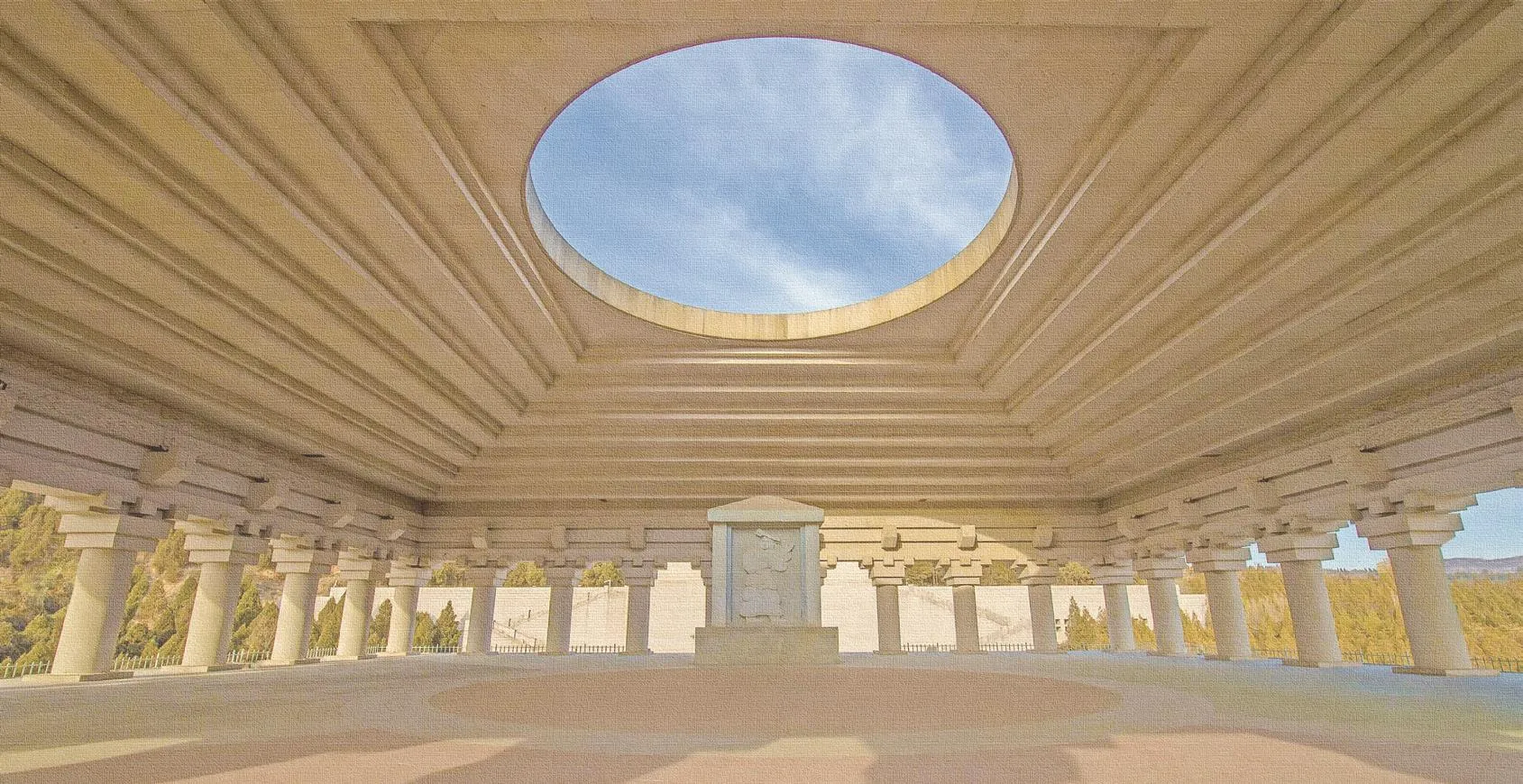
陜西黃帝陵重建時,現代設計師取“天圓地方”之意設計的軒轅殿。
猜你喜歡
城市道橋與防洪(2022年4期)2022-07-01 06:04:12
北方建筑(2021年6期)2021-12-31 03:03:54
口腔護理用品工業(2021年4期)2021-11-02 08:22:56
文苑(2020年10期)2020-11-07 03:15:36
現代裝飾(2020年6期)2020-06-22 08:43:12
當代陜西(2019年8期)2019-05-09 02:22:48
動漫星空(興趣百科)(2019年3期)2019-03-07 07:23:10
中國公路(2017年9期)2017-07-25 13:26:38
專用汽車(2016年4期)2016-03-01 04:13:43
少兒科學周刊·兒童版(2015年6期)2015-11-24 03:49:38