你的收件箱,是0未讀,還是5,000未讀?
2018-10-25 20:57:18ByJoePinsker
英語學(xué)習(xí)
2018年10期
By Joe Pinsker
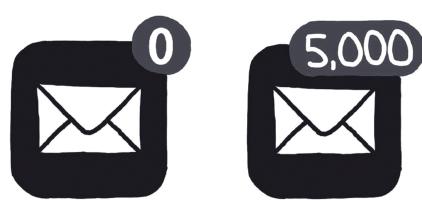
For some, its a spider. For others, its an unexpected run-in with an ex. But for me, discomfort is a dot with a number in it: 1,328 unread-message notifications? I just cant fathom1 how anyone lives like that.
How is it that some people remain calm as unread messages trickle into their inboxes and then roost there unattended, while others cant sit still knowing that there are bolded-black emails and red-dotted Slack messages?2 I may operate toward the extreme end of compulsive notification-eliminators, but surveys suggest Im not alone: One 2012 study found that 70 percent of work emails were attended to within six seconds of their arrival.
This has led me to a theory that there are two types of emailers in the world: Those who can comfortably ignore unread notifications, and those who feel the need to take action immediately.
So what puts people in one camp or the other? Gloria Mark, a professor of informatics at University of California,has explored just this sort of question. A few years ago, she ran a study in which office workers were cut off from using email for one workweek and were equipped with heart-rate monitors; on average, going cold turkey3 significantly reduced their stress levels. (One intriguing recommendation that came out of the study was for companies to experiment with setting up systems in which less-urgent emails were exchanged in batches4: in the morning, around lunchtime, and in the evening.)
After interviewing several people about their relationship with email, Mark has noticed that, for some people, email is an extension of autonomy5—its about having control. One subject, she said, told her, “I let the sound of the bell and the popups6 rule my life.” Compulsively checking email or compulsively clearing out queues of unread emails, then, can be a form of regaining some of that control. Mark said, “So I might refine your theory to say that those who feel compelled to check email may be more susceptible to feeling a loss of control [and] in missing out on information.”
When someone drops everything just to get an unread count back to zero, productivity might be taking a hit7. “It takes people on average about 25 minutes to reorient back to a task when they get interrupted,” she says. Yes, that includes even brief interruptions, like dashing off8 a quick response to an email, and it often takes so long to get back on task because the project you start doing after handling an email often isnt the same as the one you were already doing. (These interruptions are so integral to modern workflow, Mark says, that when people lack external interruptions, such as a co-worker striking up9 a conversation, they voluntarily interrupt themselves—sometimes by checking email.)
I happen to like Marks theory, but I also think theres another urge that fuels the nagging feeling that comes with unread messages: Immediately reading and archiving incoming emails is just like checking a box on a to-do list and clearing out unread stories in an RSS feed.10 In other words, the appeal of these behaviors lies in the illusion of progress that they foster. Few tasks have a sense of conclusion as neat and immediate as archiving or deleting an email. For that reason, neurotically tidy people like me cant help but triage emails the moment they arrive.11
There are, of course, other lenses through which to view these opposing email sensibilities. Jamie Madigan, a psychologist who writes about video games, thinks the arrival of a notification might be similar to the accrual of virtual loot.12 Email, in other words, might not be just a task, but a game.“Designers of apps for the Web, phones, and other devices figured this out early on,” he says. “In the case of our phones,we see, hear, or feel a notification alert show up, we open the app, and we are rewarded with something we like: a message from a friend, a like, or whatever.” He guesses that people who dont mind notification pileups dont perceive as much of a reward from getting retweets or likes.
Ian Bogost, a professor of interactive computing at the Georgia Institute of Technology (and an Atlantic contributing editor), offers a similar theory. “What if actually there are people who care about technology as a part of their identity, and people who dont?” He stressed that his potential explanation was untested, but I do think his point about selfidentity might account for a portion of the difference.
Still, the chasm13 between these groups seems too wide to be just about technology. The icky feeling I get when I catch a glimpse of someones inbox junkyard of unread emails is the same one I get when I see the pile of magazines I have yet to read, or when I know theres an errand that needs running—the itch isnt constrained to technology.14 My email theory is really just a corollary of another, more expansive pop philosophy: Muppet Theory, proposed by Dahlia Lithwick, a writer at Slate.15 Under Lithwicks classification, everyone is either a Chaos Muppet (“out-of-control, emotional, volatile”) or an Order Muppet (“neurotic, highly-regimented, averse to surprises”).16 Lithwicks theory plays nicely with Gloria Marks, and I tend to think that—hold on, an email just came in and if you give me one sec, I just need to respond to it.
有的人最害怕蜘蛛,有的人最害怕撞見前任。而我最害怕的是一個小點和上面的數(shù)字:1,328條未讀信息?我簡直不能理解怎么會有人能夠忍受。
當(dāng)未讀信息溜進收件箱時,為什么有人就能安如泰山,將之晾在那里不管,有人卻一看到有黑色加粗的郵件和點了紅點的工作消息就坐不住呢?我屬于那種強迫癥似的通知終結(jié)者,調(diào)查顯示我這樣的人還不少:2012年的一項研究發(fā)現(xiàn),70%的工作郵件都在收到后六秒內(nèi)就被處理了。
我由此得出一個結(jié)論:這個世界上收郵件的有兩類人,一類可以完全無視未讀消息,一類則非要趕緊點開不可。
那么,是什么因素決定了你在哪一陣營呢?加利福尼亞大學(xué)信息學(xué)教授格洛麗亞·馬克對這個問題進行了研究。幾年前,她做了一個實驗,讓一群坐辦公室的人連續(xù)五天都不用郵件,然后測他們的心率。平均來看,這種突然切斷郵件的做法可以顯著降低他們的焦慮程度。(由此帶來的一個有趣的建議是,公司可以嘗試建立一種機制,把不太緊急的郵件分散在早上、午間和晚上發(fā)送。)
在問了幾個人他們和電子郵件的關(guān)系之后,馬克注意到,有些人把電子郵件看作是自主權(quán)的延伸,也就是說一定要由自己來掌控。她說,一名受訪者告訴她:“我讓消息提示音和彈出窗口來主宰我的生活。”那么,強迫癥似的查看郵件或者點開一溜未讀郵件就成了重獲控制權(quán)的一種方法。馬克說:“我或許可以這么說,那些非查看郵件不可的人,在漏看信息時更容易感到失去控制。……
登錄APP查看全文
猜你喜歡
當(dāng)代陜西(2022年5期)2022-04-19 12:10:18
新世紀(jì)智能(數(shù)學(xué)備考)(2021年9期)2021-11-24 01:14:28
湘潮(上半月)(2021年4期)2021-07-20 08:05:28
汕頭大學(xué)學(xué)報(自然科學(xué)版)(2020年4期)2020-12-14 07:05:00
中華手工(2017年2期)2017-06-06 23:00:31
學(xué)習(xí)月刊(2015年21期)2015-07-11 01:51:44
中外會展(2014年4期)2014-11-27 07:46:46
建筑創(chuàng)作(2001年3期)2001-08-22 18:48:14
軍事歷史(1996年4期)1996-08-20 07:23:52
祝您健康(1987年3期)1987-12-30 09:52:32