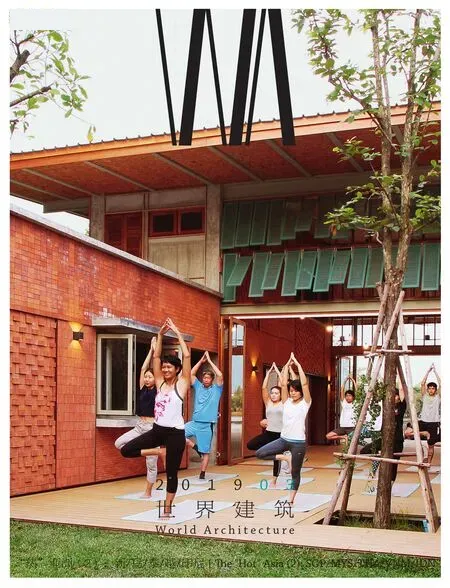
亞洲熱帶建筑
2019-04-19 07:42:28維羅妮卡VeronicaNg
世界建筑 2019年3期
關鍵詞:建筑
維羅妮卡·吳/Veronica Ng
黃華青 譯/Translated by HUANG Huaqing
“熱帶”作為形容詞,常用來描述某個地區或氣候的特征。熱帶地區占據了地球表面上很重要的一部分,但這里的建筑相對而言鮮受外界關注。熱帶地區廣泛分布于世界各地,包括相隔遙遠的加勒比群島、印度、東南亞,以及澳洲、非洲和中南美洲的大部分地區。盡管各地的文化迥異,卻擁有相似的氣候和生態特征,以及后殖民時代的普遍境遇和全球化時代下的現代化壓力。建筑師對熱帶文脈的回應方式,就和該區域本身一樣呈現出多樣的風景。
盡管熱帶地區分布很廣,但通常意義上的“熱帶”建筑主要集中在亞洲范圍。熱帶指向一個具有類似氣候條件的區域,具有該氣候區所導致的特征的建筑通常就被稱為熱帶建筑。盡管如此,本文仍將討論“亞洲熱帶建筑”的復雜性。它將梳理熱帶建筑的多種面向,強調這個詞語的復雜性超越了人們慣常的理解,還可作為一處真實可觸的空間、一個概念,以及一種語境。
1 作為實體和現實的熱帶建筑:熱帶的特質與影像
過去幾十年來,后現代性崛起所標榜的多元性與復雜性概念,導向了多樣的建筑實踐路徑,亞洲熱帶建筑便為其一。當下,圖片的力量借助網站傳播,如Archdaily、Contemporarist、Dezeen以及Pinterest這樣的網頁和應用,為我們打開一個無窮無盡、具有視覺沖擊力的影像世界。建筑的視覺投射強化了空間的實體性和現實性。在這些網絡平臺上,當代亞洲熱帶建筑的形象表現為本土的,同時又是當代的。因此,熱帶建筑的形象不僅令人聯想到現代建筑的某種雜交體,也回應了特定的氣候和文化。
調節熱帶的日照、風、光和雨的意義,也與更宏大的環境可持續性理念相關。在聯合國教科文組織發布的《亞太地區低碳綠色增長指南》中,熱帶建筑就被視為一種本土而綠色的建筑類型。
“熱帶建筑可視為一類適用于特定熱帶氣候的綠色建筑,借助設計來最大化地降低建筑能耗、尤其是制冷能耗。熱帶建筑并非一個新概念。亞太地區的國家早已采用適應于各自氣候條件的本土建筑設計理念。例如,高屋頂是為了利用煙囪效應。馬來住宅采用很大的屋頂懸挑,西印度群島則借助涼廊來減少光照受熱。這些設計策略讓住宅得以在雨季保持開窗通風。薩摩亞人過去并不建造墻體,以促進自然通風。馬來住宅的大量窗戶也是為了將穿堂風最大化[1]。”
盡管環境可持續性通常局限于建筑科學領域,但熱帶建筑在建筑領域內借助書籍傳播的形象,則是將實體特征描繪為熱帶的浪漫想象,突顯室內外的強關聯,讓人不免聯想到基于傳統和文化的建筑。例如,1994年出版的陳復鳴的著作《熱帶建筑與室內設計:印度尼西亞、馬來西亞、新加坡、泰國基于傳統的設計》[19]。該書簡介中的這段節選就通過照片強調了熱帶建筑的這種特征及形象:
“本書通過簡明的介紹以及大量頂級照片,描繪了一幅關于熱帶風格的全景畫。它完美呈現出熱帶建筑的感官品質和生動之美,以展現這個世界上文化最豐富的地區之一的建筑。這本書罕見地全面記錄了東南亞豐富多彩的優雅建筑及引人注目的室內空間。本書收集了那些天才建筑師與設計師最具魅力的作品。設計的靈感來自于對大地、氣候及迷人環境的敬意,夾雜著一股鮮活的傳統氣息。這些卓越的設計作品既包括造價有限的私人住宅,也包括一些世界上最高端的度假酒店。[19]”
其他類似出版物還包括:《熱帶亞洲建筑的新方向》[2]《新近馬來西亞建筑》[3]《熱帶風格:馬來西亞的當代夢想住宅》[4]《新馬來住宅》中收錄的當代住宅[5]《重思:馬來西亞木構的新范式》[6]《可持續亞洲住宅》中收錄的亞洲豪宅[7],還有《熱帶住宅:重新定義赤道居住環境》[8]。在這些出版物中,亞洲熱帶建筑的形象大多是浪漫的,空間的感官品質突出,室內外融為一體,由此塑造的形式與熱帶的日照、風和光之間產生對話,凝聚著強烈的物質性、文化和傳統。

1 《熱帶亞洲建筑的新方向》封面/Book cover, New Directionsin Tropical Asian Architecture

2 《熱帶亞洲住宅》封面/Book cover, The Tropical Asian House

3 《熱帶建筑和室內設計》封面/Book cover, Tropical Architectureand Interiors

4 《21世紀熱帶建筑》封面/Book cover, Tropical Architecture for the 21st Century
Def i nition of "tropical"
a: of, relating to, occurring in, or suitable for use in the tropics
b: of, being, or characteristic of a region or climate that is frost-free with temperatures high enough to support year-round plant growth given sufficient moisture
The notion of "tropical" as an adjective describes the characteristics of a region or the climate. The tropical region covers a signi fi cant proportion of the globe, and yet its architecture receives relatively little outside comment or exposure. Dispersed widely throughout the world, the region incorporates areas as far- fl ung as the Caribbean islands, India, South-East Asia, and large parts of Australia, Africa and South and Central America. Despite their great cultural diversity, these areas share both climatic and ecological factors, as well as a post-colonial condition and the pressures of modernisation in the world of globalisation. Architects' reactions to the tropical context are as varied as the region is diverse.
Despite the wide tropical region, commonly the term "Asian" is synonymous to "tropical". Tropical architecture refers to a region with shared climatic conditions which often results in a plethora of architecturaloutcomes commonly referred to as tropical architecture. While this may be the case,this article discusses the complexity of the notion"Asian tropical architecture" by reviewing the diverse positioning of tropical architecture and highlighting its complexity of the term not only as what is commonly known, but as a physical and real space, a concept and a discourse.
1 Tropical architecture as physical and real:Character and image of the tropics
Since the last few decades, the rise of postmodernity which premised itself on ideas of plurality and multiplicity, has informed a diverse palette of architecturaloutcomes including that of Asian tropical architecture. At present, the power of image via websites such as Archdaily,Contemporarist, and Dezeen and web apps such as Pinterest provide unlimited access to visually powerful images of architecture. The visual-driven projections of architecture reinforce the notion of space as physical and real. These platforms also foreground contemporary Asian tropical architecture as vernacular and at the same time contemporary.As such, tropical architecture is being portrayed as images alluding to hybridisations of modern yet climatically and culturally responsive.
The significance of modulating the tropical sun, wind, light and rain is also linked to the broad notion of environmental sustainability. In the Low Carbon Green Growth Roadmap for Asia and the Pacific by United Nations Educational, Scientific and Culturalorganisation (UNESCO), the notion of tropical Architecture is seen as a vernacular and green building typology.
"Tropical architecture can be regarded as a type of green building applicable specif i cally for tropical climates, using design to optimally reduce buildings'energy consumption, particularly the cooling load.Tropical architecture is not a new concept. Countries in the Asia-Pacific region have adopted vernacular designs adapting to their climatic needs over many centuries. For instance, a high ceiling demonstrates an understanding of the stack effect. Malay homes install a large roof overhang and the West Indians use verandas to reduce solar gains. These design solutions allow windows to remain open for natural ventilation in a building during rainy season.Samoans long ago did not install walls to allow freef low breezes. Malayan homes' plentiful windows aim to maximize cross-ventilation.[1]"
While environmental sustainability is about the science behind buildings, the dissemination of tropical architecture within the fraternity of architecture through books portray the physical character of tropical architecture as imageries of the romantic tropics emphasising a strong connection between outside and inside, and draw links with tradition-based and culturally situated architecture.For example in the book published in 1994 titled Tropical Architecture and Interiors: Tradition-based Design of Indonesia, Malaysia, Singapore, Thailand by Tan Hock Beng[19]. An excerpt of the book's description emphasised the character of tropical architecture and its imagery through photography:
"This book provides concise information and has lavish, superb photography giving a kaleidoscopic vision of the tropical style. It celebrates the sensual qualities and vivid beauty that add up to the tropical architecture of one of the culturally richest regions of the world. It is one of the very few that documents the splendid range of elegantly conceived buildings and remarkable interiors in Southeast Asia. Gathered together in this unique collection are some of the most charming works by talented architects and designers. Inspiration is drawn from a reverence for the land and climate, the enchanting surroundings and a lively sense of tradition. These exemplary works range from modestly budgeted private residences to some of the most exclusive resorts in the world.[19]"
Other examples include publications such as New Directions in Tropical Asian Architecture (2005)[2],Recent Malaysian Architecture (2007)[3], Tropical Style: Contemporary Dream Houses in Malaysia(2008)[4], collection of contemporary houses in the New Malaysian House (2008)[5], Rethink - A New Paradigm for Malaysian Timber (2010)[6], and design showcase of luxury Asian homes in Sustainable Asian Houses (2017)[7]and Tropical Houses:Equatorial Living Redef i ned (2017)[8]. Through these publications, Asian tropical architecture is often illustrated as romantic, sensual qualities of space drawing close connections between the inside and outside resulting in forms that is a dialogue with the tropical sun, wind and light, as well as a strong sense of materiality, culture and tradition.
2 Tropical architecture and the concept of critical regionalism
Besides the physical and real space imagined through tropical architecture, the notion of tropical architecture also has explicit connection to the concept of (critical) regionalism, evidenced through writings of Bruno Stagno and earlier writings of Kenneth Frampton, Alexander Tzonis and Liane Lefaivre's[9,16-17].
In the broader global region, Bruno Stagno,founder and director of the Instituto de Arquitectura Tropical (Institute for Tropical Architecture), argues for communion of building with nature, juxtaposing tradition and innovation. Writing on tropicality in the highly influential volume on tropical architecture, which revived a mid-twentieth-century discourse in the new millennium, Stagno observed:
"Life in the tropics is under the permanent dominion of sensuality. This is evoked by the presence of an exuberant vegetation, under a sky inhabited by capricious clouds; the hammock with its soft swaying; by the importance of the shade that gathers; by the breeze that refreshes and evaporates the sweat of the skin; by the rain, the bracing sun and the multiple mirages. The noises at night come from vigorous nature: the sound of the buds when they blossom, the rustle of animals free and unleashed, the dense, powerful perfume of humidity wafting in the air. The architecture of tropical regions has long been defined in this manner,primarily by contrasting notions of sybaritic indolence and disease-ridden discomfort, extremes derived from the perceived otherness of the tropics to Western culture.[9]"
2 熱帶建筑及批判地域主義概念
熱帶建筑除了讓人聯想到實體和現實空間外,也顯著地指向(批判)地域主義的概念。這方面可見于布魯諾·斯塔諾的論著[9,16],以及肯尼斯·弗蘭姆普頓、亞歷山大·楚尼斯和利恩·勒費夫爾的早期作品[17]。
在更大的全球范圍內,“熱帶建筑研究院”的創立者及院長布魯諾·斯塔諾呼吁建筑與自然共享、傳統與創新并置。斯塔諾在其頗具影響力的著作 《熱帶建筑》中論述了“熱帶性”,這本書在新千年復興了20世紀中葉的建筑學語境:
“熱帶的生活始終受到感官的支配。身邊的一切皆在喚醒你的感官:繁盛的綠植,變幻無常的多云天空,晃動的吊床,聚集的樹蔭,喚醒肌膚、吹干汗液的微風,瓢潑大雨,炎炎烈日以及無處不在的蜃樓。夜晚,生命力旺盛的自然傳來躁動的聲響:花朵悄悄綻放的聲音,自由的動物發出的呼呼聲,空氣中漂浮的濕氣混雜著濃郁的香氣。熱帶地區的建筑一直以來就被兩種相反的感受所定義,一邊是奢侈逸樂的放縱,另一邊是疾病充斥的不適,這種極端來源于西方文化對熱帶他者的一廂情愿的想象[9]。”
布魯諾·斯塔諾的作品在一個全球化支配的時代,重提批判地域主義的原則。他發展出一套強有力的活動方式,專注于最大化地挖掘熱帶的氣候特征、材料的理性使用、強調景觀的熱帶生物多樣性。他也支持在發展中國家的可持續建筑中采取“設計多于技術”的理念。
熱帶建筑在1980年代的亞洲,化身為多種形式的地域主義建筑[10-11,20]。在1985年的達卡,也就是肯尼斯·弗蘭姆普頓的著作、亞歷山大·楚尼斯和利恩·勒費夫爾關于批判地域主義的著名論文出版幾年之后,阿卡汗獎的伊斯蘭建筑項目主辦了一場關于這一話題的重要論壇。出席的南亞著名建筑師包括查爾斯·柯里亞、巴克里希納·多西等,將亞洲視為一種亞文化的集合體,而地域主義是亞洲多元社會共同經歷的一次普遍覺醒,只是在不同地點呈現出迥異的形式品質。這些重量級的對談嘉賓認為,地域主義不應落入固定框架,而應作為一種隨著不同社會變化而轉變的實踐方式,并為城市帶來新的空間組織方式。達卡論壇中對地域主義的早期批判性應答也折射出新近的一些學術探索,通過開啟地域主義的非固定框架,以更準確地反映支莉蓮和陳家輝所謂的熱帶建筑的“材料多樣性和語義豐富性”[12]。這些新近評論將達卡論壇上南亞建筑師提出的挑戰帶到一個新的層面,為地域主義提出一種標準化、囊括性的概念,延伸了地域主義的內涵,以涵蓋那些介入全球化語境或根植于地方環境變遷及城市化進程的思索。
在楚尼斯、勒費夫爾和斯塔諾的著作《熱帶建筑:全球化時代的批判地域主義》(2001)中,亞洲熱帶建筑的地位在13章中的5章都進行了討論[13]:
第五章:挪用的現代化/挪用現代性/陳復鳴
第十章:熱帶印度的建筑回應/拉胡爾·邁赫特拉
第十一章:綠色議程/楊經文
第十二章:三種熱帶設計范式/貝·珠華·菲利普
第十三章:重思熱帶地區的城市:熱帶城市概念/鄭慶順
盡管在將熱帶建筑與批判地域主義和全球化聯系起來的論著中,本土建筑與文化回應的相似概念被廣泛宣揚,但不難發現,創新的主題同樣是熱帶建筑一個重要的驅動力。這便將關于“全球”V.S.“地方”價值及特征的理論探討引入熱帶建筑的話語之中。其中涉及的話題包括可持續性、生態及文化多樣性、微氣候控制技術和多學科設計。
3 作為話語的熱帶建筑
不僅“熱帶”這一概念呈現出實體和現實特征,并與批判地域主義的理論相關聯,這一名詞同樣可從權力關系的視角來審視,尤其與對“他者”文化直接或間接的接受相關。熱帶建筑常被從“熱帶性”的角度予以討論。在此便需強調,熱帶性的觀念不僅指向一個實體或現實的空間,同樣可視為一個想象的、表征的空間。
有人不免認為這是一種諷刺,即關于熱帶建筑的書籍和文章往往是從西方中心的視角撰寫的。在大衛·貝農近期的一篇文章《熱帶性、現代性與身份》中,他辯論道,盡管在歐洲殖民時期,亞洲的本土文化受到威脅、削弱或邊緣化,但與該時期的負面影響不同,去殖民時期本土文化卻在全球化語境下枝繁葉茂[14]。就像當地語言在過去受到限制或禁止之后重新得到普及一樣,受到壓抑的本地形式表達也在各個層面得到重塑,從國家層面(如印尼、馬來西亞)、省區層面(西蘇門答臘、沙撈越)到當地層面(多巴巴塔克、卡羅、伊坂)。
來自外部的對熱帶的認知導致“熱帶”建筑概念的同質化,亞洲建筑也因此持續被框束在這種他者性之中。“熱帶”這個概念所定義的建筑處于溫和氣候建筑的對立面。“熱帶”的境遇一直以來都是一個西方語境下的轉喻,所定義的一種“他者”的氣候比起“溫和”的西方來說,往往是炎熱、潮濕而不適的。無論是殖民時期的建筑折中,還是“熱帶現代主義”對東南亞地域特征的建筑回應,大多被籠罩在對這種顯而易見的惡劣環境的改善語境之下。近期出現的將熱帶性與后殖民時期亞洲身份及環境可持續性混為一談的趨勢,實際上也來自同一種建構。它進而催發人們的審思:何為亞洲熱帶建筑的替代路徑,那一種替代的熱帶性又是什么?
貝農以東南亞熱帶高山地區的當代建筑為例提出,這些建筑產生于“熱帶”限制條件相對缺席的環境下,同時這里長期存在著自治傳統及對平原國家的抵制,這帶來一種不那么同質化的熱帶性闡釋。他寫道:
“建筑總能呈現出文化關系及相互影響的某段特定歷史。很多建筑形式讓人聯想到某種當地和外來傳統的混合物,這篇文章則提出,對于東南亞建筑而言,有些傳統受到冷落,另一些則因能夠體現外國人更容易理解的熱帶性原則而得到偏愛。尤其是,東南亞建筑中匯聚的空間、材料和象征因素并不能簡單地用外來的熱帶氣候舒適性概念來解釋,由此本文提出一種不那么同質化的、對建筑熱帶性的解讀路徑[14]。”
在《走向熱帶建筑譜系:英國殖民地的權力——知識、建成環境與氣候的歷史碎片》(2011)一書中,張嘉德和安東尼·金以一種福柯式的方法梳理了熱帶建筑的譜系表。他們認為,熱帶建筑的概念是基于英國殖民地的權力關系。這個譜系并未將外在的熱帶自然條件作為熱帶建筑的首要決定因素,而是督促我們反思決定“熱帶建筑”的“自然”——它是什么,是誰定義的,在何種歷史語境下,為何如此。在迎合這種自然觀念的同時,有什么其他知識和實踐被掩蓋了[15]?這對今天而言極具啟發意義,尤其是看到熱帶建筑越發被籠罩在可持續性的霸權語境之下。
除了其他學者已介紹過的重要建筑及建筑師外,該書還關注了那些較少受到研究的20世紀中葉的熱帶建筑,尤其是借助研究和教育手段的知識生產及傳播。該書在結尾處簡要回顧了1970年代初以來熱帶建筑的重生,尤其關注當下的熱帶建筑。作者認為,今天的熱帶建筑裹挾著片段化的歷史意涵。在歷史譜系中出現過的核心主題及概念——如自然、技術科學、政府治理及社會網絡——依然以一種變異的形式重現于今天的熱帶建筑中。
這種以熱帶性概念來定義熱帶建筑的方式,也見于支莉蓮和陳家輝提出的非永恒或凝滯的“動態”概念。他們認為,當下人們對熱帶建筑的理解過于簡單化,并未對其話語及伴隨而來的議程的多樣性予以足夠關注。熱帶性所伴隨的概念并不是先驗的,而來自一系列切身實踐及具體境遇。熱帶性這樣的說法是一種與自然逆向而行的政治化路徑。因此,熱帶建筑看似生發于自然環境,實則為種族、性別和階級定義的各種權力網絡塑造下的一種復雜文化建構。該書反對將熱帶的建成環境本質化,而試圖批判這些關于熱帶建筑的現存話語——抑或將其視為毫無疑問的、與當地氣候及傳統相關的本質主義或懷舊主義,或是將其形式客體化為一種僅供被動消費的異域物品。該書的作者試圖重新審視,熱帶空間作為一種記錄的或敘述的格式,如何能夠作為一種批評模式,同時/或者能夠改變我們理解熱帶性的方式[12]280。
His work embodies the principles of critical regionalism in a time where globalisation is the dominant force. Bruno Stagno has developed an intense activity, focusing on the maximum exploitation of climatic characteristics of the tropics, logical use of materials, and emphasising on tropical biodiversity in the landscape. He endorses the concept of "more design than technology" for sustainable architecture in developing countries.
Tropical architecture was reincarnated as various forms of regionalist architecture in Asia in the 1980s[10-11,20]. It was in Dhaka in 1985, in fact,a few years following the publications of Kenneth Frampton's, and Alexander Tzonis and Liane Lefaivre's seminal essays on critical regionalism,that the Aga Khan Program on Islamic Architecture presented a major seminar on the topic. The leading South Asian architects in attendance -including Charles Correa, Balkrishna Doshi and others - conceptualised Asia as a composition of subcultures, and positioned regionalism as a kind of general consciousness wending through the many realities of Asia's diverse societies, taking on different formal qualities given the locality. Rather than fixed categories, the seminar participants argued in favour of regionalism as a practice that transforms along with changes in society, and projects new formalorganisations of the city. This early critical response to regionalism at the Dhaka seminar reflects more recent scholarly efforts at opening up the discursive categories of regionalism to more accurately reflect what Lilian Chee and Jiat-Hwee Chang call the "material diversity and semantic density" of tropical architecture[12].These more recent critiques take up the challenge posed by the South Asian architects in the Dhaka seminar to a normative and generalisable idea of regionalism and extend the meaning of regionalism to be inclusive of speculation through both engagement with global thematics and local environmental processes and urbanisation.
In Tzonis, Lefaivre and Stagno's writing in Tropical Architecture: Critical Regionalism in the Age of Globalization (2001), the positions on Asian tropical architecture have been discussed in fi ve out of thirteen chapters[13].
· Ch. 5. Modernising Appropriations/Appropriating Modernity/Tan Hock Beng
· Ch. 10. Architectural Responses in Tropical India /Rahul Mehrotra,
· Ch. 11. The Green Agenda/Ken Yeang,
· Ch. 12. Three Tropical Design Paradigms/Bay Joo Hwa Philip
· Ch. 13. Rethinking the City in the Tropics: the Tropical City Concept/Tay Kheng Soon
Although similar aspects of vernacular architecture and cultural responsiveness have been propagated in the publications that links tropical architecture to critical regionalism and globalisation,it is observed that theme of innovation appears strongly as a generating force of tropical architecture.This brings the theoretical discussions on global versus local values and character into the conversations on tropical architecture. Among the issues covered are sustainability, bio- and cultural diversity, micro-climatic control and technology and multi-disciplinary design.
3 Tropical architecture as a discourse
While the notion of "tropical" has been presented as physical and real, and linked to the concept of critical regionalism, the term is also argued from the perspective of power-relations,particularly relating to the acceptance of "other"foreign civilisation either direct or indirect. Tropical architecture is discussed from the perspective of"tropicality". It is apt at this juncture to highlight that the notion of tropicality refers to the view where the tropics being conceived as an imaginative and representational space as much as it is a physically located or real space.
One would think, is it ironic that the books and articles on tropical architecture is usually written through a Western-centric view on the tropics. In the recent writing of David Beynon on Tropicality, Modernity and Identity (2017), he argued that, unlike the adverse impacts caused by European colonisation, during which many aspects of vernacular cultures in Asia were threatened,reduced, or marginalised, decolonisation saw a proliferation of the local within the global[14].Much in the same manner as local languages that were previously restricted or prohibited in their use have gained popularity, repressed local forms and expressions legible in architecture are being remade at a variety of levels, from the national(e.g. Indonesian/Malaysian) to the provincial (West Sumatra/Sarawak) to the local (Toba Batak/Karo/Iban).
The perception of tropics from the outside leads to homogenisation of the idea of "tropical"architecture, by which architecture in Asia continues to be framed within this otherness. The term tropical was a concept de fi ning architecture that was antithesis to architecture of the temperate climate.The "tropical" condition has long been established as a Western trope that defines the "otherness" of climates perceived as hot, humid and uncomfortable compared to the "temperate" West. Both colonial adaptations and "Tropical Modernist" architectural responses to Southeast Asian locations were primarily framed in terms of their amelioration of this apparently hostile environment. That the more recent conflations of tropicality with postcolonial Asian identity and environmental sustainability remain within the same construct leads to questions not only of what architectural alternatives there might be, but also what alternative tropicalities there might be.
Using contemporary buildings in Southeast Asia's tropical highlands, Beynon argued that as the architecture is produced in the relative absence of "tropical" imperatives and the presence of longstanding traditions of autonomy and resistance to lowland state formations; it offers a less homogenous reading of tropicality. Beynon argued:
"All architecture represents particular histories of cultural relations and inf l uences. Many forms of architecture evoke a mixture of local and imported traditions, and this paper will argue in relation to Southeast Asian architecture that some of these traditions have been de-emphasised in favour of others that seem to embody principles of tropicality understandable to outsiders. In particular, it will argue that the confluence of spatial, material and symbolic aspects in Southeast Asian architecture cannot simply be reduced to those that relate to imported ideas of comfort within a tropical climate,and so suggest less homogenous readings of tropicality in relation to architecture. [14]"

5 《建筑中的地域主義》封面/Book cover, Regionalism in Architecture

6 《熱帶建筑:全球化時代的批判地域主義》封面/Book cover,Tropical Architecture: Critical Regionalism in the Age of Globalisation

7 《熱帶地區的建筑師》封面/Book cover, An Architect in the Tropics
4 結論:重思熱帶建筑
近期一些關于熱帶建筑的研究拓展了熱帶建筑的認知和定義。在當下的后現代語境下,異質性、多元性更優于同質性、單一性,福柯式的理論方法指向了一條理解所謂“熱帶”建筑的新途徑。
今天我們應超越將熱帶建筑作為一種建筑形象、一種建筑風格或一種建筑特征的觀念——這基于熱帶地區的實體屬性及環境與文化背景,熱帶建筑的觀念不僅是后殖民語境下的一種同質化的西方概念,它的理念化同樣根植于這樣一種語境:即視為一個由實體物質和建筑、多元的思想和語言、相互競爭的文化想象與意識形態所共同糅合而成的復雜網絡。
重新定義熱帶建筑的趨勢,并不止存在于學術研究領域。例如,最近一些年輕建筑師的訪談就折射出類似的思想線索。在(新加坡)國內,雅安·福蘭對“與環境共存”的考量體現在他對空調使用的節制上,以此探索熱帶建筑的特征——他定義為“室內和室外之間沒有邊界”。他熱切地擁抱在新加坡獲得的機遇,“我看到很多年輕建筑師試圖重新定義熱帶建筑。我也想成為其中一份子。”[18]
那么,這些都意味著什么?在我看來,有必要從系譜視角重新思索和定義熱帶建筑。作為一名世界觀意義上的后結構主義者,我看到一個拓展熱帶建筑研究的積極方向,即觀察當下這種離散的條件如何催生當代熱帶建筑的涌現。或許,是時候將熱帶建筑視為一個多學科框架內變化不定的客體、概念及語境,它正在借助當代建筑實踐而逐步生長。□
In the publication Towards a Genealogy of Tropical Architecture: Historical Fragments of Power-knowledge, Built Environment and Climate in the British Colonial Territories (2011), Chang & King wrote about the genealogy of tropical architecture,which is very Foucauldian indeed. They argued that the concept of tropical architecture is based on power-relations in the British colonial territories.Instead of privileging external tropical nature as the prime determinant of tropical architecture, this genealogy urges us to re fl ect upon the "nature" that"tropical architecture" was determined by - what is it, according to whom, under what historical circumstances, and why. By appealing to such a notion of nature, what other knowledge and practices are being concealed?[15]This is especially pertinent today when tropical architecture is associated with a hegemonic discourse of sustainability.
Besides looking at key buildings and architects that other scholars have already explored, the book also looks that the much less researched aspects of mid-twentieth century topical architecture,specifically issues of knowledge production and circulation through research and education. He ended the book with a short re fl ection on afterlives of tropical architecture after the early 1970s,focusing particularly on tropical architecture in the contemporary world. He argued that tropical architecture today carries historically sedimented meanings. Key themes and concepts that appeared in the genealogy - such as nature, technoscience,governmentality and network - recur, albeit in mutated forms, in today's tropical architecture.
This way of conceptualising tropical architecture through the notion of tropicality was also positioned by Chee & Chang as a concept "in-motion" rather than a finite and stagnant concept, arguing that tropical architecture as currently understood is oversimplified and insufficiently attentive to the diversity of discourses and attendant agendas. The meanings associated with tropicality are not a priori but, rather, grow from sets of bodily practices and situational contexts. Tropicality in such terms is a politicised approach as opposed to something natural. Thus, tropical architecture, which seems to connect with and connote the natural environment,is conversely a complex cultural construction that has been subjected to various networks of power marked by race, gender and class. Rejecting the essentialisation of the tropical built environment,the papers attempt to critique existing discourses of tropical architecture that have defined the field as unchallenged essentialist or nostalgic in relation to local climate and tradition, or alternately objecti fi ed its forms as exotic artifacts for passive consumption.Contributors reconsider how tropical spaces in their documented or narrated formats may operate as modes of criticism and/or transform the ways in which we understand tropicality.[12]280
4 Conclusion: Re-thinking tropical architecture
The more recent studies on tropical architecture have broadened the perception and conception of tropical architecture. In the current post-modern context where heterogeneity and multiplicity is favoured over homogeneity and singularity, the Foucauldian approach towards understanding an idea or concept is an alternative means to understand the notion we call "tropical" architecture.
Beyond the perception of tropical architecture as an image, a style or a character of architecture which is based on it physical attributes and the environmental and cultural setting of the tropics,the notion of tropical architecture is seen as a homogenous Western idea within the post-colonial contexts and it is also conceptualised from a discourse, i.e. seen as a complex web of material facts and buildings, discursive ideas and their languages,as well as competing imaginations and ideologies.
The trend towards re-defining tropical architecture not only resides within scholarly research. For example, an interview with a young architect reflect similar line of thinking; in the domestic realm, Follain's concern for "living with the surroundings" sees him discouraging the use of air conditioning and exploring tropical architecture,which he defines as "having no boundary between inside and outside." Embracing the opportunities of his new home country, he adds, "I see a trend among young architects to rede fi ne tropical architecture. I would like to be part of that.[18]"
So, what do all these mean? For me, it means that there is a need to re-think and re-de fi ne tropical architecture from a genealogical point of view. Being a post-structuralist in worldview, I see a positive light in extending the research and study on tropical architecture and how the discursive conditions,enable the emergence of contemporary tropical architecture. Perhaps, it is time to view the notion of tropical architecture as a mutable object, concept and discourse within multidisciplinary contexts, enabled through contemporary practice of architecture.□
猜你喜歡
北方建筑(2021年6期)2021-12-31 03:03:54
文苑(2020年10期)2020-11-07 03:15:36
現代裝飾(2020年6期)2020-06-22 08:43:12
現代裝飾(2020年4期)2020-05-20 08:55:08
攝影之友(影像視覺)(2019年2期)2019-03-05 08:27:16
藝術家(2017年3期)2018-01-26 08:54:49
文學自由談(2016年3期)2016-06-15 13:01:16
福建農業科技(2016年10期)2016-03-07 09:46:49
少兒科學周刊·兒童版(2015年6期)2015-11-24 03:49:38
中國工程咨詢(2015年4期)2015-02-14 03:49:56