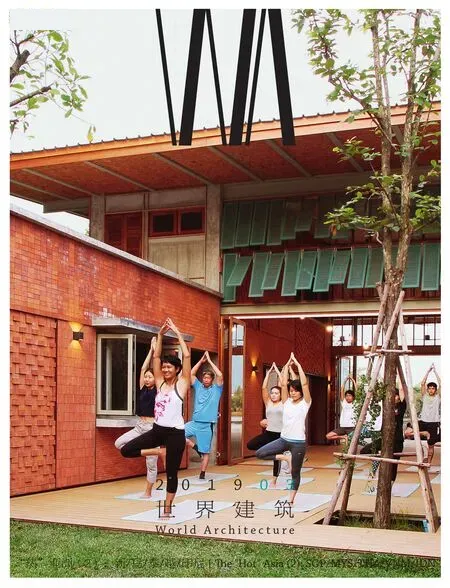
新設(shè)計與環(huán)境學(xué)院四教,新加坡國立大學(xué),新加坡
2019-04-19 07:42:40建筑設(shè)計克里斯托弗系列建筑事務(wù)所
世界建筑 2019年3期
建筑設(shè)計:克里斯托弗·李/系列建筑事務(wù)所
Design Architect: Christopher Lee/Serie Architects

1 遠(yuǎn)景/Distant view
在最好的情況下,建筑和設(shè)計學(xué)院的系館除了滿足其使用者的功能需求之外,還應(yīng)力圖展現(xiàn)和代表學(xué)院本身的雄心抱負(fù)。這一點,不論是在采用了工業(yè)生產(chǎn)邏輯的德紹包豪斯建筑,亦或是哈佛大學(xué)設(shè)計研究生院為跨學(xué)科合作提供的開放工作室平臺,又或是建筑聯(lián)盟學(xué)院喬治亞露臺學(xué)校作為社交中心的酒吧和校友聚會廳,都尤為明顯。
從一開始,設(shè)計與環(huán)境學(xué)院顯然意圖將設(shè)計和建成的這座系館作為教學(xué)工具使用,以研究和應(yīng)對熱帶氣候變化帶來的挑戰(zhàn)。在這一點上,創(chuàng)建一座零能耗建筑是其設(shè)計重點。也就是說,建筑物需要在其建造過程中產(chǎn)生和消耗一樣多(甚至更多)的能源。第二個目標(biāo)則是將建筑作為活體實驗室來使用,以學(xué)習(xí)和測試多種建筑技術(shù),以及建筑對嚴(yán)酷的熱帶氣候的反應(yīng)。
我們的設(shè)計是對東南亞熱帶本土建筑——馬來住宅——文法的一種重新論證。我們從中尋找到巨大的出挑屋頂、可以實現(xiàn)交叉通風(fēng)的松散的房間布局,以及為了將建筑抬離地面利用平臺等原型。因此,我們優(yōu)先采用巨大的出挑屋頂以避免房間受到陽光直射,與此同時,我們在這個表面上安裝1225個PV電池用于發(fā)電。
一片開放的社交廣場,結(jié)合橫跨不同工作室和教室的流線體系,旨在促進(jìn)偶遇和社交互動的機(jī)會。隨著學(xué)習(xí)和工作變得越來越具有協(xié)作性,再加上本身所具有的社交性,這些空間與系館內(nèi)4個主要的學(xué)習(xí)空間相得益彰。
第一個主要學(xué)習(xí)空間是一個大型連續(xù)的開放工作室空間,用以促進(jìn)合作和激發(fā)學(xué)生間對彼此工作的好奇心。第二個主要空間則更有助于沉思,被設(shè)計成一系列被景觀包圍的小房間,供研究員和研究生水平的學(xué)生使用。中央的展示空間能夠從建筑的各個部分包括設(shè)計工作室以不同方式被看到。它垂直地與社交廣場連通,使設(shè)計討論成為學(xué)習(xí)的核心活動。第四個主要學(xué)習(xí)空間位于東西兩側(cè)幕墻之后,用于原型和模型的制作。起伏柔和的多孔鋁板既可以緩和東西兩側(cè)的強烈陽光,同時保持了其可被拆卸的狀態(tài),讓學(xué)生和研究人員可以在此建筑上測試各種立面系統(tǒng)。

零能耗建筑在文化和技術(shù)層面上的重要變革之一在于,如何以最少的能耗為建筑降溫。在本項目中這是通過冷卻系統(tǒng)與自然通風(fēng)相結(jié)合的混合系統(tǒng)實現(xiàn)的。混合冷卻系統(tǒng)利用的是預(yù)冷空氣(比傳統(tǒng)空調(diào)降溫能耗更低)與吊扇的結(jié)合,得到的建筑通透、開放、舒適,同時幾乎不需要消耗太多能量。整體而言,該設(shè)計是對熱帶建筑文法的重新驗證,融合了新的技術(shù),并考慮到熱帶地區(qū)的能源效率。□
(克里斯托弗·李 文,龐凌波 譯)
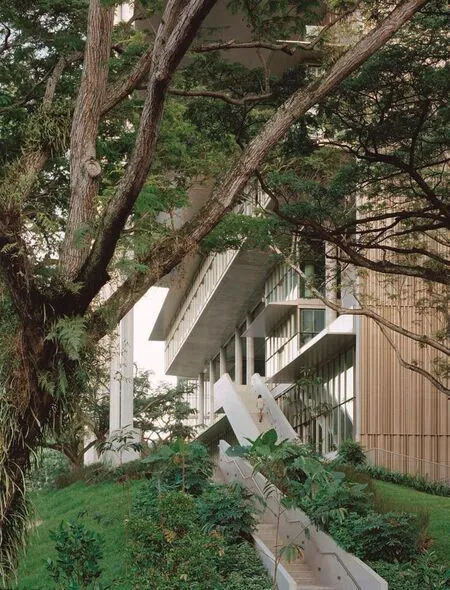
3 近景/Nearby view
At its best, faculty buildings that house schools of architecture and design - apart from serving functional needs of its occupants - strive to demonstrate and represent the pedagogical ambitions of the school itself. This is evident in the Bauhaus Building in Dessau that adopted the logic of industrial production; the open studio trays for cross-disciplinary collaboration in Harvard GSD;or the bar and front members rooms as a social condenser in the AA's Georgian Terrace School.
From the outset, it was clear that SDE intended to use the design and the completed building as a pedagogical tool for tackling the challenges of climate change in the tropics. Here, the focus was on creating a NET Zero energy building - that is to say,the building generates as much if not more energy that it consumes within its building footprint.The second ambition was to use the building as a living laboratory for learning and testing various technologies and architectural responses to the harsh tropical climate.
Our design is a revalidation of the grammar of vernacular tropical architecture in Southeast Asia,namely that of the Malay House from which we find a large over-sailing roof, the loose accumulation of rooms to allow cross ventilation and the use of platforms to raise the building off the ground. Thus our response was to first employ a large over-sailing roof to protect rooms from the sun and at the same time use this large surface for the installation of 1225 PV cells for energy generation.
An open social plaza together with a circulation system that cuts across the different studios and classrooms is intended to generate chance encounters and foster social interaction. As study and work become increasingly collaborative and thus social in nature, these spaces compliment the four key learning spaces in the school.
The first of these is the large and continuous open studio space designed to foster collaboration and instil curiosity in the work of others. The second is more contemplative in nature, designed as a series of smaller rooms surrounded by landscape to be used by researchers and masters level students. A central presentation space is highly visible from various approaches to the building and the design studios. It drops down to peer into the social plaza making design dialog a central activity of learning. The fourth learning space located behind the east and west curtain walls is intended for proto-typing and model making. Soft undulating perforated aluminium panels moderate the harsh western and eastern sun while remaining demountable to allow students and researchers to test various facade systems on the building itself.
One of the key cultural and technological shifts in this NET Zero energy building is the way the building is cooled with the least amount of energy. This was achieved by using a hybrid system of cooling coupled with natural ventilation. The hybrid cooling uses a combination of tempered air (less energy intensive than conventional AC cooling) with ceiling fans. The resulting architecture is transparent, open, and comfortable, while at the same time requiring very little energy. As a whole the design is a revalidation of the grammar of tropical architecture that fuses new technologies and thinking about energy efficiency in the tropics.□ (Text by Christopher Lee)
項目信息/Credits and Data
主持建筑師/Design Architects: Serie + Multiply Architects設(shè)計團(tuán)隊/Design Team: Christopher Lee, Bolam Lee,Martin Jameson, Edouard Bettencourt, Jerome Ng, Onusa Charuwana, Julia Cabanas, Jarrel Goh, Yap Mong Ling, Lee Pei Shyun, Tiffany Yap, Leon Yap
項目管理/Project Architect: Surbana-Jurong Consultants Pte. Ltd.
結(jié)構(gòu)設(shè)計/Structural Design: Surbana-Jurong Consultants Pte. Ltd.
SDE學(xué)院顧問/Consultants from SDE: Lam Khee Poh (SDE Dean), Heng Chye Kiang (Former SDE Dean), Erik Gerard L'Heureux (Vice Dean), Nirmal Kishnani (Former Vice Dean),Giovanni Cossu (Senior Manager, Dean's Office), Bertrand Lasternas (Energy Manager, Dean's Office)
專家小組/Panelof Experts: Chandra Sekhar, Cheah Kok Ming, Erik Gerard L' Heureux, Kua Harn Wei, Joseph Lim,Lee Siew Eang, Nalanie Mithraratne, Nirmal Kishnani, SHEN Lijun, Tan Beng Kiang, Tan Puay Yok, Tham Kwok Wai
能源與氣候顧問/Energy and Climatic Consultant:Transsolar Energietechnik Gmbh
聲學(xué)顧問/Acoustic Consultant: Acviron Acoustics Consultants Pte. Ltd.
總承建/General Contractor: Kajima Overseas Asia Singapore Pte. Ltd.
基礎(chǔ)結(jié)構(gòu)/Foundation: 鋼筋混凝土/Reinforced concrete
整體結(jié)構(gòu)/Overall Structure: 鋼筋混凝土板和框架/Reinforced concrete slab and framing
屋頂結(jié)構(gòu)/Roof: 鋼桁架與細(xì)鋼柱構(gòu)成的金屬屋頂/Metal roof with steel truss and slender steel columns
場地面積/Site Area: 5044.4m2
總建筑面積/Gross Floor Area: 8588.37m2
景觀面積/Landscape Area: 1083.4m2
竣工時間/Completion Time: 2019.01
攝影/Photos: Rory Gardiner

6 開放工作室/Open studio

7 二層平面/First floor plan

8 五層平面/Fourth floor plan

9 評圖空間/Forum

10 走廊/Veranda

11 過道/Hallway
評論
宋曄皓:SDE4設(shè)計得非常迷人,其中給人印象最深的有3個方面,一個是面向未來的教育理念和建筑的匹配,一個是建筑與氣候的適應(yīng)性關(guān)系,另一個則是在一定造價控制下實現(xiàn)零能耗的同時,對設(shè)計和完成度的追求。這3點密切交織在一起,讓我們體驗到了非常靈活的功能分區(qū),將空調(diào)和非空調(diào)區(qū)域完美地限定開,這種劃分顯然對于實現(xiàn)零能耗目標(biāo)具有顯著的意義。其中非空調(diào)區(qū)域不僅考慮遮陽和自然通風(fēng)等,其邊界的相對隨意性,實際上也非常符合教育的特質(zhì)。用于東西遮陽的鋁合金立面單元的可變性,同樣也是遮陽功能和教育功能結(jié)合的體現(xiàn)。
維羅妮卡·吳:建筑學(xué)與教育學(xué)之間的關(guān)系是長期以來始終存在的話題。新加坡國立大學(xué)設(shè)計與環(huán)境學(xué)院四教以一種包容的方式接納了這種關(guān)系,始于設(shè)計理念、形式的基本原理,止于空間的功能和實用性。作為一座零能耗建筑,新館作為一個活體實驗室,反映了該學(xué)院成為熱帶氣候變化研究和創(chuàng)新領(lǐng)域的領(lǐng)導(dǎo)者的教育雄心。
在融入當(dāng)?shù)亟ㄖ绕涫邱R來房屋的文法的同時,柱廊將其直線形式提升為現(xiàn)代主義和地方語言的對話。不同于傳統(tǒng)學(xué)校設(shè)計,它的空間秩序在平面和分區(qū)表露無遺,表現(xiàn)出空間的透明性和活力。樓梯、開放社交廣場、評圖空間與工作室實驗室相互交織,這些要素重新定義了能夠激發(fā)合作與好奇心的學(xué)習(xí)空間的語匯。建筑同等地強調(diào)著社交與學(xué)習(xí)空間,試圖通過建筑促進(jìn)教育,并闡明在當(dāng)代應(yīng)當(dāng)如何設(shè)計學(xué)校建筑。這讓我想起了赫茨伯格的話:
“我認(rèn)為一座學(xué)校應(yīng)當(dāng)像一座小型城市。一座城市會有小的地方和大的地方,各式隱蔽和半隱蔽的場所、狹長的街景,以及各種形式的活動。當(dāng)然學(xué)生們實際上還沒有達(dá)到可以進(jìn)入城市探索城市生活的年紀(jì),但他們應(yīng)該通過學(xué)校去探索生活。因此,你必須在學(xué)校里創(chuàng)造盡可能多的情景,使他們能夠在學(xué)校建筑里經(jīng)歷大千世界。”
(龐凌波 譯)

12 屋頂1225個PV電池發(fā)電/The installation of 1225 PV cells

13 可拆卸立面/Demountable fa?ade
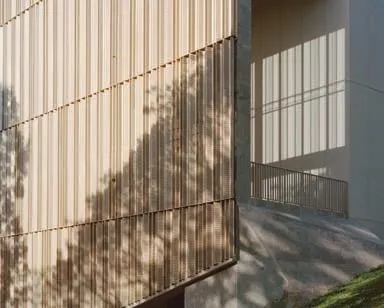
14 立面外側(cè)/Exterior view of the fa?ade

15 立面內(nèi)側(cè)/Interior view of the fa?ade
Comments
SONG Yehao: The design of SDE4 is fascinating.There are three most impressive points. One is the architectural parallel with the concept of future-oriented education, the second is the adaptable relationship between architecture and climate, and lastly the pursuit of design and completion of zero energy consumption under certain cost control. These three points are closely interwoven together, allowing us to experience a very flexible functional partition, which perfectly de fi nes the air-conditioned and non-air-conditioned areas, and this partition obviously has great signi fi cance for achieving the goalof zero energy consumption. Not only the nonair-conditioned area considers sun-shading and natural ventilation, the relative randomness of its boundary also responds to the characteristics of education.The variability of aluminum alloy facade units used for East-West shading is also the embodiment of the combination of shading function and educational function. (Translated by CHEN Yuxiao)Veronica Ng: The relationship between architecture and pedagogy has been a longstanding discourse.The New Schoolof Design and Environment 4 in the National University of Singapore have embraced this relationship in an inclusive manner, starting from its design ethos, rationale of the form, to the functions and pragmatism of space. As a NET Zero Energy building, the New School acts as a living lab that reflects its pedagogical aspirations being the protagonist for research and innovation of climate change in the tropics.
While embracing the grammar of vernacular architecture, particularly the Malay house, its rectilinear form elevated by pilotis appears as a dialogue of a modernist and vernacular language.Moving away from traditional school design, its ordering of space is evidenced through its plans and section, illustrating spatial transparency and dynamism. The stairways, the open social plaza, the forum interlaced with studios and labs re-de fi ned the language of learning space that generates collaboration and curiosity in learning. Giving a balanced emphasis on both the social and learning spaces, the building attempts to promote education through architecture and how schools should be designed for the contemporary time. In reminds me of the words on Hertzberger:
"I think a school should be like a small city. In a city you have small places, large places, all sorts of secluded and semi-secluded places, you have vistas and you have all sorts of activities. In effect, these pupils are not yet of an age to go into the city and explore the life of the city but they should explore life through the school, so you must create as many conditions as possible in the school so that they experience the world through the school building."
猜你喜歡
北方建筑(2021年6期)2021-12-31 03:03:54
文苑(2020年10期)2020-11-07 03:15:36
現(xiàn)代裝飾(2020年7期)2020-07-27 01:27:42
現(xiàn)代裝飾(2020年6期)2020-06-22 08:43:12
現(xiàn)代裝飾(2020年4期)2020-05-20 08:55:08
流行色(2020年1期)2020-04-28 11:16:38
藝術(shù)啟蒙(2018年7期)2018-08-23 09:14:18
海峽姐妹(2017年7期)2017-07-31 19:08:17
Coco薇(2017年5期)2017-06-05 08:53:16
福建農(nóng)業(yè)科技(2016年10期)2016-03-07 09:46:49