大尺度冬小麥-夏玉米微噴灌精準自動施肥增產效應
2019-05-11 06:52:36邢素麗杜金鐘劉孟朝賈良良劉學彤趙士誠
農業工程學報 2019年6期
邢素麗,杜金鐘,劉孟朝,賈良良,劉學彤,趙士誠
?
大尺度冬小麥-夏玉米微噴灌精準自動施肥增產效應
邢素麗1,杜金鐘2,劉孟朝1,賈良良1,劉學彤1,趙士誠3
(1. 河北省農林科學院農業資源環境研究所,石家莊 050051;2. 河北省石家莊市藁城區農業局,石家莊 050000; 3. 中國農業科學院農業資源與區劃研究所,北京 100081)
為了明確微噴灌精準自動施肥對冬小麥-夏玉米產量、產值、生產成本效益等的影響,該文以傳統施肥技術為對照,設置6.67 hm2大尺度微噴灌精準自動施肥在冬小麥-夏玉米上的應用效果試驗,定量分析微噴灌精準自動施肥對冬小麥和夏玉米產量、產值、生產成本、效益、氮磷用量和灌溉量等方面的影響。結果表明:大尺度冬小麥-夏玉米微噴灌精準自動施肥具有增產、增收、節約成本、節肥、節水的良好應用效果。與傳統施肥相比,微噴灌精準自動施肥在冬小麥季顯著提高小麥產量,增產10.6%,增加效益43.77%,降低生產成本26.17%,減少氮磷化肥24.20%,節約灌溉用水57.45%。微噴灌精準自動施肥在夏玉米季顯著增加玉米產量,增產13.73%,增加效益13.73%,降低生產成本17.09%,減少氮、磷養分用量20.34%,節省灌溉用水36.94%。微噴灌精準自動施肥在冬小麥-夏玉米輪作季增產12.26%,增收效益37.39%,降低生產成本21.85%,減少氮磷化肥22.26%,節省灌溉用水46.51%,具有良好的經濟效益和生態效益。研究結果可為該技術的推廣提供參考依據,促進農業生產力和農業可持續發展。
灌溉;作物;精準自動施肥;冬小麥;夏玉米;增產效應
0 引 言
微噴灌自動施肥系統是由專家依據土壤養分及作物實際需肥規律制定施肥方案,借助計算機控制灌溉系統對作物供應肥水,相比傳統施肥技術,能精準、定時、定量、均勻澆灌作物根區,適時、適量滿足作物對水分和養分的需求,實現水肥協同和高效利用[1-5]。華北平原冬小麥-夏玉米輪作制度的傳統人工施肥管理粗放,盲目過量施用化肥、水肥資源浪費流失、土壤水環境污染等風險,已經越來越不適應現代農業的發展需要。微噴灌精準自動施肥技術目前在國內多用于附加值較高的溫室蔬菜[6-7]、花卉或果樹生產,尚未見該技術在冬小麥-夏玉米輪作制作物大面積應用效果報道,缺乏大尺度條件下微噴灌自動施肥對作物農學的和經濟效益的相關影響分析。本文界定種植面積6.67 hm2(100畝)及以上為大規模尺度,分析研究華北平原冬小麥-夏玉米輪作制條件下微噴灌精準自動施肥對作物產量、成本、效益、肥水用量等方面影響效果,為微噴灌自動化施肥技術在糧食作物應用推廣提供科學依據,促進微噴灌自動施肥技術在大田作物的推廣、應用和發展,顛覆傳統人工操作施肥技術,對華北平原水資源嚴重短缺條件下的小麥玉米生產具有重大意義。
1 材料與方法
1.1 試驗地點概況
試驗地點位于藁城區西關鎮北孟村(38°14′24.87″N,114°46′56.41″E)、豐上村(38°13′21.6″N,114°46′48″E)和辛集王下村(38°2′44.17″N,115°25′32.98″E),3個試驗點同屬華北北部平原小麥-玉米輪作典型代表區,屬暖溫帶半濕潤氣候,年均氣溫12.4~12.6 ℃,≥10℃積溫4 181~4 863 ℃,年降水量488.2~498 mm,無霜期190~209 d。基礎地力中等偏上,耕層(0~20 cm)土壤類型及養分含量如表1。
1.2 試驗方法
小麥品種選用“藁優2018”,玉米品種選用“鄭單958”。試驗時間2016年10月~2018年6月,歷時2個冬小麥-夏玉米輪作季,小麥當季10月中旬播種,次年6月中旬收獲。玉米6月中旬播種,9月底~10月初收獲。3個試驗地均設傳統施肥(CK)和微噴灌精準自動施肥2個處理,采用大區試驗,每個處理面積設定6.67 hm2為1個處理單元,隨機排列,重復3次。CK采用試驗點所在地平均傳統施肥量,微噴灌精準自動施肥養分施用總量依據試驗地點土壤養分含量狀況結合試驗地點微噴灌小麥、玉米養分吸收量及最佳施肥量專家經驗知識確定,不同地點各處理養分用量見表2。
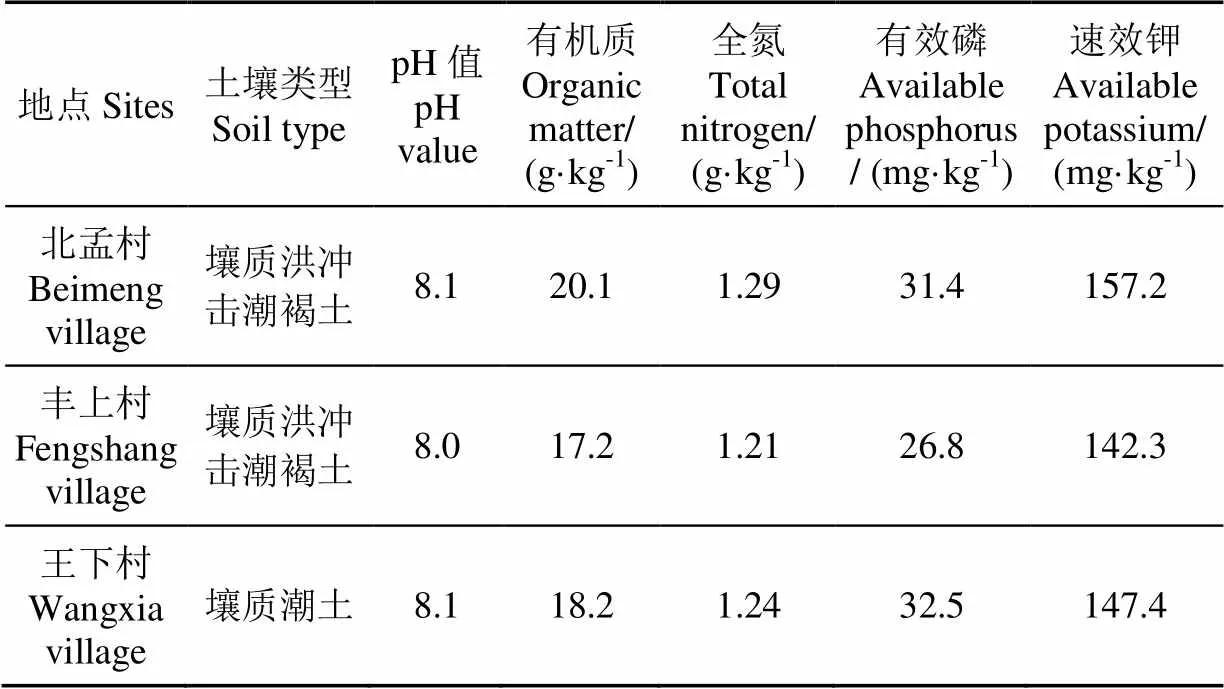
表1 試驗地基礎土壤養分含量(0~20 cm土層)

表2 不同處理的養分施用量
在不同時期施肥量分配方面,CK小麥季、玉米季均各施底肥1次,追肥1次。各試驗點均為小麥季底施復混肥750 kg/hm2,追施尿素(N46%,下同)225 kg/hm2;玉米季底施復混肥600 kg/hm2,追施尿素300 kg/hm2。其中小麥季復混肥N-P2O5-K2O比例各試驗點北孟、豐上、王下分別為15∶15∶15,17∶16∶15和22∶14∶10,玉米季底肥N-P2O5-K2O比例分別為28∶6∶6,30∶8∶4和28∶8∶6,折合不同時期肥料分配為:磷鉀全部底施,純氮底肥與拔節肥比例為52%~61%:39%~48%(小麥)和53%~57%:43%~47%(玉米)。微噴灌自動施肥在小麥季、玉米季各施底肥1次,追肥2次,同一作物各試驗點采用相同的施肥時期和分配比例如下:冬小麥季底肥、拔節肥、穗肥分別為N 42.5%、42.5%、15%;P2O565%、5%、30%;K2O 60%、20%、20%;玉米季底肥、拔節肥、花粒肥分別為N 50%、45%、5%;P2O560%、20%、20%;K2O 50%、30%、20%。底肥用復混肥(小麥季底肥N-P2O5-K2O比例為18∶15∶10,玉米季底肥N-P2O5-K2O比例為28∶6∶6。追肥用尿素、磷酸二氫銨(又稱磷酸一銨,含N 12%、P2O561%)、氯化鉀(K2O 60%)、磷酸二氫鉀(P2O552%,K2O 34%)每輪作季養分用量相同。
施肥方法結合灌溉,CK小麥季底肥隨整地撒施,玉米季底肥隨播種機械施入,追肥在小麥和玉米的拔節期隨灌溉施入。CK灌溉方式為畦灌。小麥季灌溉量50~70 m3/次,全生育期灌溉3~5次,玉米季灌溉量50~70 m3/次,生育期灌溉3次。微噴灌自動施肥處理底肥施用方法與CK底肥施用方法相同。追肥借助田間微噴灌系統自動控制完成。微噴灌自動化控制系統由計算機首部、肥料罐、田間灌溉管道、傳感器等幾個主要部分組成,工作原理如圖1。施肥時間、施肥量、灌溉時間、灌溉量等由專家知識事先設定并預先輸入系統。施肥操作開始前先將肥料溶于肥料母液槽內,由首部計算機控制設備根據內嵌專家系統程序,通過智能按鈕啟動各個部位連接的電動閥門,不同種養份的肥料根據每次追肥設定量進行自動計量并注入灌溉管道,完成自動化給水、注肥、施肥等全過程。田間管道系統主管道選用PN110,垂直支管PN76,地面橡膠支管CN65,微噴帶選用CN40,壁厚0.4 mm,噴孔直徑2 mm,孔距15 cm。微噴管鋪設行間距180 cm,噴幅半徑100 cm,標準工作壓力0.15 MPa。小麥行距15 cm,玉米行距60 cm,微噴出水量設定23.3 m3/h。微噴灌自動施肥,小麥季灌溉量設置每次灌溉20~30 m3,全生育期灌溉5次,玉米季灌溉量設置每次灌溉量30~40 m3,全生育期灌溉3次。
春季小麥返青時鋪設微噴帶,小麥收獲時不需收卷微噴帶,玉米播種后整平1次,收獲前收卷微噴帶留做第2年再用。微噴帶可反復使用約10 a。其他田間管理措施保持一致。

圖1 微噴灌精準自動施肥系統工作原理示意圖
1.3 取樣與測試方法
作物播種前采用S形取樣法采集耕層0~20cm土樣,測定土壤pH值、有機質、全氮、有效磷和速效鉀養分含量;收獲期按各處理實際產量計產。作物生長期記錄不同處理的生產管理成本,主要包括肥料成本、灌溉量及灌溉用電費、水肥用工、設備折舊及維修,以及其他播種收獲、病蟲害防治等必要支出,作為效益核算的依據。
1.4 樣品分析測定方法
土壤pH值測定采用pH計法,土壤有機質含量測定采用重鉻酸鉀容量法,土壤全氮含量測定采用凱氏法,土壤有效磷含量測定采用Alson法,土壤速效鉀含量測定采用火焰光度法[8]。
1.5 數據統計與分析
試驗數據用Excel軟件進行統計和作圖,用DPS軟件進行重復間數據的顯著度比較分析。
2 結果與分析
2.1 微噴灌精準自動施肥對冬小麥和夏玉米產量的影響
表3為微噴灌精準自動施肥對冬小麥和夏玉米產量的影響數據表。結果顯示,微噴灌自動施肥顯著增加冬小麥和夏玉米產量。微噴灌自動施肥2016~2018年2個冬小麥季3個試驗點小麥產量平均9 190.50 kg/hm2,CK平均產量8 310.00 kg/hm2,微噴灌自動施肥較CK平均增產880.50 kg/hm2,增產10.60%,產量差異顯著;2017~2018年微噴灌自動施肥2個玉米季3個試驗點玉米產量平均10 715.75 kg/hm2,CK玉米產量平均9 422.51 kg/hm2,微噴灌自動施肥較CK平均增產1 293.24 kg/hm2,增產13.73%,產量差異顯著。小麥玉米輪作季增產2 173.74 kg/hm2,平均增產12.26%。

表3 微噴灌精準自動施肥對冬小麥和夏玉米產量的影響
注:不同小寫字母表示在0.05水平上差異顯著。下同。
Note: Different lowercase letters indicate significant difference at the level of 0.05. The same below.
2.2 微噴灌精準自動施肥對冬小麥和夏玉米水肥用量的影響
微噴灌精準自動施肥顯著減少氮磷化肥的用量(表2)。微噴灌精準自動施肥3個試驗點小麥季平均投入純N 172.3 kg/hm2,P2O593.75 kg/hm2,K2O 67.5 kg/hm2,合計投入氮磷鉀養分333.55 kg/hm2,其中氮磷養分合計為266.05 kg/hm2。小麥季CK平均投入純N 238.5 kg/hm2,P2O5112.5 kg/hm2,K2O 75 kg/hm2,合計投入氮磷鉀養分426 kg/hm2,其中氮磷養分合計投入351 kg/hm2。冬小麥季微噴灌精準自動施肥較CK顯著減少氮磷用量,減少氮磷純養分84.95 kg/hm2,減少氮磷化肥24.20%。微噴灌精準自動施肥玉米季平均投入純N 240 kg/hm2,P2O542 kg/hm2,K2O 60 kg/hm2,合計投入氮磷鉀養分342 kg/hm2,其中投入氮磷養分為282 kg/hm2。玉米季CK平均投入純N 306 kg/hm2,P2O548 kg/hm2,K2O 36 kg/hm2,合計投入氮磷鉀養分390 kg/hm2,其中投入氮磷養分354 kg/hm2,玉米季微噴灌精準自動施肥較CK顯著減少氮肥用量,減少氮磷純養分72 kg/hm2,減少氮磷化肥20.34%。冬小麥、夏玉米輪作季減少氮磷用量156.95 kg/hm2,平均單季減少氮磷肥料用量22.26%。
微噴灌精準自動施肥較傳統施肥技術有顯著節水效果(表4)。表4可以看出,微噴灌精準自動施肥2016年~2018年3個試驗點冬小麥季每季平均灌溉量2 000 m3/hm2,CK平均灌溉量4 700 m3/hm2,與CK相比,微噴灌精準自動施肥顯著減少灌溉量,有效節水2 700 m3/hm2,差異顯著,節水率57.45%。微噴灌精準自動施肥夏玉米季每季平均灌溉量1 750 m3/hm2,CK平均灌溉量2 775 m3/hm2,夏玉米季微噴灌精準自動施肥有效節水1 025 m3/hm2,節水36.94%。微噴灌精準自動施肥冬小麥-夏玉米輪作季總灌溉量3 750 m3/hm2,CK總灌溉量6 837.5 m3/hm2,微噴灌精準自動施肥輪作季總計節水3087.5 m3/hm2,平均節水45.16%。
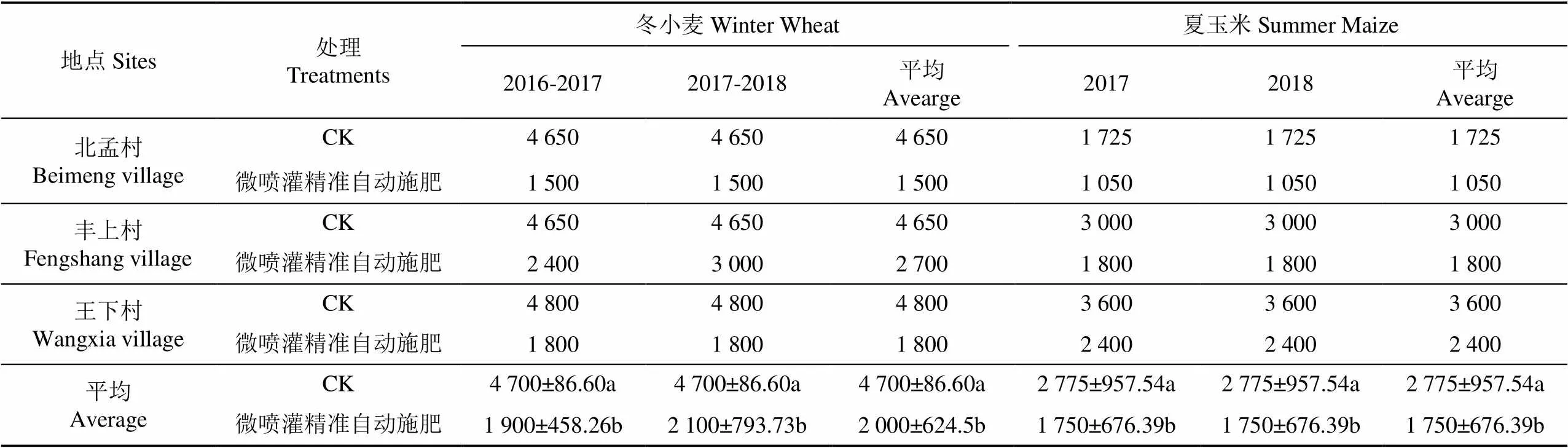
表4 微噴灌精準自動施肥對灌溉用水量的影響
2.3 微噴灌精準自動施肥對冬小麥、夏玉米生產成本和效益的影響
微噴灌精準自動施肥明顯降低冬小麥季生產成本,提高產值和效益(表5)。表5顯示,微噴灌精準自動施肥3個試驗地點2016年~2018年2個冬小麥季平均單季化肥成本1 578.21元/hm2、灌溉電費710.00元/hm2、設備折舊和維修成本1 043.25元/hm2,水肥用工成本844.95元/hm2,其他成本1 500.00元/hm2,合計生產成本6 984.61元/hm2,產值22 057.22元/hm2,效益15 072.61元/hm2。CK處理冬小麥季平均單季化肥成本2 015.85元/hm2、灌溉電費1 668.50元/hm2、水肥用工成本2 560.05元/hm2,其他成本1 500.00元/hm2,合計生產成本9 460.25元/hm2,產值19 944.01元/hm2,效益10 483.76元/hm2。與CK相比,精準微噴灌自動施肥冬小麥季增加產值2 113.20元/hm2,提高效益4 588.85元/hm2,增收43.77%,減少成本2 475.64元/hm2,減少26.17%。

表5 微噴灌精準自動施肥對小麥生產效益的影響
注:1. 計算依據的市場價格:小麥2.4元·kg-1,玉米1.3元·kg-1,純N 4.6元·kg-1,P2O55.5元·kg-1,K2O 4.0元·kg-1,灌溉電費0.355元·m-3,系統年折舊費按系統使用年限10 a計算,年維修費用按系統投資總額的3%計算[9-10]。其他成本包括播種成本150元·hm-2,除草成本300元·hm-2,病害防治成本450元·hm-2,收獲成本600元·hm-2。下同。
Note: 1. The market price on which the calculation is based: wheat 2.4 Yuan·kg-1; maize 1.3 Yuan·kg-1; N 4.6 Yuan·kg-1; P2O55.5 Yuan·kg-1; K2O 4.0 Yuan·kg-1; power charges of irrigation 0.355 Yuan·m-3. The annual depreciation fee of the system is calculated according to the service life of 10 years, and the annual maintenance fee is calculated according to 3% of the total investment of the system[9-10].. 2. The other costs including sowing cost 150 Yuan·hm-2, weeding cost 300 Yuan·hm-2, disease control cost 450 Yuan·hm-2, harvesting cost 600 Yuan·hm-2. The bbelow.
微噴灌精準自動施肥明顯降低夏玉米季生產成本,提高產值和效益(表6)。表6顯示,微噴灌自動施肥3個試驗點2017年~2018年2個夏玉米季平均單季化肥成本1 575元/hm2、灌溉電費479.25元/hm2、設備折舊和維修成本1 043.25元/hm2,水肥用工成本868.80元/hm2,其他成本1 800元/hm2,合計生產成本7 101.30元/hm2,產值13 930.47元/hm2,效益3 214.72元/hm2。CK處理夏玉米季平均單季化肥成本1 815.60元/hm2、灌溉電費843.13元/hm2、水肥用工成本2 434.50元/hm2,其他成本1 800 元/hm2,合計生產成本8 564.83元/hm2,產值12 249.26元/hm2,效益2 826.75元/hm2。與CK相比,微噴灌自動施肥夏玉米季增加產值1 681.21元/hm2,提高效益387.97元/hm2,增收13.73%,減少成本1 463.53元/hm2,減少17.09%。

表6 微噴灌精準自動施肥對玉米生產效益的影響
微噴灌自動施肥冬小麥-夏玉米輪作季產值合計生產成本14 085.91,效益18 287.33元/hm2,較傳統施肥CK平均單季增加產值3 794.41元/hm2;提高效益4 976.82元/hm2,增收37.39%;降低生產成本3 939.17元/hm2,節約成本21.85%。
3 討 論
自動化施肥技術在中國糧食作物研究和應用上起步較晚[11-13],結合灌溉方式有滴灌施肥[14-16]、噴灌施肥[17]等方式。微噴灌結合了滴灌和噴灌的優點,造價成本低,可在低電壓條件運行,節省能源[18]。微噴灌作物根層土壤水分分布均勻,利于提高土壤儲水能力,減少作物耗水量,提高水分利用效率[19-23],解決了傳統灌溉大量浪費水資源的缺陷[24-26]。小麥微噴灌溉可提高小麥在關鍵生長期的葉面積指數,促進光合作用,提高灌漿期旗葉水勢和群體光合速率[27-29],顯著提高生物量、粒重和籽粒產量[30-31],還可以降低小麥灌漿期冠層溫度,提高冠層相對濕度,防控小麥干熱風[32]。很多研究表明,微噴灌溉施肥技術對提高水肥利用效率、促進作物生長有明顯作用。
本文分析了微噴灌精準自動施肥在糧食作物上的應用效果,通過不同地點的大尺度試驗示范肯定了微噴灌精準自動施肥對冬小麥-夏玉米產量、肥水資源、生產成本、經濟效益等方面的積極影響,為大田糧食作物推廣應用微噴自動化施肥技術提供科學參考依據,從而促進農業生產力水平和可持續發展。
傳統施肥全部肥料在作物生長前期完成施入土壤,而當作物對營養需求高峰的花粒期不進行追肥,從而導致過早施入土壤的養分由于被固定、流失等無法發揮良好的效果。本文在不同的土壤條件下,借助微噴自動灌溉施肥系統,比傳統施肥方法減少氮磷總量,增加作物生長后期水溶性速效磷鉀肥供應,解決了農民傳統施肥在作物籽粒形成的養分需求關鍵期缺乏有效肥料供應的問題,根據作物的階段營養需求供應水分和養分,契合冬小麥、夏玉米對養分的需求規律,與現有文獻的研究結果相吻合[14]。相比傳統施肥,顯著增產、增效、節肥、節水,驗證了該技術比傳統施肥技術具有明顯的先進性。
4 結 論
1)大尺度冬小麥-夏玉米微噴灌精準自動施肥具有增產、增收、節約成本、節肥、節水的良好應用效果。與傳統施肥相比,微噴灌精準自動施肥顯著提高小麥產量880.5 kg/hm2,增產10.6%;增加產值2 113.20元/hm2;提高效益4 588.85元/hm2,增收43.77%;降低生產成本2 475.64元/hm2,節約成本26.17%;減少氮磷純養分用量84.95 kg/hm2,減少氮磷化肥24.20%;節約灌溉用水2 700 m3/hm2,節水率57.45%。
2)微噴灌精準自動施肥顯著增加玉米產量1 293.24 kg/hm2,增產13.73%;增加產值1 681.21元/hm2,提高效益387.97元/hm2,增收13.73%;減少生產成本1 463.53元/hm2,節約成本17.09%。減少氮磷純養分用量 72 kg/hm2,減少氮磷化肥 20.34%;節省灌溉用水1 025 m3/hm2,節水36.94%。
3)冬小麥-夏玉米輪作季微噴灌精準自動施肥增產小麥、玉米總計2173.74kg/hm2,平均增產率12.26%;增加產值3794.41元/hm2;提高效益4976.82元/hm2,增收37.39%;降低生產成本3939.17元/hm2,節約成本21.85%;減少氮磷純養分用量156.95kg/hm2,減少氮磷化肥22.26%;節省灌溉用水3087.50 m3/hm2,節水46.51%。具有良好的經濟效益和生態效益。
[1] 師志剛,劉群昌,白美健,等. 基于物聯網的水肥一體化智能灌溉系統設計及效益分析[J]. 水資源與水工程學報,2017,28(3):221-227. Shi Zhigang, Liu Qunchang, Bai Meijian, et al.Water and fertilization integrated intelligent irrigation system design and benefit analysis based on the Internet of Things[J]. Journal of Water Resources and Water Engineering, 2017, 28(3): 221-227. (in Chinese with English abstract)
[2] 趙吉紅. 水肥一體化技術應用中存在的問題及解決對策[D]. 楊凌:西北農林科技大學,2015.
Zhao Jihong. The Problems and Solutions in the Aadapation of Fertigation Technology[D]. Yang Ling: Northwest A&F University, 2015. (in Chinese with English abstract)
[3] 路華忠. 水肥一體化技術及其應用[J]. 農業災害研究,2014(8):50-52. Lu Huazhong. Fertigation technology and its application[J]. Journal of Agricultural Catastrophology, 2014 (8): 50-52. (in Chinese with English abstract)
[4] 張承林,鄧蘭生. 水肥一體化技術[M]. 北京: 中國農業出版社: 2012.
[5] 陳小彬. 水肥一體化技在設施農業中的應用調查[D]. 福州:福建農業大學,2014. Chen Xiaobin. Investigation on the Application of Fertigation Technology in Facility Agriculture[D]. Fuzhou: Fujian Agriculture and Forestry University, 2014. (in Chinese with English abstract)
[6] 袁洪波,李莉,王俊衡,等. 溫室水肥一體化營養液調控裝備設計與試驗[J]. 農業工程學報,2016,32(8):27-32. Yuan Hongbo, Li Li, Wang Junheng, et al. Design and test of regulation and control equipment for nutrient solution of water and fertilizer integration in greenhouse[J]. Transactions of the Chinese Society of Agricultural Engineering (Transactions of the CSAE), 2016, 32(8): 27-32. (in Chinese with English abstract)
[7] 袁洪波,程曼,龐樹杰,等. 日光溫室水肥一體灌溉循環系統構建及性能試驗[J]. 農業工程學報,2014,30(12):72-78. Yuan Hongbo, Cheng Man, Pang Shujie, et al. Construction and performance experiment of integrated water and fertilization irrigation recycling system[J]. Transactions of the Chinese Society of Agricultural Engineering (Transactions of the CSAE), 2014, 30(12): 72-78.(in Chinese with English abstract)
[8] 魯如坤. 土壤農業化學分析方法[M]. 北京:中國農業科技出版社,1999.
[9] 中華人民共和國水利部.水利工程水利計算規范SL104-2015 [S] .北京:中國水利水電出版社,2015.
[10] 中華人民共和國水利部.水利建設項目經濟評價規范SL72-2013[S]. 北京:中國水利水電出版社,2013.
[11] 白由路.國內外施肥機械的發展概況及需求分析[J]. 中國土壤與肥料,2016(3):1-4. Bai Youlu. Analysis of the development and the demands of fertilization machinery[J]. Soils and Fertilizers Sciences in China. 2016 (3): 1-4. (in Chinese with English abstract).
[12] 白由路. 我國肥料產業面臨的挑戰與發展機遇[J]. 植物營養與肥料學報,2017,23(1):1-8. Bai Youlu. Challenges and opportunities of fertilizer industry in China[J]. Journal of Plant Nutrition and Fertilizer. 2017, 23(1): 1-8. (in Chinese with English abstract)
[13] 杜建軍,廖宗文,王新愛,等. 高吸水性樹脂包膜尿素的水肥一體化調控效果研究[J]. 農業工程學報,2007,23(6):71-77. Du Jianjun, Liao Zongwen, Wang Xin'ai, et al. Effects of integral regulation and control of super absorbent polymer coated urea on water and fertilizer use efficiencies[J]. Transactions of the Chinese Society of Agricultural Engineering (Transactions of the CSAE), 2007, 23(6): 71-77. (in Chinese with English abstract)
[14] 何進宇,田軍倉. 膜下滴灌旱作水稻水肥耦合模型及組合方案優化[J]. 農業工程學報,2015,31(13):77-82. He Jinyu, Tian Juncang. Model of coupling water with fertilizer and optimum combination scheme of rice cultivated in aerobic soil with drip irrigation under plastic film[J]. Transactions of the Chinese Society of Agricultural Engineering (Transactions of the CSAE), 2015, 31(13): 77-82. (in Chinese with English abstract)
[15] 官雅輝,牛文全,劉璐,等. 肥料類型及濃度對水肥一體化渾水滴灌滴頭輸沙能力的影響[J]. 農業工程學報,2018,34(1):78-84. Guan Yahui, Niu Wenquan, Liu Lu, et al. Effect of fertilizer type and concentration on sediment transport capacity of dripper in drip fertigation with muddy water[J]. Transactions of the Chinese Society of Agricultural Engineering (Transactions of the CSAE), 2018, 34(1): 78-84. (in Chinese with English abstract)
[16] 李康勇,牛文全,張若嬋,等. 施肥對渾水灌溉滴頭堵塞的加速作用[J]. 農業工程學報,2015,31(17):81-90. Li Kangyong, Niu Wenquan, Zhang Ruochan, et al. Accelerative effect of fertigation on emitter clogging by muddy water irrigation[J]. Transactions of the Chinese Society of Agricultural Engineering (Transactions of the CSAE), 2015, 31(17): 81-90. (in Chinese with English abstract)
[17] 趙偉霞,李久生,栗巖峰. 大型噴灌機變量灌溉技術研究進展[J]. 農業工程學報,2016,32(13):1-6. Zhao Weixia, Li Jiusheng, Li Yanfeng. Review on variable rate irrigation with continuously moving sprinkler machines[J]. Transactions of the Chinese Society of Agricultural Engineering (Transactions of the CSAE), 2016, 32 (13): 1-7. (in Chinese with English abstract)
[18] 周斌,封俊,張學軍,等. 微噴單孔噴水量分布的基本特征研究[J]. 農業工程學報,2003,19(4):101-103. Zhou Bin, Feng Jun, Zhang Xuejun, et al. Characteristics and indexes of water distribution of punched thin-soft tape forspray[J]. Transactions of the Chinese Society of Agricultural Engineering (Transactions of the CSAE), 2003, 19(4): 101-103. (in Chinese with English abstract)
[19] 李英,趙福年,丁文魁,等. 灌溉方式和播期對玉米水分動態與水分利用效率的影響[J]. 中國農學通報,2015,31(6):62-67. Li Ying, Zhao Funian, Ding Wenkui, et al. Effect of irrigation modes and sowing date on maize water dynamics and water use efficiency[J]. Chinese Agricultural Science Bulletin, 2015, 31(6): 62-67. (in Chinese with English abstract)
[20] 李漫. 不同密度及灌溉方式對春玉米對春玉米生長發育及產量的影響[D]. 烏魯木齊:新疆農業大學,2012. Li Man.The Influence of Growth and Yield under the Different Density and Irrigation Methods on the Spring Corn[D]. Urumqi: XinJiang Agricultural University, 2012. (in Chinese with English abstract)
[21] 王勇,白曉玲,趙舉,等. 噴灌條件下玉米地土壤水分動態與水分利用效率[J]. 農業工程學報,2012,28(增刊1):92-97. Wang Yong, Bai Lingxiao, Zhao Ju, et al. Dynamic variations of soil moisture and water use efficiency of maize under sprinkler irrigation[J]. Transactions of the Chinese Society of Agricultural Engineering (Transactions of the CSAE), 2012, 28(Supp. 1): 92-97 (in Chinese with English abstract)
[22] 周新國,何俊卿,郭樹龍,等. 多孔軟管地面灌溉技術研究及應用[J]. 灌溉排水,2002,21(1):55-57. Zhou Xinguo, He Junqing, Guo Shulong, et al. Study and application for multiple outlets hoses surface irrigation technique[J]. Irrigation and Drainage, 2002, 21(1): 55-57. (in Chinese with English abstract)
[23] 劉海軍. 微壓多孔軟管水力性能研究[D]. 楊凌:西北農林科技大學,2008. Liu Haijun. Study on Hydraulic Characteristics of Micro-pressure Perforated Flexible Hose[D]. Yangling: Northwest A & F University, 2008. (in Chinese with English abstract)
[24] 張璐,黨高兵,杜紅利. 微噴灌對旱地小麥產量和水分利用效率的影響[J]. 中國農技推廣,2015(2):44-46. Zhang Lu, Dang Gaobing, Du Hongli. Effects of micro sprinkler irrigation on yield and water use efficiency of winter wheat in dryland[J]. China Agricultural Technology Extension, 2015(2): 44-46. (in Chinese with English abstract)
[25] 張其魯,姜官恒,魏秀華. 微噴技術在小麥生產上的應用研究[J]. 安徽農學通報,2012,18(9):190-195. Zhang Qilu, Jiang Guanheng, Wei Xiuhua. Study on the application of micro spray technology in wheat production[J]. Anhui Agricultural Science Bulletin, 2012, 18(9): 190-195. (in Chinese with English abstract)
[26] 許驥坤,于振文,石玉,等. 微噴帶長寬對不同區段麥田水分和小麥旗葉葉綠素熒光特性的影響[J]. 應用生態學報,2017, 28(11):3599-3609. Xu Jikun, Yu Zhenwen, Shi Yu, et al. Effects of micro-sprinkling hose length and width on wheat field water condition and flag leaf chlorophyll fluorescence characteristics in different sampling districts[J]. Chinese Journal of Applied Ecology, 2017, 28(11): 3599-3609. (in Chinese with English abstract)
[27] 王東,徐學欣,張洪波,等. 微噴帶灌溉對小麥灌漿期冠層溫濕度變化和粒重的影響[J]. 作物學報,2015,41(10):1564-1574. Wang Dong, Xu Xuexin, Zhang Hongbo, et al. Effects of irrigation with micro-sprinkling hoses on canopy temperature and humidity at filling stage and grain weight of wheat[J]. Acta Agronomica Sinica, 2015, 41(10): 1564-1574. (in Chinese with English abstract)
[28] Dogan E, Kirnak H, Dogan Z. Effect of varying the distance f collectors below a sprinkler head and travel speed on easurements of mean water depth and uniformity for a inear move irrigation sprinkler system[J]. Biosystems ngineering, 2008, 99(2): 190-195.
[29] Cavero J, Jiménez L, Puig M, et al. Maize growth and yield under daytime and nighttime solid-set sprinkler irrigation[J]. Agronomy Journal, 2008, 100(6): 1573-1579.
[30] 張英華,張琪,徐學欣,等. 適宜微噴灌灌溉頻率及氮肥量提高小麥產量和水分利用效率[J]. 農業工程學報,2016,32(5):88-95. Zhang Yinghua, Zhang Qi, Xu Xuexin, et al. Optimal irrigation frequency and nitrogen application rate improving yield formation and water utilization in winter wheat under micro-sprinkling condition[J]. Transactions of the Chinese Society of Agricultural Engineering (Transactions of the CSAE), 2016, 32(5): 88-95. (in Chinese with English abstract)
[31] 姚素梅,康躍虎,呂國華,等. 噴灌與地面灌溉條件下小麥籽粒灌漿過程特性分析[J]. 農業工程學報,2011,27(7):13-17.Yao Sumei, Kang Yuehu, Lü Guohua, et al. Analysis on grain filling characteristics of winter wheat under sprinkler irrigation and surface irrigation conditions[J]. Transactions of the Chinese Society of Agricultural Engineering (Transactions of the CSAE), 2011, 27(7): 13-17. (in Chinese with English abstract)
[32] 魏秀華,于海濤,張其魯. 微噴防控小麥干熱風研究[J]. 農業科技通訊,2016(9):82-84. Wei Xiuhua, Yu Haitao, Zhang Qilu.Study on dry hot wind prevention and control for wheat with micro spray[J]. Agricultural science and technology communication. 2016 (9): 82-84. (in Chinese with English abstract)
Yield increasing effect of precision automatic fertilization and micro-spray irrigation for winter wheat-summer maize in large-scale
Xing Suli1, Du Jinzhong2, Liu Mengchao1, Jia Liangliang1, Liu Xuetong1, Zhao Shicheng3
(1.,,050051,;2.,,,050000,;3.,,100081,)
To illustrate the agronomic and economic effectsof precision automatic fertilization and micro-spray irrigation technology on the winter wheat and summer maize,3 field experiments were conducted in Beimeng village(38°14′24.87′′N, 114°46′56.41′′E), Fengshang village(38°13′ 21.6′′N, 114°46′48′′E) and Wangxia village(38°2′44.17′′N, 115°25′32.98′′E) in Xinji City Gaocheng District from October 2016 to June 2018. Each experiments including 2 treatments of CK and precision automatic fertilization and micro-spray irrigation treatment, the plot area is 6.67 hm2for each treatment with 3 replication at random arrangement. The study areas belongs to the typical winter wheat and summer maize rotation in the northern North China Plain, and belongs to the semi-humid climate in warm temperate zone. The average annual temperature is 12.4-12.6 ℃, the accumulated temperature is 4 181-4 863 ℃, the annual precipitation is 488.2-498 mm, and the frost-free period is 190-209 days. The winter wheat sown in mid-October, and harvested in next mid-June, the maize sown in mid-June and harvested from the end of September to the beginning of October. Totally 2 winter wheat-summer maize rotation seasons were included in this experiments. For CK treatment, the fertilization rates and allocation budgets were based on farmers’ survey in the experiments areas. The winter wheat fertilization rates was N 216, 231 and 268.5 kg/hm2, P2O5112.5, 120 and 105 kg/hm2, and K2O 112.5, 37.5 and 75 kg/hm2respectively for each teat sites. All the P and K fertilizer applied before sowing, 52%-61% N as basal fertilizer applied before sowing and 39%-48% applied at shooting stage as topdressing. The summer maize fertilization rates were N 306, 318 and 294 kg/hm2, P2O536, 48 and 60 kg/hm2, K2O 36, 24 and 48 kg/hm2respectivelyfor each teat sites, all the P and K fertilizers applied as basal fertilizer, 53%-57% N as basal fertilizer applied before sowing and 43%-47% applied at 10 leaf stage as topdressing. The irrigation strategy for CK treatment was flooding irrigation. For precision automatic fertilization and micro-spray irrigation, fertilization rates and allocation budgets were based on agriculture experts knowledge. The winter wheat fertilization rates were N 157,180 and 180 kg/hm2, P2O590, 90 and 101.5 kg/hm2, K2O 52.5, 75 and 75 kg/hm2for each teat site. The allocation proportion for N as basal fertilizer, jointing stage topdressing and booting stage topdressing was 42.5%, 42.5% and 15%, respectively. P2O5was 65%, 5%, 30%, respectively. K2O was 60%, 20%, 20%,respectively. The summer maize fertilization rates were N 210, 240 and 270 kg/hm2, P2O537.5, 43.5 and 45 kg/hm2, K2O 52.5, 60 and 67.5 kg/hm2for each teat sites. The allocation proportion for N as basal fertilizer, 10 leaf stage topdressing and flowering stage topdressing was 50%, 45% and 5% respectively, P2O5was 60%, 20% and 20%respectively, K2O was 50%, 30% and 20%respectively. For this treatment, the precision automatic fertilization and micro-spray irrigation was used in the whole growth seasons, fertilizers were accompanied with the irrigation water through the automatic irrigation channel system. The results showed that large scale the precision automatic fertilization and micro-spray irrigation technology used on winter wheat and summer maize could increase the crop yield, decrease the N, P fertilizer application and irrigation water amount, improve the net benefit. Compared with CK, the precision automatic fertilization and micro-spray irrigation technology significantly increased winter wheat yield by 10.6%, increased net income by 43.77%, significantly reduced the production cost by 26.17%, reduced the amount of nitrogen and phosphorus by 24.20%, decreased the irrigation water by 57.45%. Correspondingly, precision automatic fertilization and micro-spray irrigation technology significantly increased summer maize yield by 13.73%, maize net benefits increased by 13.73%, reduced the production cost by17.09%, reduced the amount of nitrogen and phosphorus by 20.34%, decreased the irrigation water by 36.94% than the CK treatment. For the whole winter wheat and summer maize rotation season, the precision automatic fertilization and micro-spray irrigation technology significantly increased the crop yield by 12.26%, increased the net benefits by 37.39%, reduced the production cost by 21.85%, reduced the amount of nitrogen and phosphorus by 22.26%, reduced the irrigation water by 46.51%. This study confirmed the effect of precision automatic fertilization and micro-spray irrigation technology on winter wheat and summer maize, which can provides reference basis for the promotion of this new technology, thus promoting productivity and agricultural sustainable development.
irrigation; crops; precision automatic fertilization; winter wheat; summer maize; yield increasing effect
2018-07-19
2019-03-01
國家科技支撐計劃項目(2015BAD23B0207);河北省科技計劃項目(14397502D)。
邢素麗,研究員,主要從事作物高效施肥技術研究。 Email:834591172@qq.com
10.11975/j.issn.1002-6819.2019.06.012
S275.6
A
1002-6819(2019)-06-0100-07
邢素麗,杜金鐘,劉孟朝,賈良良,劉學彤,趙士誠.大尺度冬小麥-夏玉米微噴灌精準自動施肥增產效應[J]. 農業工程學報,2019,35(6):100-106. doi:10.11975/j.issn.1002-6819.2019.06.012 http://www.tcsae.org
Xing Suli, Du Jinzhong, Liu Mengchao, Jia Liangliang, Liu Xuetong, Zhao Shicheng. Yield increasing effect of precision automatic fertilization and micro-spray irrigation for winter wheat-summer maize in large-scale[J]. Transactions of the Chinese Society of Agricultural Engineering (Transactions of the CSAE), 2019, 35(6): 100-106. (in Chinese with English abstract) doi:10.11975/j.issn.1002-6819.2019.06.012 http://www.tcsae.org