
Aresearchon lexical density-acase study of oral English teaching papers
2019-10-21 06:16:00徐旭菲律賓德拉薩大學
新生代 2019年15期
關鍵詞:大學
徐旭 菲律賓德拉薩大學
Abstract:The lexical density of the English language helps us to understand the formality of English written texts.This paper has made a study about the introductions of oral English teaching papers on lexical density. The author chose ten articles that all related to the teaching of oral English. The objective of the study is to find out the lexical density of oral English teaching papers’ introductions. Lexical density of this paper was tested by using Analyze My Writing (http://www.analyzemywriting.com). The results of the analysis showed that:In most oral English teaching articles that chosen for this study,the lexical density of their introduction is around 60%. From this figure we can know that the introduction part of these paper is very formal. It is suggested that further article writers should pay more attention to the lexical density of the Introduction part of the paper so that the introduction can be better understood by the readers.
Key words : lexical density; Oral English teaching;introduction.
Introduction
In the process of oral communication in foreign languages, English learners will inevitably encounter some expression problems. At this time, it is necessary for teachers to consciously use various teaching strategies to guide students to solve these problems. Based on this situation, more and more teachers begin to study how to improve students’ oral expression ability, accordingly, there appears more and more papers that related to the study of oral English teaching. For example, Wen qiufang et al. (2003) discussed the issue of colloquial tendency in written English of Chinese students from two perspectives of the distribution of words in written English of Chinese students in terms of readers' and authors' visibility and word frequency.However, many papers analyze and solve problems from different perspectives, so the difficulty of each article will be different.
Lexical density is characterized as the quantity of lexical words (or content words) partitioned by the all out number of words. In other words, lexical density is a state of the words’proportion in the whole passage. Lexical density is “the kind of complexity that is typical of written language” (Halliday,1985). Lexical words show the meaning of the text and provide information regarding what the text is mainly about. Lexical diversity is a measure of how many different words that are used in a text, while lexical density provides a measure of the proportion of lexical items (i.e. nouns, verbs, adjectives and some adverbs) in the text (Johansson, 2008). Halliday(1985)believes that the words in a sentence are divided into two categories: one is the grammatical item, also known as the functional item, which refers to the word that plays a role of qualification in the sentence, including articles, pronouns, most prepositions, conjunctions, some adverbs and determinative verbs; the other category is lexical items, or words. Lexical density reflects the proportion of lexical words in sentences. To be precise, lexical words are simply nouns, adjectives, verbs,and adverbs. Nouns tell us what is the subject, and adjectives tell us more information about the subject, verbs tell us what subject and object do, and adverbs tell us how they do it. Since most of the information in a sentence is transmitted by the lexical words, the more the lexical density of a sentence is,the more lexical words there are in the sentence and the more information the sentence contains. Conversely, there is less information. That is, lexical density is simply a measure of how informative a text is. Bersyebah(2014) stated that lexical density describes the development of lexical in the written language.
Low lexical density will affect the quality of information expression and the accuracy of text genre. However, too high vocabulary density will increase the difficulty of people's perception of the text. Ure(1971) had studied the lexical density of written text and spoken text, and came to the conclusion that the lexical density of written text was above 40% and that of spoken text was below 40%. Moreover, Sholichatun (2011)states that a high lexical density measures of around 60-70%,quite lexical density measures of around 50-60%, and a lower lexical density measures of around 40-50%.
This paper focus on the analysis of the lexical density of ten articles that related to the research on oral English teaching.The objective of the study is to find out the lexical density of the introduction part of these oral English teaching papers. So,what is the lexical density of the introduction section of the paper? With this question, the author explores to analyze the outcomes of the lexical density and conclude the result of this research.
Methodology
The data of this paper were selected from the influential journals in the field of English teaching—The Journal of Asia TEFL. In order to avoid the influence of cultural differences on language use, the author selected all English papers and their introductions from the magazine, involving 10papers from the year of 2017-2018whose author are from Korea, Japan, China,Thailand and other countries.
The lexical density analysis of this paper mainly based on the authoritative
Website—Analyze My Writing (http://www.analyzemywriting.com). Articles of different difficulty, their lexical density is also different. The method of measuring the word density of this website was based primarily on the method of computing the word density in accordance with Ure's(1971)calculations.
Ure was one of the first people to study lexical density.The calculation method of textual lexical density proposed by her has become the most commonly used traditional calculation method today. That is, the lexical items in a text were divided by the total number of words in a text and multiplied by 100%to get the number of words contained in the text average per hundred words. Ure adopted this method to analyze the texts she collected, and came to the conclusion that the lexical density of oral texts was below 40% and that of written ones was above 40%.
Result and Discussion
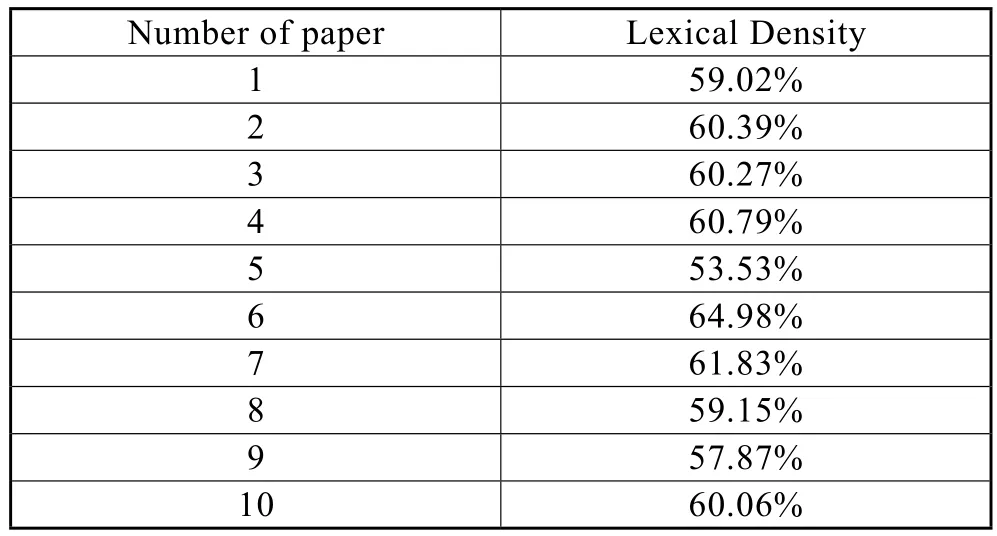
Number of paper Lexical Density 159.02%260.39%360.27%460.79%553.53%664.98%761.83%859.15%9 57.87%10 60.06%
In this study, the author numbered the ten papers and their introduction successively, and calculated the lexical density with the method proposed by Ure (1971) which was applied to Analyze My Writing to obtain the statistical results as shown in Table 1.According to the above statistical results, the lexical density of most paper’s introductions is around 60% among the selected papers. Moreover, only four introductions of then articles’lexical density are significantly lower than 60%, Among them,the fifth article has the lowest lexical density and the sixth article is the highest. Other articles have a similar vocabulary density.
Ure (1977) maintained that the matter of lexicality is important when discussing the concept of lexical density.According to Ure’s opinion, the higher the lexical density of the article, the more difficult and informative it is. Therefore,through the data analysis in the table, the difficulty of the 10articles selected by the author is basically not much different.For future research, it will be helpful for author of oral English teaching papers to pay more attention to the Introduction part of the whole paper, so as to make it easier to understand by readers.
However, due to the limitations of the conditions, the research in this paper also has some limitations. On one hand,the 10articles selected by the author are taken from different volumes of the same Journal, so they cannot represent all such articles. On the other hand, since we use a computer algorithm to analyze the lexical density of different parts of article, not each word will be properly classified as lexical or non-lexical.And so far, no computer algorithm can do this task perfectly.Thus, this website which computes lexical density can only offer a close approximation.
猜你喜歡
中學生天地(A版)(2022年6期)2022-07-14 12:39:26
大學(2021年2期)2021-06-11 01:13:48
大學(2021年2期)2021-06-11 01:13:12
海峽姐妹(2020年12期)2021-01-18 05:53:08
文苑(2020年8期)2020-09-09 09:30:16
民主與法制(2020年16期)2020-08-24 06:54:50
新世紀智能(英語備考)(2020年6期)2020-08-14 01:06:20
華人時刊(2017年13期)2017-11-09 05:39:29
浙江工業大學學報(社會科學版)(2017年3期)2017-10-13 02:23:52
中國現當代社會文化訪談錄(2016年0期)2016-09-26 08:46:07
