王竹紅 葛均青 劉紫晶


摘要 草地貪夜蛾Spodoptera frugiperda (J.E.Smith)是世界重要農業害蟲,具有很強的遷飛性,對玉米等禾本科植物造成危害。調查草地貪夜蛾卵寄生性天敵資源,明確其種類和鑒別特征,對篩選優勢天敵種類和開展生物防治具有重要意義。對福建省寄生性天敵資源調查結果表明,福建省有兩種草地貪夜蛾卵寄生蜂,分別為夜蛾黑卵蜂Telenomus remus Nixon和螟黃赤眼蜂 Trichogramma chilonis Ishii,本文記述了這兩種卵寄生蜂的主要形態特征,并觀察了其寄生行為。
關鍵詞 草地貪夜蛾; 寄生蜂; 調查; 鑒別; 寄生行為
中圖分類號: S 435.132 ?文獻標識碼: A ?DOI: 10.16688/j.zwbh.2019614
Abstract The fall armyworm, Spodoptera frugiperda, is one of the most important agricultural pests in the world. It has strong immigrating ability and causes harm to corn and Gramineae plants. Therefore, it is of great importance to further surveys and identification on parasitoid wasps of S. frugiperda egg for selection of superior natural enemies and field application. Through field surveys, two species of egg parasitoid wasps, Telenomus remus Nixon and Trichogramma chilonis Ishii were collected in Fujian province. The morphological characteristics and occurrence of parasitoid wasps were briefly recorded with the photographs of parasitoid wasps, and the parasitic behavior was also studied.
Key words Spodoptera frugiperda; parasitoids; investigation; identification; parasitic behavior
草地貪夜蛾Spodoptera frugiperda (J.E.Smith)隸屬鱗翅目Lepidoptera,夜蛾科Noctuidae,又稱秋黏蟲(英文名fall armyworm),原產于美洲熱帶及亞熱帶地區,具有食性雜、繁殖能力強、遷飛擴散快、為害嚴重等特點[1-4]。2019年1月,草地貪夜蛾入侵我國云南省,僅歷時9個月就已入侵我國25個省份,見蟲面積100多萬hm2,實際為害面積16.4萬 hm2[5]。草地貪夜蛾將在我國西南、華南地區越冬定殖,成為我國又一個“北遷南回、周年循環”的重大遷飛性害蟲,其發生和為害可能成為常態[5]。因此,加強草地貪夜蛾的監測與防控研究刻不容緩。
生物防治是害蟲防治持續有效的方法。國外對草地貪夜蛾的生物防治研究主要集中于寄生性天敵,包括膜翅目和雙翅目昆蟲[6],其中,緣腹細蜂科Scelionidae的夜蛾黑卵蜂Telenomus remus Nixon是美洲、非洲、亞洲等地草地貪夜蛾重要的卵寄生蜂[7-10];繭蜂科Braconidae脊繭蜂屬的Aleiodes laphygmae (Viereck)、懸繭蜂屬的Meteorus laphygmae (Viereck)、內繭蜂屬的Rogas vaughani (Muesebeck)和R. laphygmae (Viereck)、雕絨繭蜂屬的Glyptapanteles creatonoti (Viereck)是幼蟲期主要寄生蜂[10-13],甲腹繭蜂屬寄生蜂Chelonus spp.是“卵-幼蟲”兼性寄生蜂[14-15];姬蜂科Ichneumonidae齒唇姬蜂屬的Campoletis grioti (Blanchard)、黑唇姬蜂C.sonorensis (Cameron)和棉鈴蟲齒唇姬蜂C.chlorideae Uchida是幼蟲期主要寄生蜂[10-12];姬蜂科的Diapetimorpha introita (Cresson)是蛹期主要寄生蜂[12]。此外,赤眼蜂科Trichogrammatidae的赤眼蜂屬Trichogramma spp.也是卵期寄生蜂[16-17]。這些寄生蜂在生物防治中發揮了重要作用,尤其是卵寄生蜂寄生率高,田間適應性強,被多個國家成功應用于草地貪夜蛾的生物防治[6,18-21]。
2019年5月,在福建省泉州市、南安市首先發現草地貪夜蛾入侵。之后,全省各地陸續發現草地貪夜蛾為害[22]。我們在福建各地進行了草地貪夜蛾寄生性天敵的調查,共采集到兩種卵寄生蜂,分別為夜蛾黑卵蜂Telenomus remus Nixon和螟黃赤眼蜂Trichogramma chilonis Ishii。由于草地貪夜蛾是今年重大入侵害蟲,及時進行監測和綠色防控勢在必行。深入調查發掘、準確鑒定優勢種天敵至關重要。本文在對福建省草地貪夜蛾寄生性天敵資源調查的基礎上,重點研究了兩種卵寄生蜂,夜蛾黑卵蜂和螟黃赤眼蜂的形態特征,提供了寄生蜂的形態特征照片;概述了目前草地貪夜蛾卵寄生蜂的種類;初步研究了兩種卵寄生蜂的寄生行為,為進一步利用寄生性天敵開展草地貪夜蛾生物防治提供科學依據。
1 材料與方法
1.1 寄生性天敵調查
2019年8月-2019年10月在福建省多地采集草地貪夜蛾卵塊,帶回實驗室飼養收集寄生蜂。先將羽化的寄生蜂進行拍照,然后連同采集標簽放入100%乙醇中保存,待制作玻片標本和種類鑒定。
1.2 兩種卵寄生蜂的主要形態特征和寄生行為
1.2.1 玻片標本制作
根據黃建[23]的方法進行玻片標本制作。
1.2.2 標本拍照
寄生蜂和寄主照片采用Nikon SMZ18體視鏡(帶Nikon DS-Ri2攝像頭、NIS-Elements D軟件)拍攝。玻片標本照片采用Nikon Ni微分干涉顯微鏡(帶Nikon DS-Ri2攝像頭、NIS-Elements D軟件)拍攝。
1.2.3 種類鑒定
寄生蜂體長在未制作玻片標本前測量,其他形態特征則在玻片標本上進行測量。
1.2.4 夜蛾黑卵蜂和螟黃赤眼蜂的產卵行為觀察
分別以草地貪夜蛾和斜紋夜蛾卵為寄主,體視鏡下觀察比較夜蛾黑卵蜂和螟黃赤眼蜂的產卵行為。室溫條件下進行。
1.2.5 數據分析
利用SPSS 17.0 對數據進行比較分析。
2 結果與分析
共采集到草地貪夜蛾卵寄生蜂兩種,分別為夜蛾黑卵蜂T. remus Nixon和螟黃赤眼蜂T. chilonis Ishii,對兩種寄生蜂的主要鑒別特征記述如下。
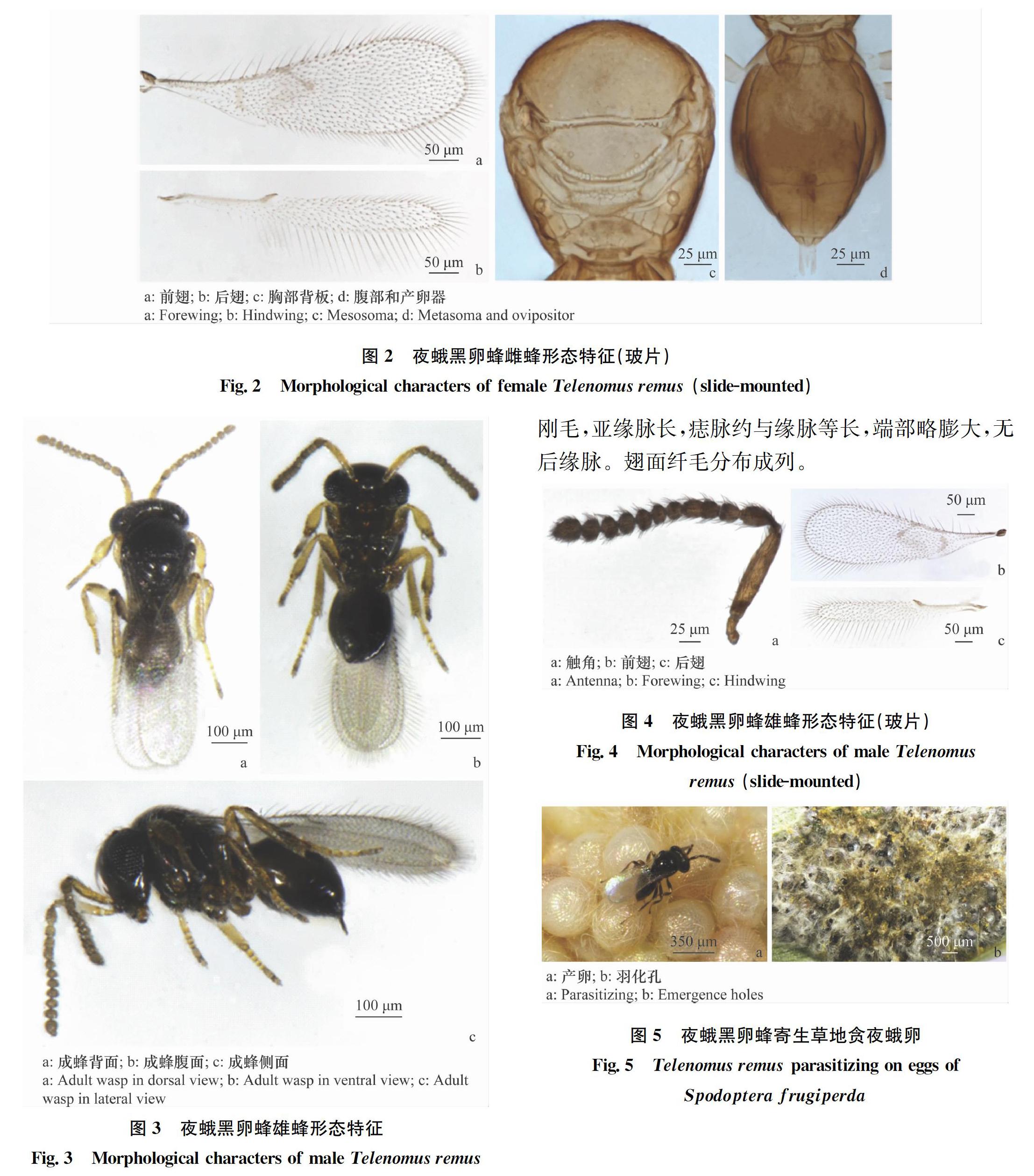
2.1 夜蛾黑卵蜂Telenomus remus Nixon, 1937(圖1~圖5) ?Telenomus remus Nixon, 1937. Annals and Magazine of Natural History, 20: 444-475.
雌:體長0.5~0.6 mm,體亮黑色。觸角暗褐色,足基節、腿節和脛節大部分暗褐色,轉節、脛節基部小部分、跗節第1節或第1~4節褐黃色至稍暗色,跗節端部暗色。翅透明,前翅亞緣脈約2/3處下方具一不規則的淺煙褐色豎條紋,緣脈下方、痣脈內側具一淺煙褐色云斑。
復眼具細毛。頭橫寬略大于胸寬,頭頂散生細毛。觸角11節,各節具較密的短毛。柄節長約為寬的5.52倍;梗節長于鞭節各節,約與棒節末節等長;索節5節,小,念珠狀;棒節膨大,4節,各節長度比為2.3∶3.3∶3.4∶5.0。
胸部隆起,胸部背板密布細毛。中胸盾片兩側緣各具1個近三角形側突;小盾片前緣兩側各具6~7個小齒,后緣及側緣具脊,形成弧形念珠狀;后胸背板中部具網狀脊;并胸腹節兩側、氣門下方具梯形或不規則形的塊狀脊,整體呈拱狀。
前翅窄長,長為寬的3.20倍;緣毛為翅寬的0.42倍。亞緣脈長,具8根剛毛;緣脈短,約為亞緣脈長的0.16倍,約為痣脈長的0.57倍,具2~3根剛毛;后緣脈不發達。后翅細長,前后緣近平行,緣脈長,約為翅寬的1.54倍。
足跗節5-5-5。
腹部長梭形,稍長于胸部。第1、2節背板基部具縱脊溝,其余各節光滑;第2背板最長,為其后各節背板總和長的2.04倍。末節腹節的腹板不縱裂,產卵器從腹部末端伸出,側面觀與腹部縱向平行,通常產完卵后產卵器會縮回腹部內,再次產卵時又伸出。
雄:體色、形態結構、翅等十分近似雌性。但觸角12節,且棒節不明顯,整個鞭節呈線形念珠狀(雌性觸角11節,棒節膨大,4節);梗節長于鞭節各節,鞭節中末節相對最長且寬,觸角各節具較密的短毛。足腿節和脛節相對淺褐色。雄性外生殖器從腹部末端朝腹向伸出,側面觀與腹部縱向呈一定角度(雌性產卵器從腹部末端伸出,側面觀與腹部縱向平行)。
2.2 螟黃赤眼蜂Trichogramma chilonis Ishii,1941(圖6~圖8) ?Trichogramma chilonis Ishii, 1941. Knotyu, 14: 169-176.
雄:體長0.35~0.40 mm。體暗黃色,中胸盾暗褐色,腹部黑褐色。翅透明,前翅基部到痣脈下方翅面大部分淺煙褐色,翅脈暗褐色。雄性外生殖器鉤爪黑褐色。
觸角5節;柄節長為寬的4.25倍;梗節長為寬的1.55倍;環節2節,小(第2環節通常不易看到);棒節1節(索節與棒節愈合),明顯長于柄節與梗節之和,長為寬的6.31倍,具長毛,最長的毛為棒節寬的2.68倍。前翅闊圓,長為寬的1.86倍;緣毛為翅寬的0.14倍。翅脈呈“S”形彎曲,緣脈短,具約3根剛毛,亞緣脈長,痣脈約與緣脈等長,端部略膨大,無后緣脈。翅面纖毛分布成列。
足跗節3-3-3。
外生殖器:陽基背突三角形,端部較鈍圓,具明顯的半圓形側葉,陽基背突末端達D(腹中突基部至陽基側瓣末端距離)的約1/2;腹中突較大,約為D的0.48倍;中脊略長于D,成對;鉤爪末端伸達D的1/2左右。陽莖與其內突約等長,兩者全長約等于陽基長度。
雌:體長0.34~0.47 mm。體褐黃色,腹部暗黃色,約第2~3節具1暗褐色橫帶。翅透明,前翅基部到痣脈下方翅面大部分淺煙褐色,翅脈暗褐色。產卵器基部外側各具1個小暗褐色斑。
觸角7節;柄節長為寬的3.76倍,梗節長為寬的1.83倍,長于2節索節之和;環節2節,小(第2環節通常不易看到);索節2節,第1索節稍短于第2索節;棒節1節,粗長,長于梗節、環節和索節之和,從基向2/5到末端的腹面強烈斜截,具多個長條形感覺器。前翅闊圓,長為寬的1.98倍,其他特征基本類似雄性。
足跗節3-3-3。
產卵器第3產卵瓣短,約為第2負瓣片長的0.17倍。
從田間采集的草地貪夜蛾卵中飼養出來的螟黃赤眼蜂,有些個體發育不良,多為翅縮短變小(圖7c)。同時,據林乃銓記述,在不同溫度條件下培養出來的螟黃赤眼蜂雌成蟲體色有差異[24]。
2.3 草地貪夜蛾卵、卵-幼蟲寄生蜂種類
據國內外文獻報道,草地貪夜蛾的卵寄生蜂有緣腹細蜂科Scelionidae的1種,赤眼蜂科Trichogrammatidae的7種;卵、卵-幼蟲寄生蜂有繭蜂科Braconidae的4種(表1)。卵-幼蟲寄生蜂為卵-幼蟲跨期寄生,寄生蜂產卵在寄主卵中,寄主卵孵化為幼蟲后,寄生蜂卵才孵化,在寄主幼蟲體內完成寄生蜂幼蟲發育。
2.4 夜蛾黑卵蜂和螟黃赤眼蜂的產卵行為觀察
夜蛾黑卵蜂和螟黃赤眼蜂的寄生行為都可以分為搜尋、檢測、產卵、清理等幾個過程。起初均是以觸角敲擊搜尋寄主,發現寄主后,用觸角敲擊寄主卵表面進行檢測,此時往往會圍繞卵表面轉圈試探,夜蛾黑卵蜂檢測寄主圈數往往超過一圈,而螟黃赤眼蜂檢測時間較短,繞卵表面爬行不到一圈即可確定是否產卵。確認好寄主后,兩種蜂都會掉轉身,伸出產卵針插入寄主卵中,后足支撐身體,將卵產入寄主體內。螟黃赤眼蜂產卵時腹部末端有規律地伸縮,產卵時有時將產卵器拔出一部分后再以不同角度插回寄主卵中,可在相同或不同寄主卵塊上多次產卵,并且產卵時間較檢測時間長。產卵結束后,拔出產卵針,清理。分別以草地貪夜蛾和斜紋夜蛾卵為寄主,比較了夜蛾黑卵蜂和螟黃赤眼蜂的寄生行為,對檢測時間、檢測圈數、產卵時間等[40]進行觀察記錄,發現這兩種蜂的檢測時間、檢測寄主圈數和產卵時間并無顯著差異(表2)。
3 討論
卵寄生蜂是草地貪夜蛾寄生性天敵中重要的寄生蜂類群,主要有夜蛾黑卵蜂和赤眼蜂,還有繭蜂科的一些“卵-幼蟲”跨期寄生蜂。
夜蛾黑卵蜂是草地貪夜蛾重要的卵寄生蜂之一, 寄生多種鱗翅目害蟲,尤其是夜蛾科害蟲的卵[41],能將害蟲消滅在卵期,從而降低幼蟲對作物的為害[25-29]。1937年,Nixon首次發現并描述了該蜂[42]。夜蛾黑卵蜂可利用草地貪夜蛾或其他夜蛾科寄主卵大量繁殖后進行田間釋放應用[43],是一種非常有潛力的寄生蜂。目前,利用夜蛾黑卵蜂防治草地貪夜蛾的技術日趨成熟,美國、巴西、墨西哥、委內瑞拉等國家均取得了顯著的防治效果[7-10,19,21,43]。自2019年草地貪夜蛾入侵我國以來,已報道在廣東、香港、貴州等地從草地貪夜蛾卵中調查采集到夜蛾黑卵蜂[33,44-45]。本研究在福建各地調查也發現寄生草地貪夜蛾的夜蛾黑卵蜂,且可以寄生草地貪夜蛾整個卵塊,寄生蜂種群數量大,是控制草地貪夜蛾很好的卵寄生蜂資源。
據報道,寄生草地貪夜蛾卵的赤眼蜂有7種(表1),均屬于赤眼蜂屬Trichogramma,其中T. pretiosum (Riley)是草地貪夜蛾防治應用中研究較多的一種赤眼蜂[16,26,28,32,35,37]。夜蛾黑卵蜂可寄生整個寄主卵塊,但赤眼蜂僅能寄生寄主卵塊的上部卵[26]。目前,我國廣東[33]、香港[33]等地已從草地貪夜蛾卵中調查采集到螟黃赤眼蜂。本研究調查發現,從田間草地貪夜蛾卵中采集到的螟黃赤眼蜂種群數量明顯少于夜蛾黑卵蜂。因此,這兩種卵寄生蜂在田間的種群競爭情況尚需進一步研究。
“卵-幼蟲”寄生蜂產卵在寄主卵中,因此有人也將它列入卵寄生蜂類群中。但這類寄生蜂的卵在寄主卵孵化為幼蟲后才開始孵化,并隨著寄主幼蟲的發育一起發育,而甲腹繭蜂(繭蜂科Braconidae,甲腹繭蜂亞科Cheloninae)的卵產入寄主的卵中,差不多到寄主幼蟲要化蛹時才開始它們的發育[46]。相比卵寄生蜂,“卵-幼蟲”寄生蜂寄生后,寄主幼蟲仍可以繼續造成危害,是該類寄生蜂不足之處。甲腹繭蜂屬的Chelonus cautus和C.insularis曾被報道是草地貪夜蛾的“卵-幼蟲”寄生蜂[14-15,38-39],而C. antillarum和C.formosanus也曾被報道是草地貪夜蛾的卵寄生蜂[34],根據甲腹繭蜂的寄生習性[46],后兩種甲腹繭蜂可能也是“卵-幼蟲”寄生蜂。
本文在調查與鑒別草地貪夜蛾兩種卵寄生蜂的基礎上對其寄生行為進行了初步研究,其他生物學特性及防治應用尚在進一步研究中。
參考文獻
[1] SPARKS A N. A review of the biology of the fall armyworm[J]. The Florida Entomologist, 1979, 62(2): 82-86.
[2] JOHNSON S J. Migration and the life history strategy of the fall armyworm, Spodoptera frugiperda in the Western Hemsphere [J]. Insect Science and its Applications,1987,8:543-549.
[3] ASHLEY T R, WISEMAN B R, DAVIS F M, et al. The fall armyworm: a bibliography[J]. Florida Entomologist, 1989, 72(1): 152-202.
[4] 楊普云, 朱曉明, 郭井菲, 等. 我國草地貪夜蛾的防控對策與建議[J]. 植物保護, 2019, 45(4): 1-6.
[5] 中華人民共和國農業農村部. 農業農村部就草地貪夜蛾防控工作舉行新聞發布會[EB/OL].[2019-09-17]. http:∥www. moa. gov. cn/hd/zbft_news/cdtyefk/.
[6] 盧輝, 唐繼洪, 呂寶乾, 等. 草地貪夜蛾的生物防治及潛在入侵風險[J]. 熱帶作物學報, 2019, 40(6): 1237-1244.
[7] KENIS M, DU PLESSIS H, VAN DEN BERG J, et al. Telenomus remus, a candidate parasitoid for the biological control of Spodoptera frugiperda in Africa, is already present on the continent [J]. Insects, 2019, 10(4): 1-10.
[8] DE QUEIROZ A P, DE FREITAS BUENO A, POMARI-FERNANDES A, et al. Influence of host preference, mating, and release density on the parasitism of Telenomus remus (Nixon) (Hymenoptera, Platygastridae)[J]. Revista Brasileira de Entomologia, 2017, 61: 86-90.
[9] GAZIT Y, LEWIS W J, TUMLINSON J H. Arrestment of Telenomus remus(Hymenoptera: Scelionidae) by a kairomone associated with eggs of its host, Spodoptera frugiperda (Lepidoptera: Noctuidae) [J].Biological Control,1996,6:283-290.
[10] SHYLESHA A N, JALALI S K, ANKITA G, et al. Studies on new invasive pest Spodoptera frugiperda (J.E.Smith) (Lepidoptera: Noctuidae) and its natural enemies [J]. Journal of Biological Control, 2018, 32(3): 1-7.
[11] WYCKHUYS K A G, ONEIL R J. Population dynamics of Spodoptera frugiperda Smith (Lepidoptera: Noctuidae) and associated arthropod natural enemies in Honduran subsistence maize [J]. Crop Protection, 2006, 25(11): 1180-1190.
[12] MEAGHER R L, NUESSLY G S, NAGOSHI R N, et al. Parasitoids attacking fall armyworm (Lepidoptera: Noctuidae) in sweet corn habitats [J]. Biological Control, 2016, 95: 66-72.
[13] RUZ-NJERA R E, MOLINA O J, CARPENTER J E, et al. Survey for hymenopteran and dipteran parasitoids of the fall armyworm (Lepidoptera: Noctuidae) in Chiapas, Mexico[J]. Journal of Agricultural and Urban Entomology, 2007, 24: 35-42.
[14] JOURDIE V, ALVAREZ N, MOLINA-OCHOA J, et al. Population genetic structure of two primary parasitoids of Spodoptera frugiperda (Lepidoptera), Chelonus insularis and Campoletis sonorensis (Hymenoptera): to what extent is the host plant important?[J]. Molecular Ecology, 2010, 19(10): 2168-2179.
[15] MOLINA-OCHOA J, HAMM J J, LEZAMA-GUTIRREZ R, et al. A survey of fall armyworm (Lepidoptera: Noctuidae) parasitoids in the mexican states of michoacán, colima, jalisco, and tamaulipas [J]. Florida Entomologist, 2001, 84(1): 31-36.
[16] DE FREITAS BUENOR C O, DE FREITAS BUENO A, POSTALLI PARRA J R, et al. Biological characteristics and parasitism capacity of Trichogramma pretiosum Riley (Hymenoptera, Trichogrammatidae) on eggs of Spodoptera frugiperda (J.E.Smith) (Lepidoptera, Noctuidae)[J]. Revista Brasileira de Entomologia, 2010, 54(2): 322-327.
[17] DEQUECH S T B, CAMERA C, STURZA V S, et al. Population fluctuation of Spodoptera frugiperda eggs and natural parasitism by Trichogramma in maize [J]. Acta Scientiarum: Agronomy, 2013, 35(3): 295-300.
[18] MARTINEZ G A, BECERRA T A, BRAVO L X B.Biological control of Spodoptera frugiperda eggs using Telenomus remus Nixon in maize-bean-squash polyculture [J]. American Journal of Agricultural and Biological Sciences, 2012, 7: 285-292.
[19] FIGUEIREDO M L C, LUCIA D T, CRUZ I. Effect of Telenomus remus Nixon (Hymenoptera: Scelionidae) density on control of Spodoptera frugiperda (Smith) (Lepidoptera: Noctuidae) egg masses upon release in maize field [J]. Revista Brasileira de Milho E Sorgo, 2002, 1: 12-19.
[20] CARNEIRO T R, FERNANDES O A, CRUZ I. Influence of females intraspecific completion and lack of host on Telenomus remus Nixon (Hymenoptera: Scelionidae) parasitism on Spodoptera frugiperda(Smith) (Lepidoptera: Noctuidae) eggs[J].Revista Brasileira de Entomologia,2009,53(3):457-460.
[21] CAVE R D. Biology, ecology and use in pest management of Telenomus remus[J]. Biocontrol News and Information, 2000, 21: 21-26.
[22] 加強草地貪夜蛾的監測工作(南靖縣2019年第8期)[EB/OL]. http:∥www. fujian. gov. cn/xw/ztzl/yjgl/yjxx/zrzhl/nyyhsw/201906/t20190610_4895367. htm.
[23] 黃建. 中國蚜小蜂科分類[M]. 重慶: 重慶出版社, 1994.
[24] 林乃銓. 中國赤眼蜂分類(膜翅目: 小蜂總科)[M]. 福州: 福建科學技術出版社, 1994.
[25] PEAFLOR M F G V, DE MORAES SARMENTO M M, DA SILVA C S B, et al. Effect of host egg age on preference, development and arrestment of Telenomus remus (Hymenoptera: Scelionidae) [J]. European Journal of Entomology, 2012, 109: 15-20.
[26] GOULART M M P, DE FREITAS BUENO A, DE FREITAS BUENO R C O, et al. Interaction between Telenomus remus and Trichogramma pretiosum in the management of Spodoptera spp.[J]. Revista Brasileira de Entomologia, 2011, 55(1): 121-124.
[27] PEAFLORM F G V, ERB M, MIRANDA L A, et al. Herbivore-induced plant volatiles can serve as host location cues for a generalist and a specialist egg parasitoid[J]. Journal of Chemical Ecology, 2011, 37: 1304-1313.
[28] DE SOUZA TAVARES W, CRUZ I, PETACCI F, et al. Potential use of Asteraceae extracts to control Spodoptera frugiperda(Lepidoptera: Noctuidae) and selectivity to their parasitoids Trichogramma pretiosum (Hymenoptera: Trichogrammatidae) and Telenomus remus (Hymenoptera: Scelionidae)[J]. Industrial Crops and Products, 2009, 30: 384-388.
[29] POMARI-FERNANDES A, DE QUEIROZ A P, DE FREITAS BUENO A, et al. The importance of relative humidity for Telenomus remus (Hymenoptera: Platygastridae) parasitism and development on Corcyra cephalonica (Lepidoptera: Pyralidae) and Spodoptera frugiperda (Lepidoptera: Noctuidae) eggs [J]. Annals of the Entomological Society of America, 2015, 108(1): 11-17.
[30] HOBALLAH M E, DEGEN T, BERGVINSON D, et al. Occurrence and direct control potential of parasitoids and predators of the fall armyworm (Lepidoptera: Noctuidae) on maize in the subtropical lowlands of Mexico[J]. Agricultural and Forest Entomology, 2004, 6(1): 83-88.
[31] MORALES J, VSQUEZ C, PREZ BN L, et al. Especies de Trichogramma (Hymenoptera: Trichogrammatidae) parasitoides de huevos de lepidópterosen el Estado Lara, Venezuela[J]. Neotropical Entomology, 2007, 36(4): 542-546.
[32] BESERRA E B, DIAS C T, PARRA J R P. Behavior of Trichogramma atopovirilia Oatman & Platner and T. pretiosum Riley (Hymenoptera: Trichogrammatidae) on Spodoptera frugiperda (J.E.Smith) (Lepidoptera: Noctuidae) egg [J]. Brazilian Journal of Biology, 2005, 65(1): 9-17.
[33] 李志剛,呂欣,押玉柯,等.粵港兩地田間發現夜蛾黑卵蜂與螟黃赤眼蜂寄生草地貪夜蛾[J].環境昆蟲學報,2019,41(4): 760-765.
[34] MOLINA-OCHOA J, CARPENTER J E, HEINRICHS E A, et al. Parasitoids and parasites of Spodoptera frugiperda (Lepidoptera: Noctuidae) in the americas and caribbean basin: an inventory [J]. Florida Entomologist, 2003, 86(3): 254-289.
[35] DAZ M F, RAMíREZ A, POVEDA K. Efficiency of different egg parasitoids and increased floral diversity for the biological control of noctuid pests [J]. Biological Control, 2012, 60(2): 182-191.
[36] YOUNG J R, HAMM J J. Reproduction of Trichogramma fasciatum in eggs from tepa-sterilized fall armyworms[J]. Journal of Economic Entomology, 1967, 60(3): 723-724.
[37] CARNEIROT R, FERNANDESO A.Interspecific interaction between Telenomus remus (Hymenoptera: Platygastridae) and Trichogramma pretiosum (Hymenoptera: Trichogrammatidae) on Spodoptera frugiperda (Lepidoptera: Noctuidae) eggs[J]. Anais da Academia Brasileira de Ciências, 2012, 84(4): 1127-1135.
[38] RAJAPAKSERH S, WADDILLVAN H, ASHLEYT R. Effect of host age, parasitoid age and temperature on interspecific competition between Chelonus insularis Cresson, Cotesia marginiventris Cresson and Microplitis manila Ashmead [J]. International Journal of Tropical Insect Science, 1992, 13(1): 87-94.
[39] JOURDIEV, VIRLAE, MURILLO H, et al. Phylogeography of Chelonus insularis (Hymenoptera: Braconidae) and Campoletis sonorensis (Hymenoptera: Ichneumonidae), two primary neotropical parasitoids of the fall armyworm (Lepidoptera: Noctuidae) [J]. Annals of Entomological Society of America, 2010, 103(5): 742-749.
[40] 李元喜, 羅晨, 周長青, 等. 煙粉虱兩種寄生蜂生物學特性及寄主競爭關系研究[J]. 昆蟲學報, 2008, 51(7): 738-744.
[41] 唐雅麗, 陳科偉, 許再福. 夜蛾黑卵蜂(Telenomus remus Nixon)個體發育研究[J]. 長江蔬菜, 2010(18): 1-3.
[42] NIXON G E J. LIV.-Some Asiatic Telenomin (Hym., Proctotrupoidea)[J]. Annals and Magazine of Natural History, 1937, 10: 444-475.
[43] POMARI A F, BUENO A D, BUENO R, et al. Releasing number of Telenomus remus Nixon (Hymenoptera: Platygastridae) against Spodoptera frugiperda Smith (Lepidoptera: Noctuidae) in corn, cotton and soybean[J]. Ciência Rural, 2013, 43: 377-382.
[44] 霍梁霄, 周金成, 寧素芳, 等. 夜蛾黑卵蜂寄生草地貪夜蛾和斜紋夜蛾卵的生物學特性[J]. 植物保護,2019,45(6):60-64.
[45] 楊帥, 張龍喜, 趙旭, 等. 夜蛾黑卵蜂雌、雄蜂鑒別方法及雌蜂寄生草地貪夜蛾卵的行為特征[J]. 植物保護,2020,46(1):55-58.
[46] 何俊華. 浙江蜂類志[M]. 北京: 科學出版社, 2004.
(責任編輯: 楊明麗)