甲狀腺手術全麻誘導中鹽酸羥考酮注射液對甲狀腺手術患者血壓、心率及BIS的影響
2020-10-29 05:38:50王輝劉愛芬
醫學信息
2020年18期
王輝 劉愛芬

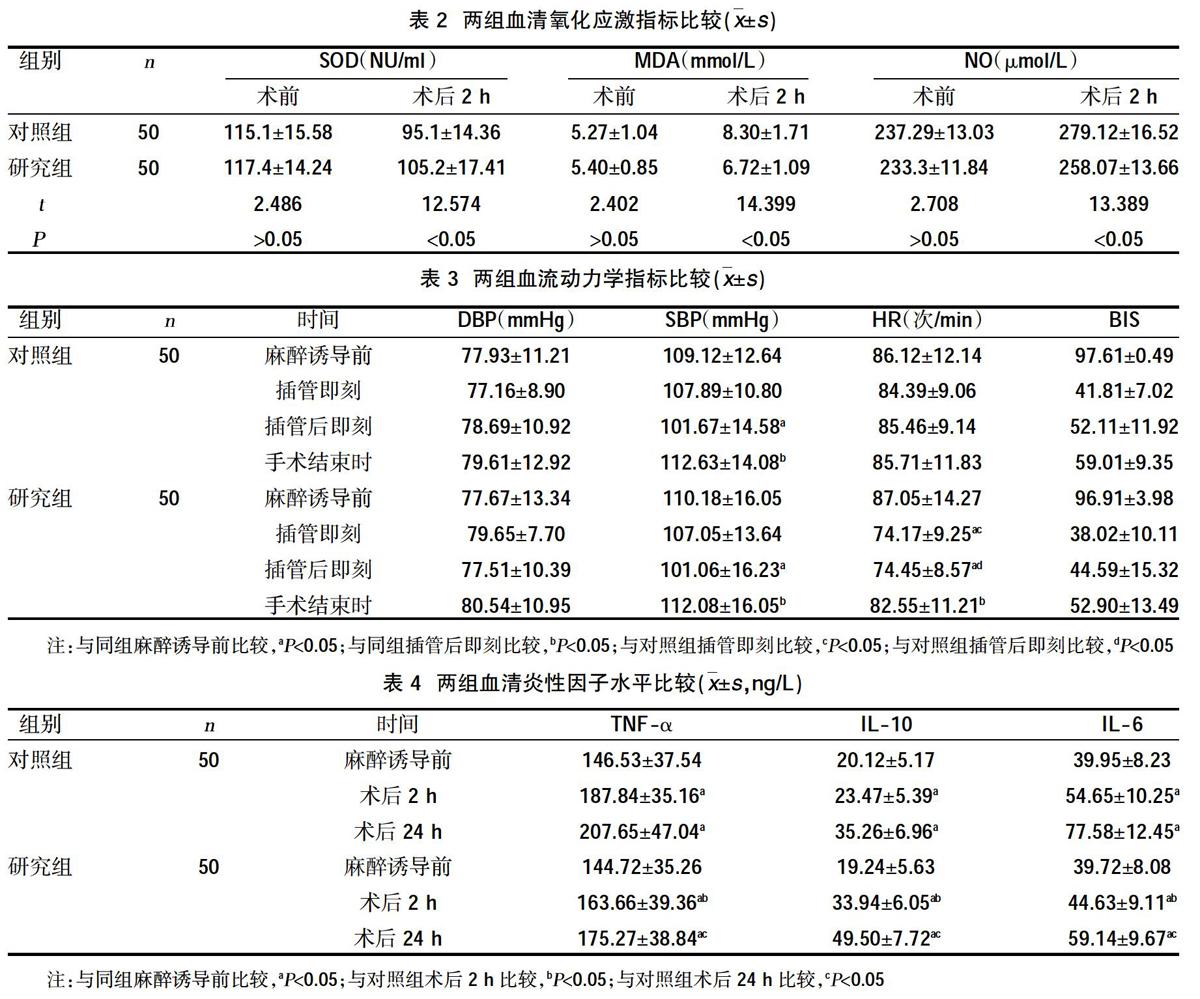

摘要:目的 ?探討鹽酸羥考酮注射液在甲狀腺手術患者全麻誘導中的效果及對患者血壓、心率及BIS的影響。方法 ?選取2018年1月~2020年6月我院住院治療的100例甲狀腺手術患者作為研究對象,按照隨機數字表法分為對照組和研究組,每組50例。對照組使用硫酸嗎啡+托烷司瓊混合生理鹽水麻醉,研究組使用鹽酸羥考酮注射液+托烷司瓊混合生理鹽水麻醉,比較兩組麻醉效果、血清氧化應激反應變化情況、血流動力學變化情況、血清炎性因子水平變化情況。結果 ?研究組拔管后鎮靜評分低于對照組[(3.02±0.50)分 vs(3.85±0.96)分],拔管時間、麻醉蘇醒時間短于對照組[(7.22±1.90)min vs(9.92±2.33)min]、[(5.20±1.09)min vs(6.93±1.73)min],差異有統計學意義(P<0.05);術后2 h,兩組SOD較術前下降,MDA、NO較術前上升,且研究組SOD高于對照組,MDA、NO低于對照組,差異有統計學意義(P<0.05);兩組間麻醉誘導前、插管即刻、插管后即刻、手術結束時DBP、SBP、BIS比較,差異無統計學意義(P>0.05);兩組麻醉誘導前、手術結束時HR比較,差異無統計學意義(P>0.05);研究組插管即刻、插管后即刻HR低于對照組,差異有統計學意義(P<0.05);術后2、24 h,兩組TNF-α、IL-10、IL-6水平均較麻醉誘導前上升,且研究組優于對照組,差異有統計學意義(P<0.05)。結論 ?甲狀腺手術患者全麻誘導中使用鹽酸羥考酮注射液,可縮短患者麻醉蘇醒時間,降低氧化應激反應,對血壓以及BIS的影響較小,可有效抑制術后炎癥的發生,麻醉效果較好。
關鍵詞:甲狀腺手術;全麻誘導;鹽酸羥考酮注射液
中圖分類號:R614.2 ? ? ? ? ? ? ? ? ? ? ? ? ? ? ? ? 文獻標識碼:A ? ? ? ? ? ? ? ? ? ? ? ? ? ? ? ? DOI:10.3969/j.issn.1006-1959.2020.18.022
文章編號:1006-1959(2020)18-0073-04
Effect of Oxycodone Hydrochloride Injection on Blood Pressure,Heart Rate and BIS
in Patients Undergoing Thyroid Surgery During General Anesthesia Induction
WANG Hui1,LIU Ai-fen2
(1.General Surgery,Tianjin Public Security Hospital,Tianjin 300042,China;
2.Department of Anesthesiology,the Second Hospital of Tianjin Medical University,Tianjin 300021,China)
Abstract:Objective ?To investigate the effect of oxycodone hydrochloride injection in the induction of general anesthesia in patients with thyroid surgery and its influence on blood pressure, heart rate and BIS.Methods ?A total of 100 thyroid surgery patients who were hospitalized in our hospital from January 2018 to June 2020 were selected as the research objects. According to the random number table, they were divided into a control group and a study group, with 50 cases in each group. The control group was anesthetized with morphine sulfate + tropisetron mixed saline, and the study group was anesthetized with oxycodone hydrochloride injection + tropisetron mixed saline. The anesthesia effect, changes in serum oxidative stress, and blood flow were compared between the two groups dynamic changes, changes in serum inflammatory factor levels.Results ?The sedation scores of the study group after extubation were lower than those of the control group [(3.02±0.50) points vs (3.85±0.96) points], and the extubation time and anesthesia recovery time were shorter than those of the control group [(7.22±1.90) min vs (9.92±2.33)min],[(5.20±1.09)min vs (6.93±1.73)min], the difference was statistically significant (P<0.05); 2 h after operation, SOD of the two groups decreased compared with preoperatively, and MDA and NO were lower than preoperative Increased, and SOD of the study group was higher than that of the control group, MDA and NO were lower than the control group, the difference was statistically significant (P<0.05); DBP between the two groups before induction of anesthesia, immediately after intubation, immediately after intubation, and at the end of the operation, SBP, BIS, the difference was not statistically significant (P>0.05); the comparison of HR before induction of anesthesia and at the end of the operation, the difference was not statistically significant (P>0.05); the study group was intubated immediately and immediately after intubation HR was lower than that of the control group,the difference was statistically significant (P<0.05); at 2 and 24 h after surgery, the levels of TNF-α, IL-10, and IL-6 in the two groups increased compared to before anesthesia induction, and the study group was higher the control group, the difference was statistically significant(P<0.05).Conclusion ?The use of oxycodone hydrochloride injection in the induction of general anesthesia in patients with thyroid surgery could shorten the patient's awakening time from anesthesia, reduce oxidative stress, and had little effect on blood pressure and BIS. It could effectively inhibit postoperative inflammation and had a better anesthetic effect it was good.
Key words:Thyroid surgery;General anesthesia induction;Oxycodone hydrochloride injection
甲狀腺手術前后的插管、拔管會對機體產生強烈刺激,術后疼痛明顯,手術創傷較大,易導致患者發生炎性反應、全身應激反應,出現術后并發癥,對患者的身心健康、生活質量產生嚴重影響[1]。此外,手術過程中,麻醉藥物的使用會使機體釋放多種活性物質,增強機體交感神經興奮性,引起血流動力學發生變化[2]。因此,為甲狀腺手術患者選擇更加穩定的麻醉方法,穩定患者血流動力學,降低患者全身應激反應具有重要意義[3]。隨著醫療技術的發展,麻醉誘導技術有很大進步,麻醉誘導期患者的心血管反應可以通過選擇合適的麻醉誘導藥物達到改善[4]。鹽酸……
登錄APP查看全文