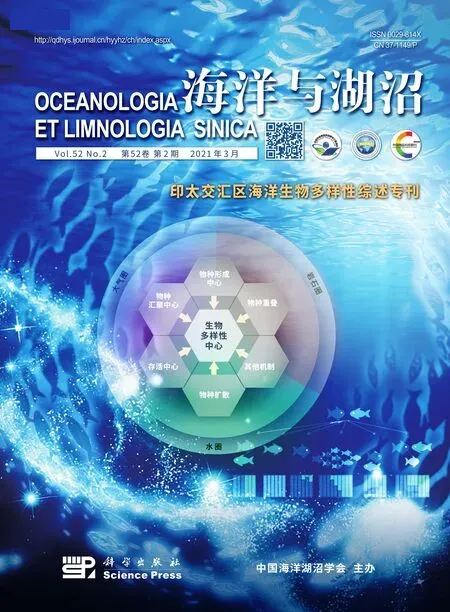
海洋生物多樣性中心形成與演變機制的比較基因組研究進展*
2021-03-30 02:38:20陳楠生
海洋與湖沼 2021年2期
陳楠生
海洋生物多樣性中心形成與演變機制的比較基因組研究進展*
陳楠生1, 2, 3
(1. 中國科學院海洋研究所 海洋生態(tài)與環(huán)境科學重點實驗室 青島 266071; 2. 青島海洋科學與技術試點國家實驗室 海洋生態(tài)與環(huán)境科學功能實驗室 青島 266237; 3. 中國科學院海洋大科學研究中心 青島 266071)
在大氣圈、水圈、巖石圈和生物圈等多圈層相互作用下, 全球范圍內(nèi)海洋生物多樣性中心的地理位置、物種組成結構和優(yōu)勢度都呈動態(tài)變化。迄今, 海洋生物多樣性中心的形成與演變機制在生態(tài)、遺傳和分子等層面正逐步得到解析。在生態(tài)層面, 學界涌現(xiàn)出了物種形成中心、物種匯聚中心、物種重疊中心和物種保存中心等重要科學假說, 解析了生物多樣性分布格局的重塑以及生物多樣性中心的形成機理; 其中, 地質(zhì)和洋流等是生物多樣性分布格局形成的重要制約因素, 從而形成了類似華萊士區(qū)這樣具有特殊生物多樣性的區(qū)域。在遺傳層面, 物種種內(nèi)或種間頻繁的基因交流和適應性輻射可以促進生物間不同基因型和表型的重新組合, 衍生出更高更復雜的生物多樣性水平, 進而加速了生物多樣性中心的形成。在分子層面, 染色體進化、基因組多倍化、超級基因形成、基因復制、基因滲入、水平基因轉(zhuǎn)移、遺傳通路的進化和調(diào)控元件的進化等分子調(diào)控與進化機制可以引發(fā)新性狀的形成和物種的多樣化, 從而推動生物多樣性中心的形成。本文重點介紹了比較基因組學方法在揭示海洋生物多樣性形成與演變的分子生物學機理方面的研究進展。對于海洋生物多樣性中心形成和演變機制的深入了解, 不僅可以提高我們對生物多樣性動態(tài)變化理論的認知, 亦可以促進海洋生物多樣性保護和資源利用手段的改進和提高。
印太交匯區(qū); 生物多樣性; 生態(tài); 比較基因組學; 基因組加倍; 超級基因; 基因家族; 基因滲入
創(chuàng)始于19世紀中葉的海洋系統(tǒng)地理學(phylogeography)和海洋生物地理學(biogeography)研究, 囊括了基于物種形態(tài)的物種分類、物種地理分布研究和物種遺傳關系的探索, 揭示了全球海域基于物種組成劃分的若干生物地理區(qū)(biogeographic provinces)(Bowen, 2016)。針對不同生物地理區(qū)域的代表性物種和物種優(yōu)勢度的比較與分析, 發(fā)現(xiàn)每一個生物地理區(qū)都可能是某些物種的起源中心(center of origin), 并且新物種傾向于往起源中心以外擴散, 而生物地理區(qū)只有跟蹤物種的起源中心才能夠得到清楚解釋 (Bowen, 2016)。20世紀70年代DNA測序技術取得突破性進展, 促使生物地理區(qū)研究實現(xiàn)了一個質(zhì)的飛躍, 從根本上改變了我們對生物多樣性中心的形成與演變規(guī)律的認知, 進一步加強了對生物地理學的認識 (Avise, 1987)。這個認識轉(zhuǎn)變的一個重要標志是人們對生物多樣性的認識從物種水平, 深入到了種下水平, 即遺傳多樣性(genetic diversity)(Bowen, 2016)。
研究表明, 在過去約50 Ma間, 海洋生物多樣性中心發(fā)生了三次重大遷移, 從始新世(Eocene)時期的西南歐洲、西北非洲、阿拉伯半島、巴基斯坦和西印度遷移到晚始新世(Late Eocene)時期的阿拉伯中東地區(qū); 隨著阿拉伯生物多樣性中心的消失, 新的生物多樣性中心于20 Ma前的早中新世(Early Miocene)再次遷移, 到達現(xiàn)在的印太交匯區(qū)(Indo-Pacific Convergence Region), 幾乎跨越了半個地球; 遷移的時間和地點與主要地球板塊事件高度吻合, 顯示地球板塊事件在生物多樣性中心遷移過程中的重要性 (Renema, 2008)。現(xiàn)在的海洋生物多樣性中心位于印太交匯區(qū), 包括位于菲律賓、印度尼西亞和新幾內(nèi)亞之間的珊瑚大三角(the Coral Triangle), 及其周圍的特有物種熱點海域(endemism hotspots)(Miller, 2018)。這些特有物種熱點海域包括位于印太交匯區(qū)邊緣的夏威夷和紅海。在過去約兩千萬年間, 珊瑚大三角一直具有穩(wěn)定的珊瑚礁, 而這些穩(wěn)定的珊瑚礁則是形成和傳播新物種的關鍵 (Pellissier, 2014)。
本文從生態(tài)、遺傳和分子三個層面綜述海洋生物多樣性中心形成與演變的機理, 重點介紹基于比較基因組分析方法研究生物多樣性中心形成與演變的研究進展, 并對存在的問題和研究方向進行展望。
1 印太交匯區(qū)及其生物多樣性概述
生物多樣性(biodiversity)既包括物種多樣性, 也包括物種內(nèi)的多樣性, 即遺傳多樣性。許多物種在同一地域群體(sympatric population)內(nèi)顯示出很高的遺傳多樣性。印太交匯生物多樣性中心最顯著的特征是其豐富的珊瑚(Bellwood, 2009; DeVantier, 2020)、島礁魚類(Cowman, 2017; Miller, 2018; Barth, 2019; Pinheiro, 2019; Limmon, 2020)和貝類。除此之外, 印太交匯區(qū)的藻類(Jorde, 2018)和海膽也顯示出很高的生物多樣性(Moore, 2019)。有關生物多樣性的研究進展和研究成果受研究方法的影響很大, 基于形態(tài)的物種分類雖然揭示了印太交匯區(qū)顯著的生物多樣性, 但是同時可能也嚴重低估了生物多樣性。分子研究手段的引入不僅揭示了更高的生物多樣性, 而且揭示了更加復雜的動態(tài)分布, 以及不同生境之間的連通性(Torres, 2018)。分子研究方法的廣泛使用揭示了不同海域珊瑚的生物多樣性, 包括我國南海深海珊瑚()(Liu, 2020b)、我國臺灣屬珊瑚(Palmas, 2018)、我國南海和新加坡海域珊瑚(Ng, 2019)、日本海域珊瑚(Liu, 2020a)、印度尼西亞珊瑚(Wijayanti, 2018)和澳大利亞珊瑚(Underwood,2018)。
生物多樣性分子分析的一個突破性進展是隱種(cryptic species)的發(fā)現(xiàn)(Pfenninger, 2007)。幾乎所有珊瑚物種都存在隱種(Warner, 2015; Rosser, 2017; Kang, 2020; Wepfer, 2020)。對珊瑚隱種的準確分析和判斷深化了遺傳多樣性研究(Sheets, 2018)。分子分析方法的引入也提高了大家對物種的分類水平和對物種邊界的認識, 推動了初級物種假說(Primary Species Hypothesis, PSH)和次級物種假說(Secondary Species Hypothesis, SSH)的提出(Pante, 2015)(圖1)。印太交匯區(qū)a屬具有很高的生物多樣性和大量隱種, 不僅體現(xiàn)了初級物種假說和次級物種假說的思想, 也反映了相應研究思路的重要性(Gélin, 2017)。

圖1 整合分類環(huán): 物種假設包括初級物種假設和次級物種假設(改自Pante et al, 2015)
注: ①群體采樣; ②采集到的樣本可能具有較大的分化; ③基于形態(tài)和分子依據(jù)的初級物種假設; ④對初級物種假設進行評估; ⑤由初級物種假設到次級物種假設
研究表明, 不僅珊瑚本身具有很高的生物多樣性, 珊瑚的共生微生物也具有很高的生物多樣性(Glasl, 2020)。比如印太交匯區(qū)蟲黃藻具有很高的遺傳多樣性(Wham, 2016), 大堡礁珊瑚的共生微生物也具有顯著的多樣性和適應性(van Oppen, 2018)。
印太交匯區(qū)魚類生物多樣性尤其高(Cowman, 2017; Miller, 2018), 其中珊瑚大三角海域迄今得到描述的海洋魚類物種就有4350種(Limmon, 2020), 以大型島礁魚類為主, 有相當大一部分的小型島礁魚類(cryptobenthic reef fishes)尺寸小于50 mm(Brandl, 2018)。分子標記分析表明, 還有更多的魚類物種有待進一步鑒定和發(fā)現(xiàn)(Cowman, 2014), 因此魚類多樣性可能是被嚴重低估的。的確, 自2010年起印太交匯區(qū)島礁魚類平均每年都有51.3個新種的報導(Allen, 2015)。珊瑚島礁魚類與珊瑚的進化具有一定的相互依賴性和相似性(Bellwood, 2017)。在古新世(Paleocene)和始新世(Eocene), 即66—34 Ma, 絕大多數(shù)的現(xiàn)代魚類和珊瑚類物種已經(jīng)形成, 功能形態(tài)性狀也已經(jīng)相當豐富。與此相比, 在漸新世(Oligocene)和第三紀中新世(Miocene), 即34—5.3 Ma,魚類和珊瑚類物種顯示出快速分化。在此期間, 島礁面積增加, 生境擴張, 魚類豐度也有增加, 現(xiàn)代珊瑚島礁獲得了很多功能性性狀。很多物種形成于最近的5.3 Ma, 即上新世-更新世(Plio-Pleistocene), 其中魚類物種的形成時間為5.3 Ma, 珊瑚為1.9 Ma (Bellwood, 2017)。值得一提的是, 這些不同時期的魚類和珊瑚性狀的區(qū)別僅僅局限于顏色或微小形態(tài)方面, 物種之間的差異不顯著。
印太交匯區(qū)腹足類具有很高的生物多樣性, 主要驅(qū)動因素是較高的新物種形成速度(Frey, 2008)。腹足類新物種形成機制也逐步得到揭示。比如最近研究表明, 適應性輻射促進了腹足類生物多樣性的提升(Layton, 2018)。近年來, 多個海域報道了海蛞蝓的生物多樣性, 包括新加坡海域(Chan, 2019)、澳大利亞和塔斯曼海海域(Nimbs, 2018), 以及印度尼西亞海域海(Eisenbarth, 2018; Undap, 2019; Papu, 2020)。另外, 我國海南島硨磲也具有較高的多樣性, 包括很多隱種(Liu, 2020a)。
2 海洋生物多樣性中心形成與演變的生態(tài)機理
生態(tài)學的一個核心目標是揭示地球上特異性分布格局(Mora, 2003)。進化論先驅(qū)者達爾文(Charles Darwin)和華萊士(Alfred Russel Wallace)的工作為生物多樣性中心形成與演變奠定了基本框架。在過去70年間, 盡管針對物種形成的地理位置和驅(qū)動生物多樣性中心形成的過程尚未達成共識(Cowman, 2014), 大量基于形態(tài)學特征的分類研究仍產(chǎn)生了多個有關印太交匯區(qū)生物多樣性中心的形成和演變機理的假說。從生態(tài)層面分析, 印太交匯區(qū)生物多樣性中心的形成是物種類型、生態(tài)、環(huán)境、地質(zhì)與水動力等多因素、綜合驅(qū)動下的結果, 可能受到了多個相互獨立的機理驅(qū)動(Bellwood, 2009)。因此, 生物多樣性中心(center of biological diversity)并不等同于新物種形成中心(center of origin)。海水魚類的多樣性在赤道附近高于兩極, 以印太交匯區(qū)珊瑚大三角的多樣性水平最高; 而海水魚類新物種形成的速度在兩極卻高于赤道附近海域(圖2), 其與海水魚類物種的多樣性以及海水溫度成反比(Rabosky, 2018)。

圖2 海水魚的生物多樣性與物種形成速度的維度梯度(改自Rabosky et al, 2018)
注: a. 海水魚的多樣性分布格局; b. 海水魚新物種形成速度
新物種形成中心只是生物多樣性中心形成的機制之一, 而印太交匯區(qū)被認為是多種不同機制共同作用的結果, 顯示了多個機制的疊加效應。比如, 菲律賓近岸海域魚類被認為是魚類生物多樣性中心的中心(center of the center), 而所有這些假說的共同作用可能驅(qū)動了這個中心的形成(Carpenter, 2005)。目前, 不同生態(tài)機理對印太交匯區(qū)生物多樣性中心形成的相對貢獻并不清楚, 而比較基因組學分析可以追溯不同機理的相對貢獻。比如, 通過分子標記序列分析印太交匯區(qū)軟粒藻屬()紅藻物種多樣性的驅(qū)動力和生物地理學過程中發(fā)現(xiàn), 物種形成中心假說(center of origin hypothesis)和物種匯聚假說(center of accumulation hypothesis)兩種機制的共同作用, 而非單個機制的獨立作用, 解釋了軟粒藻屬物種的生物多樣性分布格局 (Leliaert, 2018)。通過比較分析、16S rDNA和28S rDNA等通用分子標記基因的多樣性, Eilertsen等(2015)揭示了深海水手螺(Scaphander)的物種分化和新物種起源機理。通過比較分析通用分子標記、組蛋白基因H3、線粒體基因16S rDNA、核糖體基因18S rDNA和28S rDNA基因, Rodriguez-Flores等(2020)揭示了深海鎧甲蟹(squat lobster)的生殖隔離以及與淺海鎧甲蟹之間的連通性。
針對全球海洋生物多樣性中心形成的理論探究, 在生態(tài)層面的主要假說主要包括物種形成中心假說、物種匯聚中心假說、物種重疊中心假說(center of overlap hypothesis)、物種保存中心假說(center of survival hypothesis), 以及物種擴散中心(center of expansion hypothesis)假說(圖3)。

圖3 生物多樣性中心形成與演變的生態(tài)、遺傳和分子機制(改自Runemark et al, 2019)
新物種形成中心假說的核心思想是新物種在新物種形成中心不斷形成并逐步擴散到周邊的其他海域(Briggs, 2003)。根據(jù)這個模型, 高特異性生境中的強烈競爭導致具有更高適應性的新物種的形成(Bowen, 2013)。印太交匯區(qū)新物種形成中心形成的島礁魚類物種逐步出現(xiàn)在周邊的群島(Mora, 2003)。印太交匯區(qū)新物種形成始于20—12 Ma以前的中新世, 生物多樣性輸出始于7 Ma前, 一直持續(xù)到現(xiàn)在, 覆蓋了上新世(Pliocene)、更新世(Pleistocene)和全新世(Holocene)(Bowen, 2013)。新物種形成中心假說的直接推論是位于新物種形成中心的物種比較年輕, 而位于新物種形成中心周邊的物種比較古老(Bowen, 2013; Huang, 2018)。物種形成中心通常也是物種擴散中心, 從生物多樣性中心擴散出去的物種, 可能在獲得新的變異以后返回到生物多樣性中心, 進一步豐富了生物多樣性中心。
物種匯聚中心假說認為新物種在生物多樣性中心的周邊群島等海域形成, 逐步隨著海流匯聚到生物多樣性中心(Budd, 2010)。研究表明珊瑚大三角中的造礁珊瑚生物絕大多數(shù)來源于其他海域, 通過物種擴張到達珊瑚大三角進行累積, 表明地理范圍移動(geographic range shifts)是珊瑚大三角造礁珊瑚生物多樣性中心形成的主要原因(Huang, 2018)。
物種重疊中心假說首先由美國科學家Woodland (1983)于1983年提出。比如, 藍子魚科(Siganidae)魚類有印度洋和西太平洋兩個特有物種分布熱點(areas of endemism)。Woodland認為籃子魚科在東印度群島(East Indies)海域的高物種多樣性緣于印度洋和西太平洋這兩個特有物種分布熱點的重疊。
物種保存中心假設, 認為印太交匯區(qū)的物種滅亡速度低于周圍海域(Barber, 2005)。比如, 珊瑚礁海豬魚(Halichoeres)在印太交匯區(qū)的生物多樣性很高。通過對、16S rDNA和12S rDNA三個分子標記線粒體基因分析表明, 印太交匯區(qū)與新世界(New World)的海豬魚顯示出很大的特異性。兩個不同海域的海豬魚相距21.2—18.1 Ma年, 表明二者都是特提斯海(Tethys)的后代。這個分析表明印太交匯區(qū)魚類的生物多樣性可能以物種保存中心機制為主, 但是也不能排除具有多機制起源。
隨著基于分子標記和基因組信息的生物多樣性研究的深入, 有關生物多樣性中心形成與演變的認識也將逐步深入。最近, Hu等(2021)利用三個分子標記對我國陸地野生生物的比較研究揭示了它們的地理分布格局, 發(fā)現(xiàn)它們在我國南部和西南部具有更高的多樣性, 并探討了驅(qū)動分布格局的生態(tài)因子, 發(fā)現(xiàn)包括降雨和氣溫在內(nèi)的氣候因子起重要作用。類似規(guī)模的針對印太交匯區(qū)海域生物多樣性的研究將揭示高分辨率的生物多樣性格局及其動態(tài)變化過程。
3 生物多樣性起源與演變的遺傳機理研究
整體來講, 生態(tài)機制為生物多樣性中心的形成與演變機制提供了一個平臺。生態(tài)機制可以說是生物多樣性中心形成的第一驅(qū)動力。生物多樣性中心初步形成以后, 物種間或物種內(nèi)雜交(hybridization)驅(qū)使生物多樣性發(fā)生下一個層次的變化。雜交在物種演化和多樣性形成過程中起關鍵作用(Marques, 2019)。新物種起源就是雜交可育自然種群與其他類似種群產(chǎn)生生殖隔離的過程(Marques, 2019)。雜交可以把種群中已經(jīng)存在很長時間的古老的突變組合起來形成新物種, 并適應新的環(huán)境, 這些驅(qū)動新物種形成突變的過程經(jīng)常比物種分離時間更加古老, 而這些古老突變的組合可以驅(qū)動新物種的快速形成(Marques, 2019)。由雜交形成新物種的機制也被稱為雜交起源機制(hybrid speciation)(Mallet, 2007)。根據(jù)邁爾(Ernst Mayr)和杜布贊斯基(Theodosius Dobzhansky)的觀點, 生殖隔離(reproductive barrier)是逐步形成的, 起因是在位于不同地理位置的種群的互作基因中累積了突變, 即貝特森–杜步贊斯基–穆勒不相容 (BDMIs)。因此, 物種起源是在種群生殖隔離條件下產(chǎn)生的(Kulmuni, 2020), 生殖隔離使不同種群在鄰近地理區(qū)域中維持其基因型和表型的特異性(Seehausen, 2014)。
適應性輻射(adaptive radiation)是生態(tài)和進化共同作用的結果(Gillespie, 2020)。適應性輻射的基礎是突變, 但是由于突變過程比較慢, 因此通過適應性輻射形成新物種的速度也比較慢(Wagner, 2012; Stroud, 2016)。適應性輻射包括三個必需要素(Gillespie, 2020): 第一個必需要素是生態(tài)機會(ecological opportunity), 生態(tài)機會可能以多種形式出現(xiàn), 比如一個物種密度低或者沒有被充分利用的生態(tài)環(huán)境, 某種新穎性狀使得物種可以獲得一個獨特的與環(huán)境互作的能力, 或者導致該優(yōu)勢物種的滅亡; 第二個必需要素是時間, 適應性輻射在物種獲得生態(tài)機會的初期往往比較快, 隨著生境的逐步飽和, 適應性輻射的速度會逐步慢下來; 適應性輻射的第三個必需要素是適應性響應(adaptive response), 在進化過程中, 輻射可以是適應性的, 也可以是非適應性(nonadaptive)的, 即表現(xiàn)出很弱或者沒有對生態(tài)位的適應性。
通過基因滲入(introgression)形成新物種的時間往往比較漫長(Hedrick, 2013; Poelstra, 2018)。基因滲入促進同域性物種形成(sympatric speciation) (Bolnick, 2007)。根據(jù)物種組成, 印太交匯區(qū)可以劃分為至少6個生物地理區(qū)(biogeographic provinces)(He, 2019)。生物地理區(qū)的縫合區(qū)(suture zones)形成雜交帶(hybrid zone), 進化關系較近, 還沒有形成完全生殖隔離的物種可能發(fā)生“第二次接觸”(secondary contact), 導致物種間雜交(Mallet, 2007)。物種間雜交可能導致多種不同結果, 包括: (1) 雜交后代可能具有生殖隔離; (2) 可能導致基因滲入, 并逆轉(zhuǎn)物種分化; (3) 產(chǎn)生新物種和輻射事件(He, 2019)。印太交匯區(qū)存在兩個公認的縫合區(qū), 位于東印度洋的圣誕和科科斯/基林島(Christmas and Cocos/Keeling Islands), 以及位于西印度洋的索科特拉群島(Socotra Archipelago)。這些縫合區(qū)是印度洋、太平洋以及紅海的交匯區(qū), 是研究雜交和基因滲入如何引起新物種形成的一個理想海域(He, 2019)。
在島礁生態(tài)系統(tǒng)中, 鹿角珊瑚屬內(nèi)的不同物種之間存在廣泛雜交(即網(wǎng)狀進化, reticulate evolution), 并導致基因滲入和多倍體的產(chǎn)生, 形成大量的共配群(syngameon)(Mao, 2020)(圖4)。鹿角珊瑚是珊瑚中分布最為廣泛的一個屬, 且具有很多物種, 廣泛分布在印太交匯區(qū)和加勒比海, 是研究物種起源與演化的理想研究對象(van Oppen, 2001)。其中有些物種分布范圍比較廣, 另外一些物種分布范圍則比較窄, 有70余物種的分布區(qū)域重疊。通過對5個鹿角珊瑚物種的全基因組比較, 發(fā)現(xiàn)了一個基因滲入事件, 以及多個獨立的基因流事件(Mao, 2018)。除珊瑚外, 在魚類(Harrison, 2017; He, 2019)和硅藻(De Decker, 2018)中也發(fā)現(xiàn)了雜交和基因滲入現(xiàn)象。

圖4 雜交、基因滲入以及多倍體形成(改自Mao, 2020)
4 物種起源與演變分子機理的比較基因組研究
如果說生態(tài)機制作為生物多樣性中心形成的第一驅(qū)動力, 為生物多樣性的形成與演變提供了平臺, 遺傳機制則可以被認為是生物多樣性中心的形成與演變的第二驅(qū)動力, 為遺傳多樣性的形成與演變提供了可能性。在此基礎上, 分子機制可以被認為是生物多樣性中心形成與演變的最關鍵的一步。在比較基因組技術被用于研究物種形成和演化的過程中, 逐步形成了一門新興學科——物種起源基因組學(speciation genomics)(Marques, 2019)。理解物種起源的關鍵是尋找觸發(fā)物種形成的突變和基因, 即物種起源基因(speciation gene), 并跟蹤這些基因的形成時間, 由此推測物種起源時間(Ravinet, 2017)。1953年沃森(James Watson)和克里克(Francis Crick)提出的DNA雙螺旋模型(DNA double helix model)奠定了分子生物學的基礎, 近20年來, 隨著DNA測序通量技術的迅速提升, 成本急劇下降, 測序質(zhì)量和長度逐步提升, 比較基因組技術得以被廣泛應用于解析物種起源的分子機制。因此, 研究生物多樣性中心形成與演變已經(jīng)逐步成為一個活躍的研究領域。
4.1 新基因、新變異、新剪切、新調(diào)控
基因的變化, 包括新基因的形成、基因變異、基因的剪切變化和轉(zhuǎn)錄調(diào)控變異都可以驅(qū)動物種演化。比如, 達爾文雀(Darwin’s finches)物種之間的一個顯著差異是它們的喙形態(tài)。通過比較分析具有不同喙形態(tài)的物種發(fā)現(xiàn)基因變異控制喙形態(tài)(Lamichhaney, 2015)。這個基因編碼一個包括同源異型域(homeodomain)的蛋白質(zhì), 在面顱間質(zhì)(craniofacial mesenchyme)、第一鰓弧(first branchial arch)和肢芽(limb bud)發(fā)育過程中起關鍵作用(Uz, 2010); 另一個則包括與環(huán)境相互作用的基因如免疫相關基因在進化過程中起關鍵作用。
非洲慈鯛的演化受感覺驅(qū)動力(sensory drive)的影響, 即感覺驅(qū)動力可以導致顏色多樣性, 并且導致新物種形成(Seehausen, 2008)。在非洲慈鯛物種中總共發(fā)現(xiàn)了8個視覺色素基因, 但是在每一個個體中僅有4個視覺色素基因。這些基因具有很高的變異, 特別是長波長敏感性視蛋白基因。非洲維多利亞湖雌性慈鯛對雄性顏色具有很強的選擇, 這種選擇導致了新物種的形成(Seehausen, 2008), 而這類新物種形成不依賴地理隔離。比如, 維多利亞湖的兩種慈鯛魚和的地理分布完全相同, 但它們的顏色表型完全不同,的雄性具有藍灰色體色, 而的雄性則是腹部為深紅色, 身體其他部位為黃色。最終, 雄性的不同體色促成了生殖隔離。基因的變異位點影響了雄性體色, 并且突變方式與個體在水體中的分布密切相關。
三刺魚(threespine stickleback,)是一種著名的用于研究進化的模式動物(Nelson, 2018)。典型的三刺魚生活在海洋環(huán)境, 具有用于自衛(wèi)的長刺。而生活在淡水中的三刺魚由海水物種進化而來, 他們的刺卻比較短, 這些性狀的變化可能通過基因的突變實現(xiàn)。其中, 有一些是通過基因轉(zhuǎn)錄調(diào)控元件的變化實現(xiàn), 比如轉(zhuǎn)錄因子基因的順式調(diào)控元件突變導致了腹刺消失(Shapiro, 2004)。另外一些則是通過基因的剪切變異實現(xiàn), 比如轉(zhuǎn)錄因子基因的一個剪切變異導致了背刺縮短(Howes, 2017)。
4.2 染色體反轉(zhuǎn)事件(chromosomal inversion)和超級基因(supergene)
染色體反轉(zhuǎn)事件可以降低染色體重組(Kirkpatrick, 2010), 從而阻止等位基因的互換, 增加物種的適應性, 促進生物多樣性增加(Mérot, 2020)。具體機理包括如下幾個方面(Faria, 2019): 首先, 染色體反轉(zhuǎn)可以促進累積更多突變, 從而加大生殖隔離位點(barrier locus)的范圍; 其次, 阻止物種之間的二次接觸, 促進累積更多的突變, 形成更強的生殖隔離; 最后, 保護局部適應性基因結構, 即保護有利于生殖隔離的等位基因組合。
比較基因組分析發(fā)現(xiàn)染色體反轉(zhuǎn)廣泛存在。比如三刺魚基因組中存在大量的染色體反轉(zhuǎn)事件(Jones, 2012)。單核苷酸多樣性(SNP)分析發(fā)現(xiàn)潮間帶巖石玉黍螺()不同株系的基因組中存在多個反轉(zhuǎn)(Westram, 2018; Faria, 2019; Kess, 2019)。最近, 通過群體遺傳學分析發(fā)現(xiàn)了刀鱭()對環(huán)境的適應機制, 染色體倒位是刀鱭適應與分化的關鍵分子機制(Zong, 2020)。
通過構建全基因組, 可以系統(tǒng)挖掘染色體反轉(zhuǎn)事件。不過早期的基因組組裝的contig偏短, 往往只能夠鑒定出小尺度反轉(zhuǎn)事件, 而不能夠用于確定大尺度染色體反轉(zhuǎn)事件。大西洋鯡魚()是全球最豐富的脊椎動物, 也是一個用于研究物種適應的模式動物(Pettersson, 2019)。利用最新的PacBio三代測序技術和Hi-C分析技術, 結合遺傳圖譜構建了大西洋鯡魚高質(zhì)量參考基因組, 發(fā)現(xiàn)共有16條染色體, 全長726 Mb。針對1170個大西洋鯡魚個體的45000個SNP的連鎖不平衡(LD)分析發(fā)現(xiàn), 其第12號染色體上有一個7.8 Mb長的反轉(zhuǎn), 這個反轉(zhuǎn)對大西洋鯡魚的生態(tài)適應性起關鍵作用, 也是區(qū)分不同種群的重要遺傳標記(Pettersson, 2019)。適應性研究表明, 這個7.8 Mb的反轉(zhuǎn)是一個超級基因(Kirkpatrick, 2010; Pettersson, 2019)。超級基因是染色體上兩個或多個基因形成的基因簇, 也被稱為“共適應基因復合體(co-adapted gene complexes)”(Schwander, 2014)。大西洋鯡魚的這個超級基因包括225個蛋白編碼基因(Pettersson, 2019)。除此之外, 位于反轉(zhuǎn)序列附近但是位于反轉(zhuǎn)以外的10個基因可能也起到了關鍵作用(Pettersson, 2019)。
染色體反轉(zhuǎn)可能對性染色體起源至關重要(Kirkpatrick, 2010)(圖5)。性別對抗性選擇(sex-antagonistic selection)指不同的等位基因具有性別特異性, 并且這個選擇傾向于降低性別決定基因的重組。在進化過程中, 包括性別決定基因的染色體反轉(zhuǎn)會逐步擴張。

圖5 雜合染色體反轉(zhuǎn)抑制重組(改自Kirkpatrick, 2010)
除了染色體反轉(zhuǎn), 其他類型的基因組結構變異也可以在物種起源過程中起重要作用。隨著基因組技術的普遍應用, 更多的基因組結構變異在物種起源過程中的作用將會得到解釋(Mérot, 2020)。
4.3 染色體核型變異
染色體數(shù)目的變異強烈影響生殖隔離, 導致染色體數(shù)目變化的機制很多, 包括染色體融合(fusion)和染色體分裂(fission)(de Vos, 2020)。研究表明染色體融合或分裂導致的染色體核型變異雖然并不常見, 但是存在(Salzburger, 2018)。比如非洲鯽魚的染色體數(shù)目絕大多數(shù)是22 (2= 44), 美洲鯽魚的染色體數(shù)目絕大多數(shù)是24 (2= 48), 但是, 在新物種形成過程中, 染色體數(shù)目發(fā)生了變化, 染色體數(shù)目從16 (2= 32)到30 (2= 60)均有出現(xiàn)(Poletto, 2010)。
4.4 多倍體
在進化和物種形成過程中, 基因組復制是一個很普遍的現(xiàn)象, 包括同源多倍體(autopolyploid)或異源多倍體(allopolyploid)(Van de Peer, 2017)。比較基因組分析發(fā)現(xiàn)了大量以前忽視的多倍體現(xiàn)象, 說明基因組復制在物種形成過程中的重要性遠超預期(Schumer, 2018)。鹿角珊瑚屬包括150個物種, 是當今世界上物種最為豐富的一個造礁珊瑚屬, 分布范圍在31°N和31°S之間的印太交匯區(qū), 其多樣性在印太交匯區(qū)中部達到最高(Wallace, 2006)。盡管諸多證據(jù)表明鹿角珊瑚生物多樣性緣于基因組多倍化(polyploidization)(Renema, 2016), 但比較基因組分析首次證明了基因組加倍驅(qū)動了鹿角珊瑚(staghorn coral)的生物多樣性形成和分化(Mao, 2019; Mao, 2020)。通過對6個鹿角珊瑚物種的比較分析發(fā)現(xiàn), 這些物種的共同祖先在31 Ma前有一個基因組復制(whole genome duplication, WGD)事件, 并且這個復制時間幾乎與世界范圍內(nèi)珊瑚物種的大滅亡同時發(fā)生(Mao, 2019)。基因組復制形成的基因中, 參與基因調(diào)節(jié)(比如脅迫反應)的基因顯著富集。
異源多倍體現(xiàn)象在高等植物中比較常見, 而在動物中少見。鯉魚()是一個異源四倍體(allotetraploid), 比較基因組分析發(fā)現(xiàn)它的二倍體祖先物種的分化大約于23 Ma年前完成, 而異源四倍體新物種的形成大約于12.4 Ma前完成(Xu, 2014, 2019)。鯉魚基因組分成兩個亞基因組(subgenome), 各有25條染色體, 具有很好的共線性關系。與異源多倍體植物基因組相比, 鯉魚的亞基因組之間的相似性很高, 沒有出現(xiàn)亞基因組優(yōu)勢化(subgenome dominance)現(xiàn)象。金魚(sp.)也是一個異源四倍體, 與鯉魚具有相同的祖先, 于大約14 Ma前形成(Chen, 2019)。金魚基因組中的兩條亞基因組也具有很高的相似性, 與鯉魚的亞基因組具有很高的共線性(Chen, 2019)。
藻類的異源多倍體現(xiàn)象比較少見。比較基因組分析發(fā)現(xiàn), 產(chǎn)油硅藻是一個異源多倍體, 并且具有很高的雜合度, 表明它是由兩個物種雜交而形成的新物種(Tanaka, 2015)。由于相關硅藻的基因組信息缺乏, 目前尚沒有它的祖先信息。利用基因組技術開展更多的藻類基因組研究將有助于解析藻類生物多樣性形成與演變的規(guī)律與機制(Caron, 2019)。
4.5 其他分子機制
除了上述機制, 還有很多分子機制可以驅(qū)動新物種的形成。這些分子機制包括基因家族的擴張與收縮, 基因復制與新功能基因(neo-functionization)的形成, 水平基因轉(zhuǎn)移(horizontal gene transfer)與基因島的形成(Ravinet, 2017; Wolf, 2017), 基因的轉(zhuǎn)錄調(diào)控機制的改變, microRNA的形成與分化等。在非洲鯽魚新物種的共同祖先中, 基因復制速率比其他物種高4—5倍, 表明基因復制速率與物種多樣性形成具有正相關關系(Salzburger, 2018)。
5 結論與展望
地球上的生物多樣性處于永恒的動態(tài)變化過程中, 新生物不斷涌現(xiàn), 現(xiàn)生生物也不斷滅亡。海洋生物的分布格局受海洋環(huán)流的影響, 而海洋環(huán)流又同步受地球構造板塊的影響, 從而形成特定的海洋生物多樣性中心。在過去50 Ma期間, 全球范圍內(nèi)海洋生物多樣性中心經(jīng)歷了三次重大遷移, 印太交匯區(qū)是一個最為突出的生物多樣性中心, 近10 Ma暖池的形成推動了該海域生物多樣性中心的形成。通過對印太交匯區(qū)生物多樣性中心形成與演變的研究, 不僅可以幫助我們理解生物多樣性形成與演變的機制, 也可以使我們更加有效地保護生物多樣性, 科學地利用生物資源。
海洋生物多樣性研究可以歸納為三個層次或三個相互交叉的階段。第一層次的研究以物種分類和系統(tǒng)學分析為主, 統(tǒng)計不同海域的代表性物種的物種數(shù), 這個階段的研究以形態(tài)學分析為主, 積累了大量樣本和數(shù)據(jù), 獲得了生物多樣性生態(tài)學方面的認知, 提出了多個有關生物多樣性形成的假設, 包括物種形成中心假設、物種匯聚假設、物種重疊假設以及物種保存中心假設。第二個層次的研究是遺傳層次的研究, 解析了物種形成的遺傳機理, 包括種間和種內(nèi)雜交以及適應性輻射。由于DNA測序技術的進步, 生物多樣性研究進入第三個層次, 即分子層次。比較基因組分析方法是分析生物多樣性形成和演變的有效方法, 解釋了新物種形成的重要分子機制, 包括新基因的形成、染色體的變化、基因組復制以及超級基因的形成等。隨著DNA和基因組測序技術的日趨成熟, 分析成本逐步降低, 生物信息學分析技術不斷提升, 生物多樣性中心的形成與演變研究正在進入黃金時代, 而重要物種的生物多樣性中心的起源和演化機制也必將得以逐步解析。同時, 這些進步也會促進對印太交匯區(qū)生物資源的認識、保護和合理開發(fā)。
Allen G R, 2015. Review of Indo-Pacific coral reef fish systematics: 1980 to 2014. Ichthyological Research, 62(1): 2—8
Avise J C, Arnold J, Ball R M, 1987. Intraspecific phylogeography: the mitochondrial DNA bridge between population genetics and systematics. Annual Review of Ecology and Systematics, 18: 489—522
Barber P H, Bellwood D R, 2005. Biodiversity hotspots: evolutionary origins of biodiversity in wrasses (: Labridae) in the Indo-Pacific and new world tropics. Molecular Phylogenetics and Evolution, 35(1): 235—253
Barth J M I, Villegas-Ri?os D, Freitas C, 2019. Disentangling structural genomic and behavioural barriers in a sea of connectivity. Molecular Ecology, 28(6): 1394—1411
Bellwood D R, Goatley C H R, Bellwood O, 2017. The evolution of fishes and corals on reefs: form, function and interdependence. Biological Reviews, 92(2): 878—901
Bellwood D R, Meyer C P, 2009. Searching for heat in a marine biodiversity hotspot. Journal of Biogeography, 36(4): 569—576
Bolnick D I, Fitzpatrick B M, 2007. Sympatric speciation: models and empirical evidence. Annual Review of Ecology, Evolution, and Systematics, 38: 459—487
Bowen B W, Gaither M R, DiBattista J D, 2016. Comparative phylogeography of the ocean planet. Proceedings of the National Academy of Sciences of the United States of America, 113(29): 7962—7969
Bowen B W, Rocha L A, Toonen R J, 2013. The origins of tropical marine biodiversity. Trends in Ecology & Evolution, 28(6): 359—366
Brandl S J, Goatley C H R, Bellwood D R, 2018. The hidden half: ecology and evolution of cryptobenthic fishes on coral reefs. Biological Reviews, 93(4): 1846—1873
Briggs J C, 2003. Marine centres of origin as evolutionary engines. Journal of Biogeography, 30(1): 1—18
Budd A F, Pandolfi J M, 2010. Evolutionary novelty is concentrated at the edge of coral species distributions. Science, 328(5985): 1558—1561
Caron D A, Hu S K, 2019. Are we overestimating protistan diversity in nature? Trends in Microbiology, 27(3): 197—205
Carpenter K E, Springer V G, 2005. The center of the center of marine shore fish biodiversity: the Philippine Islands. Environmental Biology of Fishes, 72(4): 467—480
Chan I Z W, Chang J J M, Huang D W, 2019. Colour pattern measurements successfully differentiate two cryptic Onchidiidae Rafinesque, 1815 species. Marine Biodiversity, 49(4): 1743—1750
Chen Z L, Omori Y, Koren S, 2019. De novo assembly of the goldfish () genome and the evolution of genes after whole-genome duplication. Science Advances, 5(6): eaav0547
Cowman P F, 2014. Historical factors that have shaped the evolution of tropical reef fishes: a review of phylogenies, biogeography, and remaining questions. Frontiers in Genetics, 5: 394
Cowman P F, Parravicini V, Kulbicki M, 2017. The biogeography of tropical reef fishes: endemism and provinciality through time. Biological Reviews, 92(4): 2112—2130
De Decker S, Vanormelingen P, Pinseel E, 2018. Incomplete reproductive isolation between genetically distinct sympatric clades of the pennate model diatom. Protist, 169(4): 569—583
De Palmas S, Soto D, Denis V, 2018. Molecular assessment of(Scleractinia; Pocilloporidae) distribution along a depth gradient in Ludao, Taiwan. PeerJ, 6: e5797
De Vos J M, Augustijnen H, B?tscher L, 2020. Speciation through chromosomal fusion and fission in Lepidoptera. Philosophical Transactions of the Royal Society B: Biological Sciences, 375(1806): 20190539
DeVantier L, Turak E, Szava-Kovats R, 2020. Species richness and abundance of reef-building corals in the Indo-West Pacific: the local—regional relation revisited. Frontiers in Marine Science, 7: 487
Eilertsen M H, Malaquias M A E, 2015. Speciation in the dark: diversification and biogeography of the deep-sea gastropod genusin the Atlantic Ocean. Journal of Biogeography, 42(5): 843—855
Eisenbarth J H, Undap N, Papu A, 2018. Marine heterobranchia (Gastropoda, Mollusca) in Bunaken National Park, North Sulawesi, Indonesia—a follow-up diversity study. Diversity, 10(4): 127
Faria R, Chaube P, Morales H E, 2019. Multiple chromosomal rearrangements in a hybrid zone betweenecotypes. Molecular Ecology, 28(6): 1375—1393
Frey M A, Vermeij G J, 2008. Molecular phylogenies and historical biogeography of a circumtropical group of gastropods (Genus:): implications for regional diversity patterns in the marine tropics. Molecular Phylogenetics and Evolution, 48(3): 1067—1086
Gélin P, Postaire B, Fauvelot C, 2017. Reevaluating species number, distribution and endemism of the coral genusLamarck, 1816 using species delimitation methods and microsatellites. Molecular Phylogenetics and Evolution, 109: 430—446
Gillespie R G, Bennett G M, De Meester L, 2020. Comparing adaptive radiations across space, Time, and Taxa. Journal of Heredity, 111(1): 1—20
Glasl B, Robbins S, Frade P R, 2020. Comparative genome-centric analysis reveals seasonal variation in the function of coral reef microbiomes. The ISME Journal, 14(6): 1435—1450
Harrison H B, Berumen M L, Saenz‐Agudelo P, 2017. Widespread hybridization and bidirectional introgression in sympatric species of coral reef fish. Molecular Ecology, 26(20): 5692—5704
He S, Robitzch V, Hobbs J P A, 2019. An examination of introgression and incomplete lineage sorting among three closely related species of chocolate-dipped damselfish (genus:). Ecology and Evolution, 9(9): 5468—5478
Hedrick P W, 2013. Adaptive introgression in animals: examples and comparison to new mutation and standing variation as sources of adaptive variation. Molecular Ecology, 22(18): 4606—4618
Howes T R, Summers B R, Kingsley D M, 2017. Dorsal spine evolution in threespine sticklebacks via a splicing change in. BMC Biology, 15(1): 115
Hu Y B, Fan H Z, Chen Y H, 2021. Spatial patterns and conservation of genetic and phylogenetic diversity of wildlife in China. Science Advances, 7(4): eabd5725
Huang D W, Goldberg E E, Chou L M, 2018. The origin and evolution of coral species richness in a marine biodiversity hotspot. Evolution, 72(2): 288—302
Jones F C, Grabherr M G, Chan Y F, 2012. The genomic basis of adaptive evolution in threespine sticklebacks. Nature, 484(7392): 55—61
Jorde P E, Andersson A, Ryman N, 2018. Are we underestimating the occurrence of sympatric populations? Molecular Ecology, 27(20): 4011—4025
Kang J H, Jang J E, Kim J H, 2020. The origin of the subtropical coral(Scleractinia: Acroporidae) in high-latitude environments. Frontiers in Ecology and Evolution, 8: 12
Kess T, Boulding E G, 2019. Genome-wide association analyses reveal polygenic genomic architecture underlying divergent shell morphology in Spanishecotypes. Ecology and Evolution, 9(17): 9427—9441
Kirkpatrick M, 2010. How and why chromosome inversions evolve. PLoS Biology, 8(9): e1000501
Kulmuni J, Butlin R K, Lucek K, 2020. Towards the completion of speciation: the evolution of reproductive isolation beyond the first barriers. Philosophical Transactions of the Royal Society B: Biological Sciences, 375(1806): 20190528
Lamichhaney S, Berglund J, Almén M S, 2015. Evolution of Darwin’s finches and their beaks revealed by genome sequencing. Nature, 518(7539): 371—375
Layton K K S, Gosliner T M, Wilson N G, 2018. Flexible colour patterns obscure identification and mimicry in Indo-Pacificnudibranchs (Gastropoda: Chromodorididae). Molecular Phylogenetics and Evolution, 124: 27—36
Leliaert F, Payo D A, Gurgel C F D, 2018. Patterns and drivers of species diversity in the Indo-Pacific red seaweed. Journal of Biogeography, 45(10): 2299—2313
Limmon G, Delrieu‐Trottin E, Patikawa J, 2020. Assessing species diversity of Coral Triangle artisanal fisheries: a DNA barcode reference library for the shore fishes retailed at Ambon harbor (Indonesia). Ecology and Evolution, 10(7): 3356—3366
Liu J, Cui D, Wang H, 2020a. Extensive cryptic diversity of giant clams (:) revealed by DNA-sequence-based species delimitation approaches with new data from Hainan Island, South China Sea. Journal of Molluscan Studies, 86(1): 56—63
Liu S Y V, Hsin Y C, Cheng Y R, 2020b. Using particle tracking and genetic approaches to infer population connectivity in the deep-sea scleractinian coralin the South China sea. Deep Sea Research Part I: Oceanographic Research Papers, 161: 103297
Mallet J, 2007. Hybrid speciation. Nature, 446(7133): 279—283
Mao Y F, 2020. Genomic insights into hybridization of reef corals. Coral Reefs, 39(1): 61—67
Mao Y F, Economo E P, Satoh N, 2018. The roles of introgression and climate change in the rise to dominance ofcorals. Current Biology, 28(21): 3373—3382.e5
Mao Y F, Satoh N, 2019. A likely ancient genome duplication in the speciose reef-building coral genus,. iScience, 13: 20—32
Marques D A, Meier J I, Seehausen O, 2019. A combinatorial view on speciation and adaptive radiation. Trends in Ecology & Evolution, 34(6): 531—544
Mérot C, 2020. Making the most of population genomic data to understand the importance of chromosomal inversions for adaptation and speciation. Molecular Ecology, 29(14): 2513—2516
Mérot C, Oomen R A, Tigano A, 2020. A roadmap for understanding the evolutionary significance of structural genomic variation. Trends in Ecology & Evolution, 35(7): 561—572
Miller E C, Hayashi K T, Song D Y, 2018. Explaining the ocean's richest biodiversity hotspot and global patterns of fish diversity. Proceedings of the Royal Society B: Biological Sciences, 285(1888): 20181314
Moore A M, Tassakka A C M, Ambo-Rappe R, 2019. Unexpected discovery ofin the Coral Triangle. Marine Biodiversity, 49(5): 2381—2399
Mora C, Chittaro P M, Sale P F, 2003. Patterns and processes in reef fish diversity. Nature, 421(6926): 933—936
Nelson T C, Cresko W A, 2018. Ancient genomic variation underlies repeated ecological adaptation in young stickleback populations. Evolution Letters, 2(1): 9—21
Ng C S L, Jain S S, Nguyen N T H, 2019. New genus and species record of reef coralin the southern South China Sea. Marine Biodiversity Records, 12(1): 17
Nimbs M J, Smith S D A, 2018. Beyond capricornia: tropical sea slugs (gastropoda, heterobranchia) extend their distributions into the Tasman Sea. Diversity, 10(3): 99
Pante E, Puillandre N, Viricel A, 2015. Species are hypotheses: avoid connectivity assessments based on pillars of sand. Molecular Ecology, 24(3): 525—544
Papu A, Undap N, Martinez N A, 2020. First study on marine heterobranchia (Gastropoda, Mollusca) in Bangka Archipelago, North Sulawesi, Indonesia. Diversity, 12(2): 52
Pellissier L, Leprieur F, Parravicini V, 2014. Quaternary coral reef refugia preserved fish diversity. Science, 344(6187): 1016—1019
Pettersson M E, Rochus C M, Han F, 2019. A chromosome-level assembly of the Atlantic herring—detection of a supergene and other signals of selection. Genome Research, 29: 1919—1928, doi: 10.1101/gr.253435.119
Pfenninger M, Schwenk K, 2007. Cryptic animal species are homogeneously distributed among taxa and biogeographical regions. BMC Evolutionary Biology, 7(1): 121
Pinheiro H T, Shepherd B, Castillo C, 2019. Deep reef fishes in the world’s epicenter of marine biodiversity. Coral Reefs, 38(5): 985—995
Poelstra J W, Richards E J, Martin C H, 2018. Speciation in sympatry with ongoing secondary gene flow and a potential olfactory trigger in a radiation of Cameroon cichlids. Molecular Ecology, 27(21): 4270—4288
Poletto A B, Ferreira I A, Cabral-de-Mello D C, 2010. Chromosome differentiation patterns during cichlid fish evolution. BMC Genetics, 11(1): 50
Rabosky D L, Chang J, Title P O, 2018. An inverse latitudinal gradient in speciation rate for marine fishes. Nature, 559(7714): 392—395
Ravinet M, Faria R, Butlin R K, 2017. Interpreting the genomic landscape of speciation: a road map for finding barriers to gene flow. Journal of Evolutionary Biology, 30(8): 1450—1477
Renema W, Bellwood D R, Braga J C, 2008. Hopping hotspots: global shifts in marine biodiversity. Science, 321(5889): 654—657
Renema W, Pandolfi J M, Kiessling W, 2016. Are coral reefs victims of their own past success? Science Advances, 2(4): e1500850
Rodríguez-Flores P C, Buckley D, Macpherson E, 2020. Deep-sea squat lobster biogeography (Munidopsidae:) unveils Tethyan vicariance and evolutionary patterns shared by shallow-water relatives. Zoologica Scripta, 49(3): 340—356
Rosser N L, Thomas L, Stankowski S, 2017. Phylogenomics provides new insight into evolutionary relationships and genealogical discordance in the reef-building coral genus. Proceedings of the Royal Society B: Biological Sciences, 284(1846): 20162182
Runemark A, Vallejo-Marin M, Meier J I, 2019. Eukaryote hybrid genomes. PLoS Genetics, 15(11): e1008404
Salzburger W, 2018. Understanding explosive diversification through cichlid fish genomics. Nature Reviews Genetics, 19(11): 705—717
Schumer M, Rosenthal G G, Andolfatto P, 2018. What do we mean when we talk about hybrid speciation? Heredity, 120(4): 379—382
Schwander T, Libbrecht R, Keller L, 2014. Supergenes and complex phenotypes. Current Biology, 24(7): R288-R294
Seehausen O, Butlin R K, Keller I, 2014. Genomics and the origin of species. Nature Reviews Genetics, 15(3): 176—192
Seehausen O, Terai Y, Magalhaes I S, 2008. Speciation through sensory drive in cichlid fish. Nature, 455(7213): 620—626
Shapiro M D, Marks M E, Peichel C L, 2004. Genetic and developmental basis of evolutionary pelvic reduction in threespine sticklebacks. Nature, 428(6984): 717—723
Sheets E A, Warner P A, Palumbi S R, 2018. Accurate population genetic measurements require cryptic species identification in corals. Coral Reefs, 37(2): 549—563
Stroud J T, Losos J B, 2016. Ecological opportunity and adaptive radiation. Annual Review of Ecology, Evolution, and Systematics, 47: 507—532
Tanaka T, Maeda Y, Veluchamy A, 2015. Oil accumulation by the oleaginous diatomas revealed by the genome and transcriptome. The Plant Cell, 27(1): 162—176
Torres A F, Ravago-Gotanco R, 2018. Rarity of the “common” coralin the western Philippine archipelago. Coral Reefs, 37(4): 1209—1216
Undap N, Papu A, Schillo D, 2019. First survey of Heterobranch Sea Slugs (Mollusca, Gastropoda) from the Island Sangihe, North Sulawesi, Indonesia. Diversity, 11(9): 170
Underwood J N, Richards Z T, Miller K J, 2018. Genetic signatures through space, time and multiple disturbances in a ubiquitous brooding coral. Molecular Ecology, 27(7): 1586—1602
Uz E, Alanay Y, Aktas D, 2010. Disruption ofcauses extreme microphthalmia and severe facial clefting: expanding the spectrum of autosomal-recessive-related frontonasal dysplasia. The American Journal of Human Genetics, 86(5): 789—796
Van de Peer Y, Mizrachi E, Marchal K, 2017. The evolutionary significance of polyploidy. Nature Reviews Genetics, 18(7): 411—424
van Oppen M J H, Bongaerts P, Frade P, 2018. Adaptation to reef habitats through selection on the coral animal and its associated microbiome. Molecular Ecology, 27(14): 2956—2971
van Oppen M J H, McDonald B J, Willis B, 2001. The evolutionary history of the coral genus acropora (Scleractinia, Cnidaria) based on a mitochondrial and a nuclear marker: reticulation, incomplete lineage sorting, or morphological convergence? Molecular Biology and Evolution, 18(7): 1315—1329
Wagner C E, Harmon L J, Seehausen O, 2012. Ecological opportunity and sexual selection together predict adaptive radiation. Nature, 487(7407): 366—369
Wallace C C, Rosen B R, 2006. Diverse staghorn corals () in high-latitude Eocene assemblages: implications for the evolution of modern diversity patterns of reef corals. Proceedings of the Royal Society B: Biological Sciences, 273(1589): 975—982
Warner P A, van Oppen M J H, Willis B L, 2015. Unexpected cryptic species diversity in the widespread coralmasks spatial-genetic patterns of connectivity. Molecular Ecology, 24(12): 2993—3008
Wepfer P H, Nakajima Y, Sutthacheep M, 2020. Evolutionary biogeography of the reef-building coral genusacross the Indo-Pacific ocean. Molecular Phylogenetics and Evolution, 151: 106905
Westram A M, Rafajlovi? M, Chaube P, 2018. Clines on the seashore: the genomic architecture underlying rapid divergence in the face of gene flow. Evolution Letters, 2(4): 297—309
Wham D C, LaJeunesse T C, 2016. Symbiodinium population genetics: testing for species boundaries and analysing samples with mixed genotypes. Molecular Ecology, 25(12): 2699—2712
Wijayanti D P, Indrayanti E, Nuryadi H, 2018. Molecular identification and genetic diversity offrom Boo and Deer Island, Raja Ampat, West Papua. IOP Conference Series: Earth and Environmental Science, 116: 012065
Wolf J B W, Ellegren H, 2017. Making sense of genomic islands of differentiation in light of speciation. Nature Reviews Genetics, 18(2): 87—100
Woodland D J, 1983. Zoogeography of the Siganidae (Pisces): an interpretation of distribution and richness patterns. Bulletin of Marine Science, 33(3): 713—717
Xu P, Xu J, Liu G J, 2019. The allotetraploid origin and asymmetrical genome evolution of the common carp. Nature Communications, 10(1): 4625
Xu P, Zhang X F, Wang X M, 2014. Genome sequence and genetic diversity of the common carp,. Nature Genetics, 46(11): 1212—1219
Zong S B, Li Y L, Liu J X, 2020. Genomic architecture of rapid parallel adaptation to fresh water in a wild fish. Molecular Biology and Evolution, doi: 10.1093/molbev/msaa290
ADVANCES IN COMPARATIVE GENOMICS ANALYSIS OF MECHANISMS UNDERLYING THE FORMATION AND EVOLUTOIN OF MARINE BIODIVERSITY
CHEN Nan-Sheng1, 2, 3
(1. Key Laboratory of Marine Ecology and Environmental science, Institute of Oceanology, Chinese Academy of Sciences, Qingdao 266071, China;2. Functional Laboratory for Marine Ecology and Environmental Science, Pilot National Laboratory for Marine Science and Technology (Qingdao), Qingdao 266237, China; 3. Center for Ocean Mega-Science, Chinese Academy of Sciences, Qingdao 266071, China)
Within the framework of the interactions among the Atmosphere, the Hydrosphere, the Lithosphere, and the Biosphere, the geographical center of the marine biodiversity and the composition and relative abundance of organisms is dynamic. Mechanisms underlying the formation and evolution of marine biodiversity have been explored at the ecological, genetics, and molecular levels with remarkable success. At the ecological level, multiple hypotheses was proposed, including the center of origin hypothesis, the center of accumulation hypothesis, the center of overlap hypothesis, and the center of refuge hypothesis, to explain the pattern of the center of the marine biodiversity formation and dynamic changes. The distribution of marine biodiversity may have been influenced and restrained by geographical and ocean circulations, which drove the formation of geographical patterns such as the Wallacea. At the genetics level, inter- and intra-species hybridization and adaptive radiation can facilitate the recombination of different genotypes and phenotypes, leading to the formation of new species suitable for different ecological niches, and the formation of biodiversity with increased complexity. At the molecular level, mechanisms including chromosomal fusion and fission, polyploidization, chromosome inversion and the formation of super genes, gene duplication, gene family expansion and contraction, horizontal gene transfer, changes of transcriptional elements, the formation of microRNAs can lead to the formation of novel phenotypes, thus driving the formation and alteration of biodiversity center. This review article summarized advances in research on the formation and evolution of the center of marine biodiversity applying comparative genomics approaches. Such a research not only help us understand the dynamic changes of biodiversity, but also facilitate bioconservation and effective resource exploitation.
Indo-Pacific Convergence Region; biodiversity; ecology; comparative genomics; genome duplication; super gene; gene family; introgression
* 中國科學院戰(zhàn)略性先導科技專項(B類), XDB42000000號。陳楠生, 博士, 研究員, E-mail: chenn@qdio.ac.cn
2020-12-29,
2021-01-23
Q349+.1
10.11693/hyhz20201200344
猜你喜歡
英語世界(2023年10期)2023-11-17 09:18:18
天天愛科學(2022年9期)2022-09-15 01:12:54
天天愛科學(2022年4期)2022-05-23 12:41:48
當代水產(chǎn)(2022年3期)2022-04-26 14:26:56
航空世界(2020年10期)2020-01-19 14:36:20
科學大眾(中學)(2019年3期)2019-05-17 10:04:30
文苑(2018年21期)2018-11-09 01:23:06
汽車觀察(2018年10期)2018-11-06 07:05:26
中國衛(wèi)生(2015年9期)2015-11-10 03:11:12
少兒科學周刊·少年版(2015年1期)2015-07-07 17:15:12