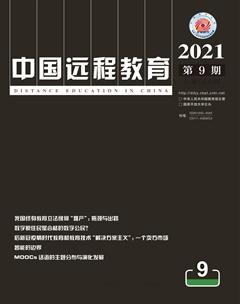
Abstracts
2021-11-05 10:40:30
中國遠程教育 2021年9期
關鍵詞:英文
Why does China have no Lifelong Education Act?
Lantao Jin
China has yet to legislate for lifelong education, which is arguably due to the epistemological divergences. In other words, there is no consensus on whether lifelong education should be interpreted in its broad sense or narrow sense, whether it should focus on education or on learning, and whether it should be compulsory or merely a value proposition. Consensus on these three issues can facilitate the legislation for lifelong education in China. In light of the problems existing, it is proposed that such a legislation should focus on social education so as to cater for specific needs and demands. Moreover, while it is true that the Lifelong Education Act aims to protect learners interest and rights, it should also require the government to play a leading role in resource investment, orchestration and sharing, given disparities in educational development across the country. Finally, feasibility and accountability are essential in terms of organizational system, resource assurance, and supervision and regulation.
Keywords: lifelong education; lifelong learning; learning society; legislation for lifelong education; lifelong education act; regulation on promoting lifelong education; education law
From digital native to digital citizen: enhancing digital citizenship
Shun Xu, Hao Yang and Sha Zhu
There is no consensus on the definition of digital native or even on the existence of such a generation. Digital natives are often defined in terms of age, or referring to the generation growing up with information technology. Nevertheless, this definition begs such questions: do these people possess the attributes of digital natives? Are digital natives qualified digital citizens? The current study aims to answer these questions. It makes an in-depth analysis of the concepts of digital natives and digital citizenship and attempts to verify the relationship between digital native attributes and digital citizenship empirically. The study involves 415 students from a university in Hubei Province, China. Findings show that these university students do not possess salient attributes of digital natives and that four attributes, i.e., growing up with technology, multitasking, graphic communication, and instant gratification and reward, can significantly predict digital citizenship. Implications of the findings are also discussed for the transformation from digital natives to digital citizens.
Keywords: information technology; digital technology; digital native; digital citizen; university student; digital citizenship; digital literacy; higher education; lifelong learning
Post-Covid-19 education and education technology ‘solutionism: a sellers market
Marko Ter?s, Juha Suoranta, Hanna Ter?s and Mark Curcher
The Covid-19 pandemic and the social distancing that followed has affected all walks of society, also education. In order to keep education running, educational institutions have had to quickly adapt to the situation. This has resulted in an unprecedented push to online learning. Many, including commercial digital learning platform providers, have rushed to provide their support and ‘solutions, sometimes for free. The Covid-19 pandemic has therefore also created a sellers market in ed-tech. This paper employs a critical lens to reflect on the possible problems arising from hasty adoption of commercial digital learning solutions whose design might not always be driven by best pedagogical practices, but their business model that leverages user data for profit-making. Moreover, already before Covid-19, there has been increasing critique of how ed-tech is redefining and reducing concepts of teaching and learning. The paper also challenges the narrative that claims, ‘education is broken, and it should and can be fixed with technology. Such technologization, often seen as neutral, is closely related to educationalization, i.e., imposing growing societal problems for education to resolve. Therefore, this is a critical moment to reflect how the current choices educational institutions are making might affect with Covid-19 education and online learning: Will they reinforce capitalist instrumental view of education or promote holistic human growth? This paper urges educational leaders to think carefully about the decisions they are currently making, and if they indeed pave the way to a desirable future of education.
Keywords: Covid-19; pandemic; critical pedagogy; educational technology; Paulo Freire; Ivan Illich; technologization; postdigital
A study on the influence of blended synchronous learning environments on students cognitive engagement
Yafei Shi, Mingwen Tong, Jia Sun, Hongbin Dai, Taotao Long, and Jianhu Wang
Blended synchronous classroom is a key venue for information technology to enable the balanced development of urban and rural education. However, how the blended synchronous learning environment affects learning effectiveness remains understudied. Learning motivation, an internal psychological factor in students' learning activities, can effectively explain their learning behavior. Hence, this study sets out to explore the influencing mechanism of blended synchronous learning environments on students' cognitive engagement with learning motivation as an intermediate variable. The method of structural equation modeling is used to verify the model and hypotheses. The results show that extrinsic motivation is a mediating variable for the impact of blended synchronous learning environments on shallow cognitive engagement while intrinsic motivation has a mediating effect in its influence on both deep cognitive engagement and shallow cognitive engagement. Furthermore, extrinsic motivation has a significant positive effect on intrinsic motivation, and extrinsic motivation and intrinsic motivation have a chain mediating effect in the influence of blended synchronous learning environments on cognitive engagement. Suggestions on how to enhance learning motivation are also discussed.
Keywords: blended synchronous learning; cognitive engagement; learning motivation; mediating effect; educational balance
(英文目次、摘要譯者:肖俊洪)
猜你喜歡
國際展望(2017年2期)2017-03-21 18:34:18
鄱陽湖學刊(2016年6期)2017-01-16 13:05:41
中國遠程教育(2016年6期)2016-12-07 10:07:02
財經(2016年19期)2016-08-11 08:17:03
中國遠程教育(2016年5期)2016-06-29 10:13:42
中國遠程教育(2016年2期)2016-03-21 10:31:21
中國遠程教育(2016年1期)2016-02-26 10:37:15
國際展望(2015年5期)2015-09-15 05:41:45
國際展望(2015年4期)2015-07-13 05:30:56
能源(2014年9期)2014-09-15 13:18:12