《Goldilocks and the three bears》教學實錄
2016-10-13 17:54:29錢希潔
江蘇教育研究 2016年26期
【編者綜述】
孩子們喜歡故事,老師也喜歡故事,因此,通過故事的方式引導小學生學習英語已經成為當前一種有效的英語教學方式。《義務教育英語課程標準》(2011年版)在“語言技能”二級要求中就英語故事教學做出如下描述:“能聽懂簡單的配圖小故事,能在教師的幫助下和圖片的提示下描述或講述簡單的小故事,能正確朗讀所學故事或短文,能在教師的幫助下表演小故事或小短劇。”為此,當前很多小學英語教材都在權重板塊設置了“Story Time”,旨在通過故事的方式引導學生開展富有趣味的英語學習活動。確實,故事教學給小學英語課堂帶來了新的活力、新的氣象,然而,當一些英語小故事被抹上過于濃重的“教學味”的時候,它們在學生眼中便失去了原有的魅力,所謂的“Story Time”也就或多或少地缺失了故事該有的滋味。因此,如何使故事教學更具有故事的味兒,也是我們當今面對的一個重要課題。多年來,錢希潔老師對此進行了深入的實踐與探索,本文主要以她執教的譯林出版社出版的《義務教育教科書· 英語》(五年級上冊)Unit 1 Story time板塊中的故事“Goldilocks and the three bears”教學中的幾個片段為例,闡述了她對小學英語故事教學的思考,旨在與廣大同行朋友們探討:如何使小學英語故事教學散發出更為濃郁的故事味。我們相信,這樣的探討對于其它學科的教學,也有一定的借鑒意義。
【執教者簡介】
錢希潔,無錫市錫山教師進修學校,中學高級教師,江蘇省英語特級教師,江蘇省教師培訓團導師,教育部“國培計劃”(英語)專家組成員,《江蘇教育》專欄主持人。曾獲得江蘇省“藍天杯”小學英語優質課評比一等獎,在江蘇省“教海探航”頒獎大會上多次上示范課、進行教學點評、作學術報告。近年來,赴華東師范大學、北京師范大學、蘇州大學、揚州大學、新疆師范大學、廣西師范學院等單位上課、舉辦講座100多次,發表和獲獎論文200多篇,出版《英語語篇教學論》《論文寫作的N個經典故事》和《找尋屬于自己的教學》等3部教育專著,翻譯英語作品4部。
一、故事的導入
師:Dear boys and girls. Do you like stories?
生:Yeah!
師: Today Id like to tell you a story. It is an old story. Maybe it is a bit difficult for you. But dont be afraid.(afraid 為故事中即將出現的新單詞。)
生:OK
師: In the story,there is a mountain. On the mountain there is a temple. In the temple, there is an old monk. The old monk says…
教者一邊講述故事,一邊用簡筆畫勾勒出了故事的大概,如圖(1)所示。
生:(搖頭晃腦地跟著老師一起用英語吟誦這個古老的中國童謠)In the story ,there is a mountain. On the mountain there is a temple. In the temple, there is an old monk. The old monk says…
師: Mmm, there are so many lovely monks here.
師:(筆者用簡筆畫在黑板上畫出幾棵樹)Look!Near the mountain, there are many trees. It is a forest. (朗讀新單詞forest)
師:Whats in the forest? Can you guess?
生1:There are some birds.
生2:There are some flowers.
生3:There is a river.
生4:There are some animals.
師:What animals are there in the forest?
生6:There are some tigers, I think.
生7:I think there are some snakes.
生8:There are some bears, I think.
師:Yes, so amazing things in the forest. And today there is a lovely girl in the forest too. Do you know her name?
生9:Her name is Goldilocks.
師:Yes .So the story is about Goldilocks and the three bears.
(揭示課題,并板書、朗讀課題)
二、故事的展開
1.第一片段
師:Now Goldilocks is walking in the forest. What does she say? Lets listen!
PPT課件呈現句子:What a beautiful house! (引導學生模仿朗讀)
師:So how does she feel now ?
生:She is happy in the forest.
師:Why?
生:Because she can see many flowers, animals and a beautiful house.endprint
2.第二片段
師:Now Goldilocks is in the house. How does Goldilocks feel now? Is she happy?
生:Yes.
師:But is she always happy? Lets watch the cartoon and try to find the answer.
(學生觀看故事動畫。)
生:No. She is not always happy.
師:How does she feel now?
生:She is hungry and thirsty.
師:Look, soup! There is some soup on the table. But How about the soup? Is it nice ?Lets listen!
(PPT 課件呈現如下三個主要句子。)
This soup is too cold.
This soup is too hot.
This soup is just right.
師:This soup is not too cold, not too hot. So this soup is just right. (朗讀新詞組just right.)
師:(小結故事第二片段)Now Goldilocks is in the house. She is hungry and thirsty. There is some soup on the table. This soup is ...Now practice in pairs. One acts as Goldilocks. One acts as the narrator.
(學生表演故事第二片段,略。)
3.第三片段
師:Now we know Goldilocks eats some soup. So is she hungry now?
生:No.
師:Is she thirsty now?
生:No.
師:How does she feel now?
生:She is sleepy now.
師:Anything else?
生:She is tired now.
師:Yes. She is sleepy and tired now. So where does she go?
生:She goes into a bedroom.
(PPT呈現主人公在小熊臥室的場景。)
師:What s in the bedroom?
生:There are three beds in the room.
師:Look at the first bed. This bed is hard. (朗讀新單詞hard)
(敲敲desk, door, wall 等一些比較硬的物品。)
師:Is it hard?
生:No.
師:Now please look at the second bed. Is this bed hard too?
生:No.
師:This bed is soft. (朗讀新單詞soft)
師:Now please look at the third bed. How about this bed? Hard?
生:No.
師:Soft?
生:No. Its just right.
師:I think so. Goldilocks is lying on the bed. She feels very comfortable.
Now if you were Goldilocks, What would you say?
生1:Woo,three beds. Now I can sleep.
生2:The beds are so beautiful. I like the beds.
生3:I am so tired. I want to sleep on the bed now.
師:Then look at the beds. They are different. Can you say sth. about the beds?
生4:(指著第一張床)This bed is too hard.
生5:(指著第二張床)This bed is too soft.
生6:(指著第三張床)This bed is just right.
師: So this is your story.
4.第四片段
師:We know Goldilocks likes the third bed. Look! She is lying on the bed soundly.(打呼嚕狀。)
(PPT 發出“Help!...”的呼叫聲。)
師:Whats wrong?
生:She is afraid.
師:Yeah! She seems afraid. Can you show how the word afraid means?endprint
(學生爭先恐后地表演“afraid”。)
師:I think youre really afraid. Thank you. Goldilocks is really afraid. Do you know why? Please look at the picture carefully.
生:Because there are three bears in front of her.(朗讀新短語in front of。)
師:Please look at the bears. They look puzzled. What will they say?
生:Who are you? Its our house.
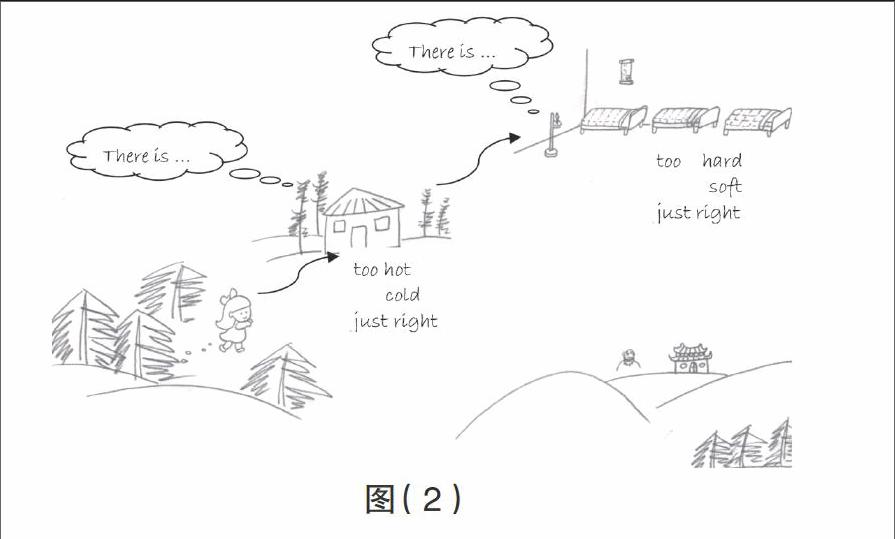
隨著故事情節的發展,教者逐漸生成板書如圖(2)。
三、故事的延續
師:Now you know the story very well. Lets have fun with the story. Do you still remember the story about the old monk? Lets try to tell the story in this way:
In the forest,there is a house.
In the house, there is some soup.
Goldilocks says: This soup is…
(學生選擇喜歡的方式講述故事或表演故事,略。)
師:Your story is so amazing! Now lets continue the story. Now you know Goldilocks is afraid and runs away. And then? Can you imagine: What will happen? You may discuss with your partner and share your ideas.
生1:Goldilocks runs back to her home.
生2:I think Goldilocks is afraid and runs away. The bears run after her and say: Dont run. Just have dinner with us.
生3:Dont run away. Were good bears. Lets be friends.
生4:The baby bear asks his mother to cook more soup.
師: Why?
生4:Goldilocks eats the soup.Now theres no soup for the baby bear.
師:Reasonable.
生5:The baby bear makes the bed again.
生6:The bears check their things.
生7:I think Godilocks runs to the temple and asks the old monk for help.
(學生大笑。)
師:So this is your story about Goldilocks and the three bears. Is it fun? Its great fun. So reading is fun. Try to read more English stories after school. There are a lot of wonderful stories. Such as Snow White, Ugly Duckling. Cinderella and so on.
(錢希潔,無錫市錫山教師進修學校,214192)
責任編輯:宣麗華endprint
猜你喜歡
快樂語文(2021年27期)2021-11-24 01:29:04
甘肅教育(2020年22期)2020-04-13 08:11:16
閱讀(快樂英語高年級)(2020年8期)2020-01-08 02:21:16
福建基礎教育研究(2019年3期)2019-05-28 23:14:43
智慧少年·故事叮當(2018年11期)2018-05-14 11:48:18
小學生導刊(低年級)(2016年2期)2016-02-24 23:02:11
小天使·五年級語數英綜合(2014年5期)2014-06-25 05:22:42
吐魯番(2014年2期)2014-02-28 16:54:42
七彩語文·低年級(2011年19期)2011-04-12 00:00:00
海外英語(2006年8期)2006-09-28 08:49:00