考慮非一致性的黃土高原區旱澇復合事件的演變特征及其動態變化
2023-07-28 01:08:44高月嬌黃生志王韓葉王志霞郭雯雯穆振俠
農業工程學報 2023年8期
高月嬌,黃生志,王韓葉,王志霞,郭雯雯,穆振俠,陳 剛,黃 強
考慮非一致性的黃土高原區旱澇復合事件的演變特征及其動態變化
高月嬌1,黃生志1※,王韓葉2,王志霞1,郭雯雯1,穆振俠3,陳 剛2,黃 強1
(1. 西安理工大學 西北旱區生態水利國家重點實驗室,西安 710048;2. 云南省水利水電勘測設計院,昆明 650021;3. 新疆農業大學水利與土木工程學院,烏魯木齊 830052)
受氣候變化和人類活動的雙重影響,傳統水文序列的一致性假設受到破壞,在考慮非一致性的條件下探究相鄰季節間旱澇復合事件的動態變化及主導因子,對區域的糧食安全與旱澇災害防御意義重大。為探究非一致性條件下旱澇復合事件的動態演變特征及其主導因子,該研究以黃土高原為研究對象,基于廣義可加模型擬合單季節標準化降水指數的邊緣分布,構建二維Copula模型分析旱澇復合事件(中、重和極端情景下)的發生概率,并利用變量投影重要性準則探究復合事件動態變化的主導因子。結果表明:1)1982—2015年間正常轉旱、旱轉正常、正常轉澇和澇轉正常事件分布廣泛且發生頻次較高(高于22次);2)春-夏內蒙古持續干旱、夏-秋青海持續干旱、秋-冬寧夏持續干旱、冬-春山西持續干旱、夏-秋陜西持續洪澇、夏-秋甘肅持續洪澇事件的發生概率較大;3)春-夏由旱轉澇、夏-秋持續洪澇、秋-冬由澇轉旱、秋-冬持續干旱和冬-春季持續干旱事件的發生概率顯著上升,對該區域社會經濟與生態將產生不利影響;4)復合事件發生概率動態變化的主導因素為北極濤動指數和太陽黑子指數。研究成果將為黃土高原地區旱澇復合事件的精準防御提供科技支撐。
干旱;洪澇;模型;旱澇復合事件;非一致性;動態變化;黃土高原
0 引 言
全球持續變暖改變了氣候系統的熱力環境,影響了全球的水循環過程,進而導致極端事件頻發[1]。干旱和洪澇是較典型的極端事件[2],具有影響范圍廣、發生頻率高的特點,易對生態環境、糧食產量和社會生產活動產生不利影響。干旱和洪澇災害在全世界的發生頻率增加,強度加大[3],每年造成的經濟損失分別超過80億美元和300億美元。雖然干旱和洪澇災害幾乎不會同時發生,但有時空相關性的災害會相互作用發展成為旱澇復合型災害[4-5],從而增加災害的影響范圍和影響強度,造成更嚴重的損失,例如澳大利亞、英國和秘魯等國發生的由旱轉澇災害均對經濟、環境和糧食安全造成嚴重影響[6-8]。
在全球變暖的背景下,季節間持續干旱(洪澇)和季節性旱澇交替等現象更加頻繁[9],其帶來的負面影響呈現出多維和多層次性的特點[10]。相鄰季節間正常轉旱、旱轉正常、正常轉澇、澇轉正常、持續干旱、持續洪澇、由旱轉澇和由澇轉旱事件統稱為旱澇復合事件[11],其中,持續干旱(洪澇)事件不僅對工農業生產、糧食安全和生態系統產生嚴重的負面影響[11-13],更會進一步加劇災害的影響時間、加大災害的破壞程度[14];而旱澇交替現象是干旱和洪澇災害在短時間內的快速轉變過程[15],具有突變性的特點,可能會引發湖泊干涸、城市缺水、泥石流和山洪災害頻發等一系列問題[16-17]。有研究表明,連續旱澇災害在未來可能成為一種常見的現象[18]。
國外主要側重于單一干旱和洪澇災害的研究[19-20],而對旱澇復合事件的研究較少,如:HE等[21]發現全球約5.9%和7.6%的陸地分別發生了春-夏和秋-冬季由旱轉澇事件;MARENGO等[22]發現“拉尼娜”現象是南美洲發生旱澇急轉現象的主要原因;ESPINOZA等[23]發現亞馬遜流域的由旱轉澇事件主要受厄爾尼諾現象的影響。國內對旱澇組合事件的研究主要集中在旱澇交替現象,其研究的時間尺度集中在夏季或汛期[24],研究內容涵蓋旱澇急轉事件的成因、演變規律、預測、應對方法和對農業的影響等[24-26]。持續干旱(洪澇)事件也開展了部分研究,例如:張冬冬等[27]研究云南省季節連旱的概率特征,發現云南北部在春-夏、夏-秋和冬-春季發生持續干旱事件的概率較大;劉宇峰等[28]發現黃土高原的持續干旱事件增多;SHI等[29]發現黃河流域春-夏和夏-秋季傾向于發生持續干旱(持續洪澇)事件;楊志勇等[10]發現灤河流域在夏-秋季易發生旱澇復合事件。
綜上所述,以往研究雖涉及單一旱災、單一澇災、旱澇交替現象和持續干旱(洪澇)事件,但未系統揭示相鄰季節間旱澇復合事件的演變機理,尚不明確旱澇復合事件的驅動因子;此外,以往研究均在一致性的條件下基于氣象站點數據分析旱澇復合事件的演變特征,忽略了氣候變化的影響和小地理尺度上的水文變化特征。因此,本文以旱澇災害頻發的黃土高原為研究對象,在考慮非一致性的條件下,基于高精度的格點數據開展相鄰季節間旱澇復合事件演變特征與影響因子研究,以期為黃土高原旱澇復合災害的精準防御提供科學依據。
1 數據與方法
1.1 研究區概況
黃土高原(圖1)位于黃河中上游地區,東起太行山,西至烏鞘嶺,南連秦嶺,北抵長城,是中國北方與西北地區的交界處。流域總面積為6.2×10⁵km2,地處34?41'~41?16'N,100?52'~114?33'E,橫跨中國7個省份(包括山西、陜西、甘肅、內蒙古、寧夏、青海和河南)。流域屬于大陸性季風氣候區,區域內降水年際變化大,年內分布不均勻,降水主要發生在夏季,多年平均降雨量為466 mm,自東南向西北遞減,具有明顯的梯度變化特征;多年平均氣溫在-4.0~13.0℃之間,由北到南逐漸升高。

圖1 黃土高原分區及多年平均降水量示意圖
1.2 數據來源
黃土高原氣象數據來自全球陸地數據同化系統生成的(GLDAS-Noah)降水產品(https://search.earthdata. nasa.gov/search?q=GLDAS/),研究所用的時間范圍從1981年到2015年,以月為時間尺度,空間分辨率為0.25°×0.25°,由于選取的GLDAS-V2.0時間僅到2014年,故本文用GLDAS-V2.1降水資料補齊2015年的降水數據[30]。此外,研究所用數據還有同期大氣環流因子,包括太陽黑子指數(Sunspots)、厄爾尼諾南方濤動指數(El Ni?o-Southern Oscillation,ENSO3.4)、北極濤動指數(Arctic Oscillation,AO)和太平洋十年濤動指數(Pacific Decadal Oscillation,PDO),其中,Sunspots來自比利時皇家天文臺(http://sidc.oma.be/silso/dayssplot);ENSO3.4、AO和PDO均來自NOAA地球系統研究實驗室(https://www.esrl.noaa.gov/psd/data/climateindices/list/)。
1.3 研究方法
1.3.1 旱澇等級的劃分
目前,國內常用的旱澇指標包括降水距平百分率、Z指數、標準化降水蒸散指數和標準化降水指數(standardized precipitation index,SPI)等[31-33]。SPI指數具有計算簡單、多時間尺度和穩定性好等特點,故本文選取SPI指數作為季尺度旱澇等級劃分的依據,同時參照國家規范GB/T 20481—2017《氣象干旱等級》,最終確定的旱澇等級劃分標準見表1。

表1 旱澇等級劃分標準
1.3.2 非一致性檢驗
水文序列非一致性檢驗包括趨勢、周期和突變檢驗。檢驗方法包括Mann-Kendall(M-K)檢驗法、雙累積曲線法、有序聚類法和Pettitt檢驗法等[34-35]。本文用M-K檢驗單季節SPI序列的變化趨勢,同時采用Pettitt檢驗法分析其突變情況,具體計算過程可參考文獻[35]。其中,當<0.05時,序列存在有效突變點,說明序列的一致性遭到破壞,需要在非一致性的條件下進行頻率分析。
1.3.3 GAMLSS模型
GAMLSS(generalized additive models for location,scale and shape)模型最早由RIGBY和STASINOPOULOS[36]于2005年提出,是一種基于位置、尺度和形狀的半參數廣義可加模型。該模型是時變矩模型的進一步發展,能夠靈活地描述統計參數與解釋變量之間的關系,且比時變矩法更便捷,極大地方便了非一致性分析工作[37-39],目前已廣泛用于經濟學、醫學和水文研究等領域[40]。因此,本文基于該模型擬合單季節SPI序列的非一致性邊緣分布,并在此基礎上探究旱澇復合事件的演變特征。
模型內含有諸多分布函數,但由于SPI在計算過程中已經標準化,同時考慮SPI序列的取值范圍,本文僅考慮用正態分布進行擬合。同時,選擇冪次函數(bfp)和三次樣條函數(cs)作為參數和解釋變量之間的連接函數,考慮到冪次函數的冪與三次樣條函數的自由度過高會存在過度擬合現象,故本文僅選取bfp(t,1)、bfp(t,2)、bfp(t,3)、cs(t,0)、cs(t,1)、cs(t,2)及cs(t,3)進行模型連接。
1.3.4 Copula函數
Copula函數能夠有效刻畫變量間的相依性,同時能夠靈活構造多變量聯合分布,目前已廣泛應用于干旱、洪水、泥沙等水文事件的研究中[41-42]。因此,本研究利用該函數構造非一致性/一致性條件下的二維聯合分布模型,定量描述旱澇復合事件的發生概率。
本文依據表1定義了中度、重度和極端情景。為計算不同情景下復合事件的發生概率(表2),參照文獻[43-44]推導出由旱轉澇、由澇轉旱、持續干旱、持續洪澇、正常轉旱、旱轉正常、正常轉澇、澇轉正常事件的發生概率計算式分別如下(以中度情景為例):


表2 不同情景下復合事件的發生概率
注:復合事件表示當季出現一種降水情形的條件下,后季出現不同或相似的降水情形,例如由旱轉澇表示當季發生干旱而后季則發生洪澇。
Note: Compound events mean that under the condition of one precipitation situation in the current season, different or similar precipitation situations occur in the later season. For example, the change from drought to waterlogging means that drought occurs in the current season and then floods occur in the next season.
1.3.5 變量投影重要性準則
變量投影重要性準則(variable importance in projection,VIP)指自變量對因變量影響的重要程度。若自變量的VIP值大于1,表明自變量對因變量的影響較為重要;若VIP值介于0.5~1,表明重要性一般;若VIP值小于0.5,則表明自變量對因變量基本沒有影響,具體計算過程可參考文獻[45]。本文用VIP準則來反映大氣環流因子對旱澇復合事件動態變化的影響情況,并選擇VIP值解釋度最大的因子為復合事件動態變化的主導因子。
2 結果與分析
2.1 相鄰季節間復合事件的時空分布特征
季節按常規劃分為:春-夏(3—8月)、夏-秋(6—11月)、秋-冬(9—2月)和冬-春季(12—5月)。依據表 2統計各像元在不同情景下黃土高原復合事件的發生頻次。計算相鄰季節間各像元的平均發生次數,發現秋-冬季最易發生旱澇復合事件,發生次數為28.88次,隨后依次是冬-春季(27.40次)和夏-秋季(26.42次)春-夏季發生旱澇復合事件的頻次較少,為25.05次,(圖 2a)。計算各像元由旱轉澇、由澇轉旱、持續干旱、持續洪澇、正常轉旱、旱轉正常、正常轉澇和澇轉正常事件的平均發生頻次,發現正常轉旱、旱轉正常、正常轉澇和澇轉正常事件的頻次較高,分別為22.15、22.83、22.81和22.42次;此外,就持續性旱澇事件與旱澇交替現象而言,持續干旱事件的發生頻次最高,為5.46次,其次為持續洪澇事件(4.70)和由澇轉旱事件(3.97次),最后為由旱轉澇事件(圖 2b)。
空間上,由旱轉澇易發生在陜西與山西地區,由澇轉旱事件主要發生在山西地區,持續干旱與持續洪澇事件則易發生在內蒙古地區,而正常轉旱、旱轉正常、正常轉澇與澇轉正常事件則廣泛分布在整個流域上。
2.2 單季節SPI序列的非一致性檢驗
用M-K檢驗法分析黃土高原地區各季節SPI序列的變化趨勢,由圖3可知:流域大部分地區春季和冬季SPI呈下降趨勢,表明春季和冬季的降水減少,干旱化趨勢突出;而夏季與秋季SPI呈上升趨勢,表明夏季與秋季的降水增多,濕潤化趨勢突出。
采用Pettitt檢驗法探究單季節SPI序列的突變情況,發現流域內春季的SPI序列未發生突變,夏、秋和冬季的SPI序列均發生突變,其突變的發生區域分別在青海、山西北部和甘肅東部地區。
2.3 旱澇復合事件的演變特征及其主導因子
2.3.1 邊緣分布與聯合分布
由于SPI在計算過程中已經標準化,同時考慮SPI序列的取值范圍,本文僅用正態分布擬合單季節SPI序列的邊緣分布。若單季節SPI序列發生突變,基于GAMLSS模型擬合該季節SPI序列的邊緣分布,同時利用赤池信息準則(akaike information criterion,AIC)與貝葉斯信息準則(schwarz bayesian criterion,SBC)篩選出最優連接方式,得出對應的位置參數和尺度參數,并基于此得到該SPI序列的最優邊緣分布;若SPI序列不發生突變,則在一致性條件下用正態分布擬合得出最優邊緣分布。
用均方根誤差(root mean square error,RMSE)和AIC準則從Clayton-Copula、Frank-Copula、Gumbel- Copula、Gaussian-Copula和t-Copula函數中選取相鄰季節間SPI序列的最優Copula函數。

圖3 單季節標準化降水指數的變化趨勢
2.3.2 旱澇復合事件的發生概率
根據優選出的Copula函數及其對應的相關參數,計算中度、重度和極端情景下相鄰季節間旱澇復合事件的發生概率、動態變化和主導因子,由于在中度、重度和極端情景下相鄰季節間旱澇復合事件的演變特征基本一致,因此以中度情景為例進行分析,下同。
時間上:春-夏季易發生正常轉澇和澇轉正常事件,發生概率均為11%;夏-秋季和冬-春季易發生正常轉旱(旱轉正常)事件,其發生概率分別為16%和15%;而秋-冬季易發生正常轉旱和正常轉澇事件。
空間上:正常轉旱、旱轉正常、正常轉澇和澇轉正常事件在流域上廣泛分布;就持續性旱澇事件與旱澇交替現象而言,內蒙古地區易在春-夏季發生持續干旱事件,山西北部與河南地區易發生冬-春季持續干旱事件,寧夏地易發生秋-冬季持續干旱事件,青海地區易發生夏-秋季持續干旱事件,陜西南部與甘肅地區分別易在夏-秋季與秋-冬季發生持續洪澇事件(圖4)。此外,持續干旱(洪澇)事件的發生概率比旱澇交替事件(由旱轉澇、由澇轉旱事件)大,與2.1節的頻次統計結果一致,可以相互印證結果的合理性。
2.3.3 旱澇復合事件的動態變化
探究旱澇復合事件的動態變化特征,可以為預防旱澇復合事件的發生提供一定依據。本節以5 a時間序列為滑動窗口[46]探究復合事件發生概率的變化趨勢,并用M-K趨勢法進一步分析復合事件發生概率的非參數變化趨勢。由圖5可知:流域內大部分地區的春-夏由旱轉澇、春-夏正常轉澇、夏-秋持續洪澇、夏-秋正常轉旱、夏-秋旱轉正常、秋-冬由澇轉旱、秋-冬持續干旱、秋-冬正常轉澇、秋-冬澇轉正常、冬-春持續干旱、冬-春正常轉旱與冬-春正常轉澇事件的發生概率普遍呈上升趨勢;而春-夏由澇轉旱、春-夏正常轉旱、夏-秋由旱轉澇、夏-秋正常轉澇、秋-冬由旱轉澇、秋-冬旱轉正常、冬-春持續洪澇和冬-春澇轉正常事件的發生概率則呈下降趨勢。
發生概率較大的旱澇復合事件中,春-夏內蒙古持續干旱、秋-冬寧夏持續干旱、冬-春山西持續干旱、夏-秋陜西持續洪澇與夏-秋甘肅持續洪澇事件均呈上升的趨勢,而夏-秋青海持續干旱事件則呈下降趨勢。頻繁發生的正常轉旱、旱轉正常、正常轉澇和澇轉正常事件中,除春-夏正常轉旱、秋-冬旱轉正常、夏-秋正常轉澇與冬-春澇轉正常事件呈下降趨勢外,其余復合事件均普遍上升。

圖4 中度情景下復合事件的發生概率
2.3.4 旱澇復合事件動態演變的主導因素
大量研究表明,復合事件與大氣環流異常密切相關[47]。為了進一步揭示變化環境下旱澇復合事件動態變化的主導因子,本節用VIP準則分析各大氣環流因子對復合事件動態變化的影響情況,基于此得到旱澇復合事件動態演變的主導因素。
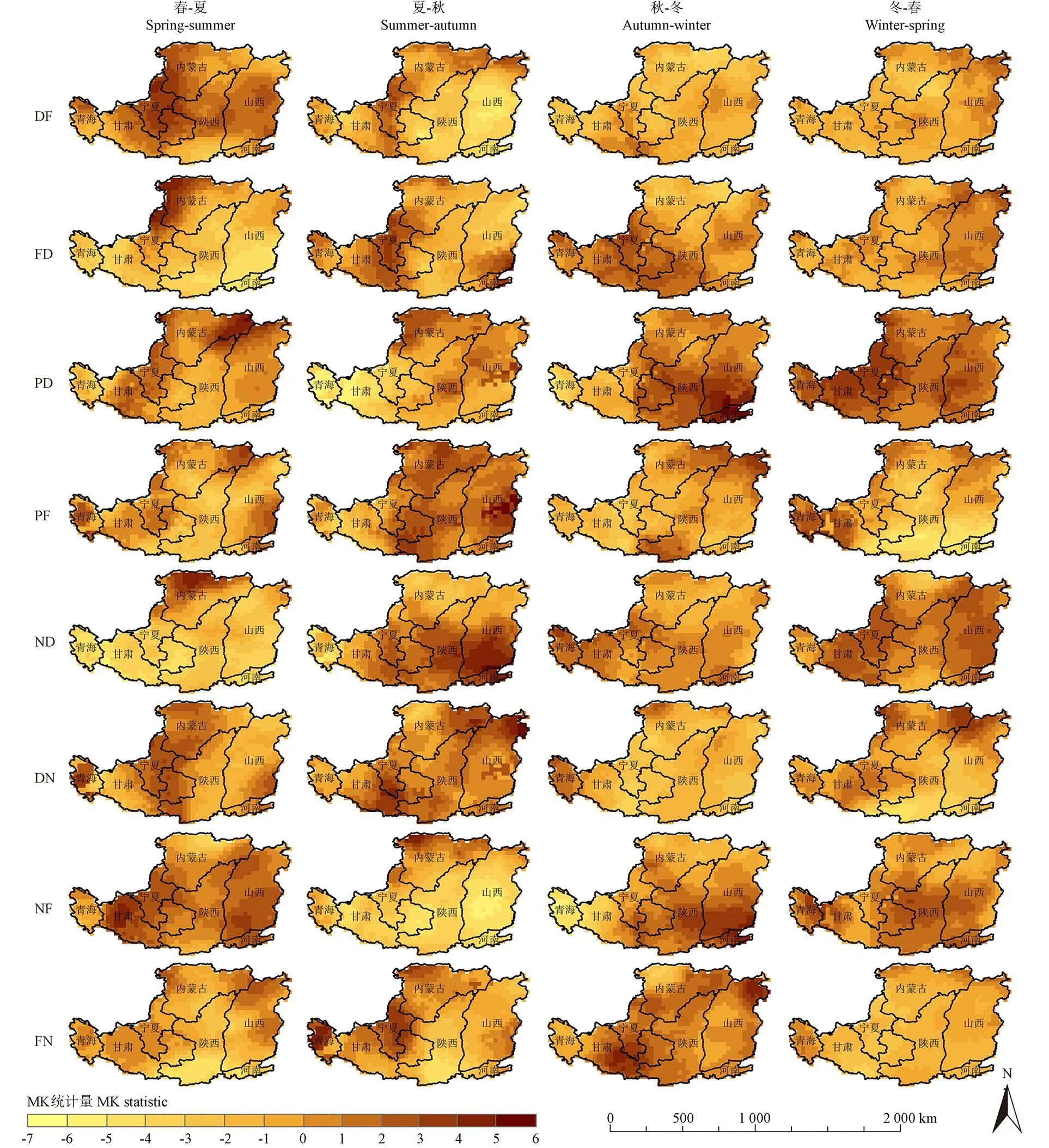
圖5 中度情景下旱澇復合事件發生概率的MK趨勢檢驗圖
由圖6可知:流域內呈上升趨勢的復合事件中,夏-秋持續洪澇、夏-秋正常轉旱和秋-冬持續干旱事件主要由北極濤動(AO)主導,秋-冬正常轉澇、秋-冬澇轉正常、冬-春持續干旱和冬-春正常轉旱事件主要受太陽黑子(Sunspots)的影響,春-夏由旱轉澇、春-夏正常轉澇、夏-秋旱轉正常和冬-春正常轉澇事件則由Sunspots與AO共同主導;呈下降趨勢的復合事件中,春-夏由澇轉旱、春-夏正常轉旱和夏-秋由旱轉澇事件主要受AO的影響,秋-冬旱轉正常、冬-春持續洪澇和冬-春澇轉正常事件由Sunspots主導,而夏-秋正常轉澇和秋-冬由旱轉澇事件則主要受Sunspots與AO的影響。此外,發生概率較大的春-夏內蒙古持續干旱事件由Sunspots主導,秋-冬寧夏持續干旱、夏-秋陜西持續洪澇、夏-秋甘肅持續洪澇、夏-秋青海持續干旱事件主要由AO主導,而冬-春山西持續干旱事件則由Sunspots與AO共同主導。

注:ENSO3.4、AO、 PDO、Sunspots分別為厄爾尼諾南方濤動指數、北極濤動指數、太平洋十年濤動指數和太陽黑子指數。
總體而言,流域內大部分地區的春-夏正常轉旱、夏-秋由旱轉澇、夏-秋持續干旱、夏-秋正常轉旱、夏-秋澇轉正常、秋-冬由澇轉旱事件的動態變化主要受AO影響;而春-夏澇轉正常、秋-冬正常轉旱、秋-冬旱轉正常、秋-冬正常轉澇、冬-春持續干旱、冬-春持續洪澇和冬-春正常轉旱事件的動態變化由Sunspots主導。綜合分析復合事件動態變化的主導因素,可發現流域的復合事件主要受AO和Sunspots的影響。張永瑞等[48]研究發現AO與降水在黃土高原地區密切相關;竇睿音[49]發現黃土高原地區的干旱和洪澇災害基本隨著太陽黑子的升降而升降。
3 討 論
有關復合事件的文獻報道,其研究對象多集中于夏季(汛期)的旱澇急轉事件或相鄰季節的旱澇交替(由旱轉澇與由澇轉旱)事件或持續干旱(洪澇)事件,少有研究考慮相鄰季節中降水正常的情況(主要包括正常轉旱、旱轉正常、正常轉澇和澇轉正常事件),且相關研究均在一致性的條件下探究復合事件的發生概率、演變規律、對農業的影響以及預測方法等。但在氣候變化的影響下,水文序列的一致性假設遭到破壞,在一致性條件下探究復合事件演變規律的結果可能與實際不符。因此,文章在考慮非一致性的條件下分析相鄰季節間由旱轉澇、由澇轉旱、持續干旱、持續洪澇、正常轉旱、旱轉正常、正常轉澇與澇轉正常事件的發生概率、演變規律及其影響因子。研究發現黃土高原的旱澇災害與北極濤動指數(太陽黑子指數)密切相關,此結論與張永瑞等[48-49]的結論基本一致;此外,劉宇峰等[28]發現黃土高原的持續干旱事件增多的現象也與本文秋-冬、冬-春季持續干旱事件呈上升趨勢的結論一致;而SHI等[29]發現發生頻次較高的旱澇復合事件的風險降低,與本文研究結論(春-夏內蒙古持續干旱、秋-冬寧夏持續干旱、冬-春山西持續干旱、夏-秋陜西持續洪澇與夏-秋甘肅持續洪澇事件的發生頻率較高且呈上升趨勢)不一致,這可能與文章考慮了非一致性有關。由于非一致性條件下的邊緣分布函數以時間為解釋變量,更能反映變化環境下水文序列變異性,因而與一致性條件下的邊緣分布函數存在差異,故導致兩種條件下復合事件的動態演變規律存在一定的差異。
復合事件的發生與降水變化過程關系密切,而降水的變化過程受氣溫、對流有效位能(convective available potential energy,CAPE)和對流抑制位能(convective inhibition,CIN)等未來大氣熱力狀況的影響[50]。隨著氣溫的升高,弱CAPE和(或)CIN事件減少導致與之對應的弱-中等強度的降水減少;而中等-強CAPE和(或)CIN事件增多,其引起的強降水事件有所增多。總而言之,CAPE和CIN的平均強度普遍增加,與之對應的由旱轉澇事件在未來的發生頻率將會增加,強度也會隨之增大[18-19]。在進一步的研究中,可深入分析在氣候變暖背景下,隨著氣溫升高,CAPE與CIN的氣候態分布與變化特征,運用全球氣候模式對未來CAPE與CIN的變化特征進行模擬,并在此基礎上分析CAPE和CIN對未來降水的抑制/促進作用,進而分析CAPE和CIN對復合事件的作用機理,以期揭示復合事件形成的物理機制。
4 結 論
本文以黃土高原為研究對象,考慮單季節SPI序列的非一致性,基于GAMLSS模型擬合單季節SPI序列的邊緣分布,同時采用Copula函數構建聯合分布模型分析相鄰季節旱澇復合事件的演變特征及其動態變化,同時探究大氣環流因子對復合事件動態變化的影響情況,得出以下結論:
1)時間上,春-夏季易發生正常轉澇與澇轉正常事件,發生概率為11%;夏-秋季與冬-春季則易發生正常轉旱與旱轉正常事件,發生概率分別為15%和16%;而秋冬季發生正常轉旱(正常轉澇)事件的頻率較高。
2)空間上,1981—2015年間正常轉旱、旱轉正常、正常轉澇與澇轉正常事件在流域上分布廣泛且發生頻次較多(大于22次),持續性旱澇事件比旱澇交替事件更為頻繁;就持續性旱澇事件與旱澇交替現象而言,內蒙古地區、青海、山西北部、河南和寧夏地區易發生持續干旱事件,而陜西南部和甘肅地區易發生持續洪澇事件。
3)流域大部分地區的春-夏由旱轉澇、春-夏正常轉澇、夏-秋持續洪澇、夏-秋正常轉旱、夏-秋旱轉正常、秋-冬由澇轉旱、秋-冬持續干旱、秋-冬正常轉澇、秋-冬澇轉正常、冬-春持續干旱、冬-春正常轉旱與冬-春正常轉澇事件的發生概率普遍上升;此外,發生概率較大的復合事件的發生概率亦普遍上升。
4)復合事件動態變化的主導因子為AO和Sunspots。其中,發生概率呈上升趨勢的夏-秋持續洪澇、夏-秋正常轉旱和秋-冬持續干旱事件主要由AO主導,秋-冬正常轉澇、秋-冬澇轉正常、冬-春持續干旱和冬-春正常轉旱事件主要受Sunspots的影響。
本文在考慮非一致性的條件下開展了相鄰季節間復合事件的演變規律及其動態變化研究,并揭示復合事件動態變化的影響因子,對變化環境下黃土高原地區復合事件的精準防御提供依據,且該研究框架可應用于非一致性條件下全球其他區域復合事件的演變特征分析。
[1] 尹家波,郭生練,顧磊,等. 中國極端降水對氣候變化的熱力學響應機理及洪水效應[J]. 科學通報,2021,66(33):4315-4325. YIN Jiabo, GUO Shenglian, GU Lei, et al. Thermodynamic response of precipitation extremes to climate change and its impacts on floods over China [J]. Chinese Science Bulletin, 2021, 66(33): 4315-4325. (in Chinese with English abstract)
[2] 夏軍,佘敦先,杜鴻. 氣候變化影響下極端水文事件的多變量統計模型研究[J]. 氣候變化研究進展,2012,8(6):397-402. XIA Jun, SHE Dunxian, DU Hong. The multi-variable statistical models of extreme hydrological events under climate change[J]. Climate Change Research, 2012, 8(6): 397-402. (in Chinese with English abstract)
[3] 胡毅鴻,李景保. 1951—2015年洞庭湖區旱澇演變及典型年份旱澇急轉特征分析[J]. 農業工程學報,2017,33(7):107-115. HU Yihong, LI Jinbao. Analysis on evolution of drought-flood and its abrupt alternation in typical year from 1951 to 2015 in Dongting Lake area[J]. Transactions of the Chinese Society of Agricultural Engineering (Transactions of the CSAE), 2017, 33(7): 107-115. (in Chinese with English abstract)
[4] MEEHL G A, TEBALDI C. More intense, more frequent, and longer lasting heat waves in the 21st century[J]. Science, 2004. 305(5686): 994-997.
[5] 方偉. 多變量視角下珠江流域洪旱災害時變風險研究[D]. 西安:西安理工大學,2020. FANG Wei. Assessing Time-Varying Risk of Drought and Flood from A Multivariate Perspective in the Pearl River Basin, China[D]. Xi’an: Xi’an University of Technology, 2020. (in Chinese with English abstract)
[6] BEARD G, CHANDLER E, WATKINS A B, et al. How does the 2010-11 La Nina compare with past La Nina events[J]. Australian Meteorological and Oceanographic Journal, 2011, 24: 17-20.
[7] PARRY S, MARSH T, KENDON M. 2012: From drought to floods in England and Wales[J]. Weather, 2013, 68(10): 268-274.
[8] SON R, WANG S Y, TSENG W L, et al. Climate diagnostics of the extreme floods in Peru during early 2017[J]. Climate Dynamics. 2019, 54(1): 935-945.
[9] MU W, YU F, XIE Y, et al. The copula function-based probability characteristics analysis on seasonal drought & flood combination events on the North China Plain[J]. Atmosphere, 2014, 5(4): 847-869.
[10] 楊志勇,袁喆,方宏陽,等. 基于Copula函數的灤河流域旱澇組合事件概率特征分析[J]. 水利學報,2013,44(5):556-561. YANG Zhiyong, YUAN Zhe, FANG Hongyang, et al. Study on the characteristic of multiply events of drought and flood probability in Luanhe River Basin based on Copula[J]. Journal of Hydraulic Engineering, 2013, 44(5): 556-561. (in Chinese with English abstract)
[11] HRDINKA T, NOVICKY O, HANSLIK E, et al. Possible impacts of floods and droughts on water quality[J]. Journal of Hydro-environment Research, 2012, 6(2): 145-150.
[12] LEIGH C, BUSH A, HARRISON E T, et al. Ecological effects of extreme climatic events on riverine ecosystems: insights from Australia[J]. Freshwater Biology, 2014, 60(12): 648-657.
[13] NING Z, QIAN H, ROEDENBECK C, et al. Impact of 1998-2002 midlatitude drought and warming on terrestrial ecosystem and the global carbon cycle[J]. Geophysical Research Letters, 2005, 32(22): 45-81.
[14] 張利平,秦琳琳,張迪,等. 南水北調中線水源區與海河受水區旱澇遭遇研究[J]. 長江流域資源與環境,2010,19(8):940-945. ZHANG Liping, QIN Linlin, ZHANG Di, et al. Drought-waterlogging encounter probability research between the water source area and water receiving areas in the middle route of South-to-North Water Transfer Project[J]. Resources and Environment in the Yangtze Basin, 2010, 19(8): 940-945. (in Chinese with English abstract)
[15] 涂新軍,龐萬寧,陳曉宏,等. 傳統旱澇急轉評估指數的局限和改進[J]. 水科學進展,2022,33(4):592-601. TU Xinjun, PANG Wanning, CHEN Xiaohong, et al. Limitations and improvement of the traditional assessment index for drought-wetness abrupt alternation[J]. Advances in Water Science, 2022, 33(4): 592-601. (in Chinese with English abstract)
[16] 付文藝. 旱澇急轉現狀及水利設施發展對策[J]. 現代農業科技,2014(15):224-225.
[17] 吳紹飛. 基于Copula函數的水環境多變量概率分布及其應用研究[D]. 武漢:武漢大學,2017. WU Shaofei. Copula-Based Multivariate Probability Distribution of Water Environmental Variables and its Applications [D]. Wuhan: Wuhan University, 2017. (in Chinese with English abstract)
[18] CHEN J, DAI A, ZHANG Y. Projected changes in daily variability and seasonal cycle of near-surface air temperature over the globe during the 21st century[J]. Journal of Climate, 2019, 32(24): 8537-8561.
[19] QUESADA-MONTANO B, BALDASSARRE G D, RANGECROFT S, et al. Hydrological change: Towards a consistent approach to assess changes on both floods and droughts[J]. Advances in Water Resources, 2017, 111: 31- 35.
[20] CAVAZOS T. Large-scale circulation anomalies conducive to extreme precipitation events and derivation of daily rainfall in Northeastern Mexico and Southeastern Texas[J]. Journal of Climate, 1999, 12(12): 1506-1523.
[21] HE X, SHEFFIELD J. Lagged compound occurrence of droughts and pluvials globally over the past seven decades[J]. Geophysical Research Letters, 2020, 47(14): 1-14.
[22] MARENGO J A, ALVES L M, SOARES W R, et al. Two contrasting severe seasonal extremes in Tropical South America in 2012: Flood in Amazonia and Drought in Northeast Brazil[J]. Journal of Climate, 2013, 26(22): 9137-9154.
[23] ESPINOZA J C, RONCHAIL J, GUYOT J L, et al. From drought to flooding: Understanding the abrupt 2010-11 hydrological annual cycle in the Amazonas River and tributaries[J]. Environmental Research Letters, 2012, 7(2): 024008.
[24] 劉煒,趙艷麗,馮曉晶. 內蒙古地區夏季旱澇急轉環流異常特征及其預測[J]. 干旱氣象,2021,39(2):203-214. LIU Wei, ZHAO Yanli, FENG Xiaojing. Circulation anomaly characteristics and prediction of drought and flood abrupt alternations in summer in Inner Mongolia[J]. Journal of Arid Meteorology, 2021, 39(2): 203-214. (in Chinese with English abstract)
[25] FENG M A, AY A, JY B, et al. 2015-16 floods and droughts in China, and its response to the strong EI Nino[J]. Science of the Total Environment, 2018, 627: 1473- 1484.
[26] 高蕓,胡鐵松,袁宏偉,等. 淮北平原旱澇急轉條件下水稻減產規律分析[J]. 農業工程學報,2017,33(21):128-136. GAO Yun, HU Tiesong, YUAN Hongwei, et al. Analysis on yield reduced law of rice in Huaibei plain under drought-flood abrupt alternation[J]. Transactions of the Chinese Society of Agricultural Engineering (Transactions of the CSAE), 2017, 33(21): 128-136. (in Chinese with English abstract)
[27] 張冬冬,魯帆,嚴登華,等. 云南省干干旱時空演變規律及季節連旱的概率特征分析[J]. 應用基礎與工程科學學報,2014,22(4):705-717. ZHANG Dongdong, LU Fan, YAN Denghua, et al. Spatio-temporal analysis of droughts and the characteristic of continuous seasonal droughts probability in Yunnan Province[J]. Journal of Basic Science and Engineering, 2014, 22(4): 705-717. (in Chinese with English abstract)
[28] 劉宇峰,原志華,李文正,等. 1961-2013年黃土高原地區旱澇特征及極端和持續性分析[J]. 地理研究,2017,36(2):345-360. LIU Yufeng, YUAN Zhihua, LI Wenzheng, et al. Extreme and persistent analysis of drought-flood variation in the Loess Plateau during 1961-2013[J]. Geographical Research, 2017, 36(2): 345-360. (in Chinese with English abstract)
[29] SHI W, HUANG S, LIU D, at al. Dry and wet combination dynamics and their possible driving forces in a changing environment[J]. Journal of Hydrology, 2020, 589(5), 125211.
[30] 宋海清,朱仲元,李云鵬. 陸面同化及再分析降水資料在內蒙古地區的適用性[J]. 干旱區研究,2021,38(6):1624-1636. SONG Haiqing, ZHU Zhongyuan, LI Yunpeng. Validation of land data assimilation and reanalysis precipitation datasets over Inner Mongolia[J]. Arid Zone Research, 2021, 38(6): 1624-1636. (in Chinese with English abstract)
[31] 張尚印,姚佩珍,吳虹,等. 我國北方旱澇指標的確定及旱澇分布狀況[J]. 自然災害學報,1998(2):25-31. ZHANG Shangyin, YAO Peizhen, WU Hong, et al. Determination of drought-flood index and distribution of drought-flood in the north of China[J]. Journal of Natural Disasters, 1998(2): 25-31. (in Chinese with English abstract)
[32] 黃晚華,楊曉光,李茂松,等. 基于標準化降水指數的中國南方季節性干旱近58a演變特征[J]. 農業工程學報,2010,26(7):50-59. HUANG Wanhua, YANG Xiaoguang, LI Maosong, et al. Evolution characteristics of seasonal drought in the south of China during the past 58 years based on standardized precipitation index[J]. Transactions of the Chinese Society of Agricultural Engineering (Transactions of the CSAE), 2010, 26(7): 50-59. (in Chinese with English abstract)
[33] 楊云川,張會婭,程禹灝,等. 基于DSSAT-Canegro模型的廣西來賓市甘蔗生長對氣象干旱的響應[J]. 農業工程學報,2022,38(2):119-130. YANG Yunchuan, ZHANG Huiya, CHENG Yuhao, at al. Effects of meteorological drought on sugarcane growth using DSSAT-Canegro model in Laibin, Guangxi of China[J]. Transactions of the Chinese Society of Agricultural Engineering (Transactions of the CSAE), 2022, 38(2): 119-130. (in Chinese with English abstract)
[34] 黃強,孔波,樊晶晶. 水文要素變異綜合診斷[J]. 人民黃河,2016,38(10):18-23. HUANG Qiang, KONG Bo, FAN Jingjing. Hydrological elements comprehensive detecting variation[J]. Yellow River, 2016, 38(10): 18-23. (in Chinese with English abstract)
[35] 隆院男,唐蓉,蔣昌波,等. 近60年湘江流域水沙特性及其對人類活動的響應[J]. 農業工程學報,2018,34(24):132-143. LONG Yuannan, TANG Rong, JIANG Changbo, et al. Variability characteristics of runoff-sediment discharge and their response to human activities in Xiang River basin in recent 60 years[J]. Transactions of the Chinese Society of Agricultural Engineering (Transactions of the CSAE), 2018, 34(24): 132-143. (in Chinese with English abstract)
[36] RIGBY R A, STASINOPOULOS D M. Generalized additive models for location, scale and shape[J]. Journal of the Royal Statistical Society, 2005, 54(3): 507-554.
[37] 溫天福,熊立華,江聰,等. 基于時變矩BMA方法的贛江流域年輸沙量變化歸因分析[J]. 農業工程學報,2021,37(7):140-149. WEN Tianfu, XIONG Lihua, JIANG Cong, et al. Attribution analysis of annual sediment load of Ganjiang River Basin using BMA based on time-varying moment models[J]. Transactions of the Chinese Society of Agricultural Engineering (Transactions of the CSAE), 2021, 37(7): 140-149. (in Chinese with English abstract)
[38] VILLARINIA G, SERINALDIB F. Development of statistical models for at-site probabilistic seasonal rainfall forecast[J]. International Journal of Climatology, 2012, 32(14): 2197-2212.
[39] GU X. ZHANG Q, LI J, et al. Impact of urbanization on nonstationarity of annual and seasonal precipitation extremes in China[J]. Journal of Hydrology, 2019, 575: 638-655.
[40] 陳伏龍,楊寬,蔡文靜,等. 基于GAMLSS模型的水文干旱指數研究—以瑪納斯河流域為例[J]. 地理研究,2021,40(9):2670-2683. CHEN Fulong, YANG Kuan, CAI Wenjing, et al. Study on hydrological drought index based on GAMLSS: Taking Manas River Basin as an example[J]. Geographical Research, 2021, 40(9): 2670-2683. (in Chinese with English abstract)
[41] Xiao M, Yu Z, Zhu Y. Copula-based frequency analysis of drought with identified characteristics in space and time: a case study in Huai River basin, China[J]. Theoretical and Applied Climatology, 2019, 137(3): 2865-2875.
[42] 賈路,任宗萍,李占斌,等. 基于耦合協調度的大理河流域徑流和輸沙關系分析[J]. 農業工程學報,2020,36(11):86-94. JIA Lu, REN Zongping, LI Zhanbin, et al. Relationship between runoff and sediment load in Dali River Basin based on coupling coordination degree[J]. Transactions of the Chinese Society of Agricultural Engineering (Transactions of the CSAE), 2020, 36(11): 86-94. (in Chinese with English abstract)
[43] 張倩. 基于Copula函數的黃河中下游干支流多庫來水豐枯遭遇分析[D]. 鄭州:鄭州大學,2019. ZHANG Qian. Analysis of Water Encounters of Multi-reservoirs in the Middle and Lower Reaches of the Yellow River Based on Copula Function [D]. Zhengzhou: Zhengzhou University, 2019. (in Chinese with English abstract)
[44] 王飛宇,張彥,王偲,等. 基于Copula函數的漢江流域降水徑流豐枯遭遇研究[J]. 灌溉排水學報,2022,41(8):95-105. WANG Feiyu, ZHANG Yan, WANG Cai, et al. Using copula model to analyze consecutive wetting-drying occurrence in rainfall-runoff in Hanjiang Basin[J]. Journal of Irrigation and Drainage, 2022, 41(8): 95-105. (in Chinese with English abstract)
[45] 楊福芹,戴華陽,馮海寬,等. 基于赤池信息準則的冬小麥植株氮含量高光譜估算[J]. 農業工程學報,2016,32(23):161-167. YANG Fuqin, DAI Huayang, FENG Haikuan, et al. Hyperspectral estimation of plant nitrogen content based on Akaike's information criterion[J]. Transactions of the Chinese Society of Agricultural Engineering (Transactions of the CSAE), 2016, 32(23): 161-167. (in Chinese with English abstract)
[46] 黃錦濤. 基于文本數據的水旱災害風險評估—以河南省為例[D]. 鄭州:華北水利水電大學,2020. HUANG Jintao. Flood and Drought Disaster Risk Assessment Based on Text Data-A Case Study of Henan Province[D]. Zhengzhou: North China University of Water Resources and Electric Power, 2020. (in Chinese with English abstract)
[47] 王兆禮,李軍,黃澤勤,等. 基于改進帕默爾干旱指數的中國氣象干旱時空演變分析[J]. 農業工程學報,2016,32(2):161-168. WANG Zhaoli, LI Jun, Huang Zeqin, et al. Spatiotemporal variations analysis of meteorological drought in China based on scPDSI[J]. Transactions of the Chinese Society of Agricultural Engineering (Transactions of the CSAE), 2016, 32(2): 161-168. (in Chinese with English abstract)
[48] 張永瑞,張岳軍. 北極濤動對黃土高原氣溫和降水的影響研究[A]. 中國氣象學會. 第35屆中國氣象學會年會 S7 東亞氣候、極端氣候事件變異機理及氣候預測[C]. 中國氣象學會:中國氣象學會,2018:493-497.
[49] 竇睿音,延軍平. 關中平原太陽黑子活動周期與旱澇災害的相關性分析[J]. 干旱區資源與環境,2013,27(8):76-82. DOU Ruiyin, YAN Junping. Relationships between drought and flood disasters in Guanzhong plain and the activities of sunspot[J]. Journal of Arid Land Resources and Environment, 2013, 27(8): 76-82. (in Chinese with English abstract)
[50] MYOUNG B, NIELSEN-GAMMON J W. Sensitivity of monthly convective precipitation to environmental conditions[J]. Journal of Climate, 2010, 23(1): 166-188.
Evolution characteristics and dynamic changes of drought-flood complex events on Loess Plateau in terms of non-consistency
GAO Yuejiao1, HUANG Shengzhi1※, WANG Hanye2, WANG Zhixia1, GUO Wenwen1, MU Zhenxia3, CHEN Gang2, HUANG Qiang1
(1.-,,710048,; 2.,650021,; 3.,,830052,)
The consistency hypothesis cannot fully meet the current hydrological series in recent years, due to the dual impacts of climate change and human activities. The hydrological frequency has been also questioned under the consistency condition. Much effort has been made into the spatiotemporal evolution characteristics and leading factors of drought-flood complex events between adjacent seasons on the Loess Plateau. Therefore, it is of great significance to regional food security and the prevention of drought and flood disasters. Taking the Loess Plateau as the research object, this study aims to determine the evolution characteristics and dynamic changes of drought-flood complex events, in terms of non-consistency. Firstly, the non-consistencies of the single-season standardized precipitation index (SPI) were diagnosed to construct the two-dimensional joint distribution model of SPI sequences between adjacent seasons using the generalized additive model (GAMLSS model).Secondly, eight events were defined, including from the drought to the flood, from the flood to the drought, persistent drought, persistent flood, from the normal to the drought, from the drought to the normal, from the normal to the flood, and from the flood to the normal. The moderate, severe, and extreme scenarios were identified, according to the classification criteria of drought and flood. A systematic analysis was implemented on the spatiotemporal distribution of the combined events. Thirdly, the occurrence probability of combined drought-flood events under different scenarios was calculated using the consistent/inconsistent two-dimensional joint distribution model. Finally, the 5 year sliding window was combined with the Mann-Kendall test to explore the dynamic evolution characteristics of drought-flood complex events. The important criterion of variable projection was then used to reveal the leading factors of dynamic changes in complex events. The results showed as follows: 1) The occurrence frequencies of the normal to the drought, the drought to the normal, the normal to the flood, and the flood to the normal events were higher than 22 times between adjacent seasons. In addition, the occurrence frequencies of persistent drought (persistent flood) events were greater than that of alternating drought and flood events. 2) The combined events of drought and flood were more likely to occur, with a frequency of 28.88 and 27.40, respectively, from autumn to winter, and from winter to spring. To be specific, the events of the normal to the flood, and the flood to the normal were tended to occur in spring and summer. The events of the normal to the drought, and the normal to the drought were more likely to occur from summer to autumn, and from winter to spring. The probability of the normal drought (flood) events was higher in autumn-winter. 3) Spatially, the events of the normal to the drought, the drought to the normal, the normal to the flood, and the flood to the normal were evenly distributed over the whole basin. In addition, Inner Mongolia, Qinghai, Ningxia, and Shanxi regions tended to sustain the drought events, while Shaanxi and Gansu regions tended to the flood events. 4) There was a significant increase in the occurrence probability of spring-summer drought to flood, summer-autumn sustained flood, autumn-winter from flood to drought, autumn-winter sustained drought, and winter-spring sustained drought. At the same time, an increasing trend was found in the occurrence probability of spring-summer sustained drought in Inner Mongolia, summer-autumn sustained drought in Qinghai, autumn-winter sustained drought in Ningxia, winter-spring sustained drought in Shanxi, and summer-autumn sustained flood in Shaanxi (Gansu), indicating the adverse effects on the social economy and ecology in the region. 5) The leading factors of dynamic change in the occurrence probability of composite events were determined as the Arctic oscillation and sunspot index. The finding can provide scientific and technological support for the precise prevention of drought-flood complex events in the Loess Plateau.
drought; flood; models; combined events; non-consistency; dynamic change; The Loess Plateau
2022-10-12
2022-12-29
國家自然科學基金項目(5227090529);黑土地保護與利用科技創新工程專項(XDA28060100)
高月嬌,研究方向為水文與水資源。Email:1624508340@qq.com
黃生志,教授,博士生導師,研究方向為干旱形成及傳播機理。Email:huangshengzhi7788@126.com
10.11975/j.issn.1002-6819.202210090
P426.616
A
1002-6819(2023)-08-0133-11
高月嬌,黃生志,王韓葉,等. 考慮非一致性的黃土高原區旱澇復合事件的演變特征及其動態變化[J]. 農業工程學報,2023,39(8):133-143. doi:10.11975/j.issn.1002-6819.202210090 http://www.tcsae.org
GAO Yuejiao, HUANG Shengzhi, WANG Hanye, et al. Evolution characteristics and dynamic changes of drought-flood complex events on Loess Plateau in terms of non-consistency[J]. Transactions of the Chinese Society of Agricultural Engineering (Transactions of the CSAE), 2023, 39(8): 133-143. (in Chinese with English abstract) doi:10.11975/j.issn.1002-6819.202210090 http://www.tcsae.org
猜你喜歡
公民與法治(2022年5期)2022-07-29 00:47:28
體育科技文獻通報(2022年3期)2022-05-23 13:46:54
教學考試(高考物理)(2021年5期)2021-11-08 10:31:22
歷史教學問題(2021年4期)2021-11-05 07:02:34
天津外國語大學學報(2021年3期)2021-08-13 08:32:18
遼金歷史與考古(2021年0期)2021-07-29 01:06:54
中醫眼耳鼻喉雜志(2021年1期)2021-07-22 07:38:14
科技傳播(2019年22期)2020-01-14 03:06:54
民用飛機設計與研究(2019年4期)2019-05-21 07:21:24
汽車工程學報(2017年2期)2017-07-05 08:13:02