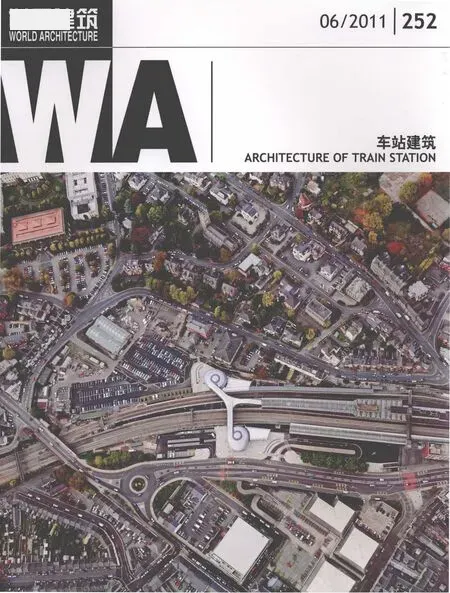
佛羅倫薩TAV車站,佛羅倫薩,意大利
2011-04-09 08:54:30建筑設(shè)計(jì)福斯特及其合伙人建筑事務(wù)所
世界建筑 2011年6期
關(guān)鍵詞:建筑設(shè)計(jì)
建筑設(shè)計(jì): 福斯特及其合伙人建筑事務(wù)所
作為新的全國高速鐵路網(wǎng)建設(shè)工程的一部分,意大利政府已開始推進(jìn)火車站改造重大項(xiàng)目的實(shí)施,其中包括許多火車站的新建工程。這套佛羅倫薩火車站設(shè)計(jì)競(jìng)賽的獲獎(jiǎng)方案設(shè)計(jì)了市中心現(xiàn)存新圣母瑪利亞教堂火車站與新建有軌電車線之間的通道。方案的設(shè)計(jì)初衷一方面來源于對(duì)這座杰出城市之建筑懷有的深刻敬意,也來源于車站客流組織應(yīng)該清晰易達(dá)的設(shè)計(jì)要求。設(shè)計(jì)方案既是對(duì)人們初抵佛羅倫薩之體驗(yàn)的儀式,也是減輕現(xiàn)代出行方式之復(fù)雜性的嘗試。
大部分新建的博洛尼亞-佛羅倫薩高鐵線的軌道都鋪設(shè)在隧道中。因此,佛羅倫薩新火車站的站臺(tái)層也位于深25m的地下。整個(gè)車站空間是一個(gè)長454m、寬52m的單一體量,采用了與倫敦金絲雀碼頭地鐵站所用方法類似的明挖回填法建成。乘客由直梯或自動(dòng)扶梯出站抵達(dá)地面層。站臺(tái)層與街道地面之間設(shè)有兩層商鋪空間,街道層還設(shè)計(jì)有一處能俯瞰站臺(tái)鐵軌和列車往來的平臺(tái)。整個(gè)綜合體由玻璃拱頂覆蓋,不禁令人聯(lián)想起19世紀(jì)那些氣勢(shì)恢宏的火車站建筑。乘客們一進(jìn)入車站,即可經(jīng)由這里寬闊高敞的建筑尺度和自頭頂上方傾瀉而下的自然光線感受到空間和光影;在這里你可以仰望天空,體會(huì)到這座城市的氣息。
設(shè)計(jì)方案致力于保證車站能經(jīng)久耐用、便于維護(hù),并盡可能節(jié)能減排、降低成本。因此,自然采光是其中的關(guān)鍵,溫度控制也同樣重要。拱頂結(jié)構(gòu)可通過永久開啟的排風(fēng)口將熱空氣向上排出,從而形成有效的溫度控制。屋頂部分也安裝了光電池組來提供電力。墻面和地面的裝飾使用了這座城市中隨處可見的材料——包括一種非常華麗的綠白相間的大理石——這些材料都將隨時(shí)間的推移而日益呈現(xiàn)出優(yōu)雅潤澤的古舊之態(tài),光彩盡顯。車站的設(shè)計(jì)既表現(xiàn)出對(duì)其所在歷史環(huán)境的敏銳感受,也體現(xiàn)出對(duì)建筑自身能源及其他資源利用方式的充分預(yù)見,是當(dāng)代軌道交通系統(tǒng)設(shè)計(jì)的典范。□(徐知蘭 譯)
業(yè)主/ Client:RFI(意大利鐵路網(wǎng)/ Rete Ferrovia Italiana)
顧問/Consultants: Arup, Davis Langdon Schumann Smith, Milan Prgetti, for Arup, Claude Engle,Arup, ETA, with Angela Grassi, Florence, Land Use Consultants, Lerch Bates Associates, Studio Progess with Engineer Amaro, Turin , Systematica, The Fountain Workshop Ltd

1 總平面/Site plan
2 效果圖/Rendering


As part of the creation of a new high-speed rail network, the Italian Government has instituted a major programme of station restructuring, including the creation of many new stations. This competitionwinning design for Florence Station provides a new facility that will connect with the citys existing Santa Maria Novella station via a new tramline.Driven by a deep respect for the architecture of this magnificent city and a quest for clarity of passenger movement, the scheme is both a celebration of the experience of entry into Florence and an attempt to reduce the complexities of modern travel.
The majority of the new Bologna-Florence high-speed line is in tunnels. Correspondingly,the platform level in the new station is located 25 metres below ground. The station chamber consists of a single volume, 454 metres long and 52 metres wide, built using cut-and-cover techniques similar to those deployed at Canary Wharf Station.Passengers move from platform to ground level via lifts or escalators. Between the platform level and the street are two levels of shops, while a terrace at street level offers a view over the tracks and trains arriving and departing. The composition is capped by an arching glazed roof, which evokes the great railway structures of the nineteenth century.Arriving in the station, the generous volume, with natural light flooding in from above, gives an immediate sense of space and light; one can see the sky and sense the air of the city.
The scheme is designed to ensure durability and ease of maintenance, to minimise energy consumption and reduce running costs. Natural light is a crucial part of this equation, so too is temperature control. The arching roof structure provides a system for effective temperature regulation by drawing warm air out through via permanent vents. It also incorporates photovoltaic cells to generate power. The walls and floors are lined with a palette of rich materials familiar throughout the city-including a highly figured green and white marble-which will patinate gracefully over time. Sensitive to its historic location, but forward looking in its use of energy and other resources, the station offers a model for contemporary rail travel.□


猜你喜歡
北方建筑(2021年6期)2021-12-31 03:03:54
文苑(2020年10期)2020-11-07 03:15:36
現(xiàn)代裝飾(2020年7期)2020-07-27 01:27:42
現(xiàn)代裝飾(2020年6期)2020-06-22 08:43:12
現(xiàn)代裝飾(2020年4期)2020-05-20 08:55:08
流行色(2020年1期)2020-04-28 11:16:38
藝術(shù)啟蒙(2018年7期)2018-08-23 09:14:18
海峽姐妹(2017年7期)2017-07-31 19:08:17
Coco薇(2017年5期)2017-06-05 08:53:16
福建農(nóng)業(yè)科技(2016年10期)2016-03-07 09:46:49