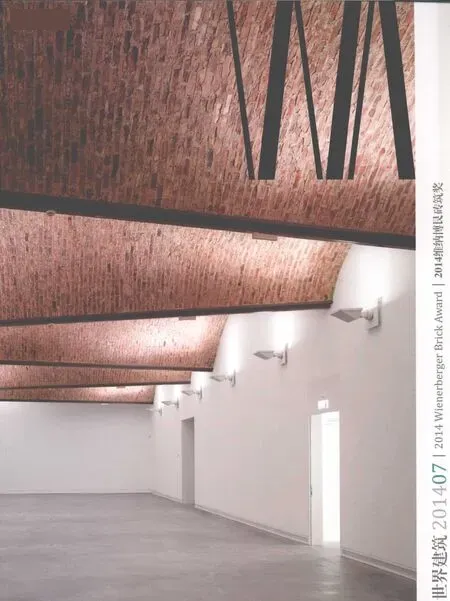
安東尼世家酒莊,巴爾吉諾,意大利
2014-02-20 05:41:08建筑設計阿克雅建筑師事務所
世界建筑 2014年7期
建筑設計:阿克雅建筑師事務所
安東尼世家酒莊,巴爾吉諾,意大利
建筑設計:阿克雅建筑師事務所

1 內景/Interior view
安提諾里侯爵酒莊是世界上最古老的葡萄園之一。這個家族企業成立于1385年,現已傳至第26代——甚至在經歷了600多年后的今天,其發展勢頭也絲毫不減當年。這家企業的葡萄酒年產量在1800萬~ 2200萬瓶之間,它最近一次較大的行動,就是在巴爾吉諾建立了新的總部大樓。這里地處基安蒂大區中部,周邊為帶狀山丘所環繞,并有數千棵柏樹直指云霄。直到最近,公司的生產與行政部門才徹底分開,后者的總部位于佛羅倫薩舊城內一處歷史建筑中,而生產部門則分布在基安蒂區的各個地區。價值近1.1億歐元的安提諾里家族酒莊,現在終于為整個家族帝國提供了一處類似精神家園的場所。
從路邊幾乎看不見這座地中海風格的建筑。整個景觀在平面上進行了兩次切割,山丘看起來似乎被水平地切開了約200m長的條帶。這里采用了一些玻璃,那里還有一些模仿托斯卡納地區赤褐色泥土的預風化耐候鋼——在這兩者之間,令人炫目的旋轉樓梯像一座雕塑一樣盤旋而上。就是這樣。正如《紐約時報》所描述的:“建筑不僅占據了一部分景觀,其自身也成為一道景觀。”
眼睛需要幾秒鐘才能適應黑暗的環境。內部燈光昏暗,空氣中有些許陳腐的味道。在裝有2000個橡木桶的地下空間,諸如天娜、碧波、帕西諾修道院存釀等香醇動人的紅葡萄酒正耐心等待屬于它們的時刻。由無數拱券組成的磚砌穹窿橫跨整個空間,猶如一陣陣形狀非對稱的波浪,充滿動感。兩間品酒室則像兩尊嵌入神圣內殿的玻璃匣。
這樣戲劇化的建筑形態自有其實用功能——高達10m的陳釀酒窖必須冷熱適宜,其環境溫度應全年控制在13~15℃之間。此外,13萬塊燒制磚的使用也賦予了空間如潮濕的貯藏室一般的獨特氣氛。簡而言之,這些傳統都是儲藏紅酒的理想條件。實施這些概念的任務被委托給了佛羅倫薩的阿克雅建筑師事務所,他們的設計在工廠的平面功能布局與空間的神圣感之間取得了完美的平衡。
順便提一句,表面未經處理的線割陶土磚被固定在次要的鋼結構體系上,這些磚的加工地點距離現場僅幾公里遠。它們是為這個項目特別定制的。其特殊的形式是建筑師與技師連續幾周通力合作、加班加點的成果,只為現場安裝時更簡便高效。它們采用了簡單的企口銜接方式彼此固定。
為了建造這座酒莊,大約挖掘了40萬m2土方,數量驚人。經過了7年的建設,其中部分土方被重新鋪設在了建筑頂部,其余部分則用于周邊場地的整頓。現在山坡上又重新生長出了葡萄藤。甚至在幾杯基安蒂紅酒下肚后,人們也很難完全相信,在整片景觀之間隱藏著一個龐大的紅酒帝國,其中包括完整的紅酒生產流線、辦公室、停車場、運料卡車和半掛式卡車的回車道,以及一條1.2km長的公路。(徐知蘭 譯)
Marchesi Antinori is among the oldest vineyards in the world. Founded in 1385, the family business is now in its 26th generation - and even after more than 600 years, it shows no signs of slowing down. The most recent coup for the enterprise, which produces between 18 and 22 million bottles of wine a year, is the construction of a new headquarters building in Bargino, an area in the middle of the Chianti Classico region, surrounded by striped hills and thousands of cypress trees that point like candles into the sky. Up until recently, production and administration were separate: the latter was quartered in an old palazzo in the inner city of Florence, the former scattered throughout the Chianti. Cantina Antinori, which came in at a cost of 110 million euros, now provides the family empire with something akin to a spiritual home.
The subterranean building is barely visible from the road. The landscape bears two level cuts, as though the hillside had been sliced horizontally over a length of 200 metres. A bit of glass here, a spot of pre-weathered Cor-Ten steel imitating the russet of the Tuscan soil there - between them, like a sculpture, a dizzying spiral staircase corkscrews upwards. That's it. As the New York Times described it, "The architecture doesn't just occupy the landscape, it becomes the landscape."
It takes the eyes a few seconds to adjust to the darkness. The light is dim, the air a bit musty. In the 2000 oak casks down below, melodioussounding wines such as Tignanello, Pèppoli or Badia a Passignano patiently await their moment. Like a dynamic, asymmetrical wave, a brick vault with numerous arches spans the space. The two tasting rooms jut like glass drawers into the inner sanctum.
This dramatic architectural gesture has a purpose: the aging cellars, up to ten metres high, need to be neither cooled nor heated. The ambient temperature remains constant at between 13 and 15 degrees Celsius throughout the year. Moreover, the 130000 fired bricks that lend the space its distinctive atmosphere act as moisture reservoirs. In short, the conditions are ideal for the storage of red wine. The credit for the concept goes to the Florentine architecture practice Archea, which has succeeded in creating a clever balance between factory floor and house of worship.
Incidentally, the untreated, wire-cut clay bricks, which are attached to a steel substructure, were manufactured only a few kilometres from the site. They were custom-designed for this project. Their special form, tweaked over weeks of collaboration between the architects and technicians, was designed for easy installation on site. They are simply interlocked with tongue-and-groove joints.
A staggering 400000 cubic metres of earth had to be excavated to build the Cantina. After 7 years of construction, part of this soil was deposited over the building, while the remaining material was used to mould the surrounding terrain. Now vines once again grow on the slopes. Even after a few glasses of Chianti, the fact that the earth conceals a giant empire, complete with wine production, administration, parking lots, turning paths for lorries and semi-trailer trucks, and 1.2 kilometres of road, is hard to swallow.
項目信息/Credits and Data
客戶/Client: 安提諾里侯爵酒莊公司/Marchesi Antinori s.r.l.
建設周期/Construction Period: 2007 - 2012
使用面積/Usable Floor Area: 139950m2
建筑用途/Building's Purpose: 紅酒生產,辦公室,博物館,演講廳,餐館/Winery, offices, museum, auditorium, restaurant
用磚類型/Brick Type: 面磚,室內飾面磚/Facing bricks, interior cladding bricks
攝影/Photos: Wienerberger AG/Pietro Savorelli (Fig.1-5, 8-10), Leonardo Finotti (Fig.7,11)

3 鳥瞰/Aerial view
評論
陸翔:正像延續了600多年歷史的酒莊所產的紅酒,封裝的是味覺的記憶,酒窖部分非承重的“磚券”呈現的是視覺的記憶。磚券的自由弧線、在洞口處的反向曲線以及在地腳處的凹入細部,都已在清晰聲明這里的磚券已不在荷載的重壓之下,加之建筑師設計的可以自鎖的手工磚的質感,使二次結構的磚券更像是一張“漂浮的磚毯”。
楊志疆:如果拋開建筑的功能屬性,該項目更應該被看作是一件大地藝術作品,如同羅伯特·史密森的螺旋形防波堤,它的存在使原有的山丘風景變得神秘而富有詩意。建筑巨大的體量大部分隱于山丘之中,外露部分是超尺度的厚重挑檐和由銹鋼板包裹的巨大的螺旋樓梯。在環境的映襯下,它們仿佛是理查德·塞拉式的大型鋼板雕塑的再現。建筑內部的酒窖空間延續了上部的地貌特征,通過特制的耐火磚,在地下如山丘般連綿起伏,令人印象深刻。建筑師在這一項目中展現了對自然的尊重,對藝術的摯愛,并最終將它們轉化為壯麗風景的一部分。

4 樓梯/Stairs

5 出口/Exit
Comments
LU Xiang: Continuing six centuries of winemaking at this location, the barrels reminds one of countless memories of wine's taste and this wine cellar, defined by non-load bearing brick vaults, presents a visual memory. The freely curving shape of the vaults and the recessing of the floor of the cellar all clearly prove that the brick vault is no longer under stress. With these details and the architect's interlocking handmade brick texture, the surface of the brick vaults appears as a "floating brick blanket".
Yang Zhijiang: If you put aside the functional properties of the building, the project can be seen as a masterpiece - like Robert Smithson's Spiral Jetty -forged from Mother Nature's bosom. It gives the original mountain landscapes a mysterious and poetic aura. Most of the blocky building mass is hidden within the hills, leaving the uber-scaled heavy overhanging eaves and steel plate wrapped in a large-scale spiral staircase to be exposed on the exterior of the building. A scenic natural background serves as a backdrop to Richard Serra's large-scale steel sculptures. The wine cellar continues the upper part of the landscape features, using special firebricks that create a rolling-hill-like effect underground that leaves visitors both astounded and in awe. The architects pay respect to nature and the love of art. They seamlessly integrate those themes into Antinori Winery's spectacular landscape.
Cantina Antinori, Bargino, Italy, 2012
Architects: Archea Associati

6 平面示意/Plan diagram

7.8 內景/Interior view


9 細部/Detail

10.11 內景/Interior view
猜你喜歡
現代裝飾(2021年6期)2021-12-31 05:27:54
北方建筑(2021年6期)2021-12-31 03:03:54
小學科學(學生版)(2020年12期)2021-01-08 09:28:10
文苑(2020年10期)2020-11-07 03:15:36
小學科學(學生版)(2020年7期)2020-07-28 08:00:52
現代裝飾(2020年6期)2020-06-22 08:43:12
少年漫畫(藝術創想)(2020年12期)2020-06-09 05:50:08
現代裝飾(2020年4期)2020-05-20 08:55:08
照明工程學報(2016年3期)2016-06-01 12:17:56
福建農業科技(2016年10期)2016-03-07 09:46:49