
五維茶室,上海,中國
2016-04-11 09:22:13建筑設計創盟國際ArchitectsArchiUnionArchitects
世界建筑 2016年3期
關鍵詞:施工
建筑設計:創盟國際Architects:Archi-Union Architects
?
五維茶室,上海,中國
Tea House,J-Office,Shanghai,China,2011
建筑設計:創盟國際
Architects:Archi-Union Architects
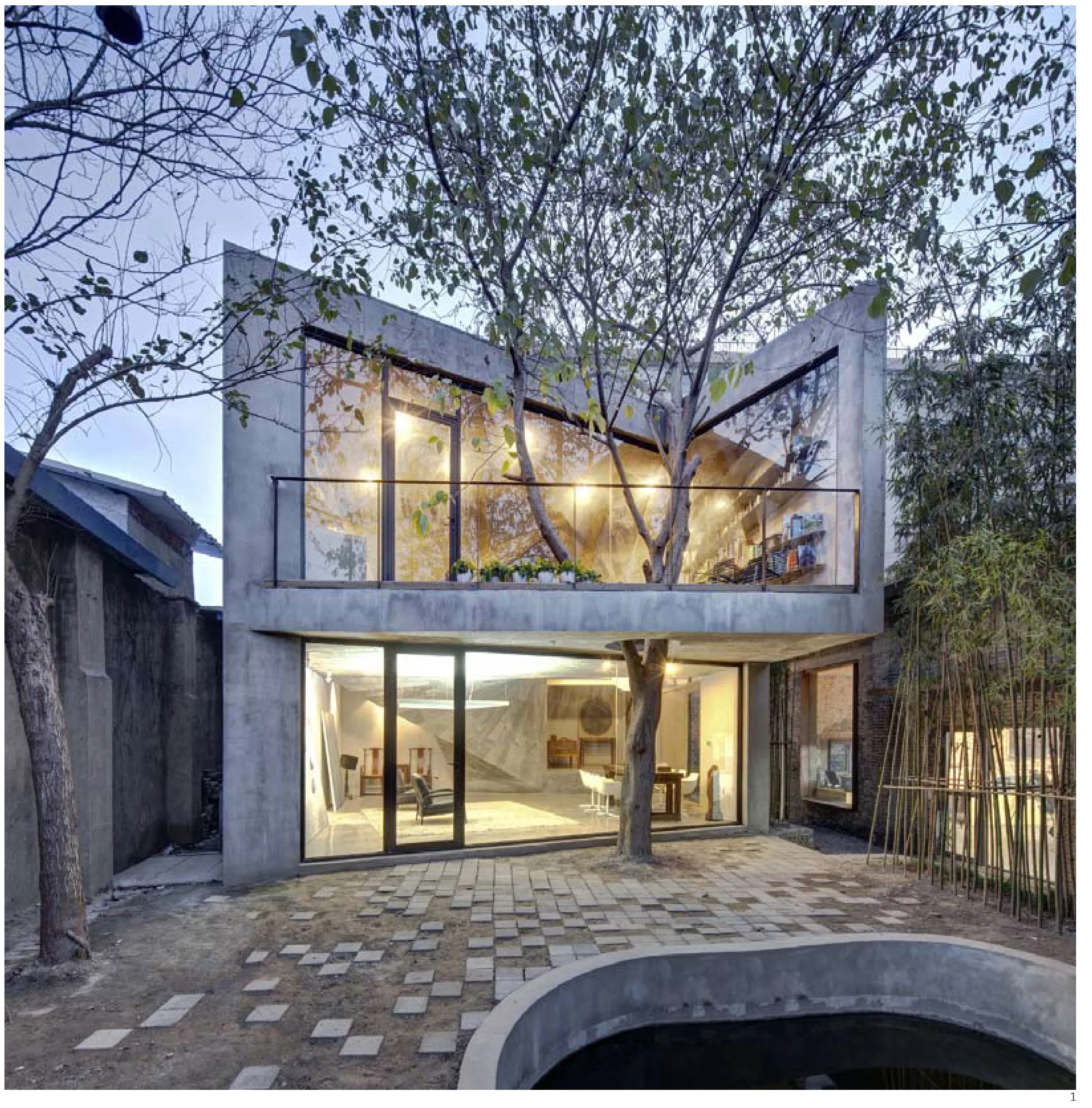
1 外景/Exterior view
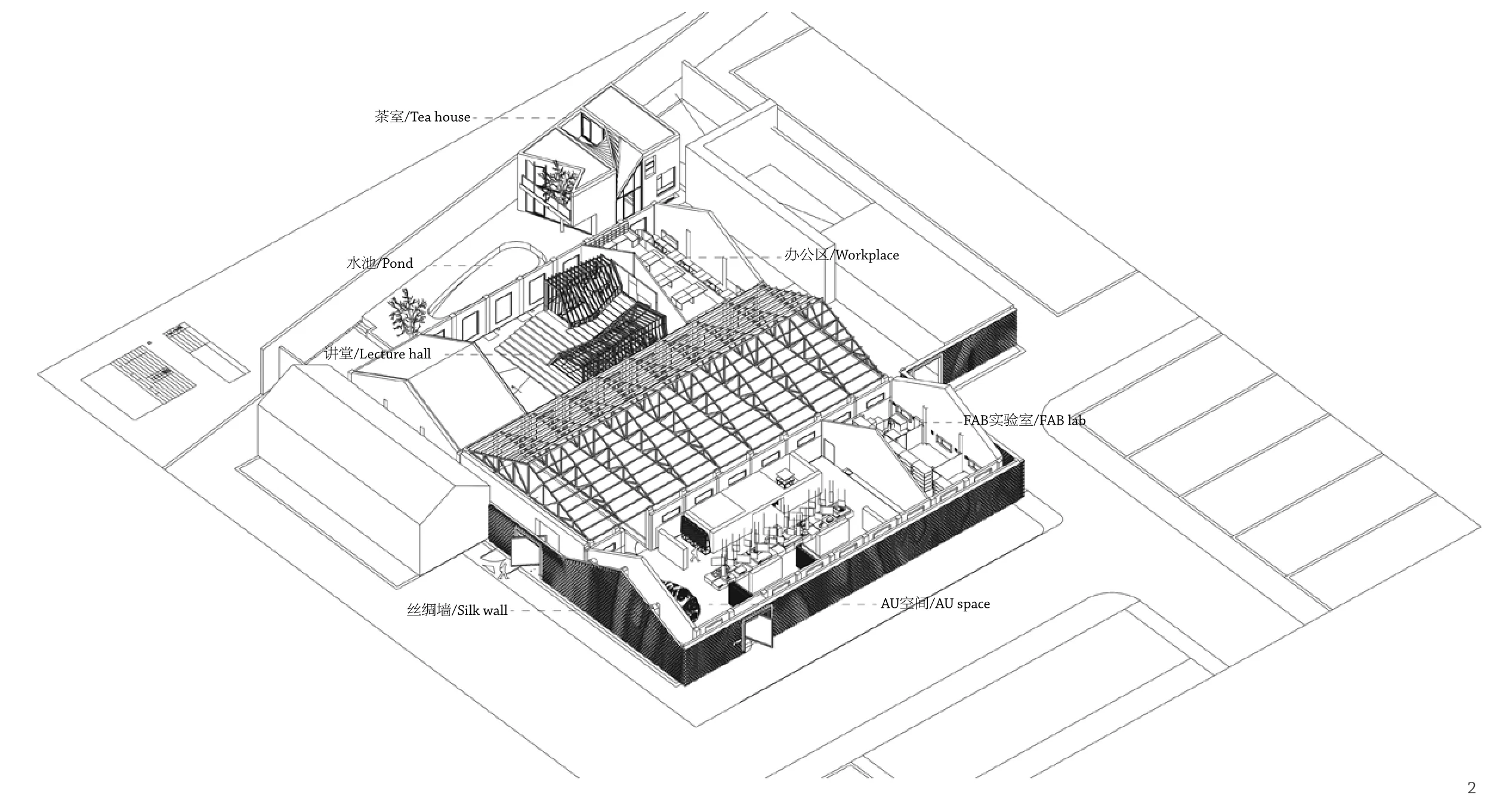
2 軸測平面/Axonometric plan
位于創盟國際J-office辦公區后院的茶室是對基地上原有的一棟屋頂已經塌掉的倉庫房的再建。基地本身極為局促,三向面墻,只有一個方向朝向一個有水池的后院,同時整個建筑對空間的索取也因為現有的一顆大樹而受到很大限制,而設計的結果也表現為一種綜合了封閉與開敞、占有與妥協、趣味空間與邏輯建造等多種復雜關系之后的和諧。整個建筑貼合基地空間,平面布局呈現為一個邏輯關系模糊的四邊形,卻也因此獲得了對空間的最大索取。整個建筑在布局上分為3部分,朝向后院一側布置相對公共性的開敞空間,一層茶室,二層圖書室,同時在二層圖書室伸出一個三角型的小平臺將現存樹木加以包裹,使得樹木和建筑本身融為一體。而背向后院一側布置休息室、圖書室以及輔助服務空間等相對私密的空間;公共空間與私密空間之間通過一個趣味性的連接空間得以串連。
連接空間是一個通過扭轉放樣得到的非線性六面體,將前后兩側的四邊形平面去掉后,連接空間將兩側屬性不同的功能空間加以融合,樓梯空間的置入既解決了茶室的豎向交通問題,又為二層圖書室貢獻了一個可以看到現存樹木的內向小庭院。而連接空間也為本來平淡的基本功能空間創造了新的空間感受,一層茶室空間出現了從平直空間向豎向空間的突變,而二層圖書室的空間也因為趣味空間的存在而獲得了獨有的場所感。
連接空間是一個無法通過平面圖紙表述的三維異形體,我們在Rhino中完成了對形體的基本推敲以及空間的把握,但這樣的數字模型很難直接轉化為可以指導工人進行施工的信息。同時工人手工施工的現有限制條件迫使設計師在提交施工方案時必須同時給出解決措施以實現前沿數字化設計與中國本土低技施工現實的結合。我們首先在數字軟件中將曲面掃描過的多根結構骨架線進行提取,使得曲面形式通過相互交錯的直線得到概括,再將直線進行等分以實現直線間的曲面擬合,等分的距離控制在木模板可擬合的尺寸之內,這樣數字化的放樣就轉化為手工可控制的形態。再根據這樣的直線擬合關系制作1:1的木骨架模具,在這一骨架基礎上蒙上細分后的木模板,由此形成一個完整的空間曲面模板構架。模板構架根據施工工序切分為上下兩次搭造。樓板的澆筑基本和普通的混凝土相一致,唯一區別就是鋼筋的鋪設也與模板的直線取向相一致。鋪設鋼筋后混凝土的澆筑也通過手工來完成,并最終形成了現有的實體效果。模板的痕跡在施工后完全保留,全手工的施工模式使得混凝土的表面出現了很多類似起泡、模板脫膠、鋼絲外露等很多質量缺憾,但曲面的獨特形式卻使得這些得以弱化。雖然無論是模板布置還是手工澆筑都具有一定的造型誤差,但這一數字化設計與低技手工施工相結合的方式對建造數字化建筑的探討也具有了特別的意義。
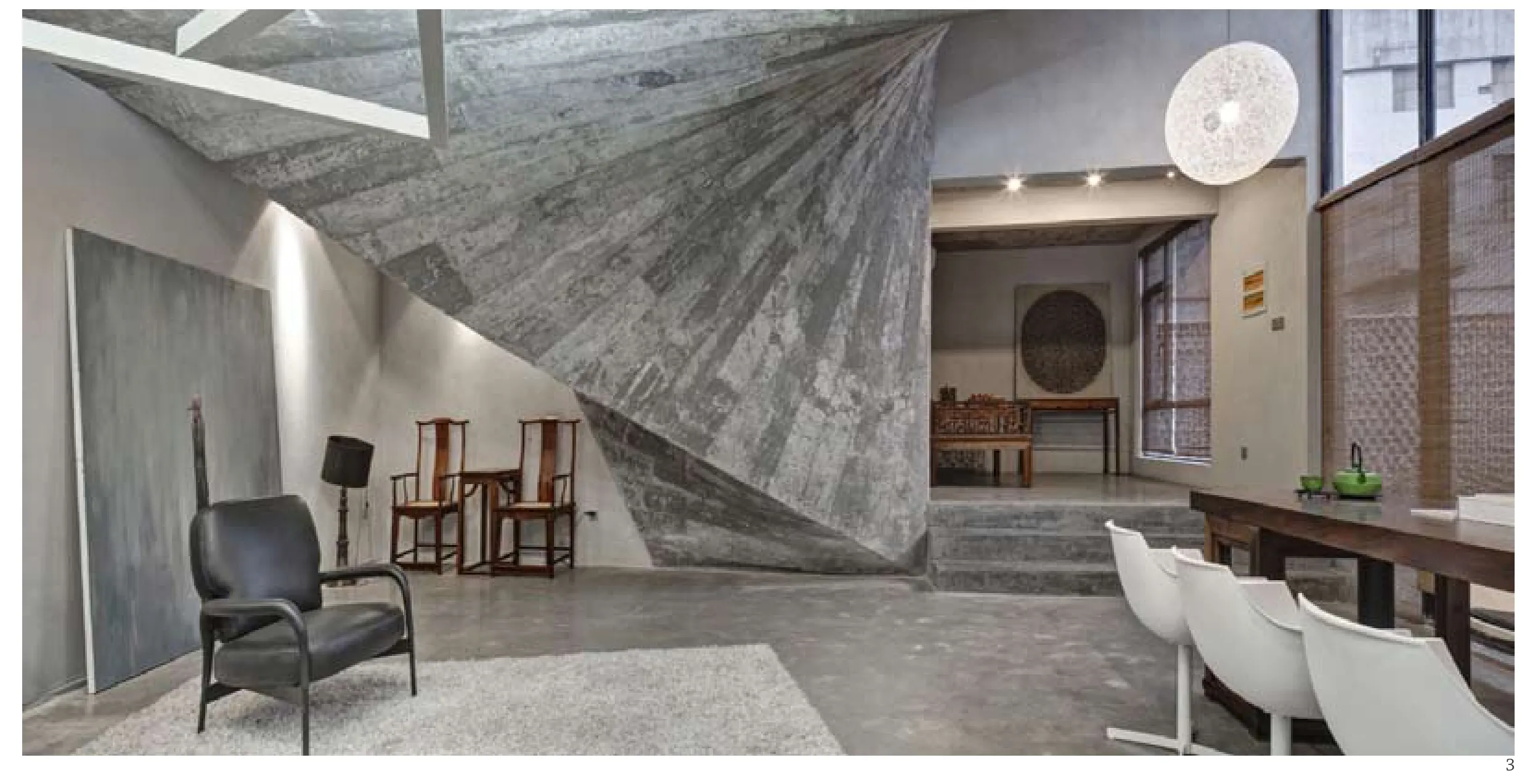
3 首層內景/Interior view,the ground floor
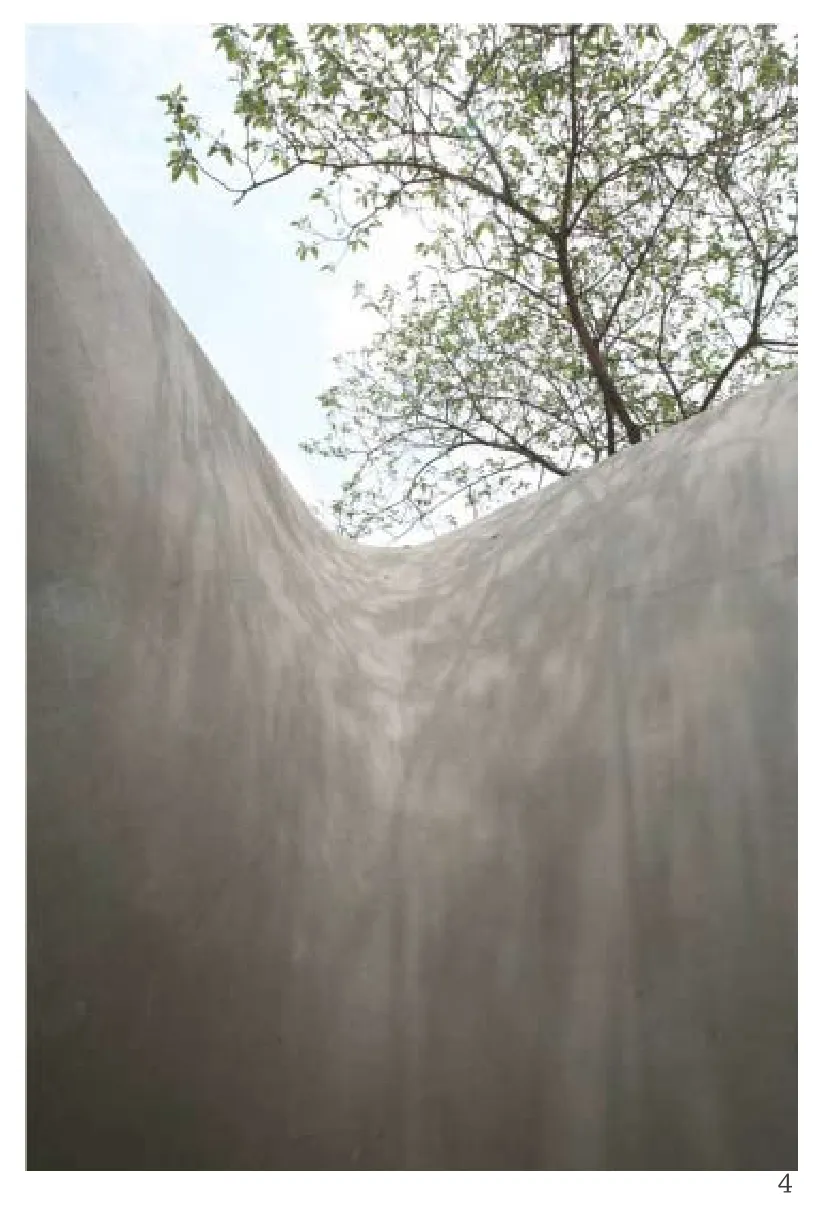
4 從二層仰望小庭院/the inner courtyard,view from the first floor
The Tea House,located in the backyard of Archi-Union's J-office,is constructed from the salvaged parts of an existing warehouse with collapsed roofs.The site was a challenge to design with considerable restrictions due to enclosing walls that only leaves one side facing towards an open space that contains a pool.The space was further restricted by a giant tree.The design ventures at harmony by integrating enclosure and openness,delightful space and logical construction and other complicated relations.This building responds to the surroundings of the site environment; the layout is a rectangle without explicit logic which maximizes the utility of space,divided into three parts.The covered public area is formed towards the open space with the pool,with an enclosed tea house on the ground floor.The library is placed on the first floor from which a small triangular balcony extends to embrace the existing tree.Spaces of more privacy such as a lounge,reading room and service room are arranged at the rear of the building; a delightful transitional space was created to connect the public space and the private spaces.
The transitional space is designed around a twisted nonlinear hexagonal staircase,which connects the functional spaces.The stair resolves the vertical transportation from the tea house and the library,providing an inner courtyard close to the reading room to watch the existing tree.The space is designed to bring a new experience to an ordinary functional space.Linear space suddenly changes into an expressive form,surging from the tea house then transforming into a tranquil space for the library on the floor above,making the reading room a unique place to experience.
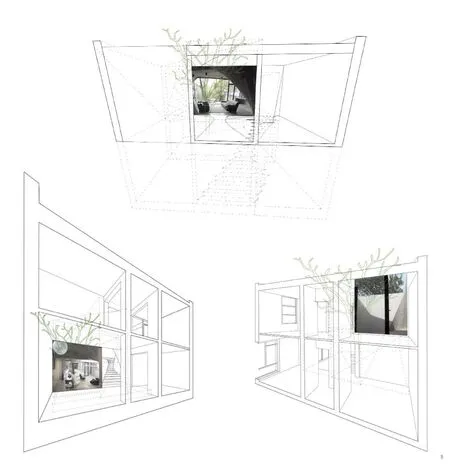
5 茶室與樹的設計關系示意圖/Diagrams of the relationship between the tea house and the tree
The volume is a three-dimensional irregular shape beyond the capability of representation in blueprints.The twisting shape was designed and scrutinized with the software of Grasshopper,an algorithmic plug-in for Rhino.However it is difficult to translate the form into two-dimensional blueprints for construction.The constraints of manual construction obliged us to invent solutions at the time of construction to realize the advanced digital design with local low-tech construction techniques.Firstly we abstracted the structural skeleton which was subsequently scanned with the software.The curvilinear shape was then recalculated through interlacing straight lines which consist of regulated surfaces to fill in the void.The spacing was set to the dimension of timber,thus the digital "setting out" could be easily translated into a manually constructible shape.A full size timber model was erected following the same logic as the digital model; a subdivided timber shuttering covered this framework to create a curved formwork.The formwork was built through a series of upper and lower layers according to the construction sequence.The casting was almost the same as ordinary concrete casting,reinforced with re-bars following the straight lines of regulated surface.Concrete casting after the reinforced bar was completed by manual labor to achieve the finishing effect.The traces of the timber formwork remained imprinted on poured concrete after construction,with quality defects such as bubbles,adhesive failures and re-bar exposure present due to the manual construction–defects,however,that are obscured by the unique curved shape.Although there are errors in the work,planning,manual casting,and a combination of digital design and low-tech manual construction altogether provide a great opportunity to explore the possibilities of digital architecture.
項目信息/Credits and Data
項目地點/Location:上海市楊浦區軍工路五維創意產業園區內/No.1436 Jungong Road,Yangpu District,Shanghai主創設計師/Principal Architect:袁烽/Philip F.Yuan
設計團隊/Design Team:韓力,何福孜/Alex Han,HE Fuzi建筑面積/Floor Area:Approx.300m2
設計時間/Design Period:2010.03-2010.08
建造時間/Construction Period:2010.08-2011.05
攝影/Photos:沈忠海/SHEN Zhonghai
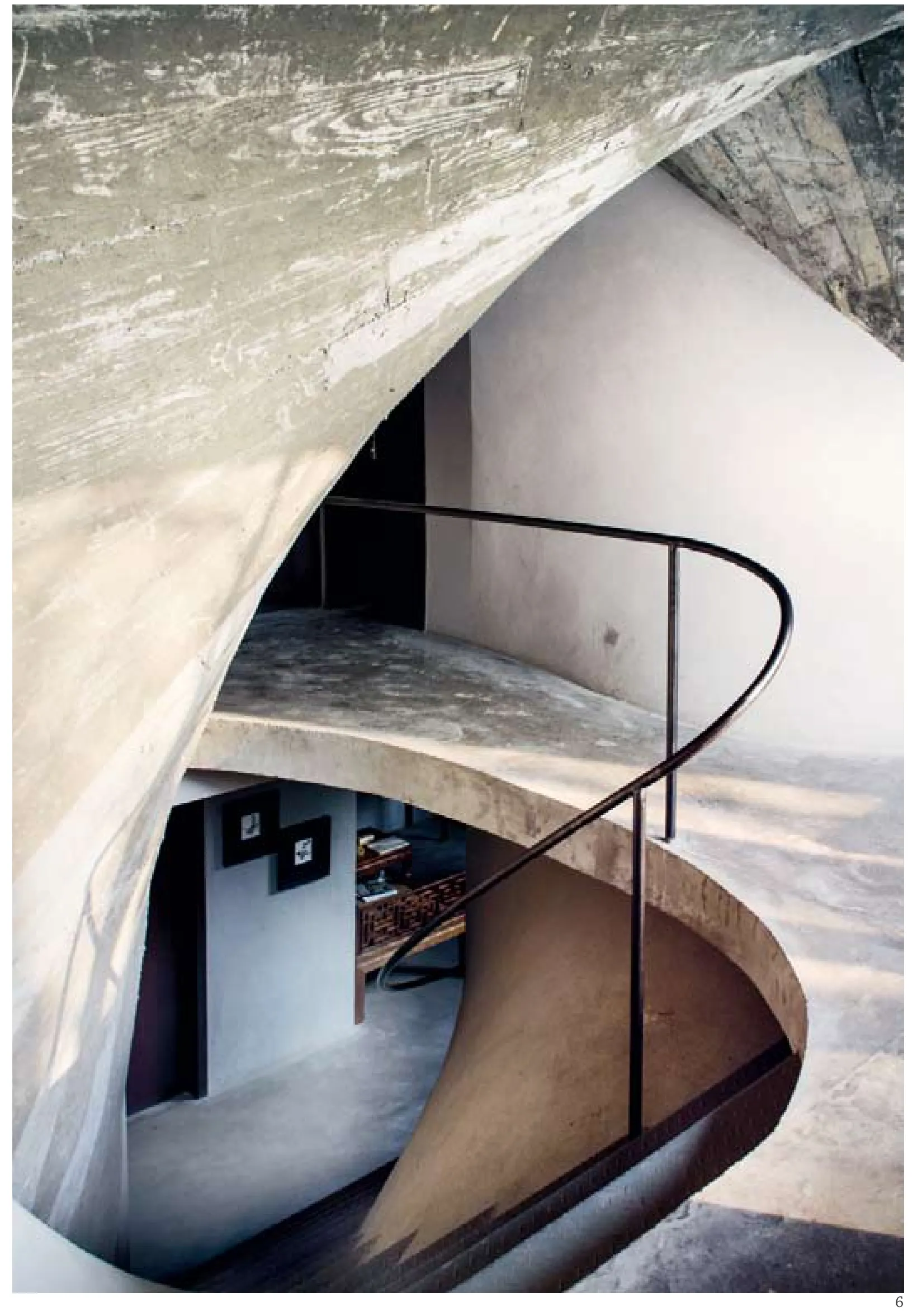
6 扭曲樓梯間/Twisted staircase
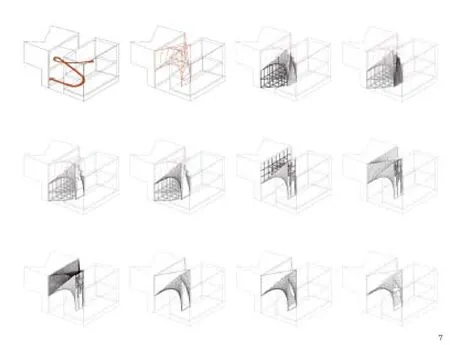
7 扭曲樓梯間建造圖解/Construction diagram of the twisted stair case
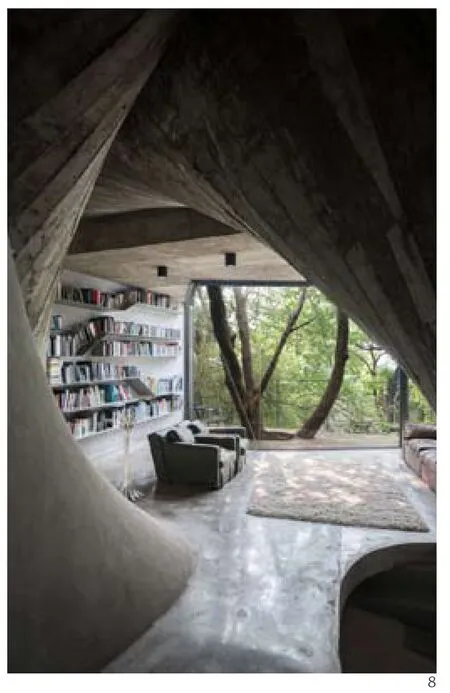
8 二層內景/Interior view,the first floor
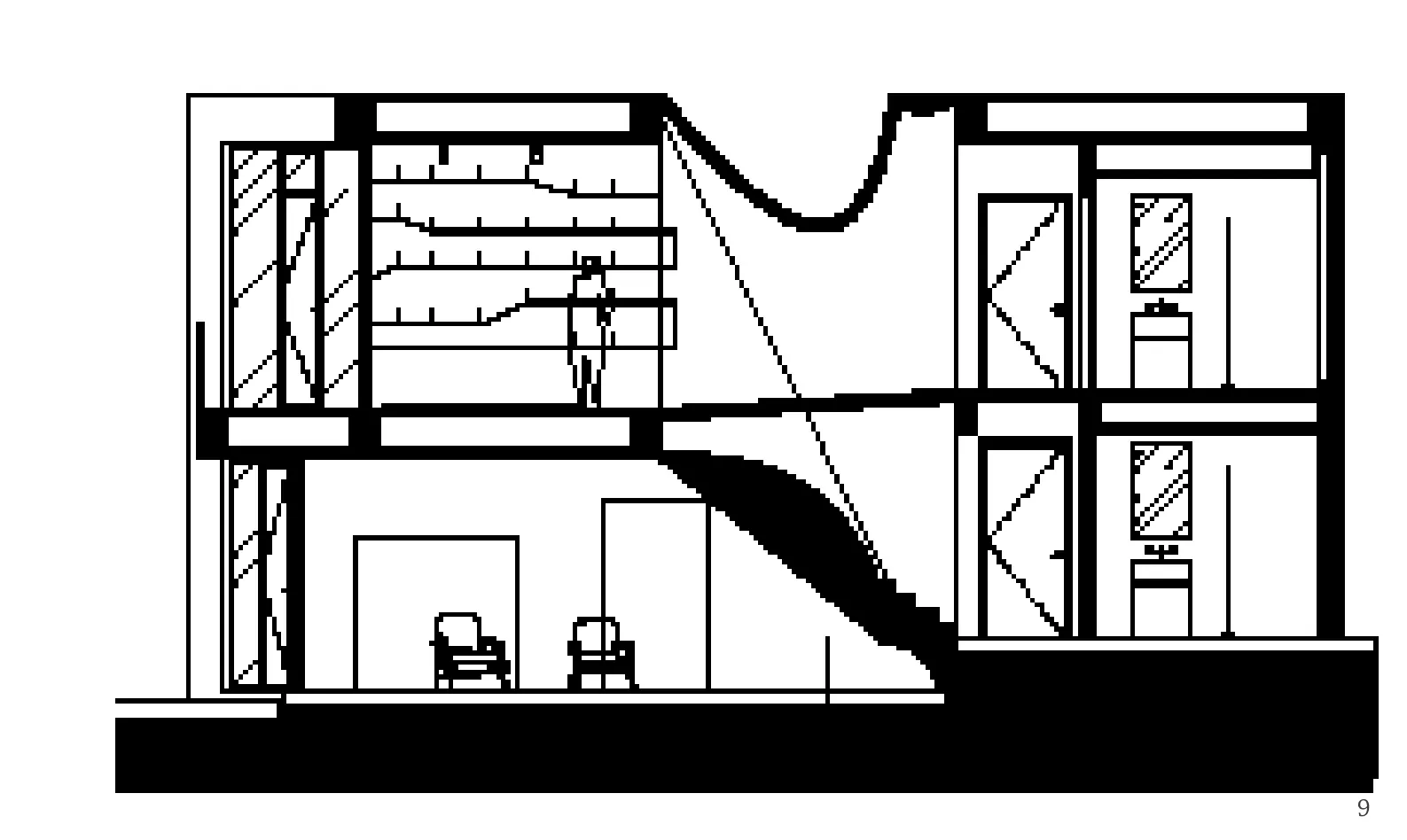
9 剖面/Section
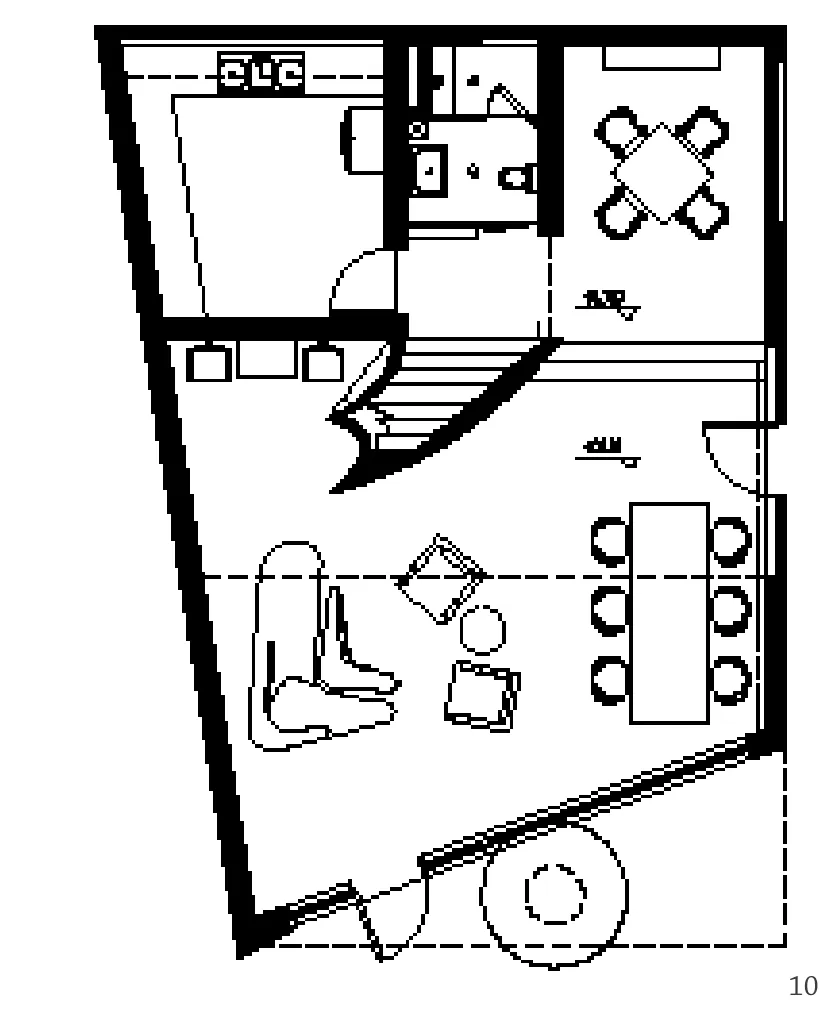
10 首層平面/Floor 0 plan
猜你喜歡
建材發展導向(2022年18期)2022-09-22 07:13:20
建材發展導向(2022年12期)2022-08-19 02:33:10
建材發展導向(2022年10期)2022-07-28 03:04:36
建材發展導向(2021年22期)2022-01-18 06:12:46
建材發展導向(2021年19期)2021-12-06 03:20:50
建材發展導向(2021年18期)2021-11-05 09:19:50
建材發展導向(2021年12期)2021-07-22 08:06:58
建材發展導向(2021年9期)2021-07-16 07:11:36
上海建材(2017年4期)2017-10-16 01:33:34
中國房地產業(2016年2期)2016-03-01 01:25:48
