
巖景茶室,威海,山東,中國Rockview Tea House,Weihai,Shandong,China,2015
2016-04-11 09:22:11建筑設計建筑事務所ArchitectsTraceArchitectureOffice
世界建筑 2016年3期
建筑設計:跡·建筑事務所Architects:Trace Architecture Office
?
巖景茶室,威海,山東,中國Rockview Tea House,Weihai,Shandong,China,2015
建筑設計:跡·建筑事務所
Architects:Trace Architecture Office
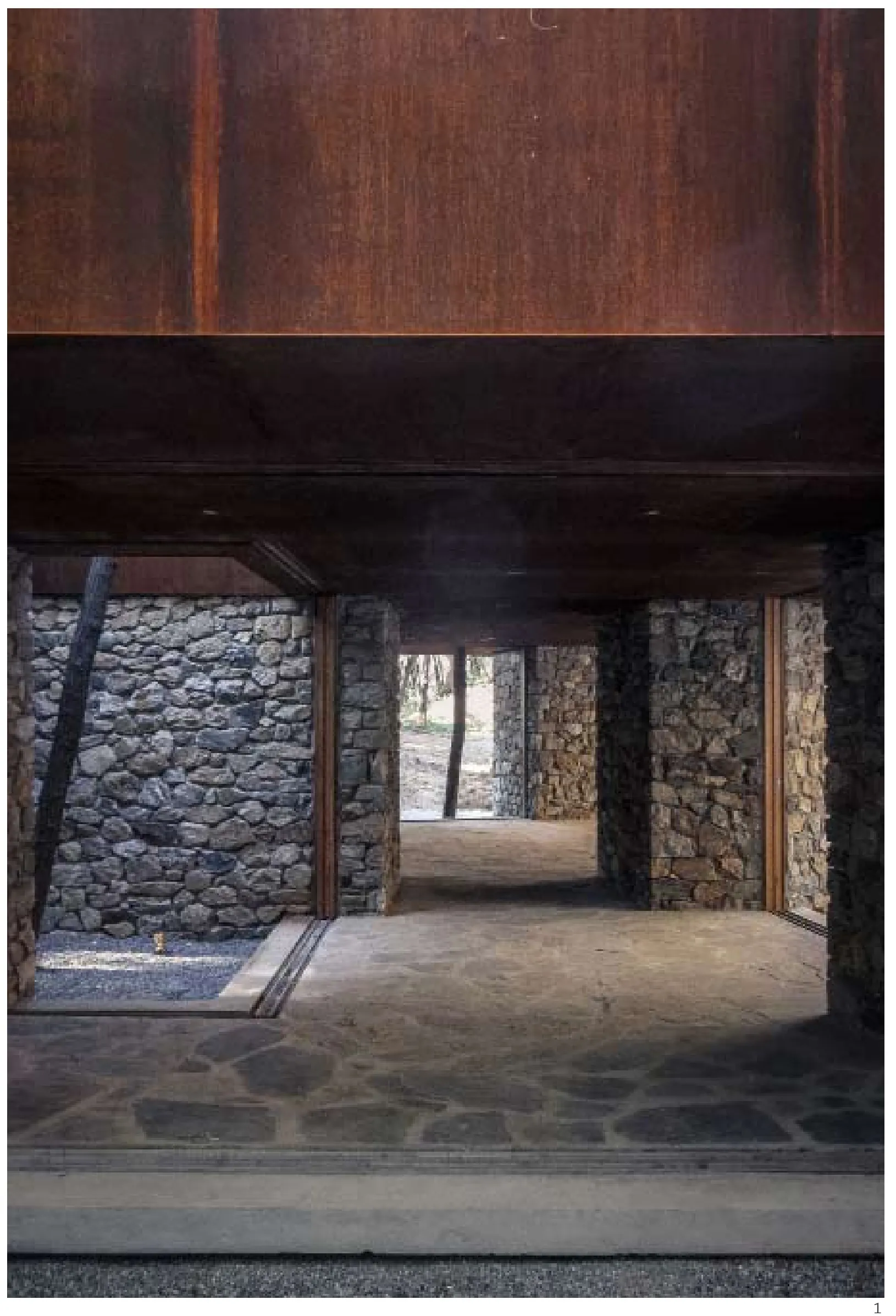
1 內景/Interior view
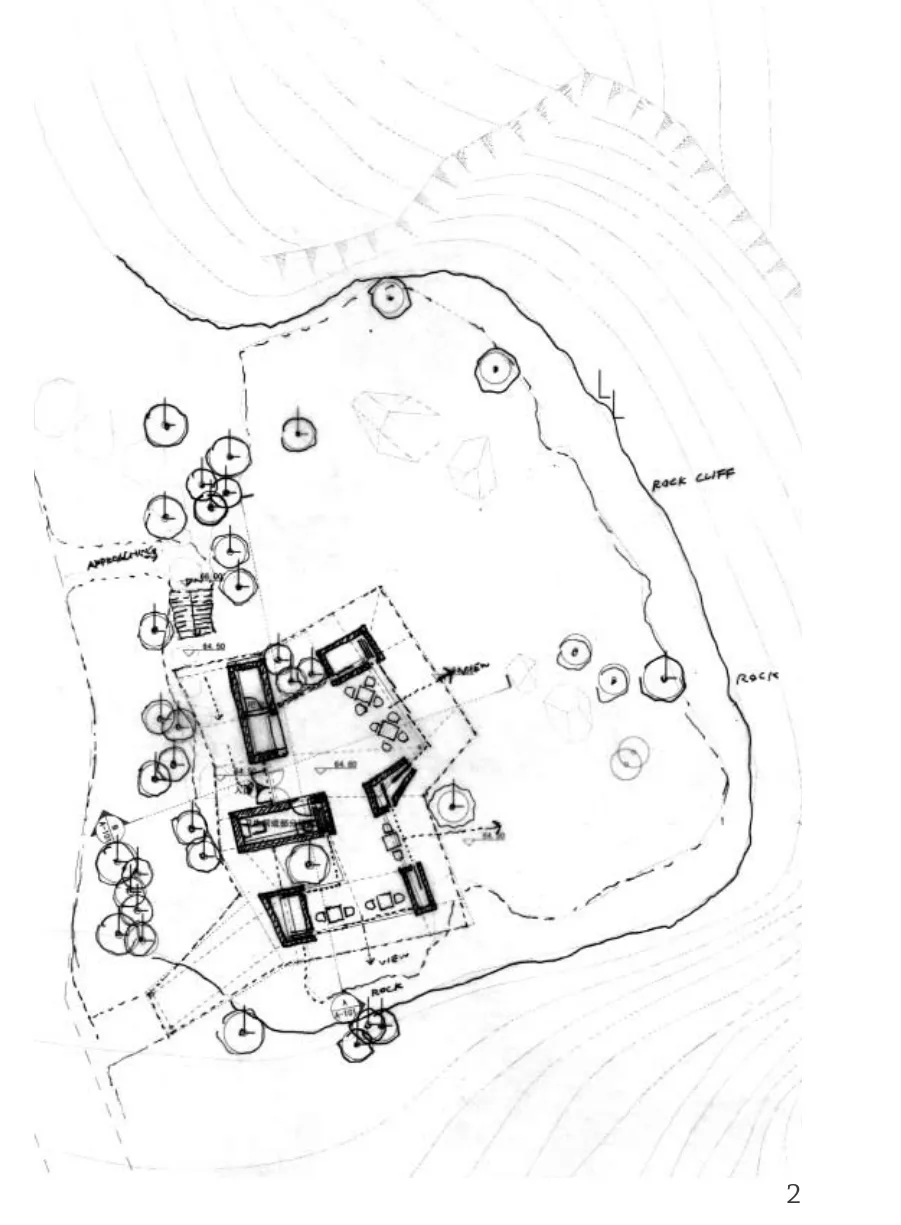
2 手繪平面/Plan sketch
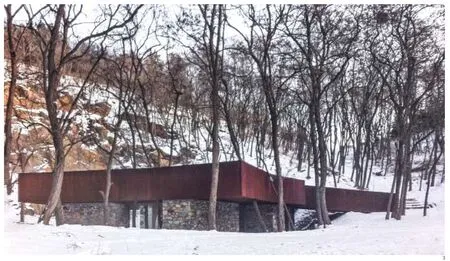
3 雪景/Exterior view in the snow
與巖石和樹木的對話
巖景茶室位于塔山公園,威海市區一處對公眾免費開放的自然景觀公園。1970-1980年代當地人在塔山上開山劈石留下幾處采石場,當地叫石窩子。政府擬將這些荒僻的場地改造為公園景觀節點,服務于市民。巖景茶室便位于其中一個石窩子中。
原本連續并被植被覆蓋的山坡因為采石挖掘被切削,形成如同斷崖式的巨大巖壁。蒼勁的巖壁,與周邊茂密的刺槐林一起,構成場地中的獨特景觀,尤其是冬天雪后,如同一幅水墨畫卷,極富意境。在這樣一個場地里建一個建筑,我感覺最重要的就是保持場地那種所謂“荒”的感覺,“荒”實際上是自然賦予的一種原始而有意趣的意境,卻不是人工造景所能替代的。因此,建筑介入場地應該非常地小心,盡可能不破壞這種意境。
建筑選位于場地內地勢較為平坦的西南角,設計從平面開始,折線形的建筑輪廓源于場地中的樹木以及巖石的自然形態,樹與巖石的位置自然地賦予了建筑的平面形態。在剖面上,建筑與場地形成半下沉的關系。設計利用場地高差搭建起聯系建筑屋面和場地的坡道,使屋面成為游客觀賞巖壁的觀景平臺。主要的室內空間則隱藏在平臺之下,從場地下幾步轉折的臺階進入。內部空間由幾個石頭墻形成的體量界定,這6個體量隱藏了所有的結構,使茶室成為完全由墻來界定的無柱空間,內部也各有其用——服務臺、儲物間、衛生間等,更重要的是,每一個石頭體量也是一個門室,當推拉門扇打開藏入門室后,室內與室外的界限消失了,外面的巖壁成為進入室內的框景。而看不到門窗的建筑,還原為如同由幾塊巨型巖石與屋頂所塑造的洞穴空間,完全融入場地環境當中,帶給人一種更加原始而強烈的感受。為避讓現狀樹而形成的兩個內庭院穿插于內部空間中,使樹木也成為引入建筑內部的景,賦予內外空間更多節奏性的轉換。
建筑從遠處看,水平向延伸的屋頂平臺穿插于樹林的豎向線條中,因出挑形成的懸浮感使屋頂與場地產生一種若即若離的輕的意向,消解了材料本身的重,同時讓下面石墻變得隱蔽,弱化了建筑的體量感。
看似厚重的建筑實際采用的卻是鋼結構,這是因為場地本身運輸困難,因此采用輕質的和預制裝配的建造方式更符合場地條件。特殊設計的淺基礎也是為減少對樹木和場地的影響。建筑采用了銹蝕鋼板與石頭兩種主要材料,銹蝕鋼板的棕色與銹蝕的歲月感很好地呼應了場地中經過多年風蝕的棕紅色巖壁。墻體的石頭則是在采石場就地取材,直接用場地清理和基礎開挖出來的毛石來砌筑的,以一種自然不加修飾的狀態與場地對話。木質門扇、自然面石板地面等材料也都是以自然質感意圖使建筑融入到場地的自然環境中。(華黎,吳純華 文)
4 推拉門扇可見/Windows visible
5 推拉門扇隱藏/Windows hidden in walls
6.7軸測圖/Axonometric drawings
8.9內景/Interior views
Dialogue with Rocks and Trees
The Rockview Tea House is located at Tashan Park,a natural landscape park in Weihai that is open to the public for free.In the 1970s and 1980s,people quarried in Tashan Mountain and left several stone pits,which are called "Shiwozi" in the local area.The local government planned to transform these deserted places into parks to serve for the people.And the location of the project is in one of these stone pits.
Because of the quarrying,the originally continuous and plants-covered hillside is cut into a giant rock that forms a unique landscape at the site together with the surrounding locust forest,which is especially beautiful after winter snows when the landscape is like a delicate inkand-wash painting.To put up a building in such a place,I believe the most important thing is to reserve the sense of "desolation",which in fact is a primitive and charming state endowed by nature and so is impossible to be replaced by artificial works.Therefore,in order to retain this state to the maximum extent,the interference of construction should be managed with extreme care.


11 橫剖面/Cross section
The building is at the southwest corner of the site where the landform is relatively flat.Starting from plans,the outline of the building,which is in the form of broken lines,originated from the natural forms of trees and rocks at the place; the position of trees and rocks naturally decides the plan of the building.From the sectional view,the building is half sunk in the site.By using the elevation difference at the site,the design sets up a slope connecting the building roof with the site,through which the roof becomes a viewing deck for tourists to appreciate the rock.The main interior space is hidden under the deck that is accessible via several steps beneath.The interior space is defined by several volumes formed by stonewalls.All of the structural elements are hidden within these six volumes,turning the tea house into a pillar-free space with wall as the definitive factor that divides the space into different functions – service,storeroom,restroom,etc.More importantly,each stone volume is also a chamber.When the sliding doors and windows are opened and hidden into the chambers,the border between interior and exterior spaces disappears,and the rock outside becomes a framed view to the interior space.At the same time,with the doors and windows concealed,the building is reduced to a cave that is constituted by several giant rocks and a roof,making it completely integrated with the surrounding environment and bringing people a strong primitive feeling.In addition,two inner courtyards,which are designed to protect existing trees,interweave with the interior space,introducing trees into the interior view and providing more rhythms for the changes between interior and exterior spaces.
Seen from afar,the horizontally extending roof interweaves with the vertical lines of the woods.The sense of suspension generated from the rising structure creates an aloof "lightness" between the roof and the site,which alleviates the heaviness of the material used; meanwhile,the stonewall underneath is concealed,which weakens the massy sense of the building.
Heavy in appearance,the building in fact is constructed with steel; because it is difficult to transport heavy materials to the site,light and precast structures are more suitable for this project.The specially designed shallow base also reflects the intention of reducing the impact on the trees and surrounding environment.By using rusted steel plates and stones as the primary materials,a sense of time is created via the brown rust on the steel plates,which corresponds to the brownish red rock that has experienced years of wind erosion at the site.The wall stones were obtained from local quarries.These quarry stones from site cleaning and base excavation respond to the surrounding environment in a natural,undecorated way.Moreover,the choosing of materials such as wooden doors and stone pavements also stresses their natural quality,so as to integrate the building with the natural environment at the site.(Text by HUA Li,WU Chunhua)
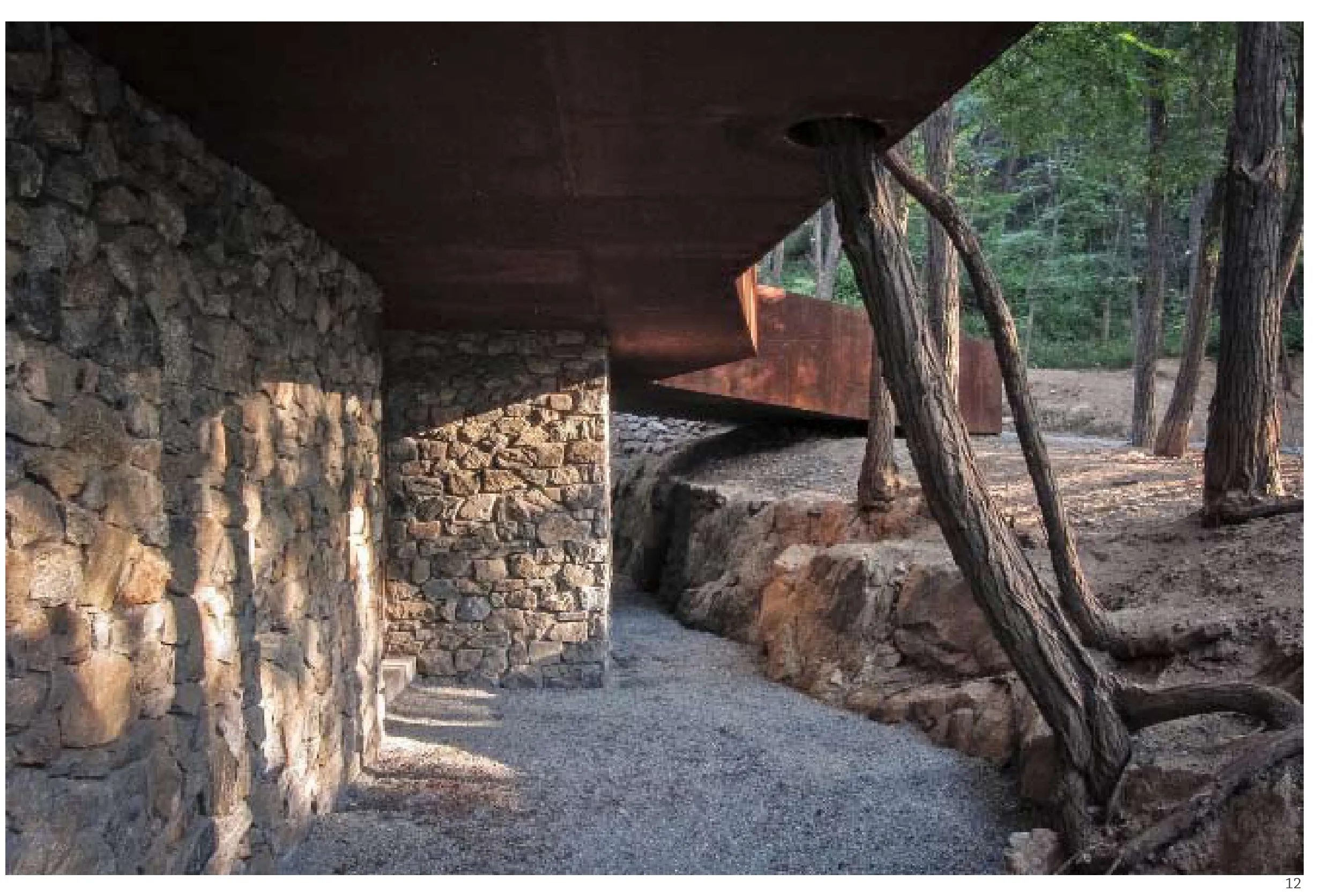
12 入口/Entrance
項目信息/Credits and Data
業主/Client:威海市園林局/Weihai Municipal Bureau of Parks and Woods
項目功能/Project Program:茶室、觀景臺/Tea house,Observation deck
設計單位/Design:跡·建筑事務所/TAO
主持建筑師/Principal Architect:華黎/HUA Li
設計團隊/Design Team:華黎,姜楠,梁文宇,賴爾遜,白婷/HUA Li,JIANG Nan,LIANG Wenyu,LAI Erxun,BAI Ting
建設團隊/Construction Team:吳純華,劉福濤,李志超/ WU Chunhua,LIU Futao,LI Zhichao
照明顧問/Lighting Consultant:遠瞻照明/zdp
建筑面積/GFA:141m2
結構體系/Structural System:鋼結構/Steel structure
設計時間/Design Period:2012-2013
施工時間/Construction Period:2014-2015
攝影/Photos:華黎/HUA Li

13 屋頂平臺手繪圖/Sketch of observation deck

14 屋頂外景/Exterior view of observation deck
猜你喜歡
北方建筑(2021年6期)2021-12-31 03:03:54
文苑(2020年10期)2020-11-07 03:15:36
現代裝飾(2020年7期)2020-07-27 01:27:42
現代裝飾(2020年6期)2020-06-22 08:43:12
現代裝飾(2020年4期)2020-05-20 08:55:08
流行色(2020年1期)2020-04-28 11:16:38
藝術啟蒙(2018年7期)2018-08-23 09:14:18
海峽姐妹(2017年7期)2017-07-31 19:08:17
Coco薇(2017年5期)2017-06-05 08:53:16
福建農業科技(2016年10期)2016-03-07 09:46:49
