Group Work in Large Classes
2016-06-16 08:41:01
瘋狂英語·新策略 2016年3期
?
Group Work in Large Classes
This series of articles from the British Council aims to help you think about your teaching and bring new ideas and activities into your classroom.
The series covers topics including homework, working with large classes and fnding resources. Today we look at group work in large classes.
What is group work?
Group work is when the students work together on an activity in groups, for example, in fours or as a class separated into two.
“To teach a class of 80 students to communicate effectively in English they need to work in groups.”
Georgina, South Africa
Do you agree?
Why use group work?
Several groups can work at the same time so instead of only one or two people practising the language and the others just listening, everyone is active.
Group work is excellent for speaking and listening. Students can also work in groups for grammar and writing tasks, for reading and taking notes while listening—in fact for almost all areas of classroom practice!
Organizing group work
■ Give the students a clear objective for the group work activity. For example, “to practice agreeing and disagreeing in English”; or “to read parts of a text then share information and answer comprehension questions.”
■ Arrange the groups. If you have 60 students you could make 12 groups of 5. Give each student a number between 1 and 12. Ask for a show of hands to check that everyone knows which number they are. All the number 1s make a group, all the number 2s, all the number 3s etc. If you have an odd number some groups will have one student more.
Each group can select a spokesperson and secretary to make notes of the group’s ideas.
During: While the students work in groups the teacher can leave the front of the class and move around,listening to the groups, helping if needed.
After: The spokesperson from each group speaks to the class and summarizes the group activity. Then we can correct any language errors and praise the students’ good work. Group work motivates students in a large class because everyone can participate and practise.
What do you think?
Mirany from Madagascar, writes:
The positive thing about large classes is that you have more life and more dynamism. I give the students more responsibility when they work in groups but I still feel that I’m in charge. I signal to the class to stop by putting up my hand. One student from each group talks to the class after the activity to give the answers or sum up their discussion so we don’t have a problem with everyone shouting out at the same time and making too much noise. We can’t move the furniture in our classroom—so I just move the students!
A classroom activity—a debate
A debate is a good way to get large classes talking in groups. Students can talk about topics that really interest them and they will really want to join in. Here’s one way to organize a debate:
■ Give the students a choice of 3 discussion topics, for example:
? Speaking is the best way to learn a language.
? Everyone should do a sport.
? Health is more important than money.
■ Have a class vote on which topic to debate.
■ Write up key expressions on the board such as “I agree with you”, “I don’t agree with you because…”and “I think…”. Ask higher level students for more ways to agree and disagree in English.
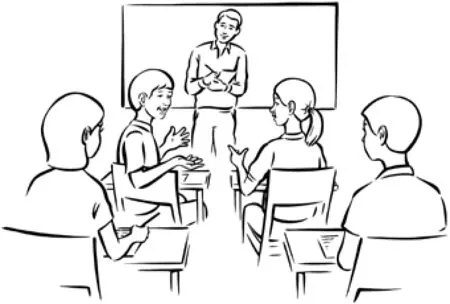
■ Organize the students into groups of 5 or 6. Each group chooses a secretary to make notes and a spokesperson to report back to the class. Set a time limit for the students to discuss the topic.
■ During the discussion phase, monitor and listen to the groups. Remind students to use the key expressions.
■ Stop the activity and ask each spokesperson/presenter to report back the important points from the group’s discussion to the class.
Tip: Vary the groups each lesson to allow students to talk to different people in the class.
Glossary
To communicate is to use language to exchange information and interact.
Comprehension questions are questions about a text. The questions can help the students understand the text.
Monitoring is watching and listening to learners while they are doing an activity but not leading them in the activity. We can fnd out what errors students make as they produce language by monitoring. Your objective is what you want your students to do.
To report back is to give information about a completed activity.
Think about
■ Before you do group work with your class, try to imagine the activity in action. What do you want the students to do? How will you explain the activity?How will you organize the groups? Will you set a time limit? How will you end the activity?
■ After the lesson, think about what you would do differently next time.
Before: Before we do group work we need to: