Finding and Creating Resources
2016-06-16 08:41:01
瘋狂英語·新策略 2016年3期
?
Finding and Creating Resources
This series of articles from the British Council aims to help you think about your teaching and bring new ideas and activities into your classroom.
The series covers topics including homework, working with large classes and fnding resources. Today we look at finding and creating resources.
Many English teachers don’t have resources such as posters, photocopies, internet access or even books.
Read these comments from teachers. Do you agree with them?
“You don’t need new technology to create an effective English lesson; you need imagination.”
Kuheli, India
“When there are no materials the teacher and the students are the main resource.”
Geoffrey, Malawi
What can we use to help us teach English?
■ Draw or cut out pictures from magazines to present new words and revise language (for example numbers, letters, sports, daily routines, greetings). Stick the pictures on card if possible to make reusable flashcards.
■ Use yourself and your students as teaching aids: For example, you can teach clothes, describe where things are, and practise parts of the face using the people in the class.
■ Mime actions (sleeping, cooking, reading…) and ask the students to guess where you are and what you are doing.
■ Use your voice. Beginners can listen and repeat new words. Higher levels can listen to the teacher then talk about their own experiences.
■ Students can learn new songs and chants by repeating each line after the teacher. Adding actions to songs is fun and makes them easier to remember.
■ Ask your students to fnd newspaper articles to discuss in class.
■ We can even use old newspapers as craft material and tear it into shapes to make vocabulary items.
■ Ask students to collect authentic materials in English such as train timetables or application forms to practise dialogues in different situations: When is the next train to…, What’s your surname?
■ Students can bring in a picture to describe or a photo of their family to talk about.
■ Use objects in and around the classroom to represent words. “This table/pencil/chair is an animal. It can swim but it can’t walk. It’s a…”
Be creative with limited resources and use your students’ knowledge and creativity to actively involve everyone in learning English.
What do you think?
Dario, from Argentina, writes:
I make flashcards from old magazines and books to help me teach English. I also draw stick fgures (on the board or on cards) to show people doing different actions or in different situations. I’m a terrible artist but my students have fun guessing what my drawings mean! I paste the pictures onto card and keep them in a folder so that we can use then again and again. I use flashcards to teach new language or to have fun with English in class. Here are some ideas: Show the class 10 cards then mix them up and remove one—ask which one is missing. Show the students 10 cards then turn them over and ask them to remember the pictures. Students work in small groups to invent a story about 5 picture cards. Hold up two pictures of famous people and ask the students to invent their conversation.
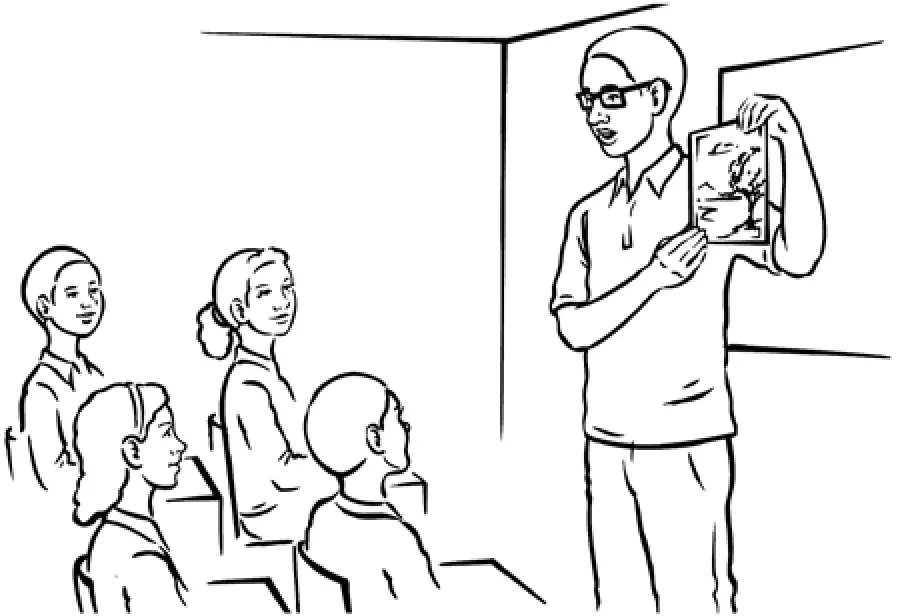
A classroom activity—a back to back game
You can use objects from in and around the classroom to practise giving and understanding instructions.
■ Ask students to collect a few things in the classroom (pencils, erasers, pieces of chalk, stones, leaves etc).
■ Place the students in pairs back to back.
■ Student A has to place his objects in a pattern and then tell his partner what order they are in. Student B has to listen and recreate the pattern.
■ Tell more advanced students that they can’t use the name of the object. This is good for practising adjectives, “Put the long, black thing next to the soft, round object.”
Glossary
Authentic material is English texts which you can use in class but that are not designed for teaching.
A chant is similar to a song; a chant has rhythm but no tune.
Dialogue is conversation.
Flashcards are pictures on cards to help students to understand new vocabulary without translation.
Presenting language is introducing new language.
Revising is practising language that learners have seen previously.
Think about
■ How could you use a newspaper as a teaching resource?
■ Can you cut out pictures of people and ask your students to describe what they are wearing, doing or saying?
■ Perhaps there are photographs that would prompt your students to discuss recent news or sports events.
■ Children could use pieces of newspaper (and their imagination!) to tear out shapes of animals or favourite food and talk about them with their classmates.