
Storytelling
2016-11-01 04:05:35
瘋狂英語(yǔ)·新策略 2016年6期
Storytelling
This series of articles from the British Council aims to help you think about your teaching and bring new ideas and activities into your classroom. The series covers topics including homework, working with large classes and finding resources. Today we look at storytelling.
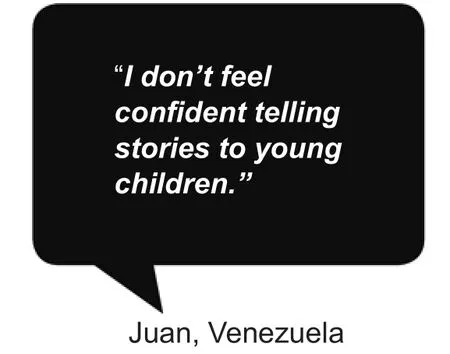
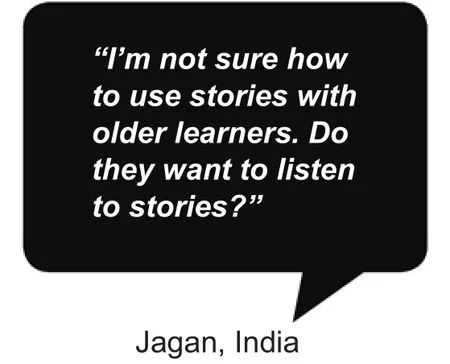
Read these comments from teachers. Do you agree?
How can we use storytelling effectively in class?
Young children usually love listening to stories.
■ Introduce a story with props. Use the cover of a storybook, puppets (use an old sock or a face on a stick) or simple drawings on the board.
■ A picture book can be in any language—just use the pictures. Remember to hold up a book for all to see.
■ Get the children’s attention by saying and miming “Eyes on me. Ears open. Mouths closed!”
■ By telling a story with feeling you can really bring it alive for the students so that they feel they are in the story. Use different voices and actions. Practise your story before presenting it.
■ Encourage children to join in with actions and repeated phrases. Translate or explain new words if necessary.
■ Draw the main characters on the board, each time the children hear the name they have to point to the character.
■ Mime closing a book (or close a real one) for silence.
■ What did the students like about the story? Do they have any similar stories to tell?
■ Retell a story in a future lesson and encourage the children to join in a little bit more each time you read it. Read stories with repeated phrases like “The Three Little Pigs” and “The Very Hungry Caterpillar”.
Older learners need a reason to listen to a story.
■ Tell students three stories about your life, two true and one false. They listen and decide which story is false.
■ We can give two different endings and the students discuss which is correct.
■ Students can listen to a story then try to retell it in groups, each person takes turns to say one sentence.
■ Give students questions to answer before they hear a story (for example, “Why is a boy sitting outside the principal’s office?” “Who’s wearing a pink bow tie?”…). They invent a story through their answers(for example, “A boy is waiting to be punished by the principal. The maths teacher is wearing a bow tie.”)Students want to hear the “real” story after inventing their version.
■ Reading stories or novel extracts can be part of a project. It could include finding information about the author, writing a book review, talking about favourite types of books, making a quiz about the characters in a story, and writing a short story.
Storytelling doesn’t need lots of resources but it can provide lots of language practice for all age groups.
What do you think?
Sharka from Czech Republic writes:
Practise telling stories for young children in front of a mirror. You need to find the right pace and know which words to emphasise (and maybe which to translate or explain!) to bring the story alive.
Telling stories and anecdotes forms an important part of our everyday communication; what we did at the weekend, the latest news, talking about films…. Everyone loves a good story—children, teenagers and adults.
A classroom activity—story grid
This is a low preparation activity to use with teens and adults. Students create a short story in small groups. They don’t write it.
■ Draw a 4x4 grid on the board and then put one word in each box, for example:
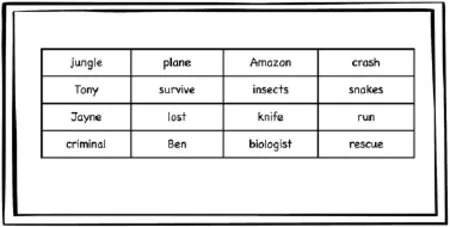
■ Include people and place names, verbs, nouns, adjectives etc. Add some words to make story more exciting such as “crime”, “l(fā)ove”, “hate”, “murder”, “robbery”, “broken- hearted”, “treasure”.
■ In small groups students create a story. They can use any language they want to but they have to include all the words in the story grid.
■ Give help to the groups as they create their stories.
■ They can retell their story to you, the rest of the class or to other groups.
■ Have a class vote on the best story.
Tip: Note errors to write on the board for class correction later.
Glossary
Miming is demonstrating something using actions, not words.
Props are things you can use in your classroom to help you tell a story or set the scene for an activity.
A project is a series of activities where students work together on a specific topic. For example, a group of teenagers produce a poster and give a talk about using social networks such as Facebook.
Think about
■ Which stories do parents tell to their children? Could you borrow picture books(it doesn’t matter what language the words are in) to use for storytelling in class?
■ Ask other teachers which stories their students have enjoyed. Do they have a copy you could borrow?
Want to find more teaching tips? Visit http://teachingenglish.britishcouncil.org.cn
- 瘋狂英語(yǔ)·新策略的其它文章
- 結(jié)合教科版小學(xué)英語(yǔ)新教材淺談如何在中年段小組合作學(xué)習(xí)中設(shè)計(jì)提高學(xué)生聽(tīng)說(shuō)能力的任務(wù)
- 中職商務(wù)英語(yǔ)實(shí)踐教學(xué)模式的構(gòu)建與實(shí)踐
- 高考英語(yǔ)閱讀“七選五”試題研究——以2016年新課標(biāo)I卷為例
- 論小組合作學(xué)習(xí)模式在小學(xué)英語(yǔ)教學(xué)中的應(yīng)用
- 基于批改網(wǎng)的中學(xué)英語(yǔ)寫(xiě)作教學(xué)模式探索
- 例談思維導(dǎo)圖在初一英語(yǔ)閱讀教學(xué)中的運(yùn)用