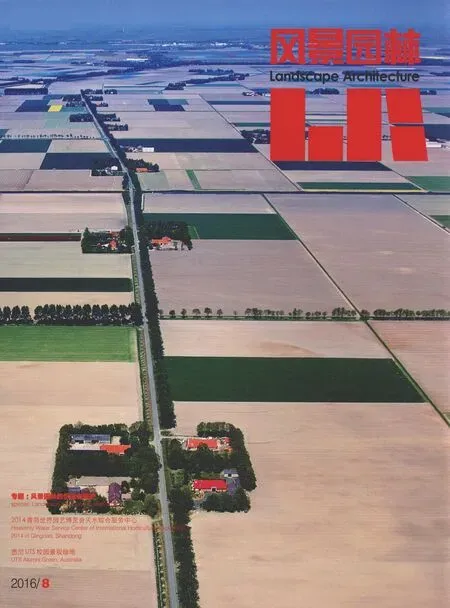
(重新)塑造景觀:中國的人類干預景觀遺產
2017-01-13 09:26:32作者約翰尼斯穆勒
風景園林
2016年8期
作者:約翰尼斯·穆勒
翻譯:張閣、陳航
校對:張晉石
Text: Johannes Müller
Translator: ZHANG Ge and CHEN Hang
Proofreading: ZHANG Jin-shi
(重新)塑造景觀:中國的人類干預景觀遺產
作者:約翰尼斯·穆勒
翻譯:張閣、陳航
校對:張晉石
Text: Johannes Müller
Translator: ZHANGGe and CHEN Hang
Proofreading: ZHANG Jin-shi
景觀作為一個整體代表了地球表面的一部分,包括導致其典型形態的所有影響因子和相互關聯性。換句話說,景觀可以被視為一個生態系統。自然景觀被人類干預(通常是農民和農業)到一定程度,即成為文化景觀,生態系統演變為農業生態系統,人在這個生態系統中是主要的生態因子。
我們今天所看到的文化景觀,尤其在中國,是9 000年甚至更長的歷史長河中,在自然和人類相互的影響之下逐步地改變、影響或適應特定的生態因子后形成的。由此產生的文化景觀反映出人與自然在悠久歷史中的相互關系。由于農業必須有定居點的存在,因此典型的文化景觀包括土地利用系統以及村莊和建筑。
更重要的是,一種長期穩定的文化景觀是可持續土地利用的結果,代表了一種內在的審美價值。經由人類活動導致的自然景觀向文化景觀的轉變不應被看作是對自然或自然景觀的破壞,而應被理解為對景觀的(重新)塑造。
取決于是否適合農業發展,文化景觀在21世紀面臨的發展趨勢包括集約化或徹底遺棄。風景園林的任務即在這兩種極端情形之間找到平衡點,提出發展理念,同時考慮文化景觀的歷史的和美學的價值。
文化景觀;風景園林;景觀歷史;土地利用系統
The cultural landscape as we see it today, especially in the case of China, is the outcome of a history of 9000 or more years of interdependencies between nature and man, step by step changing, influencing or adapting to certain eco-factors. The resulting cultural landscape therefore reflects the long history of a mutual relationship between man and nature. As farming is not possible without settlements, characterizing the cultural landscape includes land use systems as well as villages and buildings.
On top of that, on a long term stable cultural landscapes, being the result of sustainable land use systems, represent an intrinsic aesthetical value. The transformation of a natural into a cultural landscape by human activity should not be seen as the destruction of nature or the natural landscape, but should be understood as (re-) shaping of the landscape.
Possible developments of the cultural landscape in the 21st century include either the intensification of land use or its complete abandonment depending on the suitability for agriculture. It’s the task of landscape architecture to develop concepts on a scale between those two extremes including the historical and the aesthetical values of the cultural landscape.
陳航/1993年生/女/北京林業大……
登錄APP查看全文
猜你喜歡
今日農業(2022年1期)2022-11-16 21:20:05
今日農業(2022年3期)2022-11-16 13:13:50
今日農業(2022年2期)2022-11-16 12:29:47
現代裝飾(2021年6期)2021-12-31 05:27:54
今日農業(2021年14期)2021-11-25 23:57:29
大科技·百科新說(2021年6期)2021-09-12 02:37:27
小學科學(學生版)(2020年12期)2021-01-08 09:28:10
好孩子畫報(2020年5期)2020-06-27 14:08:05
少年漫畫(藝術創想)(2020年12期)2020-06-09 05:50:08
意林·全彩Color(2019年6期)2019-07-24 08:13:50