創設自主學習環境 培養自主學習能力—《WWhhaatt’s for Breakfaasstt?》課堂教學
2017-03-26 09:34:40授課張家口經濟開發區第一小學
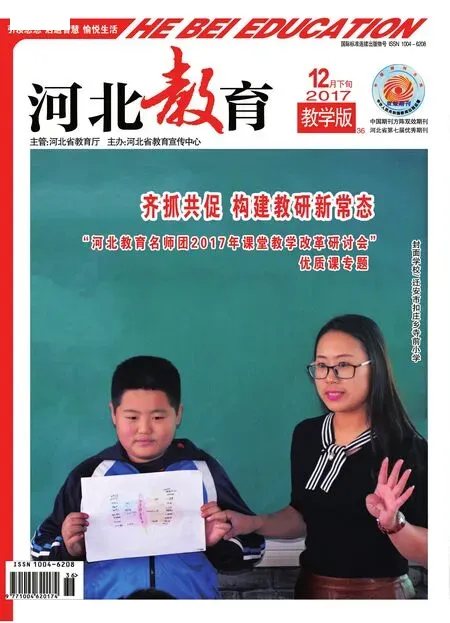
河北教育(教學版) 2017年12期
授課:張家口經濟開發區第一小學 王 莉
評析:張家口經濟開發區第一小學 張亞虹
教學思考
《What’s for Breakfast?》一課的教學對象是剛剛升入四年級的小學生,他們思維活躍,對英語學習有著濃厚的興趣,他們喜歡游戲,喜歡合作,已經形成了一定的語言學習習慣,擁有了初步的自主學習能力,他們渴望獲得更多的用英語交流的機會。正是基于這樣的學情與教學目標,我運用“三段五步”教學模式,充分體現了學生在課堂中的主體地位,改變了學生的學習方式,使學生的自主學習能力得到了提升。
本節課,利用電子書包平臺授課,通過活動化的學習,生動化的活動,讓學生能學、想學、會學,提高自主學習能力。課前學生利用平板電腦觀看微課進行自學,課中我通過平臺為學生發送游戲,發送聽力題,利用平臺的數據統計功能,及時進行反饋。互動性、趣味性、開放性、及時的課堂反饋和診斷,大大激發了學生的課堂興趣,學生學習的主動性增強,上課模式也變得更靈活,極大地提升了課堂教學效果。此外,本節課多次運用小組合作,兩人合作對話,四人合作表演,學生始終處于輕松愉快的學習氛圍中,感受著英語學習的快樂。
課中精選
20分鐘自學指導課
【學案導學】
T: Hello,everyone,goodafternoon.Areyou ready?Who can read it?(屏幕展示自學要求)
Ss:(朗讀自學要求)
T:You pay attention to your writing posture and your handwriting.Let’s begin.
Ss:(大家根據自學要求,觀看微課進行自學)
前十分鐘的時間學生會依照平時的自學習慣和方法,先完成導學案的“預習準備”部分。接著借助微課完成“信息搜集”部分,學生通過觀看微課對信息進行篩選,并將自己認為最有價值的信息記錄下來。最后完成“嘗試解決”部分,對課文內容進行整體感知。
S:(小組內互學)
后十分鐘的時間,由各小組長組織組員進行組內合作互學,仍然按照“預習準備”—“信息搜集”—“嘗試解決”的順序,對前十分鐘的自學情況進行交流,相互補充,對于仍有疑惑的問題統一標注出來等待上課時全班交流。教師通過參與交流了解學生的自學情況以及小組無法解決的疑難問題,這些都將成為課堂上老師講解的重點內容。
T:(學生自學結束)老師很高興看到大家現在的自學越來越有序。組長組織的有秩序,組員參與也很積極。對突出小組和個人進行評價表揚——利用平臺的小組對抗和個人星級評價。
【點評】首先學生與導學案對話。學生依據導語提示明確本節課的學習內容、學習目標和學習重難點并進行勾畫。接著根據導學案提示一步步進行自學。自學后小組長組織組內互學,在組長的組織下相互交流自學成果。
40分鐘展示交流匯報課
一、歌曲激趣
T: Good afternoon,everyone.Let’s sing a song,OK?
Ss:OK.(師生齊唱歌曲并配有舞蹈動作,氣氛活躍)
二、復習舊知與已有知識對話
T: Boys and girls,let’s look.(師指著黑板上的大桌子和一些食物圖片)There is a big table.Andthereismuchfood.Now,whichgroup can stand here and put the food on the table.One student stand here and the other students say“Put the XXX on the table.”You pay attention to“Where do you put them?”.
T: OK!Which group can try?
Ss:(學生躍躍欲試)
T: Wow,everyone is positive.So computer helps me.Ready!
(教師利用“人人通”互動教學平臺的搶答功能,選出幸運的一組來完成)
Zhang Jinlin:We for begin.(做好了貼圖的準備)
S1:Put the bread on the table.
Zhang Jinlin:OK.(找到對應圖片,貼在指定的位置)
T: Loudly,OK?Don’t be nervous.Please.
(小組成員輪流敘述)
T: Are they right?
Ss:Yes.
T:OK,give me five.(與臺上同學擊掌)
Don’t be nervous.Next,you should say loudly.
T:IthinkZhangJinlinisverybrave.So you can get a star for your group.(教師借助“人人通”互動教學平臺的評價功能為小組加星)
【點評】在復習準備部分,讓學生對已經學過的食物進行分類并寫出相對應的英語名稱。目的是回憶舊知,為新知學習做好鋪墊。
三、展示小組詞匯自學成果
T: Next, let’s look.There is a lot of deliciousfood.Nowwhichgroupcanstandhere and tell us“What are they?”or“What’s this?”Then put the food on the table.Can you understand?

T:Dong Yue’s group,please.(董玥組派代表上臺)
(S1,S2分別拿雞蛋圖片和單詞egg)
S1:This is an egg.Follow me,e-g-g egg.
Ss:跟讀e-g-g egg
S1: eggSs: egg
S1: e,eSs: /e//e/
S1: g,gSs: /g//g/
S1: eggSs: egg
S1: From Yu Han one by one.(于涵豎行一個接一個讀)Please say loudly.
......
T:Look at my mouth./egz//egz/
S1:/egz//egz/
T: Not/? /,it’s/e/.Can you understand?
Ss:Yes.
T: OK,let’s continue.
S2:Put the eggs on the table.
S1:OK.(把雞蛋圖片貼在桌子相對應位置)
【點評】由一個小組的學生代表展示本組的自學成果eggs一詞,學生能夠很清楚地講解自學的單詞并能夠做到糾錯,足以說明學生的自學十分充分。
(S1,S2分別拿果醬圖片單詞jam)
S2: They are jam.Follow me,j-a-m/d??m/
S3: Dong Yue,this is jam,not they are jam.
S2:Thank you.
S3:You are welcome.
T:Look, this is jam, not they are jam.Understand?
Ss:Yes.
T:(指著桌子上的食物)Let’s Look.This is milk.This is bread.They are apples.They are oranges.And They are eggs.And this is jam.Understand?
S2:Yes.
T: Let’s begin.
......
S1:Put the jam on the table.
S2:OK.(把果醬和jam圖片貼到桌子上,依照此方法,展示salad)
......
T:(拿起eggs圖片)OK,e 發元音。(幫學生貼圖)
And this is an egg.(在egg前面板書an)
T: I think today they are very brave,they say loudly and clearly.
T:Now,I find Li Na.Li Na is a careful girl.Yes?She listens very carefully.傾聽是一種習慣,傾聽是一種能力,傾聽更是一種文明。今天李娜做到了。Now,let’s clap your hands for her.Thank you.Go backto your seat.(掌聲響起)
I think,Li Na can get a star.(對上臺的學生說)You can get a star for your group.You are wonderful.(董玥組得星,組內歡呼)
【點評】學生匯報小組內新單詞互學的部分是展示課堂的重點之一,教師通過小組的展示,以及展示后其他小組的補充說明,了解學生對知識的掌握程度,然后結合學生情況,以及在自學中發現的問題,進行總結和歸納。在整個展示過程中,師生、生生的交流、補充、質疑、評價在本課展示得淋漓盡致。通過課堂,我們能夠感受到學生的歸納總結能力、表達能力、傾聽能力、與他人交流的能力,都在進行著潛移默化的提高。通過長期培養,學生不僅能自主學習,而且會學習,會合作,這也是我校“三段五步”教學模式想要達到的最終目的。
四、通過自主檢測了解學生自學成果
1.學生完成自主檢測一。
T: Next,boys and girls,do you remember?Now,let’s check.Take out your learning paper,look at text one.Fill in the blanks and check each other.Understand?
Ss: OK,let’s begin.
T:Check each other.If you finish,please sit well.Which group can answer?
......
2.教師通過“人人通”互動教學平臺向學生發送單詞游戲。
T: Please take out your ipad, and put on you earphone.
Ss:完成單詞游戲
3.利用句型I like...或I don’t like...表達自己喜歡和不喜歡的食物。
T: You are happy and I am happy.Now,boys and girls,look at the food.I like apples,butIdon’tlikejam.Becausejamisvery sweet.And how about you?You can tell me,“I like...and I don’t like...”Who can tell me?

S1: I like milk,but I don’t like bread.
T:Milk is good for you.
T:(對S1說)Can you ask the other students?
S: OK.(問其他同學)Hao Yongyi,and you?
S2:Ilikewatermelon, butIdon’tlike bread.
S3: Hao Yongyi,“watermelons”not“watermelon”,again,please.
S2:Ilikewatermelons, butIdon’tlike bread.
......
T: I think,Fu Yuhao’s words are very rich.You should learn more words after school like Fu Yuhao.OK?
Ss:OK!
4.聽力練習。
T: Now, let’sgoandlisten.Listenand checkthefoodtheylike.Pleasetakeoutyour ipad.And put on your earphones.If you finish,please point to“提交”.
【點評】讓學生表達他們喜歡和不喜歡的食物名稱這個環節中,學生能夠補充和質疑,能夠主動產生要學習新詞的欲望,還能夠主動表達自己的觀點。最后的聽力訓練,借助優學派強大的大數據分析功能,統計出哪些學生在哪里還存在問題,然后及時解決,避免了傳統教學中作業批閱不能及時反饋的現象。
五、通過小組合作、展示、交流突破難點
1.難詞突破。
T:Let’s look.I think,they are very deli-cious.So I want them all to be my breakfast.Now,let’s look at breakfast.
(學習單詞breakfast)Breakfast,breakfast.
Ss: Breakfast,breakfast.
T: Now,spell it.b,b,bSs: /b//b//b/
T: r,r,rSs: /r//r//r/
T: ea,Ss: /e/
T: k,k,kS: /k//k//k/
T: /brek/Ss:/brek/
T: f,f,fSs:/f//f//f/
T: a,a,aSs:/?//?//?/
T: No,no,no.a,a,a/?//?//?/Ss:/?//?//?/
T: /f? /Ss:/f? /
T: /st/Ss:/st/
T: OK.The boys says/brek/,the girls/f?st/
Boys:/brek/(教師翻動卡片)Girls: /f?st/
Ss:breakfast
T:Very good.(貼在黑板上)
2.句型突破。
T:What is Betty’s breakfast?Let’s go and listen.PleasetakeoutyourEnglishbook,and turn to page 5.The first one,listen.The second,listen and follow it.Understand?
Ss:Yes.(聽課文錄音并跟讀)
T:Together read it?OK?
Ss:OK!(學生齊讀課文)
T:OK!Verygood.Now, whocananswer“What is Betty’s breakfast?”Who can try?
SYuan: Bread,eggs,and oranges.
T: OK.Betty’s breakfast is...
Ss:Bread,eggs,and oranges.
T: Yes.Thank you.Sit down,please.Now,I know Betty’s breakfast,but I want to know“How to ask早餐吃什么?”Who can help me?
S1:我從課文中和微課中都找到了答案。What’s for breakfast?
T: Do you agree with her?
......
T: Very good.Let’s look at your leaning paper.Can you get the fourth stars?Please color it.OK.If you are right,please color it.If you finish,please sit well.Can you ask me“早餐吃什么?”
Ss: What’s for breakfast?
T:OK.Let’slook.Apples, bread,and milk.What’s for breakfast?
S1:Apples and a sandwich.
T: Well good.They are delicious.What’s for breakfast?
S2: A peach,and a hamburger.
......
T: I think hamburger is very delicious.Yes?
Ss:OK!
3.兩人小組練習問答句型
T:Now,boys and girls,look at your learning paper.Choosesomefoodforyourbreakfast.Andputthemonthetable.Thenfillinthe blanks and answer the question,and write it.The last,work in pairs.Ask and answer“What’s forbreakfast? _________.Ilike_____.Idon’t like__________.”Understand?
Ss:Yes.(學生完成練習,選擇食物,貼圖,書寫,同桌問答)
T:Nowwhichgroupcanstandhereand show your breakfast?Which group can try?
S1: What’s for breakfast?
S2: My breakfast is milk,eggs,and bread.
S1: Do you like it?
S2: I like milk and bread,but I don’t like eggs.
......
T: Read after me“Eggs are good for you. ”
Ss:Eggs are good for you.
(換第二位同學的作品展示)
......
T: It’s different between Chinese food and Western food.Whether,Chinese food and Western food,you pay attention to your health.
4.四人小組合作創編并展示。
T: Now, boys and girls, make a dialogue about food for your breakfast and so on.Let’s work in groups.I give you three minutes.
(教師組內巡視,幫助解決問題)
T: It’stimefortheshow.Whichgroup can stand here and show?
......
5.家庭作業,課后拓展
T: OK.Boysandgirls, let’slookatyour homework.“Makeahealthybreakfastforyour parents.”
T: A sentence is for you.“An apple a day,keeps the doctor away.”
Ss:An apple a day,keeps the doctor away.
T:OK.I hope everyone can take good care of own health.
T: Last,boys and girls,let’s sing a song.Please stand up.
Ss:(起立唱歌)
【點評】通過小組合作、交流、展示,實現組與組之間的對話、學生和老師的對話,相互交流、質疑、補充,提高了學生提出問題與解決問題的能力以及傾聽能力。通過情景劇的表演,學生對所學知識進行了很好的吸收與掌握。在此過程中,評價貫穿始終,有師生評價,組間評價,生生評價,以及優學派平臺的電子評價,每一次評價都能激發學生的學習熱情,使他們在引導激勵下看到自己的能力和進步,從而增強學習的信心。
課后點評
《What’s for breakfast?》是小學四年級英語的第一課,王老師在這節課合理運用多種教學方法,把學習的主動權還給學生,給我們呈現了一節學習環境寬松自主,學習方法多樣,學習興趣濃厚的小學英語課堂。
1.創新的課堂,培養自主學習能力。本節課,王老師每一個環節的設計都可以大大激發學生學習英語的興趣,培養學生自主學習的能力。導學案的設計,不論是“復習準備”“信息搜集”還是“嘗試解決”“合作交流”,每一個環節都環環相扣,知識點從易到難從簡到繁。聽、說、讀、寫的設計也是恰如其分地融入到每一個環節中。尤其是導學案中導語的設計既有方法的指導,更有知識點的歸納總結。學生通過與導學案的對話,實現自主學習能力的提升。在自學環節,王老師要求學生通過微課,進行egg、eggs、jam、salad等單詞讀音的自學。在展示交流環節,每個學生都積極地說出自己學到的單詞,還積極分享記憶單詞發音以及拼寫的方法。在交流、質疑、補充、總結、提煉等過程中,學生輕松掌握所學知識。
2.有效的合作交流,提高學習效率。在合作交流環節更是讓我們看到了王老師在培養小組合作上所下的功夫。王老師把每四個不同基礎的同學(即A1、A2、B1、B2)組成一個小組,學生利用簡單的英語口語進行互學環節的交流,有的學生在表達“I like eggs.”時,會表達成“like egg.”,在表達“I don’t like bread.”時,會表達成“I don’t like breads.”這時,小組長或其他組員會馬上指出其中的錯誤,同時給出合理的理由,即“like后要加可數名詞的復數,直接加不可數名詞”。這不僅可以及時更正某些易錯的知識點,同時在小組內又進行了一次梳理和強化,讓每個組員對此知識點的記憶又加深了一次,這樣的合作交流有效提高了英語學習的效率。
本節課,教師的評價也隨處可見,比如在自學環節,對學生坐姿、寫姿的評價“我們要像某某同學學習,他寫的單詞工整漂亮”,又如教師利用優學派給學生“點贊”的評價,讓學生馬上體驗到了成就感,也有效激發了其他學生積極參與的興趣,不論是個人匯報展示、小組匯報展示還是情景劇表演都讓學生真實地去感受知識,在聽、說、讀、寫、演中體驗英語學習的快樂。

猜你喜歡
科教新報(2022年12期)2022-05-23 06:34:16
今日農業(2021年14期)2021-10-14 08:35:28
海峽姐妹(2020年8期)2020-08-25 09:30:18
甘肅教育(2020年8期)2020-06-11 06:10:22
甘肅教育(2020年12期)2020-04-13 06:25:06
閱讀(快樂英語高年級)(2020年8期)2020-01-08 02:21:16
活力(2019年17期)2019-11-26 00:43:00
智慧少年·故事叮當(2018年11期)2018-05-14 11:48:18
中學數學雜志(2015年9期)2015-01-01 09:00:12
七彩語文·低年級(2011年19期)2011-04-12 00:00:00