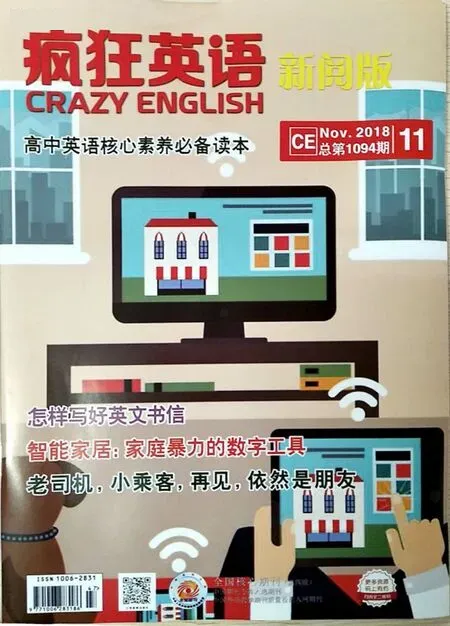
Smart home gadgetry:digital tools of domestic abuse
2018-11-17 03:48:22湖北宜昌天問(wèn)學(xué)校
瘋狂英語(yǔ)·新悅讀 2018年11期
湖北宜昌天問(wèn)學(xué)校 王 晶

精彩導(dǎo)讀
想象一下,你在家里休息,突然你家里的恒溫器上升到好幾十度,門(mén)鈴莫名其妙響起,日光燈不受控制地一開(kāi)一關(guān),而這令人恐怖的一切都是因?yàn)槟愕膶?duì)象在遠(yuǎn)程操控家里的智能家居。沒(méi)錯(cuò),這就是家庭暴力的新形式。據(jù)《紐約時(shí)報(bào)》報(bào)道,不少女性正在遭受這類(lèi)形式的家暴。

?
The people who called into the help hotlines and domestic(家庭的)violence shelters said they felt as if they were going crazy.One woman had turned on her air conditioner but said it then switched off without her touching it.Another said the code numbers of the digital lock at her front door changed every day and she could not figure out why.Still another told an abuse help line she kept hearing the doorbell ring,but no one was there.
Their stories are part of a new pattern of behavior in domestic abuse cases tied to the rise of smart home technology.Internet-connected locks, speakers, lights and cameras marketed as the newest conveniences are now also being used as a means for harassment(騷擾),monitoring,revenge(報(bào)仇)and control.In more than 30 interviews with The New York Times,domestic abuse victims, their lawyers, shelter workers and emergency responders described how smart home technology was becoming an alarming new tool.
給幫助熱線和家庭暴力受害者收容所打電話的人表示,她們覺(jué)得自己要瘋了。一位女士說(shuō)她打開(kāi)了空調(diào),但它自己關(guān)掉了,而她根本沒(méi)碰過(guò)空調(diào)。另一位女士說(shuō)她家前門(mén)電子鎖的密碼每天都會(huì)變,她搞不明白為什么會(huì)這樣。還有人向家暴幫助熱線說(shuō),她總是聽(tīng)到門(mén)鈴響,但門(mén)口根本沒(méi)人。
她們的故事是與智能家居技術(shù)的興起有關(guān)的家庭虐待案件中一種新的行為模式的一部分。互聯(lián)網(wǎng)連接的鎖、揚(yáng)聲器、燈光和攝像頭作為最新的便利設(shè)備,現(xiàn)在也被用作騷擾、監(jiān)視、報(bào)復(fù)和控制的手段。在《紐約時(shí)報(bào)》30多次采訪當(dāng)中,家庭暴力受害者、她們的律師、收容所的工作人員以及急救人員都描述了智能家居技術(shù)正如何成為一種令人擔(dān)憂的家暴新工具。
那些施虐者——使用智能手機(jī)上的應(yīng)用程序,這些應(yīng)用和聯(lián)網(wǎng)設(shè)備相連接——可以遠(yuǎn)程控制家中的日常物品,有時(shí)是為了察看和監(jiān)聽(tīng),另外一些時(shí)候是為了嚇唬受虐者或者是顯示權(quán)力。在接受《紐約時(shí)報(bào)》采訪時(shí),那些談到被智能家居設(shè)備騷擾的人都是女性,她們中的許多人來(lái)自富有階層,在那里,這類(lèi)技術(shù)已經(jīng)大受歡迎。
智能家居技術(shù)可能被輕易濫用的原因有好幾個(gè)。比如,像家中聯(lián)網(wǎng)監(jiān)視攝像頭這樣的工具相對(duì)便宜——有些零售價(jià)僅為40美元——而且安裝起來(lái)很簡(jiǎn)單。再者,通常情況下,處在一段關(guān)系中的一方會(huì)負(fù)責(zé)安裝這項(xiàng)技術(shù),了解智能家居技術(shù)是如何運(yùn)作的,并且擁有所有設(shè)備的密碼。這一切使掌握技術(shù)的一方擁有了利用技術(shù)針對(duì)另一方的能力。
相關(guān)法律手段可能很有限。幾名官員表示,這項(xiàng)技術(shù)太新了,在他們的案件中并沒(méi)有出現(xiàn)過(guò),盡管他們懷疑這類(lèi)情況正在出現(xiàn)。
“我確信這樣的事情正在發(fā)生,”加州帕洛阿爾托警察局的巡長(zhǎng)扎克·佩隆表示,“據(jù)我對(duì)家暴活動(dòng)嫌疑人心理特征的了解,這完全說(shuō)得通。家庭暴力在很大程度上就是關(guān)于控制——人們覺(jué)得只有肉體上的暴力,但其實(shí)還有情感上的暴力。”
Abusers—using apps on their smartphones,which are connected to the Internet-enabled devices—would remotely control everyday objects in the home,sometimes to watch and listen,other times to scare or show power.The people who spoke to The New York Times about being disturbed through smart home gadgetry (小器具)were all women, many from wealthy classes where this type of technology has taken off.
Smart home technology can be easily made use of for misuse for several reasons.Tools like connected inhome security cameras are relatively inexpensive—some retail for$40—and are straightforward to install.Usually,one person in a relationship takes charge of putting in the technology,knows how it works and has all the passwords.This gives that person the power to turn the technology against the other person.
Legal recourse(求助) may be limited.Several law officials said the technology was too new to have shown up in their cases,although they suspected that the activity was occurring.
“I'm sure that it's happening,” said Zach Perron,captain in the police department in Palo Alto,California.“It makes complete sense knowing what I know about the psychology of domestic violence suspects.Domestic violence is largely about control—people think of physical violence but there's emotional violence, too.”
Reading check
1.Why did the people feel as if they were going crazy in paragraph 1?
2.How are the newest conveniences misused according to paragraph 2?
3.How many kinds of functions of using apps on smartphones are mentioned in paragraph 3?
4.Whousessmarthomegadgetryvery frequently today?
5.What does the underlined word “This”refer to in paragraph 4?
6.What does Zach Perron think of domestic violence?
Language study
Vocabulary
1.market v.推銷(xiāo);促銷(xiāo)
2.go crazy發(fā)瘋;變得瘋狂
3.turn on打開(kāi)
4.switch off關(guān)上;關(guān)掉
5.figure out弄懂;弄清楚
6.be tied to連接;聯(lián)合;使緊密結(jié)合
7.be connected to與……相連/有關(guān)
8.take off(觀念、產(chǎn)品等)突然大受歡迎;迅速流行
9.make use of利用
10.take charge of負(fù)責(zé);掌管
11.turn...against(使)與……反目成仇;變得敵對(duì)
12.show up 出現(xiàn);露面
Difficult sentences
1.在接受《紐約時(shí)報(bào)》采訪時(shí),那些談到被智能家居設(shè)備騷擾的人都是女性,她們中的許多人來(lái)自富有階層,在那里,這類(lèi)技術(shù)已經(jīng)大受歡迎。
The people who spoke to The New York Times about ___________ (disturb)through smart home gadgetry were all women,many from wealthy classes__________this type of technology has taken off.
【點(diǎn)石成金】who引導(dǎo)的是一個(gè)定語(yǔ)從句,先行詞為the people。句中的about是一個(gè)介詞,其后的動(dòng)詞應(yīng)用動(dòng)名詞的形式,且disturb與其邏輯主語(yǔ)the people是動(dòng)賓關(guān)系,故首空應(yīng)用動(dòng)名詞的被動(dòng)語(yǔ)態(tài)形式。第2空前的classes,應(yīng)理解為一個(gè)抽象化和模糊化的地點(diǎn)。
2.據(jù)我對(duì)家暴活動(dòng)嫌疑人心理特征的了解,這完全說(shuō)得通。
________complete________knowing what I know about the psychology of domestic violence suspects.
【點(diǎn)石成金】句中knowing what I know about the psychology of domestic violence suspects是句子的主語(yǔ),因?yàn)橹髡Z(yǔ)過(guò)長(zhǎng),需要用形式主語(yǔ)代替;make sense“講得通;有道理”。
猜你喜歡
中國(guó)特種設(shè)備安全(2022年6期)2022-09-20 02:52:28
少兒美術(shù)·書(shū)法版(2021年8期)2021-10-20 06:08:14
甘肅教育(2020年22期)2020-04-13 08:10:56
陶瓷科學(xué)與藝術(shù)(2019年10期)2019-12-18 05:37:20
經(jīng)濟(jì)技術(shù)協(xié)作信息(2018年22期)2019-01-19 03:00:18
中國(guó)生殖健康(2019年11期)2019-01-07 01:27:56
電子制作(2018年11期)2018-08-04 03:26:08
中國(guó)篆刻(2017年6期)2017-07-18 11:09:54
工業(yè)設(shè)計(jì)(2016年12期)2016-04-16 02:52:00
中國(guó)衛(wèi)生質(zhì)量管理(2015年4期)2015-12-01 05:44:21