
比較time-lapse培養和常規體外受精胚胎培養對臨床結局的影響
2019-04-21 13:36:25陳博孫曉巖韓臨曉李青洋趙麗蔡昭煒陳雪梅
中外醫學研究
2019年30期
陳博 孫曉巖 韓臨曉 李青洋 趙麗 蔡昭煒 陳雪梅

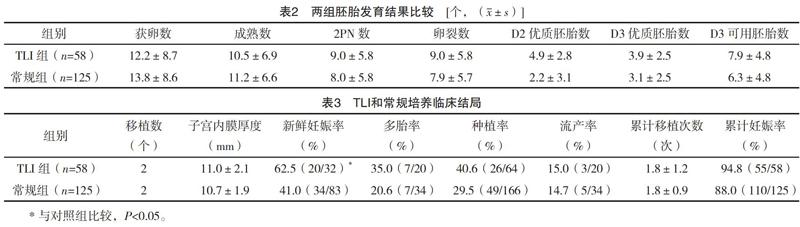
【摘要】 目的:比較延時攝像胚胎觀測技術(time-lapse)培養和常規體外受精(IVF-ET)胚胎培養對臨床結局的影響。方法:回顧性分析2016年8月-2017年5月58例time-lapse培養周期和125例常規IVF胚胎培養周期的臨床結果。比較time-lapse培養周期和常規IVF胚胎培養周期的卵裂數、D3優質胚胎數、D3可用胚胎數、種植率、臨床妊娠率。結果:time-lapse培養周期組和常規IVF胚胎培養周期組的卵裂數、D3優質胚胎數、D3可用胚胎數、多胎率、種植率、累計移植次數和累計妊娠率比較差異均無統計學意義(P>0.05),兩組臨床妊娠率(62.5% vs 41.0%)比較差異有統計學意義(P<0.05)。結論:延時攝像胚胎觀測技術(time-lapse)有助于預測胚胎發育潛能,可以改善胚胎選擇方法,對傳統的胚胎挑選給予新的思路。
【關鍵詞】 時差成像技術 胚胎培養 胚胎評估
doi:10.14033/j.cnki.cfmr.2019.30.080 文獻標識碼 B 文章編號 1674-6805(2019)30-0-03
[Abstract] Objective: To compare the clinical outcomes of time-lapse embryo observation (time-lapse) and conventional in vitro fertilization (IVF-ET) embryo cultures. Method: The clinical results of 58 time-lapse cycles and 125 conventional IVF embryo culture cycles from August 2016 to May 2017 were analyzed retrospectively. The number of cleavage, number of high-quality embryos (D3), number of available embryos (D3), implantation rate and clinical pregnancy rate were compared between time-lapse lapse culture cycle and conventional IVF embryo culture cycle. Result: There was no significant difference in the number of cleavage, number of high-quality D3 embryos, number of available D3 embryos, multiple embryo rate, implantation rate, cumulative transfer times and cumulative pregnancy rate between the time-lapse cycle group and the conventional IVF cycle group (P>0.05), The clinical pregnancy rate (62.5% vs 41.0%) was statistically different between the two groups (P<0.05). Conclusion: Time-lapse imaging (time-lapse) can be used to predict the development potential of embryos, improve the method of embryo selection, and give new ideas on the selection of conventional embryos.
[Key words] Time-lapse imaging technique Embryo culture Embryo assessment
First-authors address: The Third Peoples Hospital of Dongguan City, Dongguan 523326, China
在體外受精-胚胎移植(IVF-ET)過程中,胚胎的發育潛能是影響臨床結果的重要因素[1]。因此,如何正確判斷和選擇具有良好發育潛能的胚胎,保證較好的臨床妊娠結局已成為胚胎學研究的焦點[2-3]。延時攝像技術(time-lapse,TLI)是一種瞬時曝光連續拍攝的成像技術[4-6],通過對胚胎整個體外培養階段進行監測,保證觀察過程中胚胎發育環境的穩定,還能獲取胚胎發育各個階段的形態以及各事件發生的特定時間,為胚胎形態評估提供更為客觀、精準的方式,進而根據胚胎動力學參數有效地評估胚胎的發育潛力,為篩選出最優發育條件的胚胎進行移植。本研究旨在分析比較TLI培養和常規IVF胚胎培養對臨床結果的影響,探討TLI培養是否更有利于選擇高潛能胚胎。
1 資料與方法
1.1 一般資料
選取2016年8月-2017年5月在筆者所在醫院生殖中心行體外受精/卵胞漿內單精子注射-胚胎移植(IVF/ICSI-ET)治療的不孕癥患者。納入……
登錄APP查看全文
