以問題為中心教學(xué)方法在冠心病帶教中的臨床應(yīng)用
2020-06-11 00:37:01孫洪斌
中國衛(wèi)生產(chǎn)業(yè)
2020年7期
關(guān)鍵詞:冠心病
孫洪斌
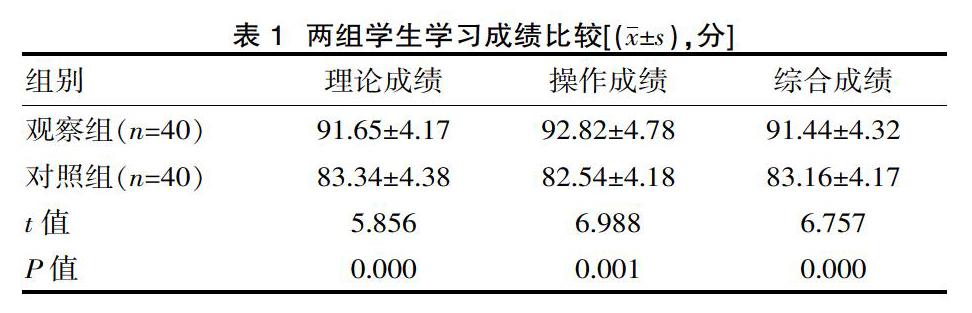
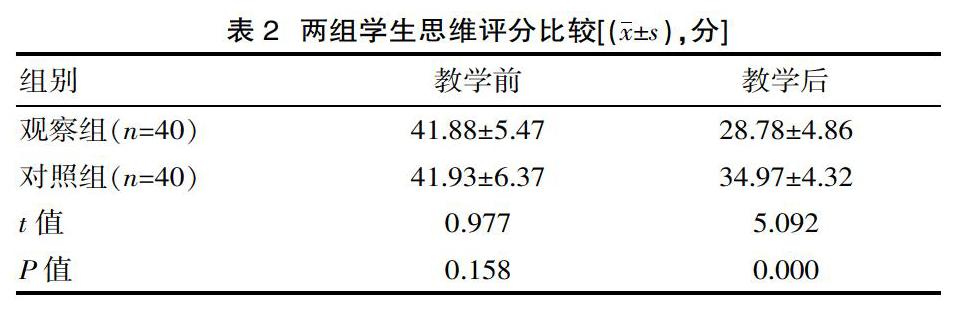
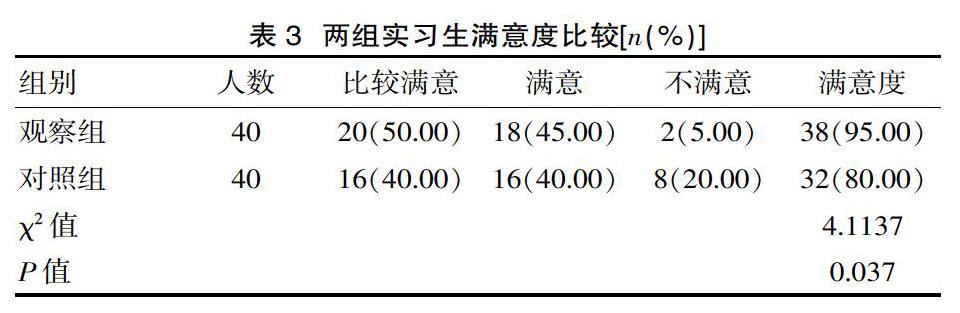
[摘要] 目的 探討以問題為中心教學(xué)方法在冠心病帶教中的臨床應(yīng)用。方法 該研究涉及對象為80名實(shí)習(xí)生,研究時(shí)間為2016年3月—2019年3月,分為對照組(40名)和觀察組(40名),給予對照組傳統(tǒng)教學(xué),給予觀察組以問題為中心教學(xué)模式,回顧分析兩組實(shí)習(xí)生一般情況,對比學(xué)習(xí)成績、思維能力與滿意度,采用統(tǒng)計(jì)學(xué)軟件進(jìn)行分析。結(jié)果 對于實(shí)習(xí)生的學(xué)習(xí)成績,觀察組的理論成績、綜合成績、操作成績均高于對照組(P<0.05)。觀察組實(shí)習(xí)生教學(xué)后的思維評分高于對照組(P<0.05)。觀察組實(shí)習(xí)生的滿意度高于對照組(P<0.05)。結(jié)論 在冠心病帶教中應(yīng)用以問題為中心教學(xué)方法,有效提高學(xué)生學(xué)習(xí)成績,改善思維能力,得到滿意評價(jià),應(yīng)用價(jià)值高,值得在教學(xué)中使用及推廣。
[關(guān)鍵詞] 以問題為中心教學(xué)方法;冠心病;臨床帶教
[中圖分類號] R541.4 [文獻(xiàn)標(biāo)識碼] A [文章編號] 1672-5654(2020)03(a)-0125-03
[Abstract] Objective To explore the clinical application of problem-centered teaching method in the teaching of coronary heart disease. Methods The study involved 80 intern students. The study period was from March 2016 to March 2019. They were divided into control group (40 cases) and observation group (40 cases). The control group adopted traditional teaching, and the observation group adopted center teaching model, retrospectively analyze the general situation of the two groups of interns, compare academic performance, thinking ability and satisfaction, and use statistical software for analysis. Results For the interns' academic performance, the theoretical, comprehensive, and operational performance of the observation group were higher than those of the control group(P<0.05). The observation group's thinking score after teaching was higher than that of the control group(P<0.05). The satisfaction rate of the intern in the observation group was higher than that in the control group(P<0.05). Conclusion The application of problem-centered teaching method in the teaching of coronary heart disease can effectively improve students' academic performance, improve their thinking ability, obtain satisfactory evaluation, and have high application value. It is worthy of use and promotion in teaching.
[Key words] Problem-centered teaching method; Coronary heart disease; Clinical teaching
臨床教學(xué)是醫(yī)學(xué)教育中一個(gè)重要環(huán)節(jié),屬于醫(yī)學(xué)教育重要組成部分。近年來,隨著全球教育規(guī)模不斷擴(kuò)大,對臨床教學(xué)質(zhì)量提出更高要求,而醫(yī)院需加強(qiáng)培養(yǎng)護(hù)理創(chuàng)新型人才,在重視護(hù)士操作技能與理論知識的基礎(chǔ)上,還應(yīng)當(dāng)注重型護(hù)理意識與創(chuàng)新思維[1]。傳統(tǒng)教育模式主要為灌輸式學(xué)習(xí),其教學(xué)內(nèi)容較為死板,方法單一,無法激發(fā)學(xué)生的學(xué)習(xí)積極性,影響學(xué)習(xí)成績,且不利于培養(yǎng)學(xué)生創(chuàng)新思維。近年來,隨著臨床研究的深入,更多帶教管理應(yīng)用于臨床,例如以問題為中心教學(xué)方法等,取得顯著效果。基于此,該文將以該院2016年3月—2019年3月80名實(shí)習(xí)生為對象,探究以問題為中心教學(xué)方法在冠心病帶教中的臨床應(yīng)用。現(xiàn)報(bào)道如下。
1 ?資料與方法
1.1 ?一般資料
該研究涉及對象為80名實(shí)習(xí)生,分為對照組(40名)和觀察組(40名)。其中對照組,男、女分別為21名與19名,年齡為18~23歲,平均年齡為(22.12±0.42)歲;觀察組,男、女分別為22名與18名,年齡為19~24歲,年齡平均值為(22.18±0.62)歲。……
登錄APP查看全文
猜你喜歡
基層中醫(yī)藥(2022年2期)2022-07-22 07:39:18
天津醫(yī)科大學(xué)學(xué)報(bào)(2021年4期)2021-08-21 02:14:32
保健醫(yī)苑(2021年7期)2021-08-13 08:47:48
基層中醫(yī)藥(2020年10期)2020-11-27 01:58:58
智慧健康(2019年36期)2020-01-14 15:22:58
中國中醫(yī)藥信息雜志(2016年5期)2016-12-01 06:07:23
中國衛(wèi)生標(biāo)準(zhǔn)管理(2015年25期)2016-01-14 09:29:17
中國衛(wèi)生標(biāo)準(zhǔn)管理(2015年3期)2016-01-14 03:41:45
醫(yī)學(xué)研究雜志(2015年7期)2015-06-22 11:01:01
中國中醫(yī)藥現(xiàn)代遠(yuǎn)程教育(2014年17期)2014-03-01 04:29:27