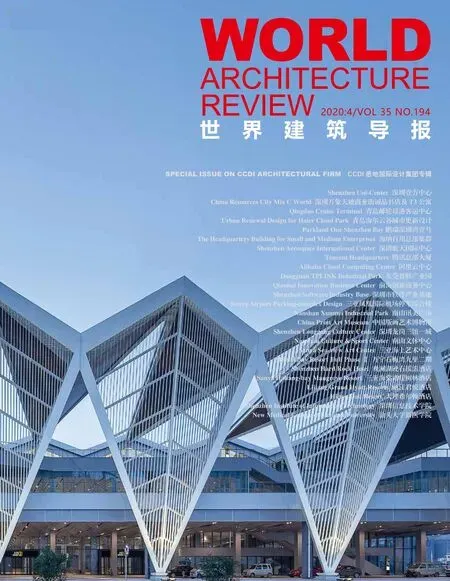
體育建筑的復合體驗與專業進階
2020-09-07 06:45:24初騰飛艾俠ChuTengfeiAiXia
世界建筑導報 2020年4期
文/圖:初騰飛,艾俠 Chu Tengfei, Ai Xia
自2002年CCDI(悉地國際)與設計聯合體通過國際競賽中標國家游泳中心(2008北京奧運會主要體育建筑之一)之后,CCDI 開啟了一系列國際頂級體育建筑的設計歷程,在最繁忙的時刻,我們每一天都有超過200 位設計師和工程師在從事體育建筑相關的設計服務。 如今,位于杭州奧體博覽城的主體育場和網球中心相繼建成,迎來了體育建筑的又一個高峰時刻。與此同時,我們有必要系統地回顧和反思體育建筑這個領域的歷史、當下和未來,人類為何會投入如此巨大的財富去建筑巨型的體育設施?人們喜愛怎樣的體育場館?這類建筑的未來可能會發生怎樣的演變?雖然在體育建筑的專業領域已經耕耘了二十年,這些問題依然讓我們對這個世界充滿著的好奇和敬畏。
時代精神的延續:體育建筑的歷史溯源
如果說體育建筑從誕生初始就承載著一個優越的使命,那就是國家國力和精神的象征。正如競技場在古羅馬的偉大建筑群中占據著重要席位,時至今日的現代體育場也沒并有超出它所蘊含的基本原型。
從世界范圍內回顧,體育建筑的起源似乎是希臘人的專利。早在公元前776年,古希臘就建造了建筑史上著名的奧林匹亞體育建筑群,包括狹長形的體育場和供運動員進行室內操練的體育館等。隨后,古羅馬帝國發展了圓形和橢圓形的體育場,并且顛覆了希臘時期借助山坡作為看臺的做法,而采用了骨架和拱券結構,成為現代觀演式體育建筑的雛形。經過千年的漫長發展, 1811年,柏林建成世界上第一座現代化體育館。1896年,第一屆奧林匹克運動會在雅典舉行,從此開始了現代意義上的體育競技比賽空間的序幕。
在此之后,現代體育建筑大致經歷了四個主要發展階段。第一次世界大戰之前的體育建筑功能單一,設施簡樸,但是體現了以體育為本的樸素發展觀。兩次世界大戰之間的第二階段,體育建筑開始出現美觀的座椅和罩棚,提升了使用的舒適性,并加入了商業服務。二十世紀五十年代到八十年代為第三階段,此時建筑技術發展促生了可開啟屋蓋技術出現,以及更多功能的介入使得體育場成為日益復雜的都市基礎設施。上世紀八十年代之后為第四階段,此時的體育建筑更注重觀賽的體驗和商業效益,復合程度也更高,除了多功能使用外,還注重建筑在競技賽事之后的靈活性使用,可持續發展和動態適應性,并開始結合數字技術提升體育建筑的整體品質。
雖然體育建筑源于西方,但中國古代對此也并非陌生。儒家孔子主張“有文事者必有武備”,君子六藝“禮、樂、射、御、書、術”中的“射、御”就直接關乎體育。古代中國人建造的球場、武場和體育學堂等,可以說是中國體育建筑的早期雛形。20世紀初,中國開始興建現代體育建筑,最早的實例是北京青年會露天體育場(1914)、上海江灣體育場(1935)等等。新中國成立后,我國在體育設施建設方面取得了長足的進步,但真正的規模化發展還是在上世紀七八十年代,各大省會級城市相繼興建了一批“初代”體育場館。
大約從北京奧運會開始,體育建筑成為體現當代中國開拓進取的時代精神的重要標識,不斷地向世界第一流的水平看齊。從北京的奧林匹克體育建筑(鳥巢&水立方)到杭州奧體博覽城的主體育場和網球中心(大小蓮花),近十年來的“新一代”體育場館正在演繹著一種超出建筑本體的時代精神,并且徹底改變了中國當下的都市景觀。
商業和競技的平衡:體育建筑的當下觀察
研究體育建筑的發展軌跡,我們可以看到,經濟的繁榮無疑是推動體育建筑進步的重要因素。作為耗費巨大資源的體量巨大的建筑類型,體育建筑往往被人們作為國家或者地區顯示技術發展水平和經濟實力的象征,同時也是展示地域文化內涵的載體。實際上,體育建筑始終都被賦予著一種英雄主義的夢想和情懷。越是規模等級高的體育建筑,在其有形的物理功能之外,越承載著越多的精神和文化價值。
同時我們可注意到,體育建筑屬于技術敏感型的先鋒建筑。結構技術、材料技術、新的工藝以及信息技術的飛速發展,都會深刻地影響到體育建筑的發展。這些新技術往往會率先運用到體育建筑中去。從這一角度來看,體育建筑雖然常常耗費巨大的社會資源,但它在推動技術進步這一點上始終都有其積極的一面。
不論在中國或是國外,我們都可以觀察到當下體育建筑的幾個顯著特征:
其一,體育建筑對于商業運營的需求愈發重視,由此帶來建筑功能的進一步復合化。由于體育建筑的建設模式正逐步從單一的政府投資向著社會資本投資增加的方向轉變,形成了多元化的投資格局。體育建筑從具有濃厚的政治色彩的建筑類型逐漸轉向具有商業色彩的建筑類型。我們在進行體育建筑設計的時候,更準確的表述應該是在開展一個具備體育競技和大眾健身功能的商業綜合體的設計,需要在業態組合和商業動線做到充分的研究。熱烈的氣氛、良好的視線、舒適的座位、完善的娛樂、社交的便利,這些都成為體育建筑必須具備的“商業基因”。
其二,雖然多元化、功能復合是當下體育建筑的發展趨勢,但是我們也注意到某些體育建筑也在朝著單一功能的專業化發展。比如一些歐洲國家,有完善的聯賽制度以保障單純的足球俱樂部圍繞足球產業獲益,所以會建造大量的專業足球場而非多功能綜合體育場。這類體育建筑將在專業的深度和精度上有更多發展,也就是把體育建筑內跟競技相關的部分做得更加純粹,而服務配套部分需要更加靈活。
其三,大型體育中心的開發模式具備一個趨同的方向,即作為城市帶動新區發展的引擎,這種模式在城市新區的發展中已有多個成功的案例。體育中心的建設逐步成為一個產業鏈的核心,對城市的影響和驅動力在增長。建筑師在真正開始規劃和建筑設計之前,需要更多關注區域經濟、政策導向,主動梳理和積極研究多重外部因素的關系,對一個體育建筑組群、園區以及其影響范圍內的周邊區域的發展做出預測。這個過程復雜而艱難,我們的工作模式也由傳統“任務書”模式變成需要在前期與業主和運營方一起探討體育建筑全生命周期的運營模式,從運營保障逐步發展為主動性的轉變和實驗。
線上線下:體育建筑的未來場景
作為全球化與當地文化的視覺媒介,體育建筑與觀演體驗將如何面向科技與未來?可以預見的是,顛覆人類生活方式的互聯網技術也將持續改變體育建筑的內涵。體育賽事作為強調參與和體驗的一種大量人群積聚的活動,未來會發展成為類似于節日慶典的活動,尤其體育建筑還拓展了社交這一功能,與互聯網的虛擬體驗正在發生迭代和互補。體育建筑的“存在感”并不會被消弱,反而在諸多線下生活場景被線上服務替代之后,作為少數必需存在的建筑類型,其未來將承擔提供更加多樣化社會生活場景的職責,光線,綠蔭,風聲,氣味,汗水,淚花,歡呼,掌聲,國歌,空氣中散開來的震撼歡愉緊張和激情……依然是不可替代的體驗。
我們不妨暢想一下未來:運動空間、觀演空間、抵離空間會進一步融合,既滿足賽事使用需求,又成為長期不斷進化的城市生活的有機組成。在材料和工藝方面,從厚重體量到輕質桿件,汲取動植物界自然之美,衍生更有效的結構形式,用更少更輕的材料和對環境影響更小的策略完成大跨大空間目標。建筑師的設計過程將采用更多的數字化科技工具,數字化支持和數據庫擴展,會快速完善多專業多工種協同優化。體育運動參與者和觀演消費個體,在運動和競技本身帶來的愉悅之外,互聯時代獲取信息和體驗方式會爆發式多元增長。AR、VR 工具幫助運動體驗和觀演體驗產品化和“增強現實”地廣泛傳播;AI 人工智能和深度學習對競賽大數據分析和競技策略建議,會增加改變競技方式與競技空間,逐漸推動物理和虛擬兩個世界里體育建筑體驗的相互關聯。

國家游泳中心(2003-2008)

國家游泳中心(2003-2008)

濟南奧林匹克體育中心(2005-2009)

寧波奧體中心 (2014-2019)
從水立方到大小雙蓮:悉地國際的設計之路
體育建筑及其相關的規劃、策劃、運營咨詢,是CCDI 悉地國際最有活力的產品線之一。早在2002年,CCDI 聯合PTW 和ARUP 在國際競賽中贏得了2008 北京奧林匹克運動會游泳館(水立方)項目,由此開啟了一系列國際頂級體育建筑的設計歷程。此后,幾乎每一座為重大國際國內賽事而籌建的大型體育設施的設計競賽,CCDI 的團隊都在積極的關注,并且竭盡全力地參與。雖然中標獲得實施的是其中一部分作品,但是大量的投身實踐,使得公司能夠快速地積累和保持這門業務的響應速度和專業敏感性,成為國內最早具備與國際賽事標準接軌的設計體系的大型民營設計機構。在最繁忙的時刻,CCDI 每一天都有超過200 位設計師和工程師在從事體育建筑相關的設計服務。近二十年來,CCDI 悉地國際為超過70 座大中型城市的體育設施提供專業的設計咨詢服務,其中包括6 座奧運場館、9 座亞運和洲際運動場館、12 座全運會及國家級運動賽事場館、以及為數更多的省市體育中心及大學體育設施。其中第29 屆奧林匹克運動會(國家游泳中心、國家網球中心,2008)、第26 屆世界大學生夏季運動會(深圳大運中心游泳館,2011)、第16 屆亞洲運動會(廣州大學體育館,2010)、第19 屆亞洲運動會(杭州奧體博覽城體育場&網球中心,2022)、第11 屆非洲運動會(剛果體育中心,2015)、第6 屆東亞運動會(天津團泊國際網球中心,2013)、非洲杯足球賽(加蓬讓蒂爾港足球場,2017)、第11 屆全國運動會(濟南奧體中心,2009)、第14 屆全國運動會(西安奧體中心,2021)、第1 屆全國青年運動會(福州海峽奧體中心,2015)、第2 屆全國青年運動會(山西奧體中心,2019)、第7 屆全國城市運動會(南昌國際體育中心,2011)等多項國際國內一流的大型賽事,并憑借出色的體育建筑設計贏得了多項國內外專業獎項。
大約從2009年落成的濟南奧林匹克體育中心開始,CCDI 發展出將城市地域特征通過有機形態加以表達的設計哲學 —— 一種浮現在技術之上的文脈觀念。不論是濟南的“東荷西柳”或是杭州的“江畔雙蓮”,對自然的某種感應得以通過體育建筑這個載體回到都市標識的視野,一系列有關參數化建筑表皮的生成技術和結構工程上的精密計算,讓這個理想變成了現實。近年來在全球體育場新一輪建設熱潮中,我們觀察到諸多變化:比賽規模在變,建筑形式材料在變,觀眾心理在變,生活方式觀演體驗在變;而不會輕易改變的是追求公平競爭的競技本質,對新極限不斷挑戰的體育精神,競賽帶給公眾的興奮歡愉,參與和觀演的強烈聯接。我們的設計試圖用一種東方的精神去回應原本起源于歐洲的競技體育建筑類型學。對于杭州的這兩座全新的體育場館,雖然它們也是中國和美國建筑師(CCDI+NBBJ)合作的結晶,但是有機的造型對于江南文化的細膩隱喻,使得它毫無爭議的立足于中國當下的時代場景。
CCDI 能夠將體育建筑從零起點做到了全國領先,在很大程度上也得益于針對體育建筑類型所開展的多項專題研發,它們隱藏在設計創作的背后,卻支撐著整個產品體系的技術框架。近十年來取得成果的課題包括:體育建筑的運行能耗分析(2008)、弦支穹頂結構實驗研究(2009)、體育建筑看臺和視線設計軟件開發(2010)、體育場館標準化圖庫(2011)、體育建筑經濟技術參數的分析與研究(2011)、幕墻系統在體育建筑中的適應性研究(2012)、體育建筑與公園化景觀的結合模式研究(2013)、建筑開啟屋蓋技術研究(2017)等等。CCDI 的體育建筑專家在建筑、結構、機電、規劃、景觀等多個領域先后發表了一百多篇學術論文,并在國內外重要的專業論壇發表多次演講,為中國建筑設計行業在體育專項領域的整體進步做出了貢獻。在超過170 座體育場館的實踐基礎上,CCDI 將體育設計理念概括為“S-P-O-R-T”五項要素:Sustainable(綠色可持續發展)、Progressive(設計和建造模式)、Operational(全生命周期的運營)、Reachable(可達性與空間體驗)、Tectonic(營造技術突破創新)。這五項要素不僅涵蓋和指導了我們幾乎全部的設計實踐,也提示著建筑師和工程師需要運用專業學科之外的更多視角,去理解和服務于體育建設的時代需求。

山西體育中心(2007-2011)

山西體育中心(2007-2011)

馬鞍山市體育中心(2008-2015)

馬鞍山市體育中心(2008-2015)

剛果布拉柴維爾體育場(2012-2015)

西安體育中心(2017-2020)

西安體育中心(2017-2020)

湛江體育中心 (2011-2015)
Multi-functional Complex Evolution and Single-purpose FaciIity Refinement in the FieId of Sports Architecture
Since its winning of the bid for the National Aquatics Center, one of the major sports venues built for the 2008 Beijing OlympicsGames, through its cooperation within a consortium of architects in 2003, CCDI has been on an exciting journey of designing top international sports complexes and facilities. During the busiest period of time,we have more than 200 architects and engineers engaged in design services related to sports architecture each day. Now, with the completion of the main sports stadium and the tennis center of Hangzhou Olympic & International Expo Center marking one more glorious milestone for sports architecture, it’s quite necessary for us to review and reflect on the past, present and future of sports architecture. What drives the mankind to invest tremendous fortunes to build titanic sports facilities?What sports venues do people like? What changes may such buildings experience in the future? Despite the fact that we have been in the professional field of sports architecture for two decades, these questions still fill us with curiosity and awe for the world.
Spirit of the Age: A Brief History of Sports Architecture
A look around the world seems to indicate that it’s the Greek that created the earliest sports architecture. As early as 776 BC, the ancient Greek people built an Olympia sports complex famous in the history of architecture, which included a long and narrow stadium and a gymnasium for athletes to do indoor exercises. Later, the ancient Roman Empire developed circular and oval stadiums. Instead of following the Greek practice of using hill slopes as stands, Roman people adopted skeleton and arch structure, known as the prototype of modern viewing sports architecture.After thousands of years of development, the world’s first modern stadium was completed in 1811 in Berlin. In 1896, the 1st Olympic Games were hosted in Greece, lifting the curtain on modern sports competition venues.
After that, modern sports architecture has roughly gone through four main stages of development. Sports architecturewas of limited functions and plain facilities before World War I, yet it embodied a pure sports-centered development view. The second stage was between the two world wars, when sports architecture began to have good-looking and comfortable seats and canopies and provide commercial services. The third phase was from the 1950s to the 1980s. During this period,the development of architectural technologies contributed to the emergence of openable rooftops, and the incorporation of more functions transformed sports facilities into increasingly sophisticated urban infrastructure. The fourth stage is from the 1980s onwards. In this phase, the focus is shifted to viewer experience and commercial value. Sports complexes featuring multiple functions and flexible usage after conclusion of sports events start to gain popularity. Architects pay greater attention to sustainability and adaptability of sports complexes and employ digital technologies to improve their overall quality.
It seems that starting from the Beijing Olympic Games, sports architectureis recognized as an important symbol of China’s pioneering and enterprising efforts to catch up with the top level of the world. From the Olympic sports architecture in Beijing (Bird’s Nest and Watercube) to the main stadium and the tennis center of Hangzhou Olympic & International Expo Center (Twin-Lotus), sports venues newly built in the recent decade are demonstrating a spirt of the times that can extend beyond the constructions themselves and are thoroughly changing the urban landscape of China.

加蓬讓蒂爾港體育場 (2015-2019)(效果圖)

南昌國際體育中心 (2007-2011)

咸陽奧體中心體育場 (2015-2018)

2008 奧運會沙灘排球場 (2005-2007)
Balancing Commercial & Athletics: Current Observation on Sports Facilities
Whether in China or abroad, we can notice the following features shaping today’s sports architecture:
First, there’s an increasing demand for commercial operation of sports architecture,which is driving further combination of diverse architectural functions. In the past,the government was the sole investor in sports architecture. Now, with large number of private investors entering the game, sports architecture has changed from construction with strong political intentions to increasingly commercialized one. To ensure an accurate design of a sports complex that accommodates both sports events and public fitness needs, it’s important to sufficiently study dynamic combination of functions and traffic flows for commercial purposes. Cosy atmosphere, good view, comfortable seating, comprehensive recreational facilities,and convenient networking opportunities are essential components of a successful sports architecture.
Second, while diversification and compounding of functions are the dominant development trend of sports architecture, we also notice that there are some sports facilities focused on professional development of a single function. Take some European countries for example. They have a perfect league system to ensure the generation of benefits for soccer clubs, so they have built large number of professional soccer fields rather than mixed-use stadiums. With greater focus on how to refine facilities for just one professional sport, such single-purpose sports architecture can provide ultimate sports experiences. In the meanwhile, their supporting services need to be more flexible.
Third, large-sized sports centers tend to share the same goal for development: that is, to serve as an engine to drive the development of new areas in cities. There have been quite a few successful cases. It’s apparent that sports center, as the very core of an industrial chain, is exerting a greater influence to drive the growth of cities. Before planning and designing such a sports center, architects need to have a close look at the local economy and its policies, and study the correlation of external factors to make accurate predictions as to the development of a cluster or zone of sports architecture as well as the surrounding areas within its radius of influence.Such a process is complicated and challenging. Accordingly,our work approach has changed. Instead of relying on the traditional mission statement, we take the initiative to discuss, in the early phases of a project, with the owner and the operation about the operation model of a sports construction throughout its full life cycle, and are open to changes and experiments rather than passively providing operation support.

國家網球中心(2005-2008)

江陰市水上運動中心 (2009-2013)

惠州體育中心(2006-2010)
From Watercube to Twin-Lotus: CCDI Journey of Sports Architecture
In the past two decades, CCDI has provided professional design consulting services for sports facilities in more than 70 large- and medium-sized cities, including 6 Olympic Games venues, 9 Asian Games and intercontinental sports venues,12 National Games and national sports event venues, and a number of provincial, municipal and university sports centers.We designed venues for many leading local and international sports events, including the 29th Olympic Games (National Aquatics Center; National Tennis Center, 2008), the 26th SummerWorld University Games (Swimming Venue of Shenzhen Universiade Center, 2011), the 16th Asian Games(Guangzhou University City Sports Center, 2010), the 19th Asian Games (the Sports Stadium and the Tennis Center of Hangzhou Olympic & International Expo Center, 2022),the 11th African Games (Congo Sports Center, 2015), the 6th East Asian Games (Tianjin Tuanbo International Tennis Center, 2013), the Africa Cup of Nations (Stade de Port-Gentil, 2017), the 11th National Games (Jinan Olympic Sports Center, 2009), the 14th National Games (Xi’an Olympic Sports Center, 2021), 1st National Youth Games (Fuzhou Strait Olympic Sports Center, 2015), the 2nd National Youth Games(Shanxi Olympic Sports Center, 2019), the 7th National Urban Games (Nanchang International Sports Center, 2011), and our outstanding sports architectural designs have earned us professional awards locally and internationally.

鹽城體育中心 (2007-2019)

大同市體育中心(2010-2019)
Starting from Jinan Olympic Sports Center completed in 2009, CCDI has developed a design philosophy that emphasizes the expression of a city’s regional characteristics through ingenious forms. This is a cultural concept realized through technological means. Whether it’s the East Lotus & West Willow in Jinan or the Twin-Lotus in Hangzhou, we aimed to establish and highlight some connection with nature in our designing of sports structures.Through sophisticated techniques that control parameters of architectural surfaces as well as precise structural engineering calculations, our vision was turned into reality. In recent years,there have been observable changes in new sports facilities built worldwide. Yet, despite changes in the scale of games,building materials, viewer mindsets, lifestyles, and viewer and player experiences, there are still some constants, namely,the pursuit of fair play, the athletic courage to challenge new limits, and the excitement and thrill the public experience in games, as well as the strong connection between participation and viewing. In our design, we are trying to evoke eastern traditions to respond to competitive sports architecture originated in Europe. While the two new sports venues built in Hangzhou are the product of cooperation between Chinese and American architects (CCDI and NBBJ), their organic form subtly reminds people of the repeating motif in the Jiangnan culture, making them an indisputably integral part of the current landscape of China.
Based on the practices for more than 170 sports facilities,CCDI summarizes the sports design concept into S-P-O-R-T,which comprises five elements, namely, sustainable (green and sustainable development), progressive (design and construction models), operational (operation throughout a life cycle), reachable (attainability and spatial experience), and tectonic (technological breakthrough and innovation). These five elements not only cover and guide almost all of our design practices but also remind architects and engineers to employ diverse perspectives, rather than being confined by their own professions, to understand and serve the needs of sports architecture in this specific era.

杭州奧體中心主體育場
猜你喜歡
北方建筑(2021年6期)2021-12-31 03:03:54
甘肅教育(2020年2期)2020-11-25 00:50:04
文苑(2020年10期)2020-11-07 03:15:36
現代裝飾(2020年6期)2020-06-22 08:43:12
現代裝飾(2020年4期)2020-05-20 08:55:08
少兒美術(快樂歷史地理)(2018年2期)2018-09-25 02:47:54
河南理工大學學報(社會科學版)(2016年1期)2017-01-15 13:52:23
中國科技信息(2016年20期)2016-12-08 06:39:48
學苑創造·A版(2016年9期)2016-10-10 11:14:12
福建農業科技(2016年10期)2016-03-07 09:46:49