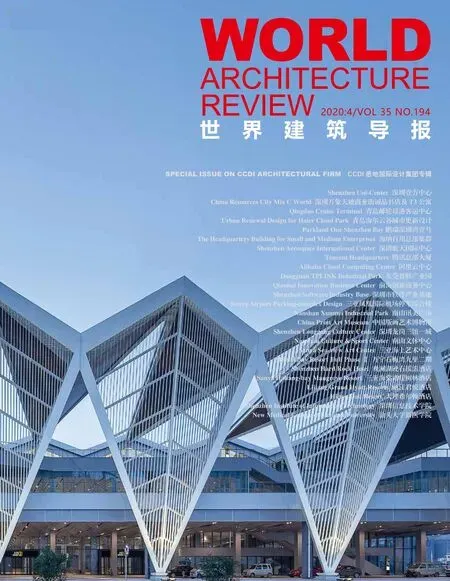
鵬瑞深圳灣壹號
2020-09-07 06:45:44
世界建筑導報 2020年4期
業主:鵬瑞集團
地點:深圳市南山區東濱路與科苑路交匯處深圳灣一號
建筑面積:173 074平方米(地上151 477平方米,地下215 96平方米)
建筑功能:辦公、酒店、商業、公寓
建筑高度:330米(71 層)
建筑設計:KPF + CCDI 悉地國際
結構設計/機電設計:CCDI 悉地國際
設計/竣工:2015/2018年
Client: Parkland Group
Location: One Shenzhen Bay at the intersection of Dongbin Road and Keyuan
Road, Nanshan District, Shenzhen, China
Floor Area:173,074 M2(151,477 M2Above Ground And 21,596 M2Underground)
Architectural Function: Office, Hotel, Business, Apartment
Building Height:330 M (71 Floors)
Architectural Design: KPF + CCDI
Structural Design/M&E Design: CCDI
Design/Completion: 2015/2018
集辦公、居住、酒店、商業于一體的深圳灣1 號總體規劃位于后海新區一片始建于2005年的填海土地上,與深圳內灣公園隔路相望。總體規劃包含8 棟塔樓,分為南北兩區,南北街區之間以連廊相接。較高的塔樓位于地段西側,較低的裙樓的塔樓沿東側排列。位于該項目南側邊緣的7 號塔樓由KPF 與CCDI 配合完成。
深圳灣壹號的八棟塔樓,分別分布在場地邊緣,共同圍合出一個開放高效的公共中庭空間。規劃概念強調自然環境的重要性,激發住戶體驗戶外空間的意愿。相較于北區,項目南部連續裙房搭配屋頂商業的小體量組合,商業界面較豐富。高330米的7 號樓,共71 層,不僅是整體規劃中最高的建筑,也是深圳最高的住宅。塔樓為“型鋼混凝土框架-核心筒”抗側力體系,上部樓面體系為鋼梁支撐的組合樓板體系。其中1 層、1 層夾層為大堂,2 層為會議中心;4~30層為辦公;33~44 層酒店(含酒店大堂);46~68 層為公寓;70~71 層商業會所。項目建筑體量巨大并且布局要求特殊,需同時考慮辦公、酒店、公寓流線及多條后勤流線。
以東側湖景為主導,7 號樓的立面設計以不遮擋景觀視線為原則,用疏密有致的橫(豎)向線條作為基本設計語言;高質量的玻璃幕墻及金屬構件配合平面體量的局部變化。溫暖、自然的豎向隔柵設計強調了純凈、挺拔的視覺效果。
作為大規模的城市綜合體,本案最高塔樓的頂部設置了獨特的文化空間,被CTBUH(世界高層建筑與都市人居學會)認定為世界最高音樂廳。
建筑師在在保證公寓安全、私密的前提下,兼顧商業及公共人流的穿行,建立復合的多層級鄰里交往空間系統。為防止防火分區域面積過大,消防性能化設計從首層局部商業出口布置,塔樓標準層防火分區劃分保證了建筑空間的高利用率及消防安全性。
綠色城市人居建設最大程度的運用在整座建筑中。雙銀LOW-E 中空夾膠三層玻璃優化了建筑的能效表現,阻隔了室外的有害光線及噪音。東西立面上的擋板提供了遮陽功能。南北立面上的水平突出部分在降低陽光熱輻射的同時為高層建筑自然通風提供了一種相較于可開啟窗扇更加安全的替代方案。
每座住宅塔樓均突出了水平構件的視覺符號,形成一組具有整體感的都市界面。這種水平性暗示著大平層的居住戶型與城市外部景觀的橫向連接。高聳的塔樓釋放出開闊的社區內部景觀,他與城市公園共同構成了可漫步、可呼吸的綠色人居氛圍。住宅塔樓的高度起伏有致,既突出了7 號塔樓的天際線高點,又在城市界面上形成連續延展的標識感。
One Shenzhen Bay, a combination of office buildings, residences, a hotel and commercial facilities, is located on a stretch of reclaimed land built in 2005 in Houhai New District,across from Shenzhen Neiwan Park. The master plan consists of 8 towers, divided into the north and south blocks connected by a corridor. The taller towers are located on the west side of the site, while lower podium buildings line the east side. No.7 Tower, situated on the southern edge of the project, is completed through a cooperation between KPF and CCDI.
The eight towers of One Shenzhen Bay are distributed along the edges of the site to surround an open and efficient public atrium. Highlighting the importance of the natural environment, the planning concept strives to arouse tenants’ interest in exploring and experiencing outdoor spaces. Compared with the northern area, the podium buildings in the south are combined with small-sized commercial facilities on the rooftop to present varied commercial interfaces.


The 330-meter-high No.7 Tower, with 71 floors, is not only the tallest building in the master plan but also the highest residential building in Shenzhen. Built with alateral force resisting system composed of a steel reinforced concrete frame - core tube, it features a composite floor system in the upper part, which is supported by steel beams. The first floor and the mezzanine are where the lobbies are located, and the second floor accommodates the conference center. Floors 4 to 30 are offices, while floors 33 to 44 are the hotel, including the hotel lobby. Floors 46 to 68 are apartments, and floors 70 to 71 are commercial clubs. The construction size of the project is huge, and the layout requirements are special as traffic flows from and to offices, the hotel, and apartments as well as for logistics purposes need to be taken into consideration.

With the lakeside view on the east side as the dominant landscape, the fa?ade of No. 7 Tower is designed on the basis of not blocking out the scenic view. Using appropriately spaced horizontal and vertical lines as the basic design language,the fa?ade features high-quality glass curtain walls and metal components to be in line with variations on the surface. The vertical grilles that look warm and natural emphasize a pure and upright visual effect.
As a large-scale urban complex, the construction highlights a unique cultural space at the top of the highest tower, which is recognized by the Council on Tall Buildings and Urban Habitat (CTBUH) as the world’s highest concert hall.
In addition to ensuring the safety and privacy of the apartments, the architects also take into account traffic flows to and from commercial and public spaces by establishing a complex multi-layered space system for neighborhood communication and interaction. To prevent the fire protection area from being too large, the fire fighting function design starts from the exit for some commercial facilities on the first floor, and the fire compartments on standard floors of the towers are appropriately planned to ensure efficient utilization and fire safety of building spaces.

The concept of building an eco-friendly urban habitat is applied throughout the entire construction. The double-silver LOW-E laminated triple-layer glass optimizes the construction’s energy efficiency and blocks out harmful outdoor light and noise. The baffles on the east and west facades provide effective shields against the sunlight.The horizontal protrusions on the south and north fa?ade provide a safer alternative to openable sashes for natural ventilation of the high-rise buildings while reducing solar radiation.
Each residential tower highlights the visual symbols of horizontal components,forming a consistent continuum of urban interfaces. Such horizontality implies a horizontal connection between top-notch residencesand the external landscape of the city. Apart from enabling an open view of the inside of community, the towering buildings, connected with an urban park, form a green habitat where people can stroll and breathe in fresh air. The residential buildings, of different heights, help to highlight No.7 Tower as the highest point in the skyline while weaving a unique continuous extension on the city’s fabric.

猜你喜歡
北方建筑(2021年6期)2021-12-31 03:03:54
文苑(2020年10期)2020-11-07 03:15:36
現代裝飾(2020年7期)2020-07-27 01:27:42
現代裝飾(2020年6期)2020-06-22 08:43:12
現代裝飾(2020年4期)2020-05-20 08:55:08
流行色(2020年1期)2020-04-28 11:16:38
藝術啟蒙(2018年7期)2018-08-23 09:14:18
海峽姐妹(2017年7期)2017-07-31 19:08:17
Coco薇(2017年5期)2017-06-05 08:53:16
福建農業科技(2016年10期)2016-03-07 09:46:49