培養(yǎng)語言能力 感受生命價值
——8B Unit 6 Reading 1教學(xué)設(shè)計
2021-12-03 07:21:38■李雪
初中生世界 2021年44期
■李 雪
一、教材分析
本課是譯林出版社牛津初中英語八年級下冊第六單元Reading1 板塊,其主題語境是“人與社會”,語篇標題為Volunteering for the Special Olympics World Games。語篇內(nèi)容圍繞劉明在2007 年上海特殊奧林匹克運動會(以下稱“特奧會”)中的志愿者經(jīng)歷展開。劉明在初選為2007 年特奧會志愿者時,他并不知道該期待些什么。然而通過對特奧會活動的了解和經(jīng)過志愿者培訓(xùn)后,他清楚地認識到了這份工作的意義。在運動員李海身上,他看到了這些有智力障礙的人所具有的勇于拼搏的精神,從而認識到——特奧會把來自不同背景的運動員和志愿者聚集在一起,每個人就像是一個大家庭的一部分。語篇的主題意義在于培養(yǎng)學(xué)生積極參加公益活動、盡自己所能幫助他人的意識。
二、學(xué)情分析
本節(jié)課的授課對象為八年級學(xué)生,他們已經(jīng)具備一定的詞匯量和閱讀策略,能夠提取、梳理文章的基本事實性信息。但他們的總結(jié)、推論等方面的能力還有待提升,需要教師加以指導(dǎo)和引領(lǐng)。
三、教學(xué)目標
1.借助主題語境,識別expect,similar 等生詞,并能推測理解其含義。
2.通讀文章,獲取、梳理特奧會相關(guān)知識和劉明的志愿者經(jīng)歷。
3.精讀文章,繪制思維導(dǎo)圖,概括、整合劉明在做志愿者工作過程中情感的變化。
4.樹立積極參加社會公益活動、盡自己所能幫助他人的意識。
四、教學(xué)重難點
繪制思維導(dǎo)圖,概括、整合劉明在做志愿者工作過程中情感的變化。
五、教學(xué)過程
1.Pre-reading
Activity(1):Share the knowledge about the Olympics.
Have students share the knowledge about the Olympics and learn the new words.
◆What does the sign stand for?
◆What do you know about the Olympics?
【設(shè)計意圖】引導(dǎo)學(xué)生分享已知的奧運會知識,學(xué)習(xí)課文中的生詞。自然地導(dǎo)入本課主題語境,激活學(xué)生的背景知識以及對于文本的閱讀興趣,形成閱讀期待,引領(lǐng)學(xué)生進入篇章主題意義。
Activity(2):Look at the title and predict.
Have students predict what the text is about according to the title and the picture and raise questions.
◆What is the article probably about?
◆What can you see in the picture?
◆What do you want to know after reading the title?
Tip1:Prediction can make us interested in reading.
【設(shè)計意圖】引導(dǎo)學(xué)生關(guān)注文章標題和插圖,運用認知策略進行讀前預(yù)測,讓學(xué)生形成閱讀期待,掌握預(yù)測這一閱讀策略。
2.While-reading
Activity(3):Skim the text and answer.
Have students skim the text quickly and an?swer the following questions:
◆Who volunteered for the Special Olympics World Games?
◆What are the Special Olympics World Games?
Tip 2:Guess the meanings of new words from the context.
【設(shè)計意圖】引導(dǎo)學(xué)生通過快速閱讀提取文本中關(guān)于主人公和特奧會的事實性信息,引導(dǎo)學(xué)生先對文本進行整體性閱讀,學(xué)會根據(jù)上下文語境猜測詞義,掌握學(xué)習(xí)策略,提升學(xué)習(xí)能力。
Activity(4):Read for the general information.
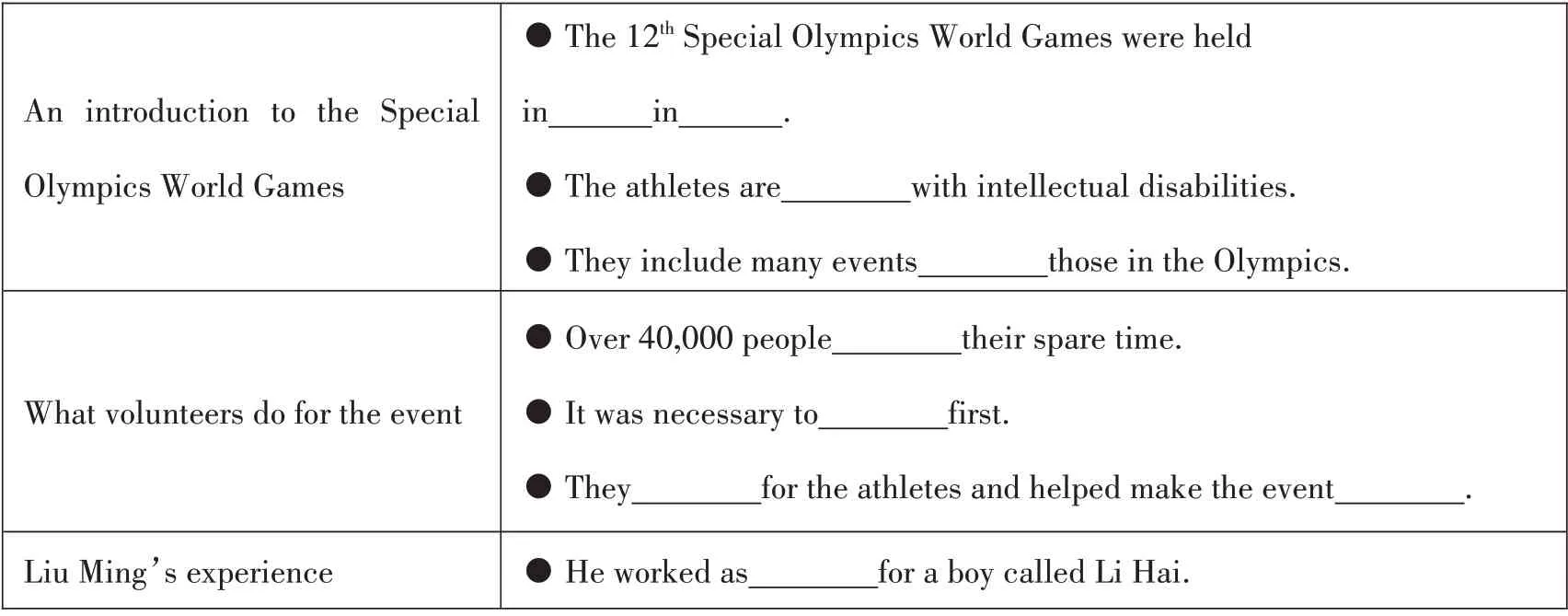
An introduction to the Special Olympics World Games●The 12th Special Olympics World Games were held in in .●The athletes are with intellectual disabilities.●They include many events those in the Olympics.●Over 40,000 people their spare time.What volunteers do for the event ●It was necessary to first.●They for the athletes and helped make the event .Liu Ming’s experience ●He worked as for a boy called Li Hai.
Have students read for more information about the text.
◆What can we learn from the report?
□An introduction to the Special Olympics World Games
□What volunteers do for the event
□Liu Ming’s experience
□Liu Ming’s feelings about the event
□Liu Ming’s dreams
【設(shè)計意圖】引導(dǎo)學(xué)生通過閱讀文本,找出文中所述要點,了解段落大意以及文本發(fā)展脈絡(luò),為后續(xù)的細節(jié)閱讀做好鋪墊。
Activity(5):Read for the detailed information.
Have students read for the details in the text and complete the table. Then answer the following questions.
◆Why are the Special Olympics World Games held for the athletes with intellectual dis?abilities?
◆Why are the events similar to those in the Olympics?
◆Is it necessary for volunteers to receive training before doing the tasks?
◆What success did they help to make?
◆What do you know about Li Hai?
【設(shè)計意圖】引導(dǎo)學(xué)生通過閱讀完成有關(guān)文本細節(jié)性信息的表格。引導(dǎo)學(xué)生通過問題鏈,思考特奧會舉辦的意義以及劉明作為志愿者的重要作用。
Activity(6):Read for Liu Ming’s feelings about the event.
Have students read the text and underline the sentences that describe Liu Ming’s feelings about the event.
Tip 3:Certain adjectives can show the feelings of the characters.
【設(shè)計意圖】引導(dǎo)學(xué)生閱讀并獲取描述劉明情感的句子,推動學(xué)生融入語境,感受主人公的情感變化,鞏固對文本內(nèi)涵的理解。
3.Post-reading
Activity(7):Draw a mind map.
Have students integrate information of the text and draw a mind map.
【設(shè)計意圖】教師為學(xué)生提供基本的圖形結(jié)構(gòu),鼓勵學(xué)生自行梳理和設(shè)計思維導(dǎo)圖,小組間分享和完善,最后在全班展示,提升學(xué)生的語言表達能力和思維品質(zhì)。
Activity(8):Discuss in groups.
Have students discuss the following question in groups:
◆Why are they“special”?
【設(shè)計意圖】啟發(fā)學(xué)生在深刻理解文本主題意義的基礎(chǔ)上,再次思考標題的內(nèi)涵,引導(dǎo)學(xué)生得出結(jié)論:特奧會讓我們看見每一個生命的真正價值。
六、教學(xué)反思
一節(jié)課下來,教學(xué)目標基本完成。通過層層遞進的教學(xué)活動,學(xué)生掌握了重點詞匯和句型,完成了相應(yīng)的學(xué)習(xí)活動,核心素養(yǎng)的各個方面得到發(fā)展。需要改進之處有以下幾點:一是課堂氣氛不太活躍,部分學(xué)生缺乏學(xué)習(xí)興趣和積極性。二是活動(4)沒有達到預(yù)設(shè)效果。雖然活動前進行了解釋,但大部分學(xué)生還是不明白,沒能找出正確的要點。三是缺少作業(yè)布置環(huán)節(jié)。因課時有限,沒能及時布置相關(guān)課后作業(yè)來促進學(xué)生鞏固所學(xué)。四是板書設(shè)計過于簡單。除了文章標題與基本生詞,還應(yīng)補充相應(yīng)內(nèi)容,凸顯文章的結(jié)構(gòu)和文本內(nèi)涵。
猜你喜歡
甘肅教育(2020年14期)2020-09-11 07:57:50
制造技術(shù)與機床(2019年10期)2019-10-26 02:48:08
電子制作(2018年18期)2018-11-14 01:48:06
藝術(shù)啟蒙(2018年7期)2018-08-23 09:14:18
東方教育(2017年19期)2017-12-05 15:14:48
海峽姐妹(2017年7期)2017-07-31 19:08:17
Coco薇(2017年5期)2017-06-05 08:53:16
唐山文學(xué)(2016年2期)2017-01-15 14:03:59
小學(xué)教學(xué)參考(2015年20期)2016-01-15 08:44:38
語文知識(2014年1期)2014-02-28 21:59:13