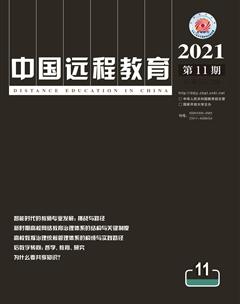
英文摘要
2021-12-09 08:02:24
中國遠程教育 2021年11期
關鍵詞:英文
Abstracts
Teacher professional development in the intelligent age: challenges and pathways
Xiaoying Feng, Wanrong Guo and Luoying Huang
The intelligent age sets new goals for, and provides new means of, teacher professional development. Intelligent technology is supposed to enable intelligent teacher professional development through the synergies of its basic attributes, circumstantial equipment and innovative application. On the one hand, intelligent teacher professional development can offer new solutions to some long-existing problems in the field. On the other, it can also bring about new challenges, including new goals and contents, model design, and application of intelligent technology and big data. Proposals to overcome these challenges are discussed. It is suggested that revision be made of the goal, model and strategy of teacher professional development to cultivate core teaching competences and that teachers be provided with relevant design theories, methods and tools to support innovation in professional development model. It is also argued that teacher educators need to enhance their own digital teaching skills and data literacy and that more research is expected to offer insights into teacher professional development in the intelligent age.
Keywords: intelligent age; teacher; professional development; teacher training; intelligent education; intelligent teacher professional development; intelligent teacher training
The postdigital turn: philosophy, education, research
Petar Jandriand Jeremy Knox
This article develops a post-determinist and a post-instrumentalist understanding of education and educational research through the lens of postdigital theory. We begin with historicizing current postdigital research by showing its intellectual ancestry and recognizing its rapidly changing nature. We move on to current state of the art, which we present in three wide themes. The first theme is the great convergence of various lower-level techno-scientific convergences, such as analog-digital, physics-biology, and biology-information, which results in new epistemologies, ontologies, and practices. The second theme is some consequences of the great convergence for education and pedagogy, which results in new postdigital ecopedagogies. The third theme is postdigital research, which is reconfigured by the great convergence towards a closer collaboration between traditional scientific fields and disciplines. We briefly outline four such reconfigurations (multidisciplinary, interdisciplinarity, transdisciplinarity, and antidisciplinarity) and their implications. The article concludes with a brief list of directions for future work in the field.
Keywords: technological determinism; instrumentalism; postdigital, philosophy; epistemology; ontology, pedagogy; ecopedagogy; multidisciplinarity; interdisciplinarity; transdisciplinarity; antidisciplinarity
Online higher education governance in the new era: structure and key systems
Hao Xie, Ling Xu and Wei Li
The reform of online education by conventional higher education institutions (HEI) faces new challenges in the new era. Accordingly, a new governance structure and new systems should be in place to underpin this reform. Based on the new goals of HEI online education and the necessity to modernize education governance, this article attempts to establish a basic structure of HEI online education for the new era, a structure embodying the leading role of government, HEI autonomy, and participation of the industry and third-party entities. Specific measures are discussed. Furthermore, quality assurance system, qualifications system, learning outcome credentialing system, and academic credit bank system are identified as the four key systems.
Keywords: online higher education; governance system; governance structure; Internet plus education; continuing higher education; HEI talent cultivation model; quality assurance system; lifelong learning system
Why share knowledge? A systematic review of factors influencing knowledge sharing in virtual learning communities
Haifeng Li and Wei Wang
Knowledge sharing is an important aim of collaborative knowledge building and creation in virtual learning communities. Nevertheless, there is no systematic research into its influencing factors. This article reports on a systematic review of knowledge sharing literature collected from major international databases. Review results show that knowledge sharing is an important theme in the literature of virtual learn- ing community research. Using various statistical analysis methods and theoretical models, researchers attempted to shed light on how knowledge sharing is influenced by circumstantial factors, team factors, motivation factors and cognitive factors, from the perspectives of social capital, social cognition and social exchange. Based on review results, a structure model is created to illustrate factors influencing knowledge sharing in virtual learning communities, including 5 dimensions which are further divided into 12 subdimensions with 37 indicators. Implications for future virtual learning community development are also discussed.
Keywords: knowledge sharing; influencing factors; virtual learning community; collaborative knowledge building; knowledge creation; eco-system; online learning; collaborative interaction; analysis model; systematic literature review
Towards an integrated management system for university data governance: its constitution and implementation pathways
Suxuan Song, Xianmin Yang and Ziqiang Song
The Big Data age enables universities to access massive amounts of data but also requires them to ensure effective data governance. Data governance is conducive to modernizing university governance. Therefore, data governance should be researched both from the perspectives of technology and integrated management. This study proposes an integrated management system for university data governance with the characteristics of “process”, “adaptation”, “multi-parties” and “interaction”. Four implementation pathways are designed in relation to issues of concern, organizational structure, value flow, and risk prevention and control, respectively.
Keywords: bid data; data governance; integrated management; university governance; data capital; education governance modernization; data
(英文目次、摘要譯者:肖俊洪)
猜你喜歡
國際展望(2017年2期)2017-03-21 18:34:18
鄱陽湖學刊(2016年6期)2017-01-16 13:05:41
中國遠程教育(2016年6期)2016-12-07 10:07:02
財經(2016年19期)2016-08-11 08:17:03
中國遠程教育(2016年5期)2016-06-29 10:13:42
中國遠程教育(2016年2期)2016-03-21 10:31:21
中國遠程教育(2016年1期)2016-02-26 10:37:15
國際展望(2015年5期)2015-09-15 05:41:45
國際展望(2015年4期)2015-07-13 05:30:56
能源(2014年9期)2014-09-15 13:18:12