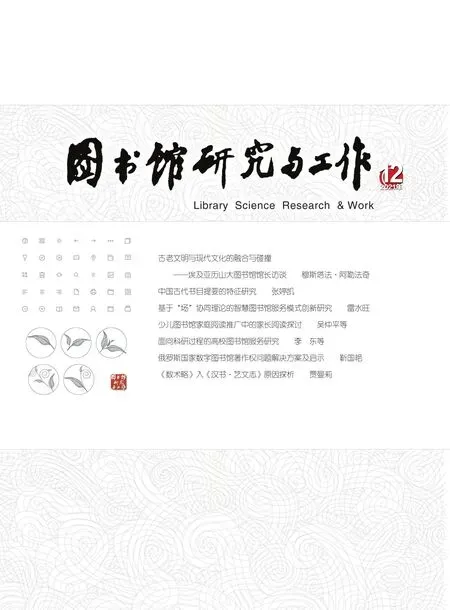
古老文明與現(xiàn)代文化的融合與碰撞
——埃及亞歷山大圖書館館長訪談
2021-12-13 11:48:14穆斯塔法·阿勒法奇,胡耀丹
圖書館研究與工作 2021年12期
訪談對象:穆斯塔法·阿勒法奇博士(Prof. Dr. Mostafa el Feki),從2017年起擔任埃及亞歷山大圖書館館長。在過去的40年里,他一直活躍在埃及的政治舞臺上,曾擔任埃及人民議會外交關系委員會主席、埃及總統(tǒng)信息事務秘書和總統(tǒng)府新聞報道辦公室主任、埃及外交部外交研究所所長、埃及駐奧地利等多個國家的大使、埃及常駐阿拉伯國家聯(lián)盟代表和駐國際原子能機構(International Atomic Energy Agency,IAEA)埃及理事等多個職務。他在開羅的美國大學附屬學院(AMERICAN UNIVERSITY COLLEGE,AUC)教授政治學十余年,并且是埃及英國大學(British University in Egypt,BUE)的創(chuàng)始校長。他也是埃及最著名的作家之一,撰寫過40多本政治和文化類書籍,是許多政治和脫口秀節(jié)目的常客。他榮獲過多項國內和國際榮譽,包括尼羅河社會科學勛章(2010年)、國家社會科學優(yōu)異獎(2003年)和國家政治學獎勵獎(1993年)等。
本刊:2020年新冠疫情肆虐全球,整個世界都遭受到了嚴重的沖擊,圖書館也深受影響。為了繼續(xù)開展公眾服務,亞歷山大圖書館或者說埃及的公共圖書館做了哪些努力?
穆斯塔法·阿勒法奇博士:在這個具有挑戰(zhàn)性的時期,亞歷山大圖書館協(xié)同其在世界各地的同行們?yōu)楸3峙c用戶的聯(lián)系做出了巨大的努力。同時,世界上一些組織、圖書館和機構都在尋求方法,以應對因保持社交距離而迅速產生的數(shù)字需求的挑戰(zhàn)。
亞歷山大圖書館具有數(shù)字化的先天優(yōu)勢。數(shù)字資產存儲庫(Digital Assets Repository,簡稱DAR)是由亞歷山大圖書館開發(fā)用來存儲數(shù)字館藏的系統(tǒng),涵蓋了世界上最豐富的阿拉伯語圖書館藏。因此,我們的用戶能夠以交互的方式繼續(xù)訪問亞歷山大圖書館館藏,甚至可根據(jù)圖書的版權狀態(tài)在社交媒體上進行分享。
同樣,亞歷山大圖書館開始推出線上讀書俱樂部、流式視頻和實時會話,信息專家們在這些平臺上分享不同主題的經驗。實際上,第一批互動小組討論中就有一個主題為“新冠疫情及其在當?shù)亍⒌貐^(qū)和國際上的影響”。
事實上,亞歷山大圖書館舉辦了很多類似的研討會和講座,并通過本館的You Tube頻道和直播持續(xù)向觀眾提供訪問文化和藝術作品、觀看表演的途徑,以及博物館和美術館的在線導覽。
我館的年輕用戶也會參與我們的線上活動,即由著名兒童文學作家主講的“在線講故事”活動。這些用戶也能獲得關于信息站點的指導,這能幫助他們提升個人技能和文化水平,改進學習語言的方法,并獲取有助于遠程學習的網址。當然,我們也向其提供預防病毒、保持健康的方法等有益信息。
亞歷山大圖書館不僅提供使用本館設施的途徑,也與其他國家機構開展合作,如和農業(yè)與土地開墾部合作,開通了吉薩動物園網站,提供虛擬訪問動物園的途徑,用阿拉伯語和英語向網站用戶提供該動物園的歷史和動物等信息。
為了減少新冠病毒對社會造成的隔閡,我們采取了大量舉措,這些例子僅僅是其中的一部分。
本刊:有人把古老的亞歷山大圖書館稱作“人類的燈塔”,您是怎么理解這一比喻的,您覺得新時期的圖書館應該怎樣發(fā)揮“燈塔”的作用?

穆斯塔法·阿勒法奇博士
穆斯塔法·阿勒法奇博士:關于亞歷山大圖書館的2001年第一號法令規(guī)定:“亞歷山大圖書館是總部位于亞歷山大市的一個公共法人,隸屬于總統(tǒng)。它是埃及文化光輝的中心,是思想、文化和科學的燈塔,涵蓋了從古至今所有文化中所有不同語言的人類思想。”
據(jù)此,亞歷山大圖書館生來就是思想和人類的燈塔。實際上,它與其古代的前身并未有所不同,是思想和討論的中心,在古代,世界上有很多著名科學家和哲學家都聚集于此。
這在本質上意味著亞歷山大圖書館,當然還有其他圖書館,都是思想、研究、討論和對話以及向更龐大的群體傳播所有成果的中心。這需要涵蓋各個級別和所有年齡段。我們是激勵者、組織者和促成者,把人類、空間、資源和工具聚集在一起,實現(xiàn)創(chuàng)新、理解、創(chuàng)造和啟迪。
本刊:如果說圖書館是“燈塔”,那么圖書館員是什么?為了適應未來的發(fā)展,您覺得圖書館員最應該培養(yǎng)的素養(yǎng)或者技能是什么?
穆斯塔法·阿勒法奇博士:我們可以在書籍和道德規(guī)范中找到圖書館員的任職資格,但根據(jù)我們的經驗,圖書館員應當肯定并相信他們在社區(qū)中所發(fā)揮的重要作用。圖書館不是書籍和資源的倉庫,其作用遠不止于此。它們是經濟、衛(wèi)生、教育、政治等所有領域社會意識的源泉。
即使不是全部領域,圖書館員也具備了大多數(shù)領域的專業(yè)技能,并與全世界最高水平的專業(yè)人士和專家保持聯(lián)系,這使得他們能緊跟時代,并在任何指定時間內找到每一個社會相關領域中最優(yōu)秀的演講者。
從本質上說,一個“好的圖書館員”應當對他們所服務的社區(qū)產生影響。
本刊:亞歷山大圖書館的外觀和設計風格都非常醒目,特點鮮明,這種風格是怎么和埃及的古老文明融合在一起的?是怎么做到既現(xiàn)代又有厚重的歷史感的?
穆斯塔法·阿勒法奇博士:亞歷山大圖書館的設計理念來源于聯(lián)合國教科文組織開展的一項國際競賽公開征集活動。獲獎者是挪威的一家名叫斯努希塔的小公司,他們成功地將當代世界的簡約與圖書館作為知識的燈塔的象征意義融合在一起,同時也抓住了亞歷山大圖書館從古至今的精神內涵。
因此,主建筑代表著從地中海海平線上冉冉升起的太陽(新的一天,新的發(fā)現(xiàn)),而圓形意味著知識是永無止境的循環(huán),天文館代表著地球圍繞太陽公轉。一座名叫永恒的橋梁連接著圖書館和大學并向大海延伸,不斷地探求知識和學問。
從外部看,主樓自豪地展示著被蝕刻在花崗巖上的人類各種符號和歷史悠久的字母。其外觀像是古代燈塔,召喚游客走向它的大門。從內部看,有蓮花形柱子裝飾著主閱覽廳,與古代巨大的圓形劇場非常相似,這會讓用戶想起圖書館輝煌的過去;內墻的壁龕讓人們有機會看到圖書館保存著的古代卷軸。此外,圖書館還使用了非洲本土的材料和顏色,如津巴布韋的花崗巖和銅色金屬墻。
整個選址也得益于其位于古代亞歷山大港皇家專屬區(qū)、古代亞歷山大圖書館舊址的附近。這本身就很神奇。
本刊:埃及擁有眾多的文化遺產項目,圖書館在文化遺產的保護和傳承方面做了哪些工作?您覺得現(xiàn)在面臨的主要問題是什么?圖書館可以通過哪些方式來加以改進?
穆斯塔法·阿勒法奇博士:保護文化和自然遺產、傳統(tǒng)知識和非物質文化遺產是亞歷山大圖書館的一項重要使命。這些領域是知識的支柱,是人類生產力的源泉,應該得到保護并世代傳承。因此,亞歷山大圖書館設有一個專門的文化和自然遺產文獻中心(Center for the documentation of cultural and natural heritage,CULTNAT),使用創(chuàng)造性的方法包括我們專有的交互式文化全景九屏放映,來展示和保存豐富的遺產內容;“知識之墻”展覽通過移動應用程序和印刷的墻板幫助記錄和展示遺產。此外,在過去的二十年里,我們實施過許多其他工程,其中包括用3D重建和全息圖來記錄文獻和發(fā)掘內容。這些數(shù)字工程與通過數(shù)據(jù)庫和書籍而不斷擴大的文化遺產文檔庫聯(lián)手,為用戶提供服務。
近年來,亞歷山大圖書館完成了文化與自然遺產領域的三大工程:在埃及文明國家博物館創(chuàng)建了一種用于博物館陳列展示的平板動畫電影的新方法,在巴倫·普里恩(El Baron Empain)博物館應用的交互式文化全景展示,以及開通了伊斯蘭開羅和動物園網站。事實上,新首都博物館也采用了觸摸屏顯示應用。
我們目前面臨的主要問題是缺乏合格的人力資源。我們正試圖通過與世界各地的其他圖書館實施共同實習計劃來克服這個問題,并針對圖書館界新生代開展能力建設和培訓的志愿項目,確保重視、保護和記錄傳統(tǒng)知識、文化和自然遺產的連續(xù)性。
本刊:數(shù)字化是世界發(fā)展的方向,也是圖書館不得不面對的挑戰(zhàn),您覺得面對越來越數(shù)字化的世界,圖書館應該怎么辦?在這方面亞歷山大圖書館有哪些經驗?
穆斯塔法·阿勒法奇博士:圖書館應該關注數(shù)字獲取對象如圖像、音頻、視頻等的質量和格式,以便將來使用。這些數(shù)字對象需要依次予以妥善編目,確保能夠找到、訪問、進行互操作和重復使用。
多年來,亞歷山大圖書館一直開展多媒體對象數(shù)字化工作。目前,亞歷山大圖書館的數(shù)字圖書館涉獵廣泛,100多名員工每年能生產3萬個數(shù)字對象。目前,其數(shù)字館藏有60余萬件。
本刊:亞歷山大圖書館作為埃及最具影響力的圖書館之一,在聯(lián)合全國的圖書館方面做了哪些工作?
穆斯塔法·阿勒法奇博士:亞歷山大圖書館在全國乃至阿拉伯地區(qū),發(fā)揮了重要的社會服務作用。自2007年在國際圖書館協(xié)會聯(lián)合會(簡稱“國際圖聯(lián)”,IFLA)被選為阿拉伯世界的代表以來,亞歷山大圖書館就開始擔此重任。此后,在國內我們與埃及圖書館協(xié)會建立了密切聯(lián)系,并作為發(fā)展伙伴提供了“構建強大的圖書館協(xié)會”和“圖書館宣傳”這兩個項目的許多培訓機會。埃及圖書館事業(yè)在服務用戶的質量和創(chuàng)造性方面有了很大的進步,同時,在滿足用戶需求和持續(xù)發(fā)展技術方面也有了較大的改善。這一點在最近幾年新冠疫情期間表現(xiàn)得尤為明顯,大多數(shù)圖書館適應了形勢,繼續(xù)為用戶提供遠程服務。
同樣,許多區(qū)域實體的聯(lián)系也得到了加強,比如阿拉伯圖書館和信息聯(lián)合會(Arab Federation for Libraries and Information,AFLI)、非洲圖書館與信息協(xié)會(AFLIA)、特殊圖書館協(xié)會——阿拉伯灣分部(African Library & Information Associations & Institutions,SLA Gulf Chapter),他們在圖書館和信息領域里分別代表中東和北非、非洲和海灣地區(qū)。亞歷山大圖書館組織了許多區(qū)域研討會和專業(yè)發(fā)展培訓項目,分享知識,并在國際圖聯(lián)國際會議期間提供阿拉伯語同聲傳譯服務。
本刊:我們知道您還是一位教育家,在教育方面也有很深入的研究。我們一直在說圖書館是一個教育機構,您覺得圖書館怎樣才能更好地發(fā)揮社會教育的功能?
穆斯塔法·阿勒法奇博士:圖書館一直扮演著非正式教育者的角色,幫助政府實現(xiàn)教育目標。圖書館代表著可靠的信息來源,一個地理分布廣泛的安全場所,一個設備齊全、互聯(lián)網連接穩(wěn)定的地方,能夠幫助縮小數(shù)字鴻溝,平等地向每一個人開放。亞歷山大圖書館長期以來一直服務從學校階段到研究生階段的學生和研究人員群體。
我們致力于根據(jù)用戶需求,定期更新館藏和全球范圍內最新的可用資源。此外,我們提供持續(xù)的培訓和支持,以協(xié)助學生和研究人員的工作。亞歷山大圖書館還依托“摩燈”(MOODEL)課程管理系統(tǒng)開發(fā)了一個在線平臺,該平臺提供高標準的課程、講座以及阿拉伯語、英語和法語的專業(yè)文憑。
我們與學校密切合作開展不同的項目,例如“教師2030”和“學校圖書館員2030”。在這些項目中,我們向教師和圖書館員提供了解新的教學趨勢和在線學習平臺所需的知識。
本刊:亞歷山大圖書館從建成開始就是一個著名的旅游景點,中國也一直在提倡文旅融合,在這方面,您覺得圖書館可以做哪些工作,有什么建議?
穆斯塔法·阿勒法奇博士:圖書館最大限度地服務于周邊的社區(qū),亞歷山大圖書館也不例外。但亞歷山大圖書館還有一個額外的目標,那就是在國際范圍內提供服務:致力于成為世界看埃及和埃及看世界的窗口。因此,亞歷山大圖書館展示了如何通過提供一個公共的討論場所在不同文化和民眾之間架起橋梁,通過國際文獻傳遞,向其他國家提供并分享豐富、特有的數(shù)字內容。
與此同時,亞歷山大圖書館也為其用戶提供了許多通過觀看藝術表演和展覽來了解其他文化的機會。事實上,為紀念偉大的國內和國際人物,亞歷山大圖書館會舉辦豐富多彩的活動,吸引眾多知識分子和公眾參與,亞歷山大圖書館對此感到非常自豪。
需要指出的是,許多與跨文化交流和理解相關的活動需要從年輕時就開始抓起,以便向其灌輸對不同文化的相互尊重意識,進而促進旅游業(yè)發(fā)展。亞歷山大圖書館的兒童圖書館和青年圖書館也正是這么做的,他們在數(shù)字平臺上與世界各地的學校和兒童合作,共同開展項目。當兒童參與共同項目時,他們自然會更多地了解彼此的國家和傳統(tǒng)。
本刊:您擔任過外交官,去過很多國家,也接觸了很多不同的文化,您覺得圖書館在文化的交流和互鑒中能起到什么作用?現(xiàn)在中國正在倡導一帶一路建設,您覺得埃及和中國的圖書館可以在其中做哪些工作?
穆斯塔法·阿勒法奇博士:文化交流是對外關系的天然支柱之一。埃及是“一帶一路”倡議沿線的國家之一。我們從埃及外交部了解到,無論在戰(zhàn)爭時期還是和平時期,中國一直以來都是埃及堅定的支持者。眾所周知,中國是發(fā)展中國家的領頭羊,特別是在人道、平等和發(fā)展方面。在這種情況下,圖書館的作用是不斷揭示我們周邊的不同文化,并為相互對話和交流提供開放的空間。
以下為訪談的英文原文:
Since the global spread of the COVID-19 in 2020, the world has been suffering from the severe attack, and libraries also have been deeply influenced by the current situation. What efforts has the Bibliotheca Alexandrina or other public libraries in Egypt to continue to provide public service?
The Bibliotheca Alexandrina, as with its peers around the world, has exerted great efforts in keeping the connection with its patrons during these challenging times. While many organizations, libraries and institutes the world over looked to address the challenges of the digital needs that social distancing quickly imposed upon us; the Bibliotheca Alexandrina had the advantage of being “born digital”.
The Digital Assets Repository (DAR – http://dar.bibalex.org/webpages/dar.jsf) was developed to maintain the library's digital collections, and contains the largest collection of Arabic books in the world. Our patrons were therefore able to continue accessing many of the BA’s collection in an interactive manner; even being able to share over social media, depending on the book’s copyright status.
In a similar manner, the Bibliotheca Alexandrina began online book clubs as well as streaming videos and live sessions where information professionals share their experiences in many diverse topics. Indeed, one of the first interactive panel discussions was organized under the title "The Corona Pandemic and its Local, Regional and International Repercussions"
Many similar seminars and lectures were organized virtually, as well as providing our audiences with continued access to cultural and artistic works and performance through the BA’s YouTube channel and through live streaming, as well as conducting live tours of our museums and galleries.
Our younger patrons were also included in our virtual efforts through online story-telling presented by famous children’s literature writers. They were also given guidance regarding information sites that help them develop personal and cultural skills. methods of learning languages and links that benefit them in distance learning. Of course, we also provided valuable information on ways to help prevent the virus, and how to maintain their general health.
Not only did the Bibliotheca Alexandrina work on providing access to our own facilities, but we also cooperated with other national institutions. In cooperation with the Ministry of Agriculture and Land Reclamation, the BA launched the Giza Zoo website; to provide virtual access to the zoo holdings, providing the site’s users with information about the history of the zoo and the animals in both Arabic and English.
These are all mere examples of the vast number of initiatives undertaken to minimize the divide that the Covid-19 virus imposed on our societies.
Someone compared the BA to “the Beacon of Mankind”. What do you think of the simile? What do you think libraries should do to play the part as a “beacon” in this new era?
ARTICLE 1, of Law No. 1 of 2001, concerning the Library of Alexandria, states: “The Library of Alexandria is a public juridical person headquartered in the city of Alexandria, attached to the President. It is an Egyptian center of cultural radiance, a beacon for thought, culture and science, encompassing all the products of the human mind in all languages, from all cultures, ancient and modern.”
Accordingly, the Bibliotheca Alexandrina from its conception was born to be a beacon for thought and mankind. Indeed, this is not dissimilar to its ancient predecessor which in its own right was a center for intellectual thought and discussion, and a homing place for renowned scientists and philosophers from around the ancient world.
What that essentially means is that the BA, and other libraries too of course, are a center for thought, study, discussion and dialogue and the ensuing dissemination of all that produces to the greater communities. This needs to be at all levels, and for all ages. We are the motivators, the playmakers, and the enablers, that bring together the people, the space, the resources and the tools that allow for innovation, understanding, creativity and enlightenment.
If a library is a “beacon”, what are the librarians that we can compare to? What are the most needed literacy or skills that the librarians should acquire in order to adapt to future development?
The qualifications of librarians can be found in books and code of ethics; but through our experience, librarians should both feel and believe in the importance of the role they play in their communities. Libraries are not a store for books and resources, they are much more than that. They are the source of awareness in the society and this covers all fields; economic, health, education, political, etc.
Librarians have a range of expertise in most domains, if not all, and are connected to the highest profile professionals and experts from all over the world which allows them to always be updated and provide the best lecturers in every subject pertinent to the society at any given time.
Essentially, a “good librarian” is a librarian who has an impact on the community they serve.
The architectural appearance and design style of the BA are very striking with distinctive features. How does this style integrate with the ancient civilization in Egypt? How does the architecture look very modern but historic in the meantime?
The design concept for the Bibliotheca Alexandrina was brought about during an open call by the international UNESCO competition. The winners were a small Norwegian firm Sn?hetta, who were successfully able to embrace the simplicity of today’s modern world, and incorporate the symbolism of the library as a beacon of knowledge; all while capturing the spirit of its ancient predecessor.
So, the main building represents the rising sun on the horizon of the Mediterranean shore (a new day, and new findings) while its circular shape denotes the never-ending circle of knowledge; with the Planetarium represent the Earth orbiting the Sun. An eternity bridge connects the Library to the University and projects out towards the sea in a never-ending quest to seek information and learning.
Externally, the main building proudly displays the different symbols and historical alphabets of humankind, etched into its granite expanse. The fa?ade a reflective representation of the ancient lighthouse summoning its visitors towards its doors. Internally, the Library’s patrons are reminded of its glorious past through the lotus shaped columns that adorn the main reading hall, itself similar to a large Amphitheatre ofthe era; the alcoves in the internal wall that represent the openings where the ancient scrolls were kept; and the use of the materials and colours native to the African continent through Zimbabwe Granite and copper coloured metallic walls.
The entire site also benefits from being located in the historic Royal Quarters of the Alexandria, in the vicinity of where the ancient Library of Alexandria once stood. That is magical in itself.
Egypt owns a great number of cultural heritage projects and her culture is very admirable. What jobs are the libraries doing in the field of cultural heritage’s protections and inheritance? What are the main problems faced by libraries now? What ways can the libraries do to solve these problems?
The protection of cultural and natural heritage, traditional knowledge and intangible heritage is a key mission of the Bibliotheca Alexandrina. These areas represent pillars of knowledge and are a source of human productivity that should be protected and disseminated through generations. Accordingly, the Bibliotheca Alexandrina houses a specific center for the documentation of Cultural and Natural Heritage (CULTNAT) using creative methods to showcase and preserve our rich heritage content, including our patented Culturama interactive 9-screen projection; the Wall of Knowledge which assists in documenting and displaying heritage using a mobile application and a printed wall plate; as well as many other projects which have been applied throughout the past 20 years including methods of documentation and developing of content through 3D reconstructions and holograms. These digital projects work hand in hand with the increasing bank of culture heritage documentation through databases and books.
Most recently, the BA has achieved three tremendous projects in the field of cultural and natural heritage: a new method of tablet animated movies for museum showcase displays has been created in NMEC Museum; the Culturama show in El Baron Empain Museum; and the launch of the websites for Islamic Cairo and the Zoo. Indeed, the touch screen application for displays has also been implemented in the New Capital Museum.
The main problem we currently face is the lack of sufficiently qualified human resources. We are trying overcome this through mutual internship schemes, which can be achieved with other libraries around the world, as well as volunteering programs for capacity building and training new generations in this field; to ensure the continuity of valuing, protecting and documenting traditional knowledge and cultural and natural heritage.
Digitization is the development tendency of the world and is also the challenge that the libraries have to face. What should the libraries do to face the development of digitization in the world? What experience does BA have in this field?
Libraries should care about the quality and format of digitally acquired objects such as images, audio, video and others, for future use. These digital objects in turn need to be properly catalogued to be able to make them findable, accessible, interoperable and reusable.
The Bibliotheca Alexandrina has been digitizing media objects for numerous years. The BA has an extensive digital lab process with over 100 employees that produces 30,000 digital objects annually. Its current collections include over 600,000 objects.
As one of the most influential libraries in Egypt, what has the BA achieved in uniting the libraries nationwide?
The BA has a great responsibility in developing the role of libraries in serving its communities, not only on the national level but also on the regional level. The BA specially developed this role since 2007 whenit was selected to be the IFLA representative in the Arab world. We have since then established a strong connection with the Egyptian Library Association on the national level and provided numerous training opportunities on Strong Library Association and Advocacy for Libraries as partners in development. The field of Librarianship in Egypt has witnessed great improvement in the services provided to its users in quality and creativity, as well as in relevance to their needs and to the continuing evolution of technology. This was especially apparent during the last couple of years during the Covid-19 crisis when most libraries adapted to the situation and continued to provide their services remotely.
Equally networks were strengthened with many regional entities such as AFLI, AFLIA, and the SLA Gulf Chapter, amongst others; representing the Library and Information field in the MENA and Africa and Gulf regions. The BA organized many regional workshops and professional development training programmes as well as sharing knowledge and providing simultaneous translations in Arabic during IFLA international conferences.
We all know that you as a successful educator with great achievements. Libraries are always regarded as educational institutions. Do you think how the libraries can better serve the social educational function?
Libraries have always acted as an informal educator helping the government reach their goal for education. Libraries represent the reliable source of information, a safe venue with a wide geographical existence, a well-equipped place with a stable internet connection that help minimize the digital divide and allow equal access to everyone. The BA has a long history in serving its community of students and researchers from the school phase to the post graduate phase.
We work on updating our collection regularly according to the needs of our users as well as the latest available resources worldwide. In addition, we provide continuous training and support to assist students and researchers in their work.
The BA also developed an online platform using “MOODEL” that offers a high standard group of courses, lectures, as well as professional diplomas in Arabic, English, and French.
We work closely with schools on different programs such as Teachers 2030 and School Librarians 2030. In these programs we provide teachers and librarians with the knowledge needed for new teaching trends and online learning platforms.
As we know, BA has always been a famous scenic spot since its establishment. China is promoting integration of culture and tourism. Do you think what work libraries can do in this field and what is your suggestion for libraries?
Libraries serve their surrounding communities to the greatest extent, and the BA is no different. But the Bibliotheca Alexandrina has the added objective to serve on an international level; aspiring to be the World’s window on Egypt, and Egypt’s window on the world. As such, the BA shows how libraries can create bridges between cultures and people through providing a common ground for discussion; through carrying international collections, and providing ample digital content of its own kind to share with other countries.
In parallel, the BA offers numerous opportunities for its patrons to glimpse other cultures through visiting artistic performances and exhibitions. Indeed, the Ba takes pride in commemorating great national and international figures, through diverse activities that appeal to intellectuals and the general public alike.
It is important to note that many of the activities related to intercultural exchange and understanding need to begin from a young age in order to instill the sense of mutual respect for different cultures, and in turn promote tourism. The BA’s dedicated Children’s Library and Young People’s Library do just that by
embarking on projects with schools and children from around the world, on digital platforms and through collaborating on joint projects. As the children engage on common projects, they naturally learn more about each other’s countries and traditions.
As a highly skilled diplomat, Your Excellency once visited a lot of countries and experience various cultures. What functions do you think the libraries can serve in the cultural exchange and mutual learning? China is promoting the Belt and Road Initiative, what job do you think the libraries in Egypt and China can fulfill in this field?
Cultural exchange is one of the natural pillars of foreign relations. Egypt is a part of the Belt Road Initiative. In the Egyptian Foreign Ministry, we are taught how China has been, and still is, a great supporter of Egypt, during both war and peace. China is well known to be a leading country in the developing world, especially towards humanity, equality, and development. The role of the library in this instance, is to continually shed light on the different culture arounds us and open spaces for mutual dialogue and exchange.
猜你喜歡
湖北教育·綜合資訊(2022年4期)2022-05-06 22:54:06
金橋(2022年2期)2022-03-02 05:42:50
黃河之聲(2021年8期)2021-07-23 03:34:28
小天使·一年級語數(shù)英綜合(2018年9期)2018-10-16 06:30:16
小太陽畫報(2018年1期)2018-05-14 17:19:25
少年博覽·小學低年級(2016年10期)2016-11-24 06:48:23
新世紀圖書館(2015年8期)2016-01-11 01:14:14
長春教育學院學報(2015年20期)2015-06-05 12:22:12
漫畫月刊·炫版(2015年4期)2015-05-27 07:52:10
出版與印刷(2014年1期)2014-12-19 13:07:37