
關麓書院實施方案設計,黃山,安徽
2022-10-25 08:24:50周榕,ZHUYayun
世界建筑 2022年10期
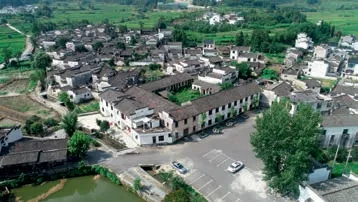
1 現(xiàn)狀鳥瞰Aerial view of the current situation
設計主持:常青
方案設計:常青,劉偉,張鵬
合作設計:馬松瑞,劉瀛澤,趙英亓
結構設計:何忻偉
設備設計:徐鐘駿,張萍
結構形式:鋼結構,磚木結構
場地面積:1680m2
建筑面積:1792m2
建筑高度:12m
設計時間:2021
Principal Architect: CHANG Qing
Schematic Design: CHANG Qing,
LIU Wei, ZHANG Peng
Cooperative Architects: MA Songrui,
LIU Yingze, ZHAO Yingqi
Structural Engineer: HE Xinwei
Mechanical Engineers: XU Zhongjun,
ZHANG Ping
Structure: Steel structure, brick and
timber structure
Site Area: 1680 m2
Floor Area: 1792 m2
Building Height: 12 m
Design Time: 2021
(1)村落時空脈絡
黃山黟縣碧陽鎮(zhèn)西武鄉(xiāng)的關麓村,是古徽州一個亦儒亦商的風土聚落,因村西南西屏山和武亭山相交處的西武關而得名。一條南連祁門北接池州,由西武關向東北延伸的官路(驛道),穿村而過。源自武亭山的“下溪”(武溪)緊貼村東邊緣,并沿“月塘”北行。后唐起汪姓在黟繁衍,明成化年間汪姓在關麓村興起,至清乾隆時鄉(xiāng)紳汪昭敩房支興旺,稱“關麓八大家”,其宗祠——承德堂在官路南側,抵近月塘。1994 年清華大學陳志華教授率隊首次考察關麓村,后出版《關麓村》一書。
(2)基地由來與現(xiàn)狀
承德堂毀于1960 年代,后所在地塊建起了磚木結構的關麓小學和茶廠,構成了一個簡陋的現(xiàn)代大場院,占地面積約1680m2,西端與汪氏 “問渠書屋”及周邊徽居建筑群毗連,北面有一約1540m2的楔形廣場。小學和茶廠今已廢棄,擬改建為一座鄉(xiāng)村博物館性質(zhì)的“關麓書院”,建筑面積約1820m2。
(3)翻建與再生設計
關麓書院立意以汪氏崇尚耕讀、廣設學堂
(1) History and Topography of Guanlu Village
Guanlu Village, located in Xiwu Township,Biyang Town, Yixian County, Huangshan City, is a vernacular settlement under both the Confucian and commercial culture in the ancient Huizhou region. It was named after the Xiwu Pass, where Xiping Mountain and Wuting Mountain meet in the southwest of the village. The village is traversed by an old post road connecting to Qimen County in the south to Chizhou City in the north and extending north-easterly from the Xiwu Pass.The Xiaxi Creek (also known as Wuxi Creek), which originates from Wuting Mountain, flows close to the eastern edge of the village and meanders north along the Moon Pond.
From the Later Tang Dynasty (923-937 CE), a WANG family began to settle down in及書屋的歷史軼事為本底,采用在原建筑及場院投影范圍內(nèi)翻建的策略,將其轉(zhuǎn)化再造為徽韻濃郁的新風土書院建筑和方庭。場院北側原關麓小學主校舍改為門廳和綜合服務空間;南側拆除校舍,復建“問渠書屋”,以三角廳與方庭相連;東側茶廠改為會堂;西側保護“承德堂”遺址,新添展覽研討空間。此外,在書院門前楔形廣場設計了類比徽式墻廈的戲臺。
翻建后的書院形體摒棄徽式仿古,追求徽韻新風,以宣示可識別今昔的普世保護原則,表達對村落歷史真實性的尊重。這樣做既可保留原場院似曾相識的空間格局,又能類比周邊徽居建筑的典型特征,如清水混凝土的圍護體,簡拙的馬頭墻、徽式的入口門樓,變幻有致的窗洞,等等。室內(nèi)以鋼架結構為主形成的簡約空間,包括了接待、文創(chuàng)、報告、研討、書吧、品茶等多重功能。總之,關麓書院作為一組舊場院建筑的翻建工程設計,將成為一種空間觸媒和文化驅(qū)動力,使關麓古村因保護與再生而富有活力,成為徽州鄉(xiāng)村文化復興和旅游目的地的新亮點和打卡地。□Yixian County. During the Chenghua reign(1465-1487) of the Ming Dynasty, they flourished here; and by the time of Emperor Qianlong's reign (1735-1796) in the Qing Dynasty, a local gentry member WANG Zhaoxiao headed a large family with eight sons, known as the "Eight Great Families of Guanlu". Their ancestral hall, known as the Chengde Hall (Hall of Inherited Virtue), was located near the Moon Pond, south of the Guan Road. In 1994, a team led by Professor CHEN Zhihua of Tsinghua University visited the village for the first time, and subsequently published the monograph Guanlu Village.
(2) Past and Present of the Site
After Chengde Hall was destroyed in the 1960s, the brick-and-wood structured Guanlu Primary School and a tea plant were built onthe site to make a modest yard, covering an area of approximate 1680 m2. Its western end abuts the Wang family's Wenqu Shuwu (Studio of Limpid Pond) and the neighbouring Huistyle residences, while to its north lies a wedgeshaped square of about 1540 m2. The currently abandoned school and tea factory will be turned into a "Guanlu Academy" rural museum, with a construction area of around 1820 m2.
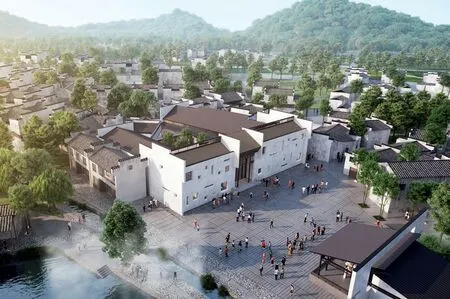
2 鳥瞰效果Rendering of Aerial view
(3) Renovation and Regeneration Design
Inspired by WANG's historical anecdotes advocating agriculture and education and establishing a wide range of schools and studies,the design adopts the strategy of re-creating the area within the projected shadow range of the original buildings and the yard, transforming it into a novel vernacular academy, with buildings and a quadrangle infused with a rich Huizhou flavour. The main buildings of the former school to the north of the yard are converted into a foyer and a multi-functional service area. The school buildings on the south are demolished to make way for the renewed Studio of Limpid Pond,which will be connected to the quadrangle via a triangle hall and subsequently to the surrounding buildings. The tea plant on the eastern side is converted into an assembly hall, while the Chengde Hall ruins on the west are preserved and a new exhibition and seminar space is added.In addition, a Hui-style theatre in the form of a portico is planned for the wedge-shaped square in front of the Guanlu Academy.
The renovated Guanlu Academy, rather than imitating the classical Huizhou form, pursues the new style of the ancient Huizhou charm in order to proclaim the universal conservation principles that distinguish the present from the past and to demonstrate respect for the historical authenticity.This approach not only preserves the spatial layout of the former yard, which evokes a sense of déjà vu, but also invites comparison with the distinctive characteristics of the Hui-style residence in the neighbourhood, such as building envelopes made of fair-faced concrete, simple horse-head firewalls,Hui-style gate towers, and elegant windows and openings of various shapes, among others. The predominantly steel-framed, simple interior space serves multiple functions, including reception,production of cultural items, presentations,seminars, book clubs and tea appreciation. In conclusion, as a restoration project of a set of an old yard and abandoned buildings, the Guanlu Academy will serve as a spatial catalyst and a cultural driving force to provide the ancient Guanlu Village with robust conservation and revitalisation opportunities, and to make it a new attraction of the revived Huizhou rural culture and a must-see tourist destination.□ (Translated by ZHU Yayun)
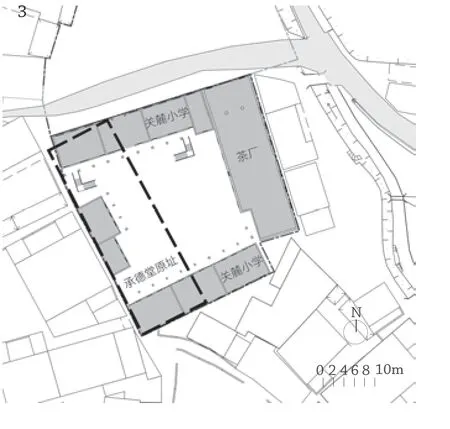
3 承德堂原址示意Diagram of the original site of Chengde Hall
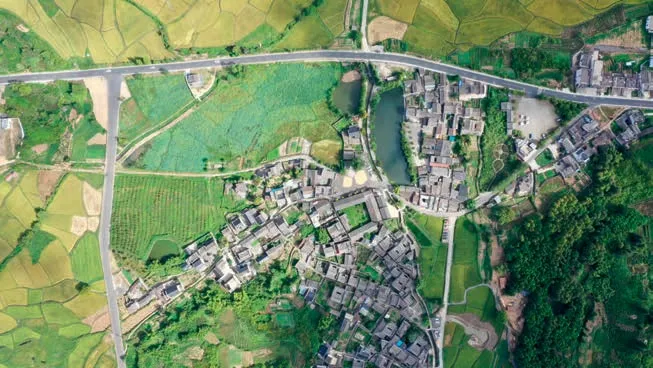
4 現(xiàn)狀航拍Aerial photograph of the current situation
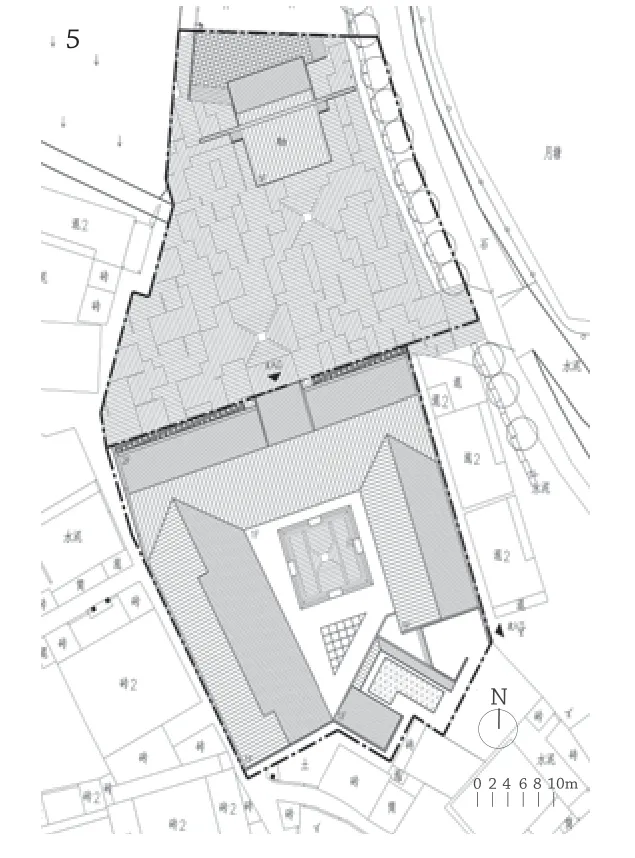
5 總平面Site plan
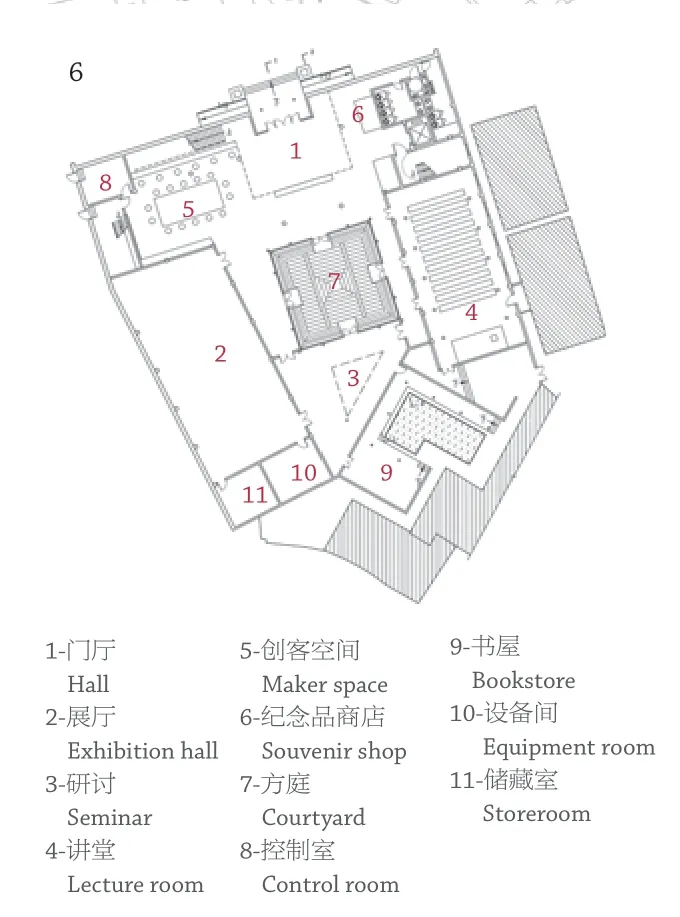
6 首層平面Ground floor plan
項目評論
關麓書院的“新風土敘事”實驗述評
對建筑師而言,設計無非某種“環(huán)境敘事”。作為諸多被發(fā)明出來的“環(huán)境敘事”中的一種,西方現(xiàn)代建筑學長期被局限于高度相似的敘事套路:“絕對時空觀”所宰制的“純粹性”和“自洽敘事”執(zhí)念,以及“物中心論”所誘導的“本體性”及“自主性”妄念,都嚴重壓抑了建筑設計原本應更加遼闊的敘事能力。
如何在一個復雜而失序的歷史環(huán)境中,采用嚴重受限的“形式方言”進行敘事,仍能從容鋪陳一個生動迷人的當代故事?這對建筑師駕馭復雜敘事的能力不啻是一次大考。對此,“關麓書院”遞交了一篇頗具示范意義的答卷。
無論是注重物質(zhì)形式還原的“整舊如舊”,抑或強調(diào)在地文脈延續(xù)的“整舊如故”,都難以使日漸衰敗的中國鄉(xiāng)村復蘇重振。事實上,從全國各地多年鄉(xiāng)建實踐效果上看,常青院士的“適應性再生”理念,才是為歷史聚落注入新活力的根本解決之道。
在筆者的理解中,所謂“適應性再生”,難點在于如何同時適應盤根錯節(jié)的“歷史復雜性”,以及嘈切多變的“當代復雜性”。因此,“適應性再生”,意味著無法簡單沿襲傳統(tǒng)和當下任何一種成熟的建筑敘事套路,而必須構建一個與“在地復雜性”和“在時復雜性”雙重適配的空間敘事的新復雜系統(tǒng)。
“關麓書院”的設計,可以被視為一次構建“與古為新”的當代微觀風土系統(tǒng)的實驗。“風土”概念中的“風”,是指充盈于場域中、非物質(zhì)但卻可以被感知的隱性文化結構;而“土”,則可以被理解為與“風”相適配的顯性物質(zhì)空間結構。由于“風”和“土”雙線敘事的交織,西方現(xiàn)代建筑學的“純粹性”與“本體性”簡化敘事套路顯然失效。而對“風” “土”敘事的雙轡并馭,則為“關麓書院”的“復方設計”提供了激發(fā)生動性和造就豐富性的因緣契機。
像傳統(tǒng)中藥配伍講求“君臣佐使”一樣,“關麓書院”的文化敘事主線是儒家的,這與關麓村整體的風土氣質(zhì)一脈相承:在拆除原有小學和茶廠的基址上,書院主體重新“結穴”,構造統(tǒng)領全局的新秩序,是為“君”;周邊體量較小的傳統(tǒng)民居錯綜輻輳,是為“臣”;將小學門前原有的楔形空地打造成多義性廣場,是為“佐”;而戲臺前出抵至用地邊緣,兼具招引和控場之用,是為“使”。君臣佐使,儒風儼然。
另一條敘事線索上,“關麓書院”的空間處理手段卻是當代的:建筑主體采用非對稱布局;正門與戲臺并不合軸;南側原有民居以突兀的角度直接“撞”進新建筑,拉滿空間的戲劇張力;而建筑造型亦古亦新,頗具某種飄浮的曖昧感,仿佛這個不確定時代的縮微寫照。
在“關麓書院”設計中,常青院士實驗性探索了中國式“新風土敘事”的可能性。“風”與“土”雙線敘事的耦合與參差,打破了西方現(xiàn)代建筑學絕對時空敘事和純粹物質(zhì)敘事的僵化桎梏,在重塑當代鄉(xiāng)村人文內(nèi)核的同時,也為如何活化中國本土建筑設計的敘事空間提供了啟示性的思路。
周榕
清華大學建筑學院副教授
建筑評論家
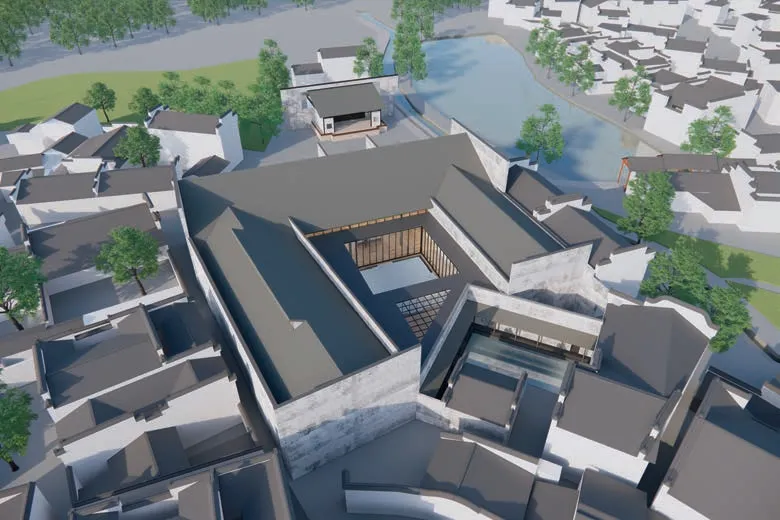
7 鳥瞰效果Rendering of Aerial view
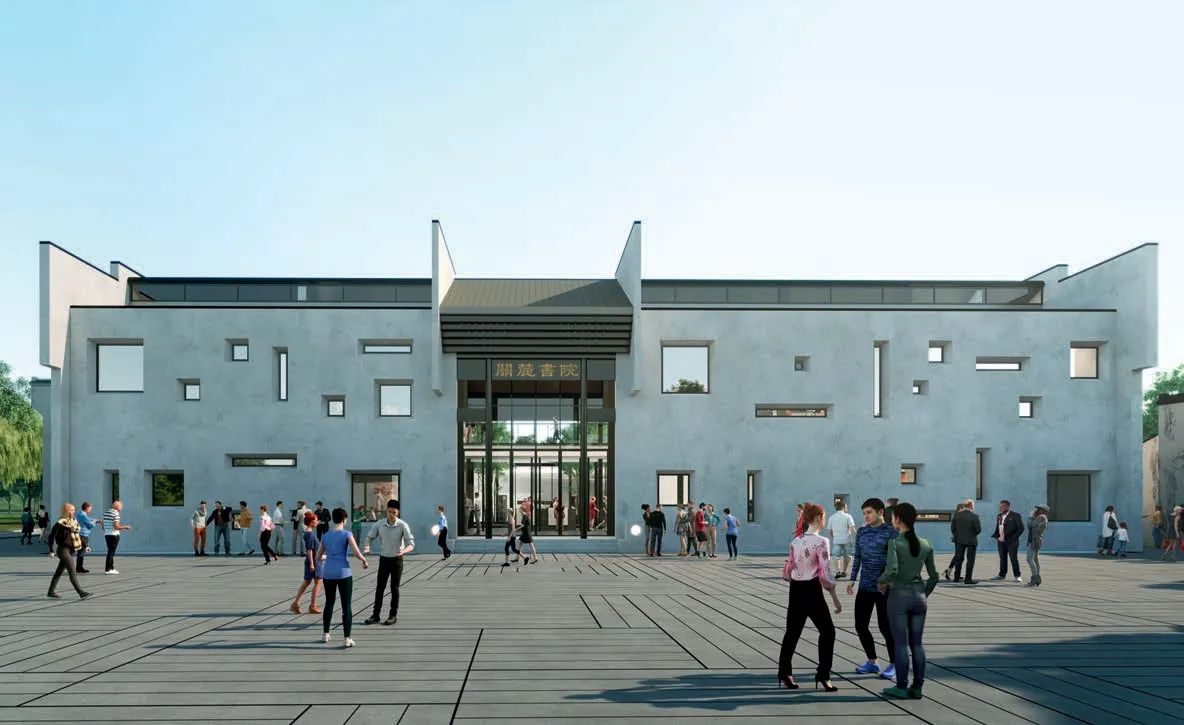
8 北立面效果Rendering of the north fa?ade
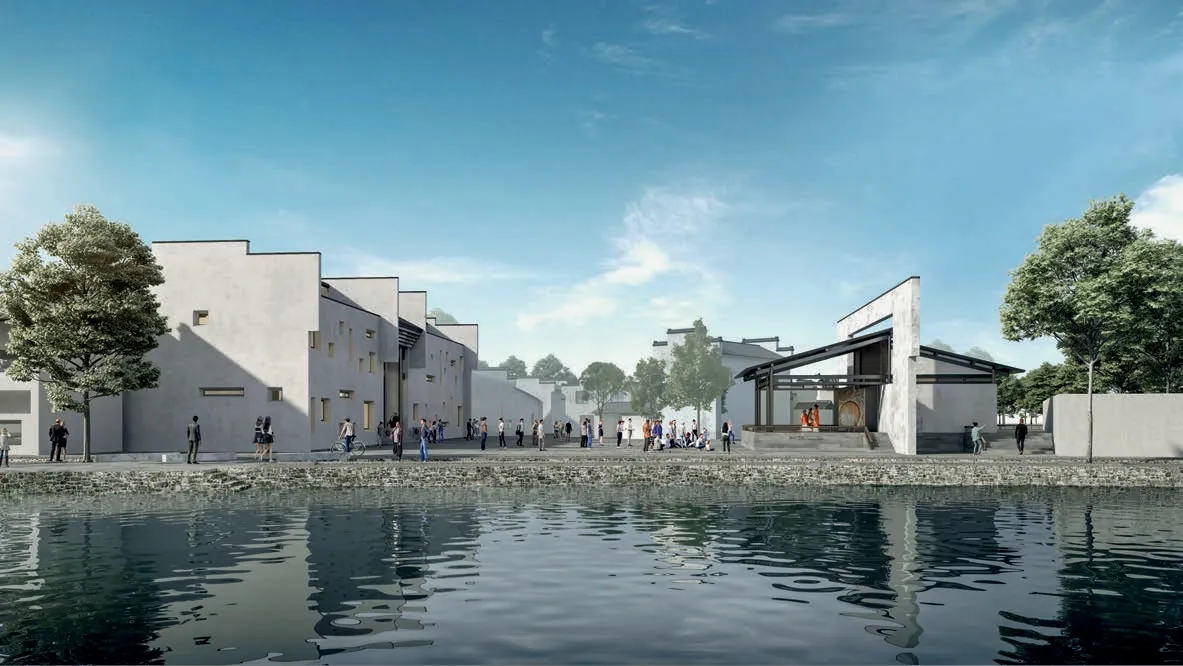
9 透視效果Perspective rendering
Comments
Guanlu Academy's "New Vernacular Narrative" Experiment
In the words of architects, design is nothing more than an "environmental narrative". The Western tradition of modern architecture has long been plagued by highly recurrent narrative tropes: both the insistence on "purity" and"self-consistency" dominated by the "absolute time and space" perspective and the delusion of "ontology" and "autonomy" induced by"material centrism" have severely suppressed the supposedly more expansive narrative capacity of the architectural design.
How can one, in the midst of a chaotic and complex historical context, conveys a compelling modern story with ease, using only the severely limited "dialect of architectural form" as their narrative tool? This is a significant evaluation of the architects' story-telling skills. Guanlu Academy has provided a response that is a model of what can be achieved.
Neither "restoring the old as it previously appeared" (zhengjiu rujiu), which emphasises the reappearance of the original material forms,nor "restoring the old as it was" (zhengjiu rugu),which highlights the continuity of culture in situ, can revive the ever-declining Chinese villages. In fact, Academician CHANG Qing's concept of "adaptive regeneration", as evidenced by the practical results of many years of rural revitalisation across the country, is the key to infusing historic settlements with new vitality.
In my opinion, the challenge of the socalled "adaptive regeneration" is in adapting to the intertwined "historical complexity" and capricious "current complexity". Therefore,"adaptive regeneration" necessitates the construction of a new complex system of spatial narratives that are consistent with both"complexity of the place" and "complexity of the time" rather than merely adhering to tradition or any of the already established architectural narratives.
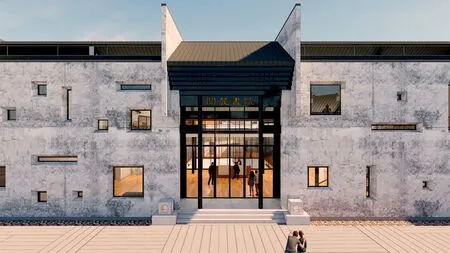
10 主入口效果Rendering of the main entrance
The design of the Guanlu Academy can be regarded as an experiment in creating a contemporary miniature "fengtu" (vernacular)system that "collaging the new with the old"(yugu weixin). The "feng” in the concept of fengtu refers to the immaterial but perceivable implicit cultural structure of a place, whereas "tu"can be interpreted as the explicit material spatial structure that is compatible with feng. The interweaving of the dual narratives of feng and tu thwarts the narrative cliché of "purity" and"ontology" in the Western tradition of modern architecture. Mastering the dual narratives of feng and tu affords the Guanlu Academy's"compound design" the capacity to arouse vividness and invent richness.
Guanlu Academy's cultural narrative theme is Confucian in nature, bearing the same root as the overall vernacular atmosphere of Guanlu Village. It assimilates the traditional Chinese herbal formulae which are based on the principle of combining major (king or jun),complementary (ministers or chen), neutralising(assistants or zuo) and delivery/retaining (envoys or shi) components together. On the original site of the demolished primary school and tea factory, the academy's main building occupies the "energy-gathering site" (jiexue) to establish a new order governing the entire land, thus being the "king"; the surrounding smaller traditional houses are intertwined and clustered, acting as the "ministers"; the original wedge-shaped open space in front of the primary school is transformed into a multi-functional square,which is the "assistants"; the space between the front of the theatre stage and the site's edge is designed to welcome and manage the visitors,which is the "envoys". The king, ministers,assistants, and envoys constitute a solemn atmosphere of Confucianism.
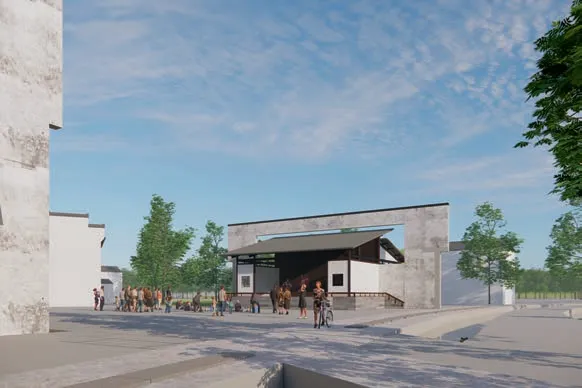
11 戲臺側視Side view of the theatre
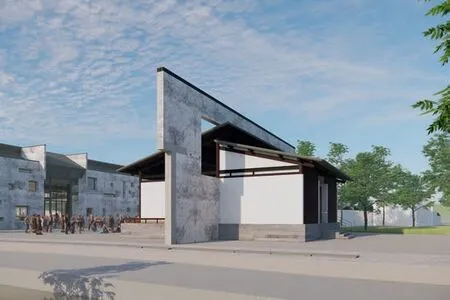
12 戲臺與廣場The theatre and the square
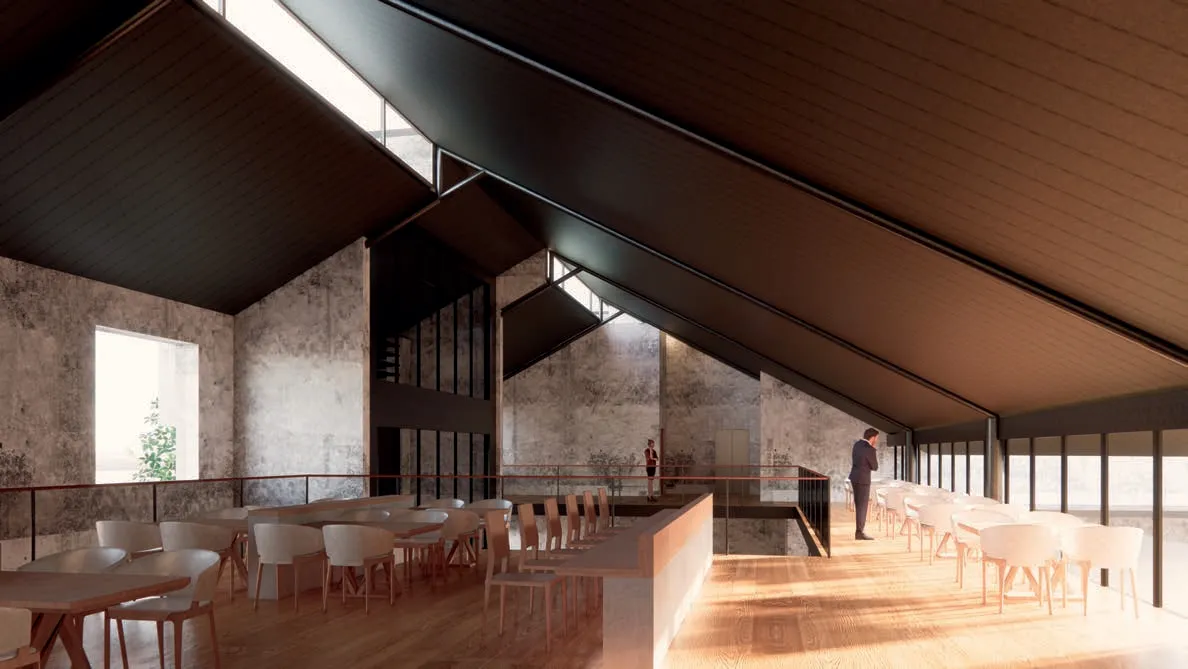
13 二層創(chuàng)客空間室內(nèi)效果Rendering of interior view of makerspace on the first floor
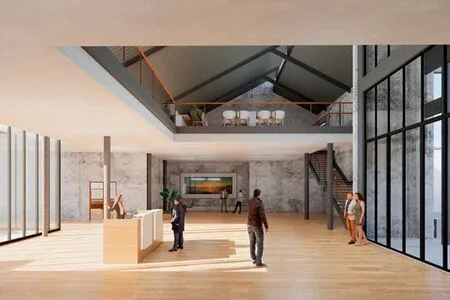
14 門廳室內(nèi)效果Rendering of interior view of foyer
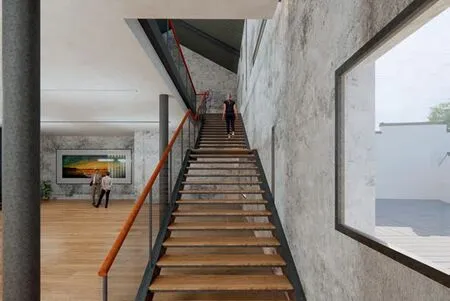
15 室內(nèi)樓梯效果Rendering of the stairs
In another narrative thread, Guanlu Academy's spatial design is contemporary. The layout of the main building is asymmetrical,with the main entrance and the theatre stage not aligned along the same axis. Existing houses on the southern side "crash" into the new building at a sharp angle, creating dramatic tension in the place. The architectural form is simultaneously ancient and new, tinged with ambiguity, as if it were a miniature portrait of this uncertain age.
In the design of Guanlu Academy,Academician CHANG Qing experimented with the possibility of a Chinse style "new vernacular narrative". The coupling and separation of the dual narratives of feng and tu cast off the shackles of the absolute temporal-spatial narrative and pure materiality of the Western tradition of modern architecture, and provide ideas for revitalising the narrative space in Chinese vernacular architectural design while refashioning the humanistic core of contemporary villages. (Translated by ZHU Yayun)
猜你喜歡
北方建筑(2021年6期)2021-12-31 03:03:54
中老年保健(2021年12期)2021-11-30 02:58:01
文苑(2020年10期)2020-11-07 03:15:36
現(xiàn)代裝飾(2020年6期)2020-06-22 08:43:12
攝影之友(影像視覺)(2019年2期)2019-03-05 08:27:14
藝術啟蒙(2018年7期)2018-08-23 09:14:18
中華詩詞(2018年11期)2018-03-26 06:41:34
海峽姐妹(2017年7期)2017-07-31 19:08:17
Coco薇(2017年5期)2017-06-05 08:53:16
Coco薇(2016年8期)2016-10-09 02:11:50
