
The Efficiency of Different Questioning on Teacher—Student Interactions in EFL Classroom
2018-01-23 11:33:04WenxiaoLi
校園英語·上旬 2018年13期
Wenxiao Li

It is admitted that teacher-student interaction plays a significant role in improving teaching quality and triggering students interests in an EFL class. According to Long and Sato (1983), the most appealing approach to start a teacher-student interaction is questioning. In terms of China, questioning is used even more frequently than in other parts of the world (Zheng, 1997). Under this circumstance, I conducted a secondary classroom-research with the regard of the questioning, To be more specific, I intends to study the efficiency of question type on teacher-student interactions in EFL classrooms and draw a conclusion through analyzing students responses to different types of questioning.
Before I move to the major findings of my mini research, there are several previous research and relevant theories that I would like to point out. Firstly, according to Ur (1996), there were six factors that should be considered when evaluating the efficiency of a question: clarity, learning value, interest, availability, extension and teacher reaction. It is believed that through analyzing students responses from the six aspects scholars were supposed to test the quality of students answers. Based on Urs (1996) framework, Hu (2007) reinforces the consideration from students perspective, which, to be more specific, is students input and output during the questioning. Hu (2007) evaluated students responses based on students preparing time and students talking time, reflecting students language input and output respectively. Based on the theories and opinions mentioned above, this mini research would analyze the effect of teachers question from Six factors proposed by Ur (1996). During the analysis, besides the interactional analysis of teacher-student interaction in the questioning, C-unit is used as major measurement of students output. C-unit, according to Forster (1998), refers to a kind of meaning unit in talks which could be a word, a phrase or a sentence. The reason why C-unit is involved lies in the frequency of the elliptical sentences using in teacher-student interactions. Those elliptical sentences are not complete sentence but serve as a more natural way to express ones opinion. Therefore, according to Forster (1998), it would be better to use C-unit to measure language output under such condition.
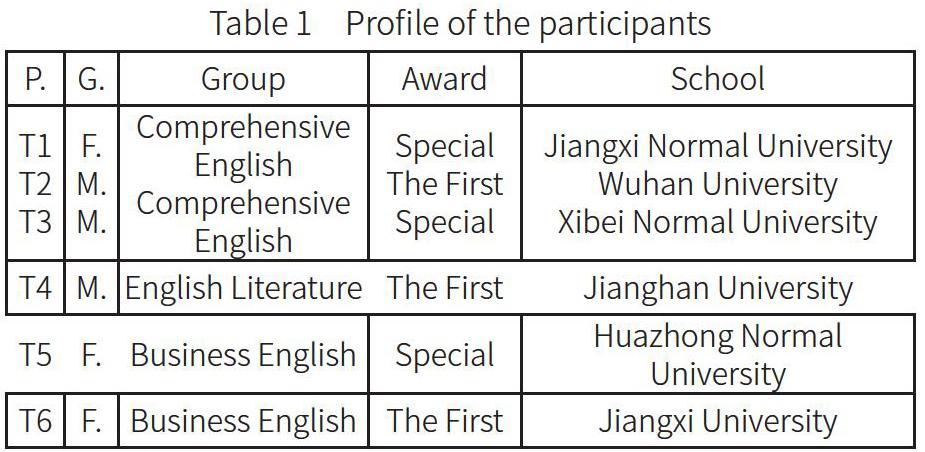
The data used in this research are from six videos from the SELEP National Foreign Language Teaching Contest. Six English teachers classes were chosen from 174 teachers who participated in the final match of the SFLEP National Foreign Language Teaching Contest were selected to be participants. Factors like gender, award, background and teaching content were taken into consideration when the teachers were selected. Because of the requirements of the contest, every class was about 20 minutes and had 15 students participating in there. To make data comparable, the six participants were chosen from three groups: English Literature, Business English and Comprehensive English, which means there were two teachers from each group respectively.
Note: P.=participants; G=Gender; F.=Female; M.=Male
Since all six teachers got special or the first prize in this contest, all types of questions are regarded as interesting, well-reacted and useful. Thus, in this part, only two factors out of Urs (1996) six aspects, which are clarity and extension, are chosen to be analyzed.
Clarity
Clarity means students understand the meaning and purpose of the teacher questions immediately. After analyzing the reaction time and answers in the six videos, it is found that convergent questions and divergent questions are much easier for students to understand than divergent questions.
According to the videos, students always need less time to understand a procedural or convergent question than to a divergent question. Moreover, teachers need less time to explain their purposes while asking procedural and convergent questions than asking divergent questions. For example, when teacher D wanted students to share their own ideas about happiness by asking “What is your opinion about happiness?”, at first, students paused for six seconds and didnt answer the question until the teacher added an explanation “what does happiness mean to you? You can answer this question by word.” Moreover, since purposes of divergent questions are usually not apparent for the students to get, they are more likely to refuse to answer them. For instance, when teacher E asked a divergent question at the very beginning of the class, no students answer the question even when the teacher gave them more time to figure out the purpose of this question. For example,
To sum up, convergent questions and divergent questions are much easier for students to understand than divergent questions, so divergent questions are more difficult for students to understand or answer, causing the decreasing effectiveness of divergent questions. This result is similar to Shaos (2009) study. According to Shao (2009), students willingness to answer questions is decided by the clarity of teachers questions directly.
Extension
Extension means students should avoid short, simple expressions and explain their opinions using complete, complicated and advanced expressions. In order to measure the extension of different types of questions, C-unit is involved in the present study. C-unit refers to a kind of meaning unit which could be a word, a phrase or a sentence. There are lots of elliptical sentences during teacher-student interactions. Those elliptical sentences are not complete sentence but serve as a more natural way to express ones opinion.
According to the C-unit data of different types of questions in each class, it is hard to say which type of questions is much better in helping to extend students answers. Besides the same c-unit of procedural questions, it is shown that three out of six classes have higher levels of C-unit in convergent questions and other three classes have higher levels of C-unit in divergent questions. The result is quite different from those of many scholars, such as Brock (1986), Nunan (1991), Han (2007), Lu (2009) and Mao (2012). Although these scholars measured extension of different types of question in different ways, they all found that divergent or referential questions worked better than convergent or displayed questions in that respect. Thus, since the average number of C-units of divergent questions and convergent questions in the six classes are different, it is hard to judge which type of questions is better than others.
To sum up, the efficiency of different types of questions do vary under different situations. It may be influenced by the clarity of the questions, teaching objectives and other factors. There is no evidence showing that one particular question type would be more efficient than others in the teacher-student interaction. Based on the finding, pedagogy implications are proposed in terms of teachers as well as students. Foreign language teachers are suggested to lay emphasis on all kinds of questions since all kinds of questions are possible to enhance teacher-student interactions in different situations. In terms of students, they are suggested to be fully aware of the importance of all kinds of teachers questions and try their best to answer them in the target language.
Admittedly, there are limitation existed inherently in this study. Firstly, the number of participants is limited and the time of each class is relatively short. Secondly, the data are collected from the SFLEP National Foreign Language Teaching Contest where classes were conducted especially for the contest. Thirdly, other factors such as students age, types of classes and contents of textbooks are not included. In the future study, more participants should be considered in the study. regular classes are suggested to be considered for the future study. More factors could be considered when evaluating the effect of question type on teacher-student interactions.
References:
[1]Brock,C.The effect of referential questions on ESL classroom discourse[J].TESOL Quarterly,1986,20(1):47-59.
[2]Forster P.A.Classroom perspective on the negotiation of meaning.Applied Linguistics,1998,19(1):1-23.
[3]Long,M.&Sato;,C.Classroom foreigner talk discourse:Forms and functions of teachersquestions[J].In H.W.Selinger & M.H.Long (Eds.),Classroom-oriented research in second language acquisition, Rowley:Newbury,1983.
[4]Ur,Penny.A Course in Language Teaching[M].Foreign Language Teaching and Research Press,2000.
[5]韓雪波.課堂互動中的教師提問研究[D].博士論文,東北師范大學,2007.
[6]胡青球.中外教師英語課堂話語對比分析——個案研究[J].外語教學理論與實踐,2007,1:32-37.
[7]劉向前.論課堂沉默[D].博士論文,曲阜師范大學,2005.
[8]盧可.教師提問對英語課堂互動影響的研究[D].博士論文,遼寧師范大學,2009.
[9]毛婷婷.英語課堂教師提問對學生回答的影響研究[D].博士論文,湖北工業大學,2012.
[10]徐立群.英語課堂教師提問類型的調查與分析[J].外語界,2010 (3):60-65.
[11]邵懷領.課堂提問有效性:標準、策略及觀察[J].教育科學, 2009,25(1):38-41.
[12]許峰.大學英語課堂提問的調查與分析[J].外語教學理論與實踐,2003(3):30-34.
[13]鄭樹棠(1997).關于大學英語教學法的研究——大學英語教學現狀研究之四[J].外語界,1997,3:1-3.
【作者簡介】Wenxiao Li, University of Pennsylvania.
猜你喜歡
中學生天地(A版)(2022年6期)2022-07-14 12:39:26
大學(2021年2期)2021-06-11 01:13:12
民用飛機設計與研究(2020年4期)2021-01-21 09:15:02
海峽姐妹(2020年12期)2021-01-18 05:53:08
甘肅教育(2020年18期)2020-10-28 09:06:52
民主與法制(2020年16期)2020-08-24 06:54:50
電子制作(2018年18期)2018-11-14 01:48:24
山東工業技術(2016年15期)2016-12-01 05:31:22
散文百家(2014年11期)2014-08-21 07:17:16
散文百家(2014年11期)2014-08-21 07:16:48
