
強(qiáng)化院感培訓(xùn)對(duì)導(dǎo)管室控制醫(yī)院感染能力及效果的作用
2015-09-11 02:36:35王秋賽劉正旺廖梅等
中國(guó)醫(yī)藥導(dǎo)報(bào)
2015年24期
王秋賽 劉正旺 廖梅等
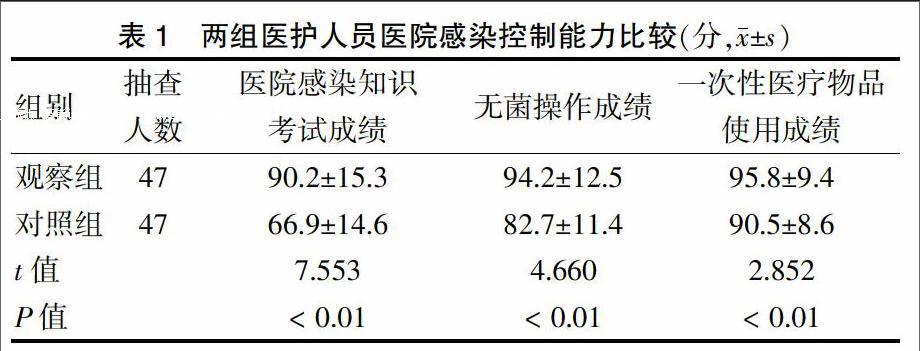
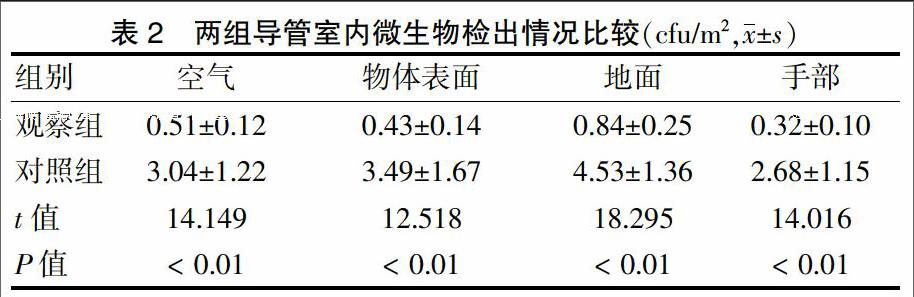
[摘要] 目的 探討強(qiáng)化院感培訓(xùn)對(duì)導(dǎo)管室控制醫(yī)院感染能力及臨床效果。 方法 回顧性分析海南省中醫(yī)院強(qiáng)化培訓(xùn)實(shí)施前(2012年1月~2013年1月)和實(shí)施后(2013年2月~2014年2月)導(dǎo)管室醫(yī)護(hù)人員控制醫(yī)院感染的能力和導(dǎo)管室醫(yī)院感染發(fā)生率。將實(shí)施前設(shè)為對(duì)照組,實(shí)施后設(shè)為觀察組。比較兩組的醫(yī)護(hù)人員醫(yī)院感染知識(shí)考試成績(jī)、無(wú)菌操作成績(jī)、一次性醫(yī)療物品使用成績(jī),兩組導(dǎo)管室內(nèi)微生物檢出情況以及醫(yī)院內(nèi)感染感染率和現(xiàn)患率。 結(jié)果 觀察組醫(yī)護(hù)人員醫(yī)院感染知識(shí)考試成績(jī)?yōu)椋?0.2±15.3)分、無(wú)菌操作成績(jī)?yōu)椋?4.2±12.5)分、一次性醫(yī)療物品使用成績(jī)?yōu)椋?5.8±9.4)分,均顯著高于對(duì)照組的(66.9±14.6)、(82.7±11.4)、(90.5±8.6)分,差異有高度統(tǒng)計(jì)學(xué)意義(P < 0.01)。觀察組空氣、物體表面、地面和手部微生物分別為(0.51±0.12)、(0.43±0.14)、(0.84±0.25)和(0.32±0.10)cfu/m2,顯著低于對(duì)照組的(3.04±1.22)、(3.49±1.67)、(4.53±1.36)和(2.68±1.15)cfu/m2,差異有高度統(tǒng)計(jì)學(xué)意義(P < 0.01)。觀察組患者醫(yī)院感染率為4.46%、現(xiàn)患率為4.44%,顯著低于對(duì)照組的6.07%和13.43%,差異有統(tǒng)計(jì)學(xué)意義(P < 0.05)。 結(jié)論 強(qiáng)化醫(yī)院感染培訓(xùn)可以有效改善導(dǎo)管室控制醫(yī)院感染能力并顯著降低醫(yī)院感染發(fā)生率,作用明顯具有臨床應(yīng)用價(jià)值。
[關(guān)鍵詞] 強(qiáng)化醫(yī)院感染培訓(xùn);導(dǎo)管室;醫(yī)院感染控制
[中圖分類(lèi)號(hào)] R197.3 [文獻(xiàn)標(biāo)識(shí)碼] A [文章編號(hào)] 1673-7210(2015)08(c)-0165-04
[Abstract] Objective To study the impact of strengthening hospital infection training on hospital infection control ability and effects in cath lab. Methods In Traditional Chinese Hospital of Hainan Province, the infection control ability and incidence in cath lab before (January 2012 to January 2013) and after strengthening hospital infection training (February 2013 to February 2014) were retrospectively analyzed, before training was as control group, and after training was as observation group. The hospital infection knowledge, sterile operation score, disposable medical articles usage score, microorganisms detection, hospital infection rate and prevalence rate of two groups were compared. Results In observation group, the hospital infection knowledge score was (90.2±15.3) scores, sterile operation score was (94.2±12.5) scores, disposable medical articles usage score was (95.8±9.4) scores, these were significantly higher than those in control group [(66.9±14.6), (82.7±11.4), (90.5±8.6) scores], the differences were statistically significant (P < 0.01). The aerial, subjects surface, geoclimatic and hands microorganisms in observation group were (0.51±0.12), (0.43±0.14), (0.84±0.25), (0.32±0.10) cfu/m2 respectively, these were significantly less than those in control group [(3.04±1.22), (3.49±1.67), (4.53±1.36), (2.68±1.15) cfu/m2], the differences were statistically significant (P < 0.01). In observation group, the infection rates was 4.46% and prevalence rates was 4.44%, these were significantly less than those in control group (6.07% and 13.43%), the differences were statistically significant (P < 0.05). Conclusion Strengthening hospital infection training has a great clinical effects on improving infection control ability and reducing infection incidence in cath lab, and it is worth for application.
[Key words] Strengthening hospital infection; Cath lab; Hospital infection control
介入治療是在X-ray透視的指導(dǎo)下將導(dǎo)管選擇性地插入目標(biāo)組織內(nèi),以其簡(jiǎn)便、微創(chuàng)、有效、安全的特點(diǎn),在現(xiàn)代醫(yī)學(xué)中發(fā)揮著重要作用[1]。隨著介入診斷和治療的廣泛應(yīng)用,與介入治療相關(guān)的不良反應(yīng)也逐漸增多,導(dǎo)管室也成為醫(yī)院感染發(fā)生的主要科室之一[2]。目前已有較多報(bào)道對(duì)導(dǎo)管室內(nèi)的感染危險(xiǎn)因素進(jìn)行了分析并以此提出了應(yīng)對(duì)方案[3-4]。但由于各研究納入標(biāo)準(zhǔn)的差異以及統(tǒng)計(jì)結(jié)果間具有一定差異,因此提出的方案也存在一定的片面性。強(qiáng)化醫(yī)院感染培訓(xùn)是通過(guò)采取一系列已經(jīng)經(jīng)過(guò)臨床驗(yàn)證的護(hù)理干預(yù)措施和教育方案綜合改善醫(yī)院醫(yī)院感染情況的培訓(xùn)方法[5]。……
登錄APP查看全文
 中國(guó)醫(yī)藥導(dǎo)報(bào)
2015年24期
中國(guó)醫(yī)藥導(dǎo)報(bào)
2015年24期
- 中國(guó)醫(yī)藥導(dǎo)報(bào)的其它文章
- 腰骶部功能性選擇性脊神經(jīng)后根切斷術(shù)治療痙攣性腦癱的效果
- 多發(fā)性骨髓瘤伴椎管浸潤(rùn)2例
- 沙美特羅替卡松與噻托溴銨聯(lián)合吸入對(duì)穩(wěn)定期中重度慢性阻塞性肺疾病患者療效的系統(tǒng)評(píng)價(jià)
- 5種大黃制劑微生物限度檢查法的建立
- 青年結(jié)腸癌患者術(shù)后肝轉(zhuǎn)移的危險(xiǎn)因素分析
- 天麻最細(xì)粉對(duì)帕金森病大鼠腦內(nèi)神經(jīng)遞質(zhì)及環(huán)磷酸腺苷/環(huán)磷酸鳥(niǎo)苷的調(diào)節(jié)作用