
跨越風景的步行橋
2016-04-11 09:21:41古斯塔夫·安布羅西尼,張裕翔
世界建筑 2016年3期
?
跨越風景的步行橋

1 弗萊姆河上的奧博斯特橋/Oberste bridge,Trutg dil Flem
在當今世界上,新建橋梁大多會以一種挑戰性能極限的姿態來標榜自己:它們不是聲稱自己“最高”,就是“最長”,或者是“最震撼”。這給人們帶來一種錯覺,就好像不倦攀登技術高峰作為一種現代性范式,仍然是主導設計評價的唯一標準。在建筑領域也存在類似的潮流:摩天樓競高,建筑表皮比拼節能效率,建筑造型以反力學原理為榮,等等。
那么,步行橋的設計是否應該為我們提供另一種看待問題的方法呢?

2 弗萊姆河上的皮爾茨費爾森橋/Pilzfelsen bridge,Trutg dil Flem

3 弗萊姆河上的瓦塞法爾橋/Wasserfall bridge,Trutg dil Flem
我們可以通過多個方面分析和認識這一設計領域的特點。步行橋設計直接涉及到結構與形式的本質關聯,并對其進行研究與實驗,在充分調動設計者創造力的同時考驗他們的結構感覺。步行橋設計需要高新科技的支撐,又關注著人的尺度;每一項技術創新都需要與橋梁上跨和慢行問題產生聯系:因為每座建成的步行橋都終將被人們經過、踩踏、撫摸、憑眺。步行橋關系到景觀的再造問題:它融入周圍景觀,卻又開辟了一片從未存在過的場地——一條空中的通路;它既是一個被觀賞的客體,又是一處目光的出發點。象征意義或是物理意義上的步行橋都會對公共領域產生影響:它既是一種純粹的符號,又是一種引入新地貌和新互動的媒介;還是一種像街道、廣場、公園一樣具有獨特行為和功能的公共場所。
因此,步行橋設計處在多個學科的交匯點上:為了建造一條河上的新道路,或者說,一個牽扯到多個學科的公共設施,工程師、建筑師、城市規劃師和景觀設計師的專業技能被熔鑄到了同一件作品當中。
值得注意的是,新步行橋的建設對城市和地方土地的再開發政策產生了深遠的影響:在被障礙物隔斷的城市區塊之間重建聯系——或引用社會學家理查德·桑奈特的說法:將邊界(強調界限的封閉性)變為邊境(強調接壤處的交流互通)[1];建立大規模的網狀關聯、“綠色基礎設施”,以及生態通道,用以恢復一個平穩合理的收效速度和一個更人性化的尺度;為重新定義理想城市和土地的概念提供標志性的價值觀引導。
瀏覽近期的建成項目,我們可以看到一幅由不同的設計手法、技術手段和意象形式構成的包羅萬象的全景圖——要從中提取出任何同質性的主流觀念是不可能的[2]。然而,我們仍然可以發現一條共通的線索,既很多優秀項目都成功避免了走向時下仍然會在公共辯論中出現的兩級化現象的任意一端:一方面,從功能主義觀點引申出的效率與經濟至上的思想體系;另一方面——鑒于建筑奇觀能夠在全球化浪潮中起到王牌效應——則是打造引起人們感官和思想共鳴的藝術品的熱望。

4 弗萊姆河上的薇韋爾橋/Verweil bridge,Trutg dil Flem(1-4圖片版權/1-4 Photo courtesy:?GLOB-Lya Blanc & Oscar Gential)
在近期,或者更早一些的項目中,融合周圍景觀之多重價值的理念——雖然從不新鮮——往往成為設計的焦點:這里的“景觀”采用其廣義的概念,即包含城市景觀[3]。具體來說,其目的是通過將步行橋固有的交匯融合的特性植入場所的精神當中。這種交融性來源于力學關系的靜態平衡,同時,也源自人流移動的動態平衡。這樣一來,步行橋設計的方式則回避了當今建筑界熱議的另一個兩極化現象——主導,還是偽裝——而以一種溫和的創造者姿態表明態度,從而引入全新的,卻又基于對現有環境特質理解的事物。
關于結構物與場地特質的相容性的問題之討論將設計對于結構系統的關注擴大到了對于結構構成的關注[4]。
當“敘事”被定義為一個幫助人們理解和賞析結構的線索時,我們的視點就需要克服學科的限制,尋找那些某某世紀的建造大師們所描繪的結構與形式的、科學與“建筑藝術”的交匯點。這是一種“結構知覺”——一種對物質行為的本能式洞察,就像愛德華多·托羅哈在他1957年編著的《結構形式的成因與實質》中所提到的那種創造既堅固又滿足功能需求的形式的能力;就像皮埃爾·魯基·奈爾維在他1945年編著的《建造的科學或藝術》中描述的建造經驗與靈敏直覺的平衡:“結構系統的設計是一個創造性活動,它只部分依賴于科學數據;靜力學評價盡管可以被看作穩態研究與材料耐力的必然作用結果,卻也與美學感知類似,是一種純粹的個人的能力和體驗,或者,至少是對于物理法則的融會貫通[5]。”
關于景觀得體性的問題,約格· 康策特最近為瑞士東南部的弗萊姆河航道設計的7座步行橋給我們提供了一個出色的參考[6](圖1-4)。
該項目是弗萊姆河邊一條徒步路線的組成部分。這條路線綿延14km,沿山坡下行,途中經過幽深的峽谷和陡峭的林地。7座橋中的4座采用簡單的木梁結構,產生于同一個概念,只在長度和跨度上有所差別。相對地,另3座橋從他們特定的場地特征中獲得了各自不同的拓撲形式。奧博斯特橋是一片橢圓形的小混凝土板,在一側設有木制欄桿,表達著越過河水這一簡單的想法,同時在河上設置了一個可以停留的觀景點。皮爾茨費爾森橋由一跨3.8m的鋼筋混凝土梁構成,行人可以通過下行的臺階到達橋頭:纖細的金屬欄桿從梁和臺階的側邊探伸出來,強化了橋下的虛空感。瓦塞法爾橋是一個18m長的石拱橋,由一條安裝有不銹鋼扶手的拱背鋼帶后張而成:它看起來像一個反過來的懸帶結構體,好似康策特大師設計的舒蘭桑橋的鏡像。
這些不同的解決方案表達了一個清晰的、適應多個地點的設計概念和一種可以融入并提升自然之美的極簡主義趣味。
從更大尺度上看,我們也應當著眼于那些設計師們基于傳統結構類型再創造出的、符合力學原則的表現形式。以下列出了少量的案例。
我們不得不提到耶爾格·施萊克和他的團隊所做的關于懸索系統和曲線梁的富有新意的研究:他們對理解只有一端由吊桿懸吊的曲線形結構體如何抵抗扭矩這一課題做出了創新性的貢獻。這一從直線到三維空間概念的進化既符合了靜態平衡的限制——增強它的有效抗扭強度——又調和了場地上的矛盾—與山地景觀相協調(圖5),保證橋面板上的光照強度,留出足夠長的坡道來達到凈空要求等等(圖6)。受拉單元(懸索和吊桿)與受壓單元(柱子)的相互關系清晰地表明了橋梁的結構平衡方式,讓人們對其力學傳遞關系一目了然[7]。
另一種更古老的結構形式——懸帶橋,例如最早的用繩索建成的喜馬拉雅步行橋——的重現也構成了有益的議題:它提出了適應特殊山地和林地環境的橋梁解決方案,并且也開始在其他場地環境中小露鋒芒。這種結構方式的一個主要限制條件——對抵抗巨大水平力的要求——使人們研發出了眾多為該系統提供整體強度支持和穩定性的技術,而這些技術做法本身又成為了重要的建筑元素:例如陡峭巖壁上的側纜網,像漢斯·普法芬高山索橋中出現的那樣;后張懸帶和厚重甲板的結合——例如約格·康策特的舒蘭桑步行橋中的不銹鋼帶和石材橋面板(圖7);或者伊里·斯特拉斯基作品中出現的先被懸吊在承重筋上又被預張筋腱后張的預制混凝土節段。在斯特拉斯基的部分作品中,經典的懸帶甲板與拱形結構相互結合,證明了這種混合式結構和形式可以消除水平作用,并使更簡易的、只承受豎向壓力的結構解決方案成為可能[8](圖8)。
最終,這種混合式拱形結構還具備良好的力學性能,并為公共空間的形成提供有益的機會。
在最負盛名的案例中,一個尤其出色的方案是位于巴黎的西蒙·德·波娃步行橋。該橋由迪特馬爾·法伊希汀格于2006年設計,兩套互為補充的結構系統構成這座橋創新性的結構形態:一個壓緊的拱結構和一個預拉的懸帶,兩者由一組放射性排布的支柱相連接。拱和懸鏈線的交匯處形成了一種有頂的廣場空間,懸浮在水面上方。這種新穎的結構還創造了多條蜿蜒的水上通道(圖9)。
同樣在巴黎,由馬克·曼朗于2000年設計的著名的索爾費里諾步行橋給行人提供了多個走上橋面的方式:其下方的橋拱在兩個平面上產生彎曲,通過V型的斜柱與上方的拱形甲板相連:該結構通過緩緩上升的階梯為行人營造了流暢的進入感。向上的臺階最終將人們引入一個位于拱橋關鍵點上的交流集會空間[9](圖10)。在另一個由馬克·曼朗設計的名為“兩岸步行橋”的項目橫跨在萊茵河上,聯通了斯特拉斯堡和凱爾。這片架在交戰數個世紀的兩個民族(法國和德國)之間的交往空間獲得了重要的象征意義。在這個項目中,橋面的拱形結構由支柱和張力桿組成,承載著一個坡度很緩的曲線步道,其橋身整體從平面上看是筆直的,作為一個梁系統被懸吊在拉索上:兩個步道在橋中點相遇,形成了一個開闊的聚會空間(圖11)。因此,這些案例都表明了步行橋作為超越界限的通道、促進交流的建筑物和聚會交往空間所具備的標志性的意義。
New bridges built in the world often seem to be protagonists of a narrative that glorifies them as superlative performance records of a never-ending world challenge:the longest,the highest,or the most astonishing one.As if,among the paradigms of modernity,the one of progress as an incessant increase of technical development would still orient the design assessment solely on exceptional performative values.A similar approach comes out in architecture as well,with regard to the height of the skyscrapers,the energy saving performances of fa?ade skins,the setup of almost "impossible" building shapes and so on.
But should footbridge design provide a different point of view?
There are many points that help to identify the features of this field of work.Footbridge design experiments the immediate relationship between structure and form,engaging designers' creativity by testing their structural sense.Footbridge design deals with high technical skills and in the meantime with human dimension; every technical innovation must be reported both to crossing span issues and to low-speed matters:every footbridge is walked,stomped,touched,grasped.Footbridge design concerns the re-foundation of a landscape:it fits in it,but it provides a new place that before didn't even exist–a walkway into the air; it is an object to be seen and at the same time a place(a way)to look from.Footbridge design operates on the symbolic and physical public realm:as pure iconic form in itself,and as a medium for new geographies and interactions; a public place then,as streets,squares and parks are,with its own specific behaviors and uses.
Thus footbridge design positions itself at the crossroads of many disciplines:the making of a new way over a river or an infrastructure entails multidisciplinary aspects,since the works of engineers,architects,planners,landscape architects converge synthetically on a single "object".
It is worth noticing that from the turn of the century the construction of new footbridges has been playing an increasing remarkable role in urban and territorial redevelopment policies:to reconnect different urban parts that were separated by barriers–or,to paraphrase sociologist Richard Sennet's words,to turn boundaries(intended as limits establishing closures)into borders(as zones of intense interaction)[1]; to implement wide-scale net connections,"green infrastructures" and ecological paths,recovering possession of an adequate speed for the fruition and a more human dimension; to provide iconic values in re-defining the imagination of cities and territories.
An overview of recent realizations offers an ample panorama of approaches,techniques,imageries that cannot be reduced to a homogeneous current[2].However,a common thread should be noticed in the way many of the most remarkable ones transcend an ineffective polarization between two opposites,that sometimes still recurs in public debate:on the one hand,the legitimacy of the unique predominance of efficiency and economic paradigms,deriving from a functional view; on the other hand,the will to create resounding and sensational artworks,as architecture-spectacle icons able to act as ace in the hole in the global competition.
What emerges as one of the main points of interest from recent,and less recent,projects,is the way–never a unique one–to engage the many values of the landscapes:here intending landscape in a broader meaning,including urban landscapes as well[3].The purpose is to define a sense of place,by rooting in a context's identity the intrinsic double dynamic feature belonging to a footbridge–to be the result of the static equilibrium of flow of forces and,in the meantime,vehicle of flow of people moving on it.It is an approach escaping from another undergoing polarization in architectural debate–impact versus camouflage; it represents an attitude expressed through a gentle innovation,in order to create something new,but based on an interpretation of existing characteristics.

5 斯圖加特馬克斯·艾特步行橋/Lake Max Eyth footbridge,Stuttgart(攝影/Photo:M.Boccuzzi)
The question of how to discuss the congruence of a structure in connection with the particularities of a specific place widens the concern from structural systems to structural compositions[4].
The definition of a narrative through which the structure should be understood or appreciated reminds the need to overcome the division among specialists and to look for a convergence between structure and shape,science and "art of building",found in the teaching of some of the XX century masters of engineering.It is rooted in the idea of a "structural sense" – an intuitive comprehension of a material behavior,creating a resistant shape and conforming it to its function – as mentioned by Eduardo Torroja in his Razón y Ser de los Tipos Estructurales edited in 1957.It refers to the balance of construction experience and clever intuitiveness,as in the words of Pier Luigi Nervi from his book Scienza o Arte del Costruire edited in 1945; "the ideaof a structural system is a creative act,only in part based on scientific data; the static sensibility even if a necessary consequence of the equilibrium study and of the material resistance,is,as the aesthetic sensibility,a pure personal ability,or,better,the consequence of the comprehension and assimilation of the physics laws"[5].

6 凱爾海姆步行橋/Kelheim footbridge(圖片版權/Photo courtesy:?schlaich bergermann and partners)

7 舒蘭桑橋/Suransun footbridge(攝影/Photo:E.Bruno)

8 奧洛穆克步行橋/Olomuc footbridge(圖片版權/Photo courtesy:?Ji?i Strásky)
About the idea of landscape appropriateness,the recent seven bridges designed by Jürg Conzett for the Trutg dil Flem Wasser Weg(Flem River Water Way)in South-Eastern Switzerland offer a remarkable example[6](Fig.1-4).
It is a trekking route that follows the river Flem for about 14km down the mountainside through profound gorges and steeply woods.Four bridges are simple timber-beam structures based on the same concept,differing only in length and span.By contrast,three bridges derive their different typology from their specific location features.The Oberste bridge is a small concrete oval slab,with a timber handrail on one side,as if to express the pure idea to jump over the water and in the meantime to offer a secure viewpoint on it.The Pilzfelsen bridge is made by a reinforced concrete beam spanning 3.8m,reached by downwards steps:slender metallic railing elements project from the sides of the beam and of the staircases,highlighting the void underneath.The Wasserfall bridge is an 18m arch stone structure post tensioned by an extrados steel ribbon supporting a stainless steel balustrade:it looks as an inverted stress ribbon structure,almost the mirror image of the celeb Conzett's Suransun bridge.
These different solutions express a clear structural concept for each of the locations and a sort of minimalist appeal to fit in,and to enhance,the wilderness beauty.
To a larger scale,a relevant investigation should be focused on the way designers re-elaborate traditional structural types producing new expressive shapes,that implement the static functioning principles.A very few examples are described below.
The seminal works of J?rg Schlaich and his team on the relationship between cable suspension system and curved beams must be mentioned:itpresents an innovative contribution to the comprehension of how curved structures suspended from hangers on one side only are able to resist to torsional moments.The evolution from the straight line concept to a three dimensional one meets both static constraints of equilibrium–increasing its effective torsional stiffness–and site conditions– harmonizing with hillside landscapes(Fig.5),ensuring deck visual lightness,providing ramps of sufficient length to achieve required clearance(Fig.6)and so on.The mutual relationship between the tension members(cables and hangers)and the compression member(the masts)clearly expresses an equilibrium configuration allowing to understand the flow of the forces[7].
The rebirth of one of the more ancient types –the stress-ribbon structure,like first Himalayan bridges made with ropes–constitutes another fruitful topic:it provides resolving solutions in special orographic and landscape conditions,but it is revealing itself suitable for other situations too.One of its main constraints–the need to resist huge horizontal forces–leads to many techniques to give stiffness and stability to the whole structural system that become architectural characters themselves:the net of lateral cables in steep mountain sites as in the experiences of alpine bridges of Hans Pfaffen; the collaboration of post-tensioning cables and thick decks–for example the stainless steel strip and the stone slabs in Suransun footbridge of Jürg Conzett(Fig.7); the precast concrete segments suspended on bearing tendons and post tensionedby steel tendons in the works of Ji?i Strásky.It is in some Strásky's projects that the classical stressribbon deck is combined with arches,determining hybrid structures and shapes able to eliminate the horizontal reactions and make possible simpler foundations loaded only by vertical forces[8](Fig.8).

9 巴黎西蒙·德·波娃步行橋/Simone de Beauvoir footbridge,Paris(攝影/Photo:Jo Pesendorfer)
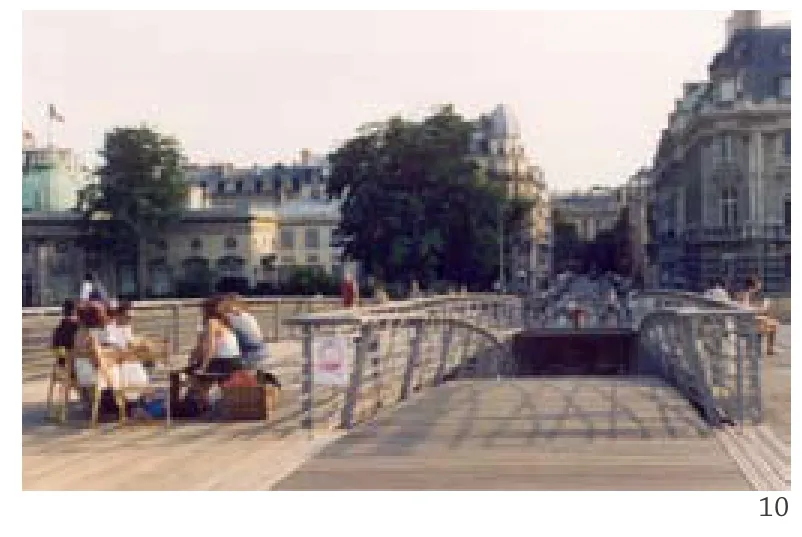
10 巴黎索爾費里諾步行橋/Déjeuner sur la passerelle Solferino,Paris

11 斯特拉斯堡與凱爾兩岸步行橋/Two Banks footbridge,Strasbourg,Kehl (10,11攝影/Photos:G.Ambrosini)
Finally the hybridization of arch shape should offer better static performances,as well as meaningful opportunities in the definition of new public spaces.
Among the most famous ones,a remarkable example is Simone de Beauvoir footbridge in Paris designed by Dietmar Feichtinger in 2006,where two different complementary systems work together and produce an innovative structural shape:a compressed arch and a pre-tensioned band,connected by radially positioned struts.The intersection of the arch with the catenary curve forms a sort of covered plaza suspended above the water,and the structural innovation allows the creation of several sinuous public paths on the water(Fig.9).
Still in Paris,the well-known Solferino footbridge designed by Marc Mimram in 2000 offers multiple ways to access the deck:a lower arch,which is curved in two planes,is connected by inclined V-shaped trusses with a superior arched deck:the system provides pedestrians with a fluid experience into the structure,by ascending the stairways up to the arches key point,where a meeting place is arranged[9](Fig.10).In another project by Marc Mimram,the Two Banks footbridge over the Rhine river between Strasbourg and Kehl,the creation of a meeting place acquires a high symbolic value in the site where two peoples(French and German)had battled for centuries.Here the arched form of a deck,straight in plan,is combined by struts and tension rods with a low sloping curved path,creating a beam system suspended to cable stays:the two paths get together in the central part of the bridge,forming a wide gathering place(Fig.11).
Therefore many works express the high iconic value of a footbridge as a way to cross a boundary,a joining structure,a place of meeting.
參考文獻/References
[1] Sennett R.(2011),the Public Realm,http://www.richardsennett.com
[2] Baus U.,Schlaich M.(2008),Footbridges:Construction,Design,History,Basel:Birkh?user; Keil A.(2013),Pedestrian Bridges,Detail Practice.One of the main reference in footbridge construction is provided by the triennial International Conferences Footbridge:Paris 2002,Venice 2005,Porto 2008,Breslavia 2011,London 2014,Berlin(scheduled 2017).
[3] Wilkinson C,Eyre J.(2001),Bridging art & science,London:Booth-Clibborn Editions.
[4] Sandake B.N.(2008),On Span and Space:Exploring Structures in Architecture,New York:Routledge
[5] Nervi,P.L.(1945),Scienza o Arte del Costruire,Roma:Edizioni della Bussola; Torroja E.(1957),Razón y ser de los tipos estructurales,Consejo Superior de Investigaciones Cientìficas.
[6] Dechau W.(2013),Trutg dil Flem.Seven Bridges by
Jürg Conzet,Zürich:Scheidegger & Spiess.See also Lya Blanc & Oscar Gential photo reportage http://www.g-lo-b.fr/glob/ch-trutg-dil-flems/
[7] Holgate A.(1997),The Art of Structural Engineering:the Work of J?rg Schlaich and His Team,Frankfurt:Edition Axel Menges.
[8] Strásky J.(2005),Stress Ribbon and Cable-Supported Pedestrian Bridges,London:ICE Publishing.[9] Fromonot F.(2001),Marc Mimram.Passerelle Solferino,Basel:Birkh?user.
摘要:新建的步行橋在城市和地方的再開發策略中所占的地位日漸顯著。本文從景觀適宜性的角度闡述了步行橋的設計,即:如何詮釋文脈特征;如何將高科技挑戰和人類尺度的問題相結合;如何詳細重述傳統結構類型以產生新的形態表達,并與景觀價值屬性和諧融合;以及如何展現一種凝聚感。
Footbridges Across the Landscape
古斯塔夫·安布羅西尼/Gustavo Ambrosini張裕翔 譯/Translated by ZHANG Yuxiang
Abstract:New footbridges are gaining an increasing role in urban and territorial redevelopment strategies.Footbridge design matter is introduced from the point of view of landscape appropriateness:how to interpret a context's identity; how to combine high technical challenges and human dimension issues; how to re-elaborate traditional structural types in order to produce new expressive shapes gently engaging the landscape values; how to provide a sense of gathering.
關鍵詞:步行橋,景觀,結構
Keywords:footbridge,landscape,structure
收稿日期:2016-03-01
作者單位:都靈理工大學
猜你喜歡
現代裝飾(2021年6期)2021-12-31 05:27:54
哲學評論(2021年2期)2021-08-22 01:53:34
小學科學(學生版)(2020年12期)2021-01-08 09:28:10
小學科學(學生版)(2020年7期)2020-07-28 08:00:52
少年漫畫(藝術創想)(2020年12期)2020-06-09 05:50:08
中華詩詞(2019年7期)2019-11-25 01:43:04
模具制造(2019年3期)2019-06-06 02:10:54
影視與戲劇評論(2016年0期)2016-11-23 05:26:01
照明工程學報(2016年3期)2016-06-01 12:17:56
現代企業(2015年9期)2015-02-28 18:56:50
