
基于3T模式的模擬電子技術(shù)課程教學(xué)改革與實(shí)踐
2018-01-31 22:23:29張俊杰杜娟崔建華
中國(guó)教育技術(shù)裝備
2017年22期
張俊杰+杜娟+崔建華

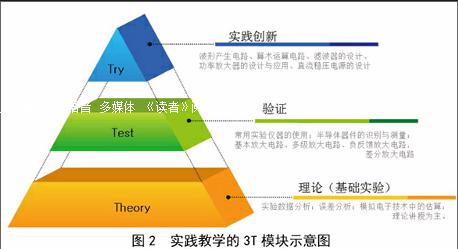
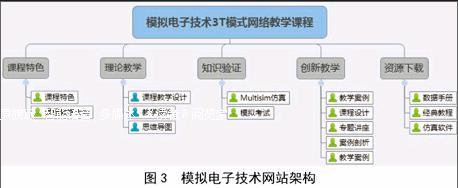
摘 要 采用理論(Theory)—驗(yàn)證(Test)—?jiǎng)?chuàng)新(Try)的3T模式,對(duì)模擬電子技術(shù)傳統(tǒng)教學(xué)內(nèi)容進(jìn)行優(yōu)化,引入工程案例和典型應(yīng)用電路,加強(qiáng)學(xué)生應(yīng)用能力培養(yǎng)。采用基于項(xiàng)目的方法和仿真教學(xué)法,激發(fā)學(xué)生學(xué)習(xí)興趣,提高課堂教學(xué)質(zhì)量。實(shí)踐證明,3T教學(xué)模式在學(xué)生動(dòng)手能力、工程素養(yǎng)和創(chuàng)新能力培養(yǎng)上效果顯著,是應(yīng)用型人才培養(yǎng)的一種有益探索。
關(guān)鍵詞 模擬電子技術(shù);3T模式;網(wǎng)絡(luò)課程;Multisim;應(yīng)用型人才
中圖分類號(hào):G652 文獻(xiàn)標(biāo)識(shí)碼:B
文章編號(hào):1671-489X(2017)22-0105-03
Teaching Reform and Practice of Analog Electronic Course based
on 3T Model//ZHANG Junjie, DU Juan, CUI Jianhua
Abstract Abstract In this paper, 3T (Theory-Test-Try) model is applied to optimize the traditional teaching content, and engineering cases and typical application circuits are introduced to strengthen the students application ability. By using the project-based learning method and simulation teaching method, the students interesting in learning is stimulated and the quality of teaching is improved. Teaching practice has proved that the 3T teaching model has remarkable effect on the training of the students practical ability, engineering quality, and innovative ability. The 3T teaching model is a useful exploration for the training of applied talents.
Key words analog electronic technique; 3T model; online course; Multisim
1 引言
模擬電子技術(shù)課程是電子信息工程類本科生的一門(mén)專業(yè)核心課程,具有較強(qiáng)的工程實(shí)踐性。課程教學(xué)的目的在于使學(xué)生掌握模擬電子線路的基本理論和基本分析方法,特別是電子系統(tǒng)的分析能力、電子器件的應(yīng)用能力和電子線路的設(shè)計(jì)能力[1]。但由于該課程需要半導(dǎo)體器件物理、線性電路、信號(hào)與系統(tǒng)等先備知識(shí),被認(rèn)為是電子信息類學(xué)生最具挑戰(zhàn)性的課程之一[2]。
此外,根據(jù)國(guó)際教育標(biāo)準(zhǔn)分類法(International Stan-
dard Classification of Education,ISCED),應(yīng)用型人才培養(yǎng)的重點(diǎn)是學(xué)生實(shí)踐能力、職業(yè)能力和創(chuàng)新能力培養(yǎng)。因此,為培養(yǎng)具有較高工程素養(yǎng)的電子信息應(yīng)用型人才,如何進(jìn)行課程體系的構(gòu)建、課程內(nèi)容的優(yōu)化以及教學(xué)模式的改革,成為眾多高校研究的重點(diǎn)。在眾多研究和實(shí)踐中,3T架構(gòu)模式采用理論教學(xué)為指導(dǎo)、技能訓(xùn)練為基礎(chǔ)、自主學(xué)習(xí)為核心、創(chuàng)新和創(chuàng)造力培養(yǎng)為目標(biāo),逐漸在許多工程技術(shù)類專業(yè)和課程中得到廣泛的應(yīng)用[3]。
鑒于此……
登錄APP查看全文
猜你喜歡
發(fā)明與創(chuàng)新(2022年30期)2022-10-03 08:40:56
內(nèi)蒙古教育(2021年20期)2021-03-08 01:09:14
計(jì)算機(jī)教育(2020年5期)2020-07-24 08:53:38
家庭影院技術(shù)(2019年11期)2019-12-09 09:14:30
人大建設(shè)(2018年6期)2018-08-16 07:23:10
文理導(dǎo)航·科普童話(2017年5期)2018-02-10 19:42:14
太空探索(2016年6期)2016-07-10 12:09:06
筑路機(jī)械與施工機(jī)械化(2015年11期)2015-07-01 16:28:43
筑路機(jī)械與施工機(jī)械化(2015年8期)2015-01-11 09:24:54
筑路機(jī)械與施工機(jī)械化(2014年4期)2014-03-01 02:58:34

- 中國(guó)教育技術(shù)裝備的其它文章
- 迷你風(fēng)力農(nóng)場(chǎng)與小風(fēng)車的制作
- 大工業(yè)時(shí)代以工程意識(shí)培養(yǎng)為導(dǎo)向的工程訓(xùn)練教學(xué)改革
- 校企合作教育運(yùn)行機(jī)制構(gòu)建研究
- 構(gòu)建大學(xué)生創(chuàng)新實(shí)驗(yàn)項(xiàng)目長(zhǎng)效機(jī)制
- 大學(xué)化學(xué)類實(shí)驗(yàn)教學(xué)與學(xué)生科研能力培養(yǎng)
- 環(huán)境工程專業(yè)實(shí)驗(yàn)教學(xué)改革與實(shí)踐